
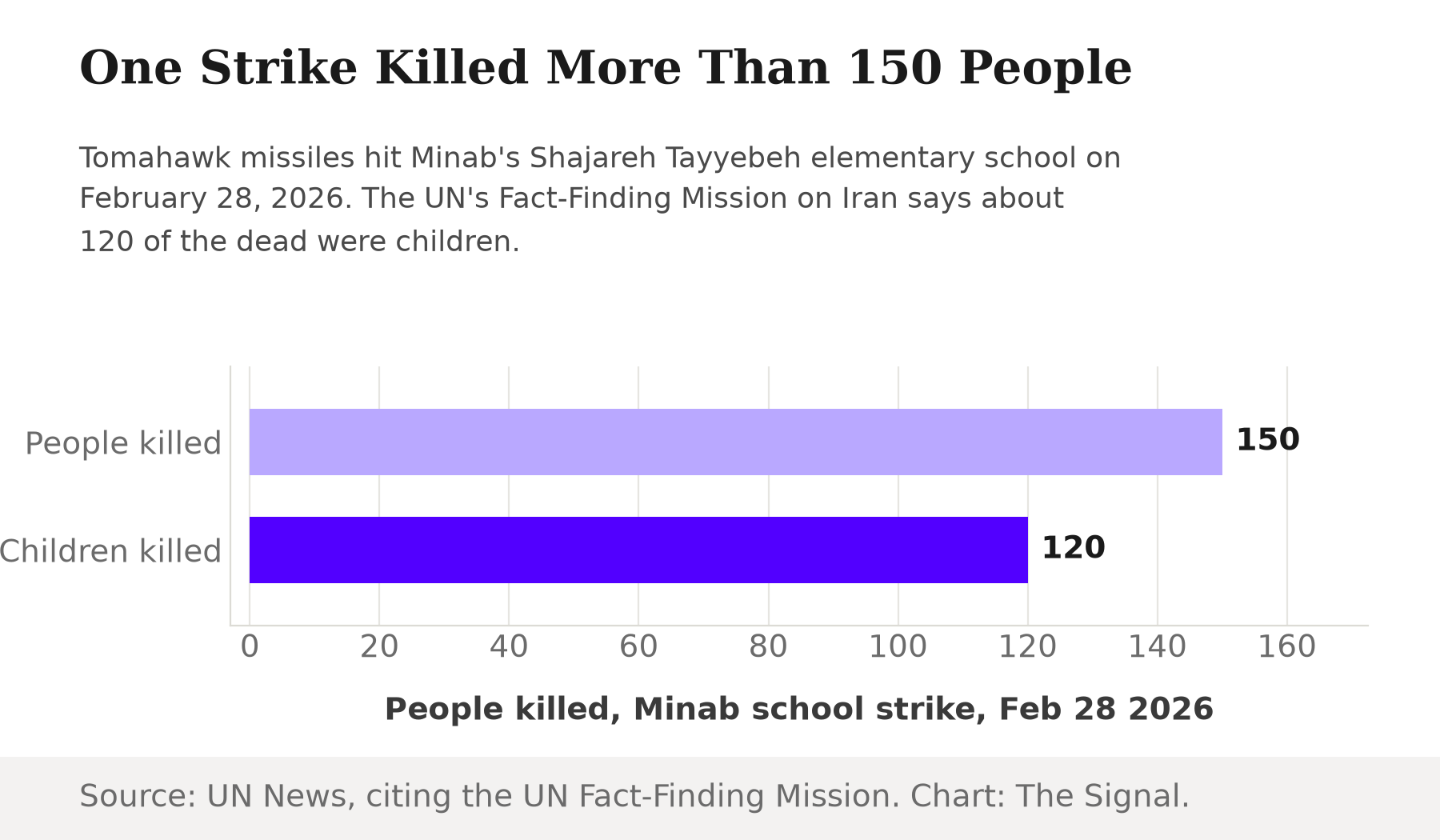
In February 2026, US Tomahawk missiles hit an elementary school in Minab, Iran, in strikes that killed more than 150 people, including about 120 children, the UN's Independent International Fact-Finding Mission on Iran found. In March 2026, 121 House Democrats wrote to Defense Secretary Pete Hegseth asking whether artificial intelligence, including Palantir's Maven Smart System, was used to identify the school as a target, and whether a human ever verified that call. This September, the Fact-Finding Mission formally classified the strikes as the war crime of launching an indiscriminate attack. Read only that far, this looks like a familiar accountability story: a lethal error, a paper trail, a body assigning blame.
It is worth slowing down on what investigators actually blamed. Nobody with access to the internal review says an algorithm chose the target on its own. Pentagon investigators instead found that a combination of outdated intelligence, stale satellite imagery, and excessive reliance on AI-assisted targeting contributed to the strike. That is a narrower, stranger claim than "the AI did it." It is a claim about how much weight a fast, software-mediated sign-off process was asked to carry.
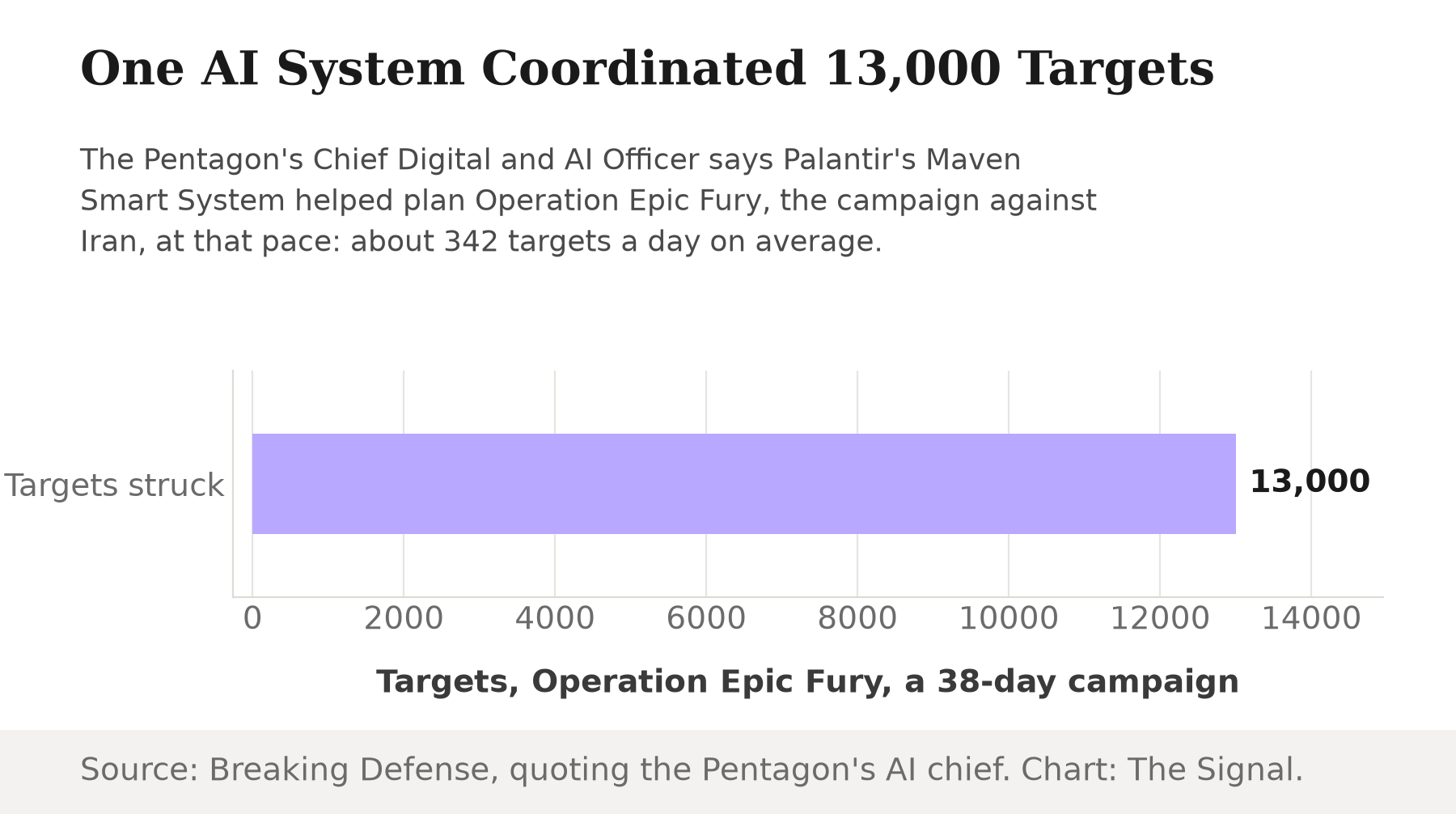
The scale behind that reliance is large. The Pentagon's own Chief Digital and AI Officer says Palantir's Maven Smart System helped plan and coordinate roughly 13,000 targets across Operation Epic Fury, the wider campaign against Iran, in 38 days, about 342 targets a day on average. Epic Fury began on February 28, 2026, the same day as the Minab strike, and ran until May 5. No source states outright that the school was one of the 13,000 targets processed through Maven that campaign. But the two events share a start date. And the throughput figure is the clearest public evidence of the pace Maven was built to sustain across that same campaign, a pace that is exactly what a genuine human check on each target is supposed to slow down.
What Congress wants to know
The letter, signed by a majority of the House Democratic caucus, put a direct question to the Pentagon: was AI, including Maven, used to identify the Shajareh Tayyebeh school as a target, and did a human verify the target's accuracy before the strike. Asked about it the same day the letter went public, a Pentagon official confirmed neither point, telling NBC News only that the incident was under investigation and that the department would respond directly to the letter's authors. Six months on, no public answer has followed. That is still the operative question. It is not "did AI kill these children." It is whether the safeguard the public assumes exists, a person confirming what the software flagged, actually ran.
What Palantir says
Palantir disputes fault directly. The company says it is not responsible for the underlying intelligence data or for identifying deficiencies in that data, and that there is no evidence its own software was at fault. This is the strongest case against blaming the tool: a targeting platform is only as good as what it is fed, and Palantir did not generate the outdated intelligence or the stale satellite imagery that investigators also cite. A company that builds the interface is not automatically responsible for the map it was handed.
That defense answers a narrower question than the one investigators raised. The finding was not that Maven inserted bad data; it was that outdated intelligence, stale satellite imagery, and excessive reliance on AI-assisted targeting together contributed to the strike. A platform can be blameless on the data and still be the thing that let a stale picture move through the chain at speed.
The UN's verdict
Beyond the immediate US chain of command, the UN mission also warned every party to the broader regional conflict, not just the United States, that continued violations of international law could give rise to accountability for war crimes. That is a wider warning than a single-country indictment, and it sits alongside, not instead of, the specific finding on the Minab strike.
| Party | What they say | Basis |
|---|---|---|
| UN Fact-Finding Mission | The US strikes, including Minab, are the war crime of launching an indiscriminate attack | OHCHR, via GlobalSecurity.org |
| Pentagon investigators | Outdated intelligence, stale satellite imagery, and excessive reliance on AI-assisted targeting contributed to the strike | Outlook India |
| Palantir | Not responsible for the underlying data or for identifying its deficiencies; no evidence its software was at fault | Gizmodo |
| 121 House Democrats | Ask whether AI, including Maven, identified the school as a target, and whether a human verified it | Rep. Ansari's office |
Four accounts of the same chain, none of them disputing the others' facts, all of them disputing where the failure sat. Sources as linked above.
The kill chain comes home
None of this is a foreign-only cautionary tale. India's own Army disclosed a roadmap in February 2026 that targets full integration of AI, machine learning, and big data analytics into its operations and decision-making by 2027. This does not show India running Maven or anything built by Palantir, and it would overstate the record to claim otherwise. The wager underneath is the same one: folding more of the sensing-to-decision chain into software, at higher speed and greater scale, is worth what it costs in the time a human has to actually check the machine's work.
That wager is not inherently reckless. Faster targeting can mean fewer prolonged campaigns and less exposure for personnel, and no source here says otherwise. But the Minab strike is the concrete case of what the wager costs when the inputs feeding the machine are old and nobody catches it in time. A doctrine aimed at full AI, machine learning, and big data integration by 2027, adopted before that specific failure mode has a public answer, is inheriting the same open question the Pentagon is only now being forced to confront in public.
The Signal
The Minab strike will likely be remembered, if it is remembered at all, as a story about an AI system and a war crime. That framing lets everyone off too easily. Investigators did not fault an algorithm's judgment. They faulted a process that let a fast recommendation engine carry more weight than the stale, outdated data underneath it could bear. And neither the Pentagon nor Palantir has yet said, on the record, that a human confirmed the target before the missiles launched, six months after Congress asked. Any military building the same speed into its own kill chain, India's included, is not adopting a hypothetical risk. It is adopting the one the Pentagon's own investigators just described in writing. The question worth watching is not whether the next system is smarter. It is whether the person whose job is to say no still has enough time, and enough independent information, to actually do it.
Reporting basis: the casualty figures for the Minab strike are from the UN Independent International Fact-Finding Mission on Iran, reported by UN News, and the formal war-crimes classification is from the same mission's report, via GlobalSecurity.org's republication of the OHCHR press release; the mission's separate warning to all parties to the conflict is per UN News. The Pentagon's internal-review findings on outdated intelligence, stale satellite imagery, and AI overreliance are per Outlook India's reporting on a Bloomberg investigation; Palantir's response is per Gizmodo's reporting on the same investigation. The scale of Maven's use in Operation Epic Fury is per Breaking Defense, quoting the Pentagon's Chief Digital and AI Officer on the record. The Congressional letter and its questions are from Rep. Yassamin Ansari's office. The Pentagon's non-answer to that letter is per NBC News. Operation Epic Fury's start and end dates are per Britannica. India's 2027 AI-integration target is per Tribune India's reporting on the Army's own disclosure. The average-targets-per-day figure is The Signal's calculation from the Breaking Defense figures.