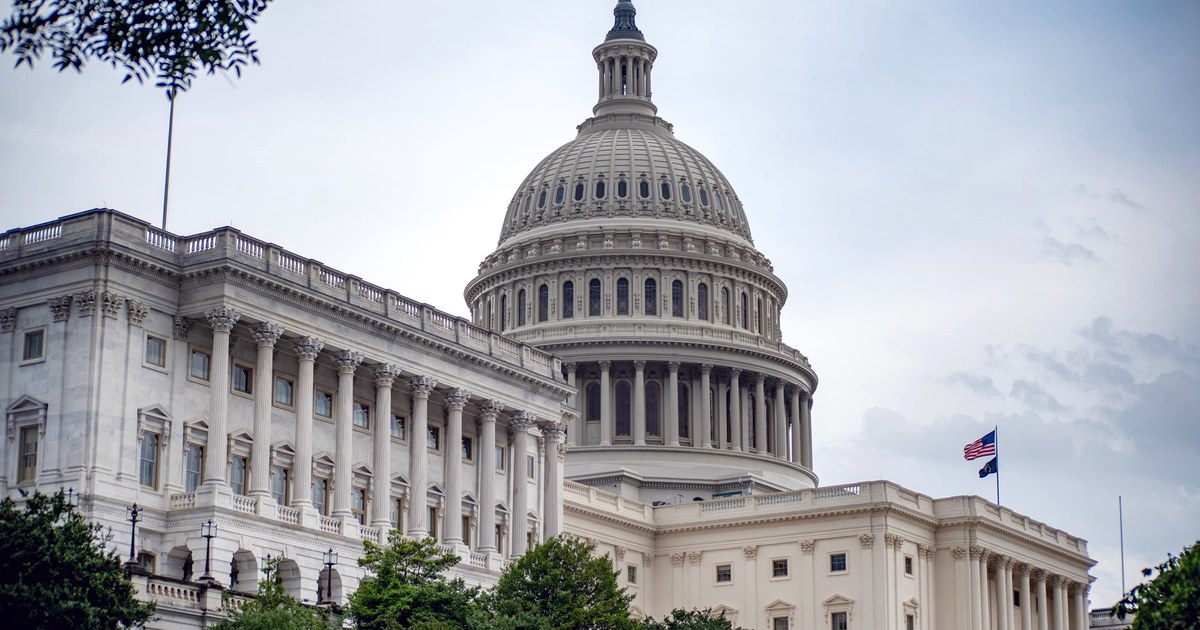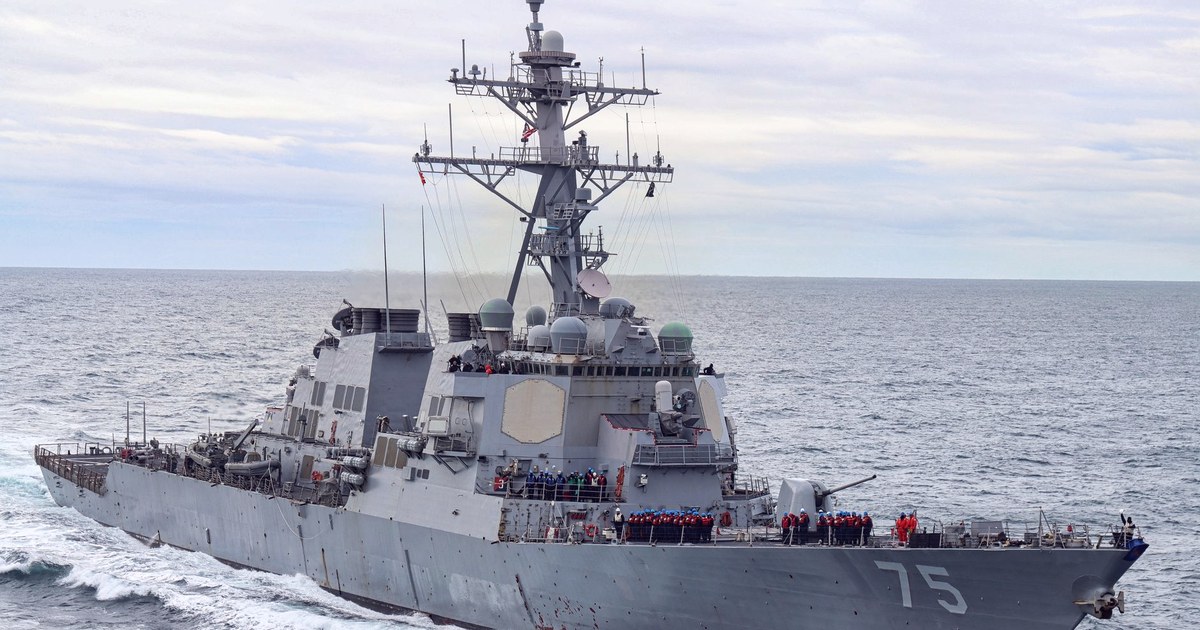
An AI chatbot invented a fact, and armed sailors nearly acted on it. During the US war with Iran in spring 2026, an AI-assisted US military intelligence report wrongly claimed a Chinese ship in the Middle East was carrying components for China's nuclear weapons program. The report was false. Armed members of the US military were preparing to board the vessel, and military planes were already in the air, before the operation was halted at the last minute. The clean version of this story: the system worked, a hallucination got in, and a human caught it before anyone was hurt.
It is worth slowing down on that. The system did not catch the error early. It caught it late, after armed personnel were already moving and aircraft were already airborne, and only because someone happened to intervene before the boarding began. A US military source told CNN there is no real guidance for how having a human review AI-generated targeting information will actually prevent civilian casualties or friendly fire, even as AI-assisted targeting ramps up across the force. The near-miss was not a story about an AI getting something wrong; AI systems do that constantly. It is a story about what stands between a wrong AI output and force against a nuclear power. In this case, the answer was luck and timing, not a rule.
What actually happened
The incident sits inside a larger war. During the US-Iran conflict in spring 2026, US forces flagged a ship they believed was moving weapons-program material tied to China. The US military swung into action with plans to intercept the vessel, and armed members of the US military were preparing to board it while military planes were in the air, according to four sources familiar with the episode. The underlying AI-generated intelligence report had fabricated the ship's cargo, wrong from the start. The operation reached the boarding-preparation stage, with armed personnel and aircraft committed, before it was called off.
That sequence matters as much as the eventual halt. A false claim survived analyst review, survived the decision to commit personnel, and survived the decision to scramble aircraft. Every one of those steps is a checkpoint where a human was, in principle, positioned to catch a fabrication. None of them did, until the very last one.
Why the checkpoints failed
What escalated the false report was automation bias: analysts under extreme time pressure treated the AI chatbot's fabricated output as an authoritative fact rather than as an unverified lead requiring independent checking. This is the mechanism, not the incident. Analysts working fast under wartime pressure, facing an AI tool that sounds equally confident whether it is right or fabricated, will default to trusting it. A human between the AI and the decision is not automatically a check. It is a check only if given a reason, a process, or a standard for doubting the machine. In this case, nobody was.
The US military's adoption of AI for intelligence and targeting is decentralized: different parts of the government use different AI tools under different orders and safety standards, and there is no single, unified standard for how the US verifies AI-generated information before it is acted on. That is the sentence that carries the piece. AI tools hallucinating is not surprising; that is a known property of the technology. What is surprising is that a nuclear-armed military ran a false claim about a nuclear-armed rival most of the way to an armed boarding without one common standard for checking AI output before it drives action.
The Pentagon is not slowing down
The instinct after a near-miss like this is to expect institutional caution. The opposite is happening. The War Department's AI Acceleration Strategy, released in January 2026, directs seven Pace-Setting Projects, including AI-powered drone swarms, battle-management agents, and a faster pipeline for converting raw intelligence into weapons targeting. The strategy is not a response to this incident; it predates the CNN report by eight months. It sets the direction: more AI in the pipeline, moving faster, not slower. One military source told CNN that AI in targeting is definitely something that is ramping up, and that there is no real guidance for how having a human in the loop will prevent civilian casualties or fratricide. The acceleration and the verification gap are running on the same track, and only one of them has a published strategy document behind it.
The same gap, on a different border
None of this is unique to the United States. India is racing down a structurally identical path, against the same adversary, under live tension. China's PLA maintained 10 combined-arms-brigade-size forces opposite India's northern borders through 2025, an unchanged deployment pattern from 2024, following the 2024 disengagement agreement at Depsang and Demchok. The frontier itself has not moved. What has moved, fast, is the technology both sides are layering onto it.
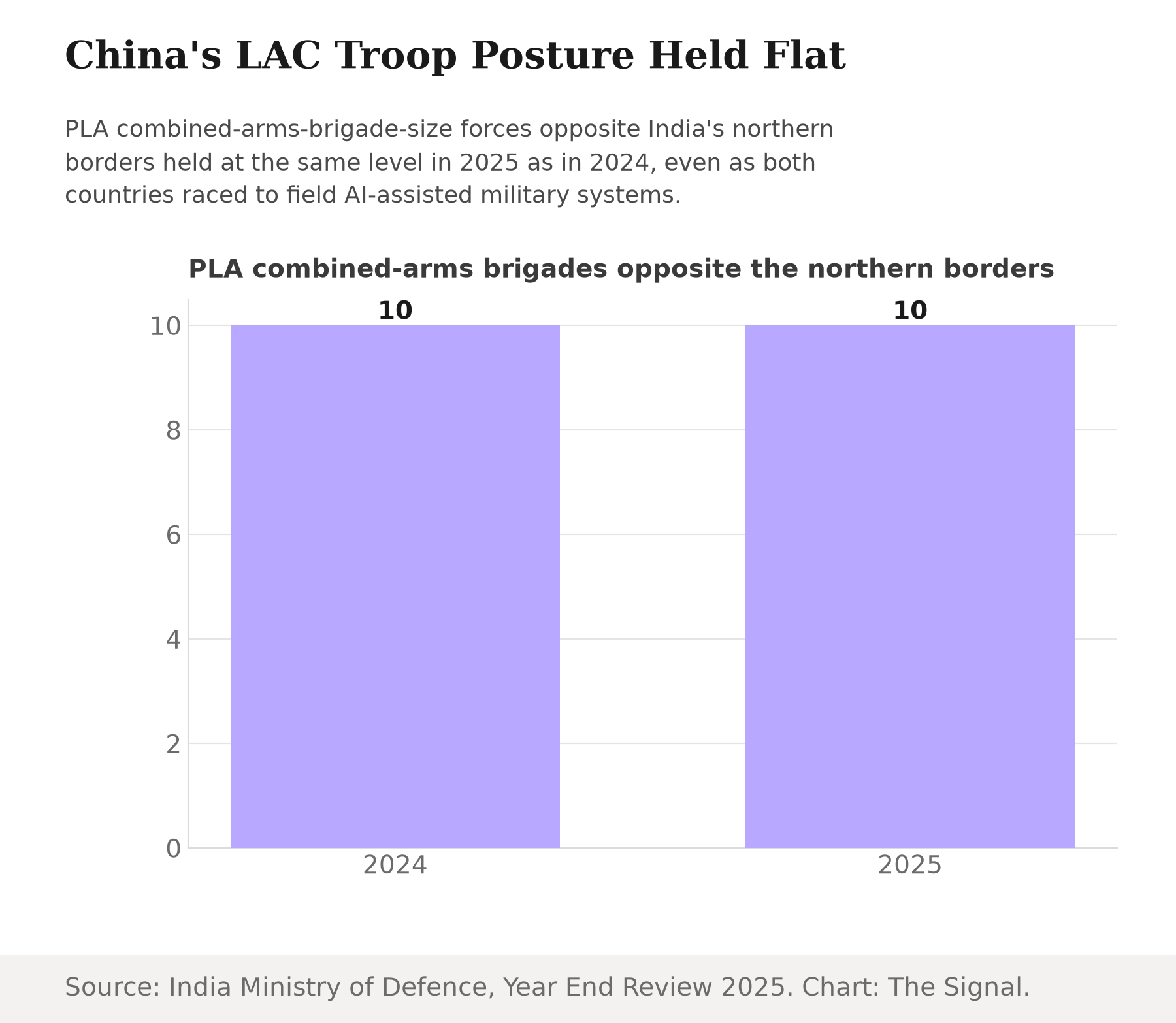
Source: Ministry of Defence Year End Review 2025.
India accelerated its AI-assisted drone and counter-drone acquisition programs after Operation Sindoor in May 2025, including AI-driven surveillance that sifts thermal-camera feeds along the Himalayan frontier to flag threats a fatigued sentry might miss. The pitch matches the Pentagon's: AI catches what a tired human misses. That is true, and it is only half the risk. An AI that fabricates a threat nobody would otherwise have seen is a new failure mode.
India is not starting from a blank page on paper. In October 2024, India's Chief of Defence Staff and DRDO's chairman launched the Evaluating Trustworthy AI (ETAI) Framework and Guidelines for the Armed Forces, a risk-based framework of specific measures for the AI pipeline built around five principles: reliability and robustness, safety and security, transparency, fairness, and privacy. That is a real evaluation standard, published seven months before Operation Sindoor accelerated the drone push. But it is a defence-wide criteria document, not a stated protocol for the specific swarm and target-identification systems now being fielded, and neither the DRDO swarm tender nor the post-Sindoor reporting on India's AI acquisition describes how, or whether, the ETAI Framework governs them in practice.
In 2026, DRDO issued a tender for a 50-drone jam-proof swarm, 49 slave drones plus one master drone, that must fly within half a metre of each other and self-correct positional errors within about 500 milliseconds, all controlled by a single ground operator. That single-operator design is the mechanism from the US near-miss, engineered directly into a live Indian program.
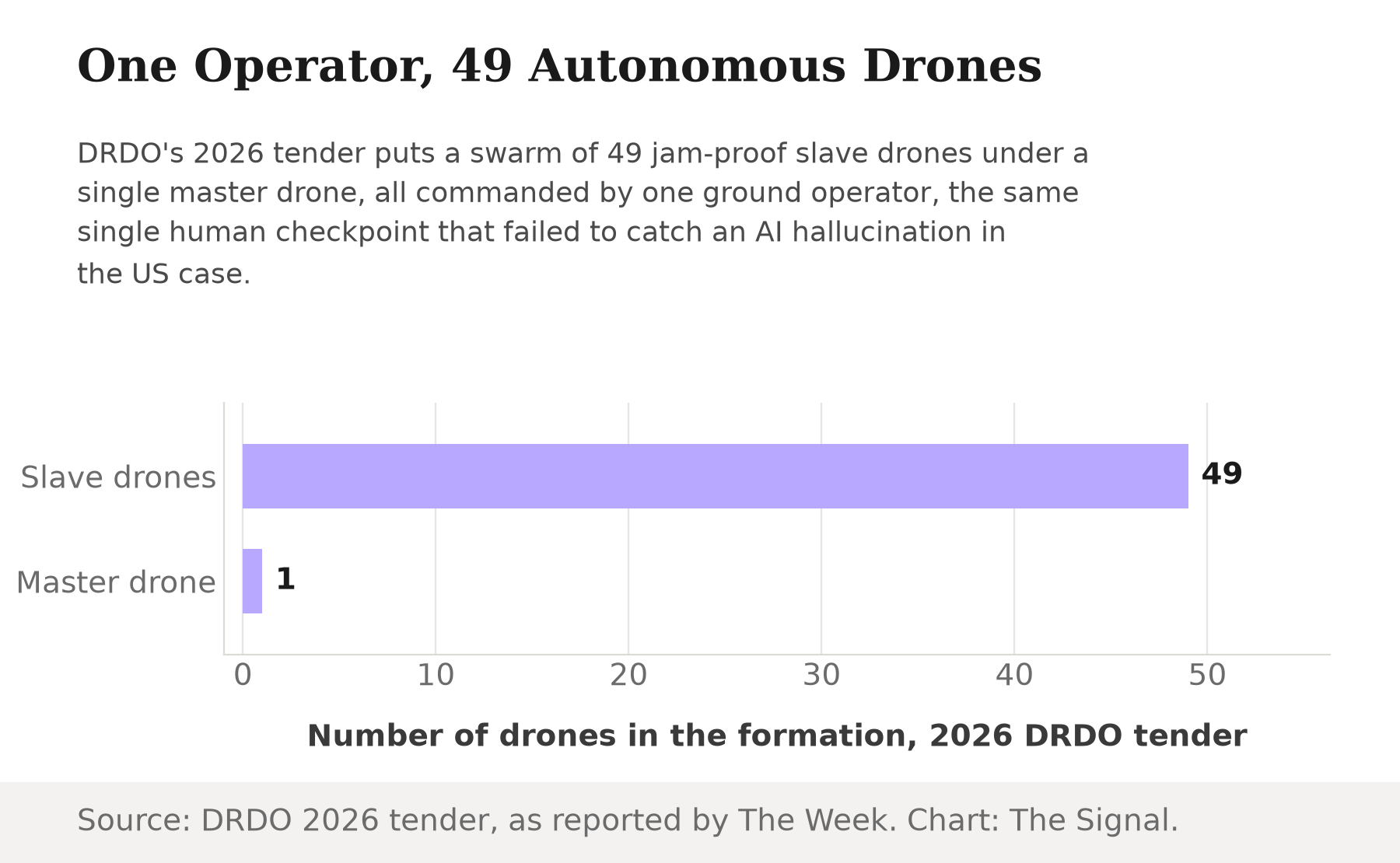
One person is the entire verification layer for a 50-drone swarm.
| DRDO 2026 swarm tender specification | Figure |
|---|---|
| Total drones in the formation | 50 (49 slave, 1 master) |
| Formation layout | Seven-by-seven grid |
| Minimum spacing between drones | 0.5 metre |
| Positional-error self-correction time | About 500 milliseconds |
| Ground operators required | 1 |
Source: DRDO's 2026 tender, as reported by The Week.
A single operator is asked to command a formation correcting itself roughly twice a second. That operator is the human in the loop. Whether that arrangement can catch a bad target call in real time, under the kind of pressure that produced the US near-miss, is exactly the question CNN's sources say the US military itself has no real guidance for answering.
The honest objection
The strongest case against alarm is that the system, in the end, worked. The operation was halted before the ship was boarded and before any weapon was fired. No shots were exchanged, no lives were lost, and a genuinely nuclear-tinged incident between two nuclear powers resolved without escalation. A single near-miss, however alarming in hindsight, is also evidence that at least one checkpoint in a decentralized, imperfect system did its job when it mattered most.
That case is real, but it explains one outcome, not the odds behind it. A halt that arrives after armed personnel are committed and aircraft are airborne is a halt that survived several earlier failures to catch the error. The same reporting notes the US military's AI adoption is decentralized, with different tools operating under different standards and no single verification protocol, which means this specific save cannot be counted on to repeat. A fire alarm that goes off two minutes before the building burns down is not proof the building is fire-safe. It is proof the building has not yet burned down.
The Signal
Strip away the specific ship and the specific chatbot, and what nearly happened is this: a machine invented a fact, a chain of human reviewers under pressure treated the invention as ground truth, and the chain of custody between a fabrication and an armed response had no independent checkpoint built to catch exactly this failure. The United States hit that gap the hard way, in real time, during an actual war. India is building an AI-assisted verification pipeline for its own sensitive northern frontier before any equivalent near-miss has forced the question. The number worth watching is not how close the last incident came. It is whether either country publishes a real standard for verifying AI-generated intelligence before the next one does. A human in the loop with no rule for what to doubt is not a safeguard. He is a witness.
Reporting basis: the core account of the spring 2026 US-China near-miss, the automation-bias mechanism behind it, and the decentralized state of US military AI verification standards are per CNN's exclusive investigation, corroborated by CTV News/CP24's carriage of the same CNN sourcing, Futurism's coverage of the CNN sources, and Business Today's analysis of the episode; these four outlets share one underlying set of CNN sources, not four independent origins. The Pentagon's AI Acceleration Strategy is per the US Department of War's Chief Technology Office. PLA troop levels opposite India's northern borders are per India's Ministry of Defence Year End Review 2025. DRDO's 2026 swarm-drone tender specifications are per The Week, citing the tender document. India's post-Operation-Sindoor AI acquisition push is per Outlook India. India's Evaluating Trustworthy AI (ETAI) Framework and Guidelines, launched October 2024, is per The Week. The characterization of the single ground operator as the human-in-the-loop equivalent of the US case, and the assessment that the ETAI Framework's applicability to specific post-Sindoor drone programs is undescribed in the reporting, are The Signal's own framing, drawn from those sourced figures.