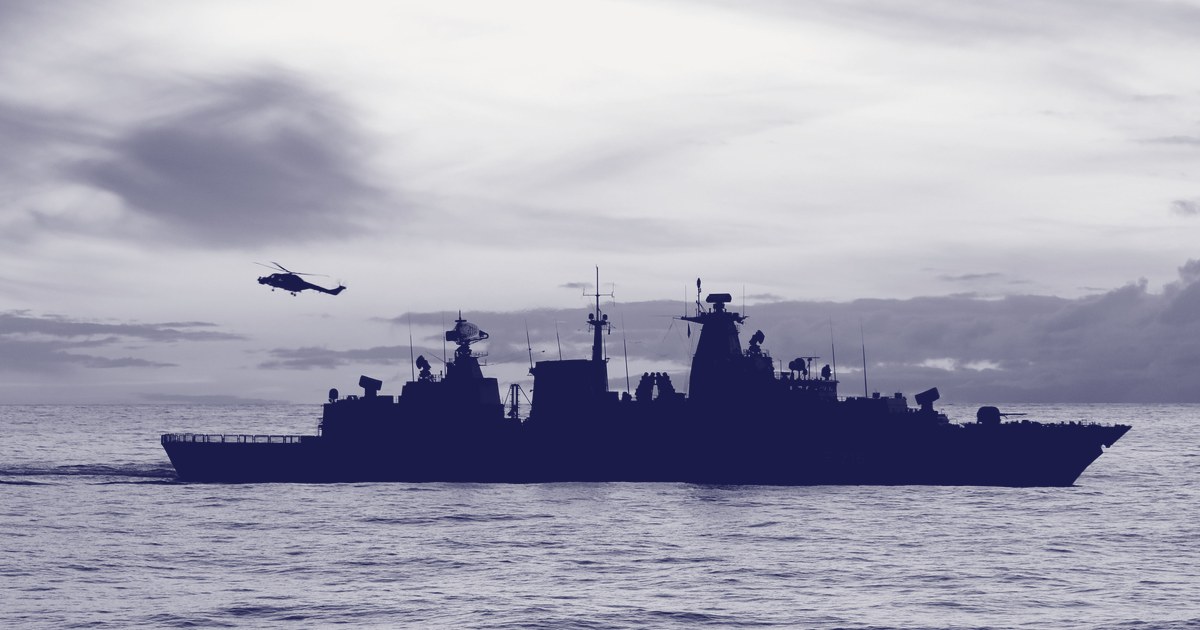
On the evening of 15 September 2026, an Indian Navy warship and a Pakistani naval vessel collided in the north Arabian Sea, in international waters roughly 220 kilometres east of Oman, Al Jazeera reports. New Delhi says Islamabad broke the rule written to prevent exactly this. Article 10 of the 1991 Agreement between India and Pakistan on Advance Notice on Military Exercises, Manoeuvres and Troops Movements bars naval ships and submarines of one country from coming within three nautical miles of the other's vessels in international waters. That is the provision India says Pakistan breached. Both sides have since given their account, and they do not agree. India's Ministry of External Affairs says PNS Hunain carried out a dangerous overtaking manoeuvre that resulted in the collision, in gross violation of Article 10. Pakistan's foreign ministry counters that the incident happened inside Pakistan's Exclusive Economic Zone during a Pakistan Navy exercise called SEASPARK-26, and followed what it called a "highly provocative and unacceptable action" by the Indian vessel. Neither navy has released tracking data or video to settle which version is right, and nothing here turns on picking one.
It is worth slowing down on what actually collided. PNS Hunain, the Pakistani vessel involved, is a roughly 2,600-tonne Yarmook-class Batch-II offshore patrol vessel, commissioned in July 2024, a fraction of the size of the Indian destroyer it struck. INS Kolkata, the Indian ship, is the lead vessel of the Kolkata-class guided-missile destroyers, built by Mazagon Dock with a full-load displacement of 7,400 tonnes and commissioned in August 2014: nearly three times Hunain's tonnage. And this was not the first such incident. The most recent prior India-Pakistan naval collision was in June 2011, when the Pakistani warship PNS Babur brushed against the Indian frigate INS Godavari in the Gulf of Aden while both were on anti-piracy duty. A confidence-building pact that has now failed to keep a corvette clear of a destroyer, fifteen years after it failed to keep a frigate clear of another corvette, is not really a story about doctrine breaking down. It is a story about scale.
The ships that collided were not evenly matched.
| Vessel | Navy | Class | Displacement | Commissioned |
|---|---|---|---|---|
| INS Kolkata | Indian Navy | Kolkata-class guided-missile destroyer | 7,400 tonnes, full load | 16 August 2014 |
| PNS Hunain | Pakistan Navy | Yarmook-class Batch-II offshore patrol vessel | Roughly 2,600 tonnes | 25 July 2024 |
Source: Livefist Defence; Naval News.
The gap that should settle every question
Money, not tonnage, orders the relationship between the two navies, and the gap is not close. India was the world's fifth-largest military spender in 2025 at $92.1 billion, up 8.9 percent on the year, roughly 7.7 times Pakistan's $11.9 billion, itself up 11 percent, according to SIPRI. On paper, a gap that size should settle every question a single collision raises. A navy that outspends its neighbour nearly eight to one should out-build, out-gun and out-last it in almost every category. In most categories, it does.
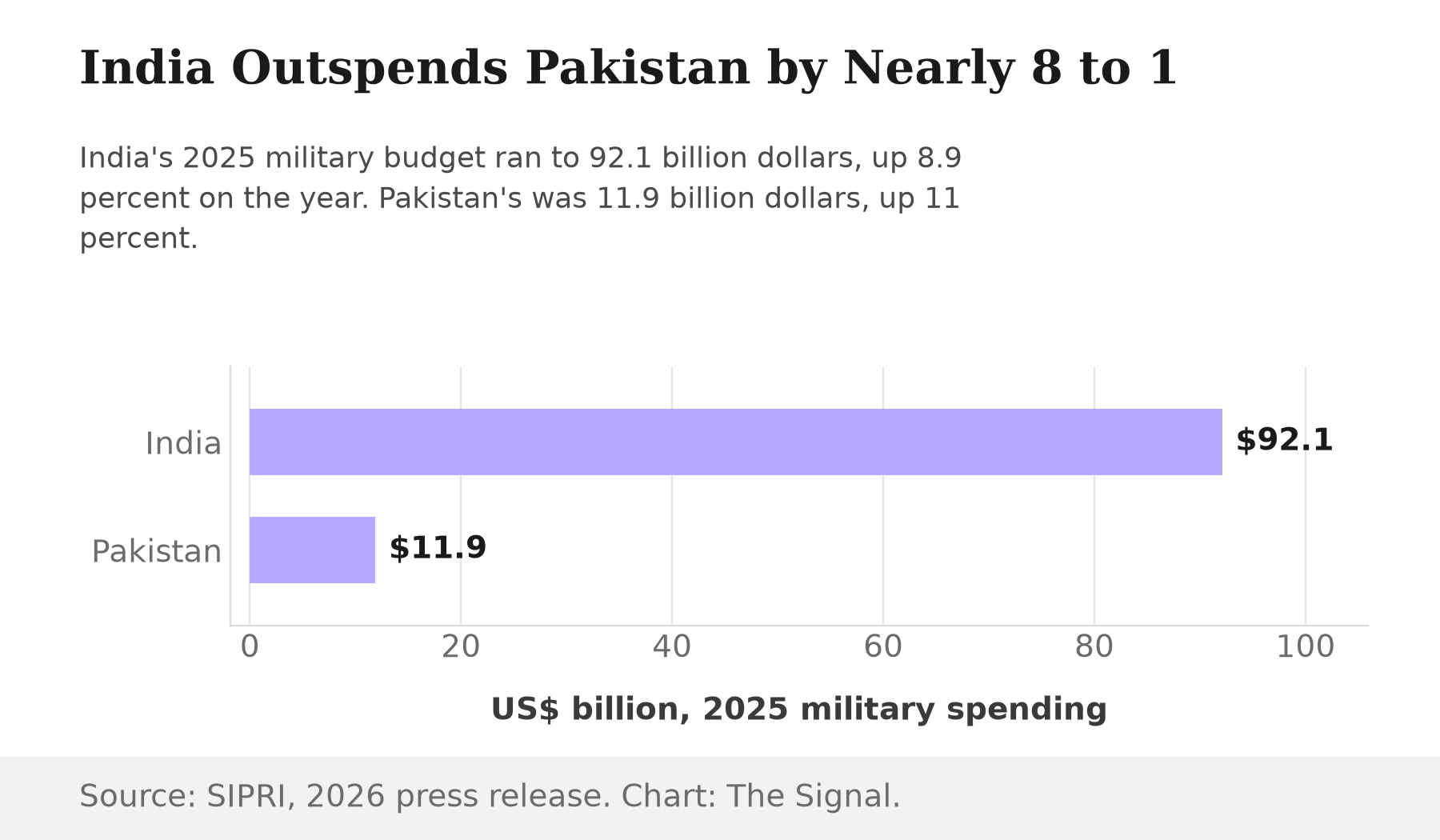
Source: SIPRI. Chart: The Signal.
The submarine pipeline nobody is counting
Submarines are the exception, and the exception is what the collision missed entirely, because neither ship involved was one. Pakistan ordered eight Hangor-class attack submarines from China in April 2015, and the first of the class was commissioned at a ceremony in Sanya, China, on 30 April 2026: eleven years from contract to first delivery, with seven boats still to come. The Hangor-class carries air-independent propulsion (AIP), which Naval News says gives it significant blue-water capability; Pakistan's existing Agosta-90B fleet, by contrast, relies on the older French MESMA-type AIP system, so the new boats are a genuine capability step, not just seven more hulls. India's most recent submarine programme moved on a different clock. Project-75 delivered six Kalvari-class diesel-electric submarines to the Navy, the last of them, INS Vagsheer, commissioned in January 2025: a finished programme, its full class in the water in about seven years.
The follow-on is not finished, and it just got bigger. As of mid-2026, India operated 19 submarines, several due for decommissioning from the late 2030s onward, and had been planning six new conventional submarines under Project-75I; that plan has now been revised to nine, under Project-75I and a follow-on Project 76, partly in response to China's and Pakistan's expanding submarine fleets. That is a larger order than the one India just finished, placed while Pakistan's own buildout is barely a year into deliveries.
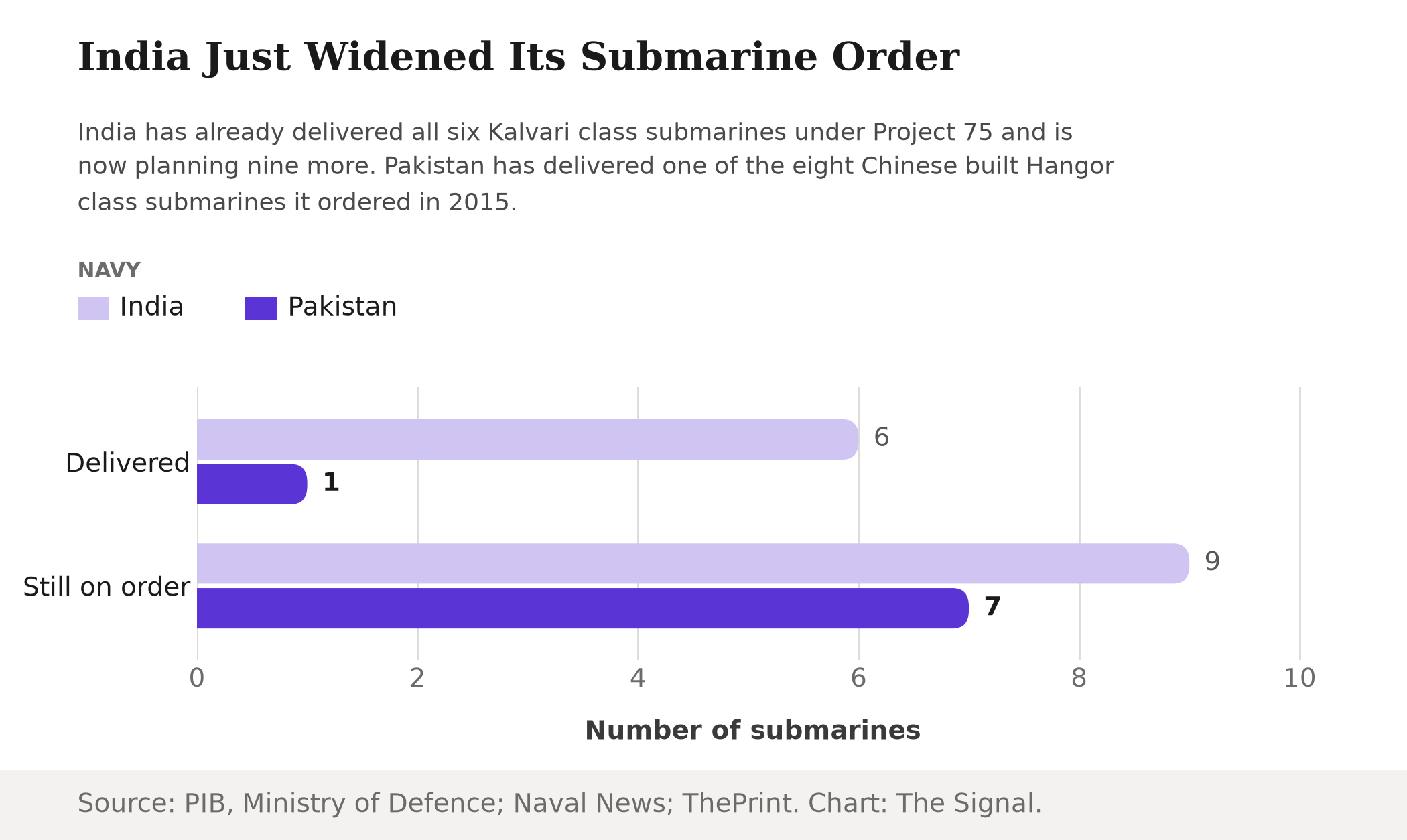
Source: Press Information Bureau; ThePrint; Naval News. Chart: The Signal.
Put the two pipelines side by side and the geometry of the standoff changes. A defence budget does not arrive pre-allocated to hulls in the water. It buys aircraft carriers, fighter squadrons, a two-front land border and a hundred other things competing for the same rupee. Pakistan does not have to match India's overall spending to contest the one domain where a handful of quiet, Chinese-built boats change what an adversary can safely assume about the water beneath its ships, and where India's own planners have just decided the existing lead was not big enough to leave alone.
The honest objection
The strongest case against reading the submarine numbers as a genuine narrowing is that raw totals mislead. India's 19-boat fleet, even with several hulls due to retire from the late 2030s, still vastly outnumbers what Pakistan will have once all eight Hangor-class boats arrive, and a budget running 7.7 times larger buys not just more submarines eventually but better sensors, better weapons and more patrol days for the fleet already afloat. On that reading, the Hangor-class is a real upgrade for Pakistan, not a real threat to India's edge: it narrows a numbers gap that barely mattered while the qualitative gap, bought by the spending gap, stays wide open.
That case holds for the fleet India has today, but it holds less well for the order India just placed. The decision to add nine boats instead of six, on top of a Project-75 class India had only just finished, was made partly because of the same regional submarine expansion, Pakistan's Chinese-built fleet included, that is now sitting inside a diplomatic protest over a collision at sea. India's own procurement planners are not behaving as though the tonnage gap is reassurance enough. They are treating the direction of travel under the water as worth paying more to answer, years before the last of Pakistan's eight boats is even built.
The Signal
The collision that made headlines this week, a 2,600-tonne patrol boat and a 7,400-tonne destroyer, disputed under a pact written in 1991, was never going to tell anyone much: it is a diplomatic incident, not a military one, and the ships involved were never a fair test of anything. The ratio worth tracking sits underwater and out of the news: six delivered of six ordered for India's finished submarine class, one delivered of eight ordered for Pakistan's. Every year that second number climbs while India's own new nine-boat order is still being built is a year in which a $92.1 billion budget bought less exclusivity beneath the surface than it did on top of it. Watch the delivery dates on Pakistan's remaining seven Hangor-class boats. They will say more about this rivalry than the next protest note over a three-nautical-mile line ever will.
Reporting basis: the 15 September 2026 collision and India's account of a breach of Article 10 are per Al Jazeera's reporting and Manorama Yearbook's description of the 1991 agreement's text. India's account of PNS Hunain's manoeuvre is per The Week, citing MEA spokesperson Randhir Jaiswal, and Pakistan's counter-account is per India.com's reporting on Pakistan's foreign ministry statement. The 2011 collision between PNS Babur and INS Godavari is per ThePrint, citing a parliamentary statement by then-Defence Minister A.K. Antony. The specifications and commissioning dates of PNS Hunain and INS Kolkata are per Naval News and Livefist Defence, each reporting the respective navy's own commissioning of the vessel. Pakistan's Hangor-class submarine order and its first commissioning are per Naval News, and the Hangor-class's AIP capability, compared with the Agosta-90B fleet's MESMA system, is per a separate Naval News feature. India's Project-75 submarine deliveries are per a Press Information Bureau release from the Ministry of Defence, and India's revised plan to order nine new submarines instead of six is per ThePrint's reporting on the Navy's procurement plans. India's and Pakistan's 2025 military spending figures are from the Stockholm International Peace Research Institute. The tonnage comparison between the two ships, the count of submarines delivered against submarines still owed, and the years elapsed in each submarine programme are The Signal's calculations from those figures.