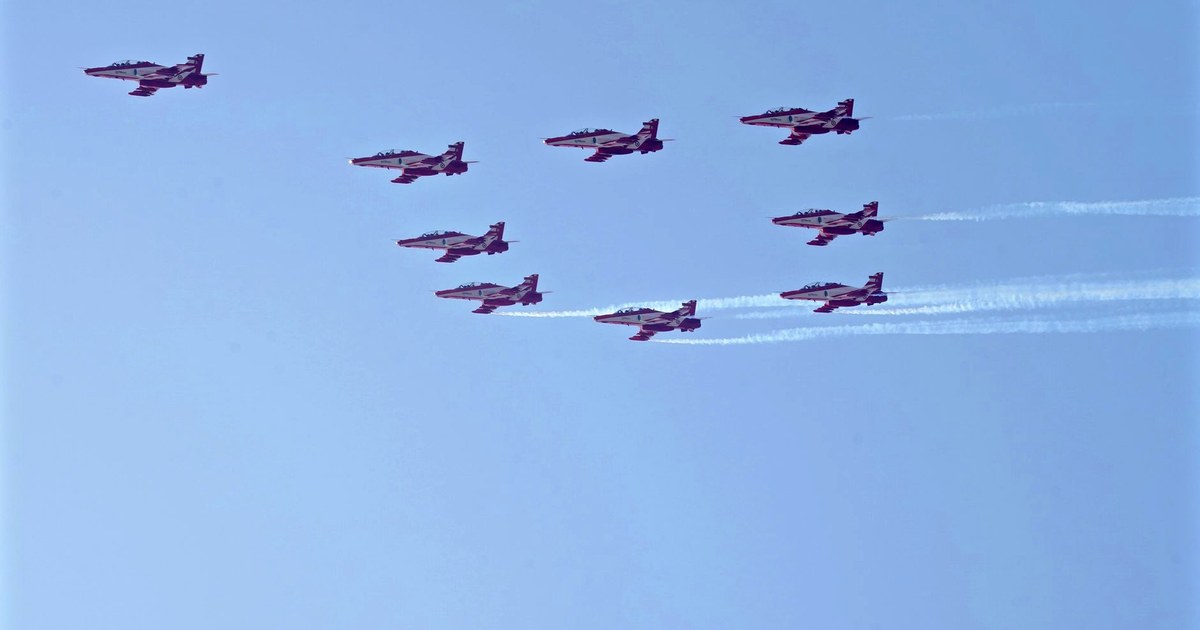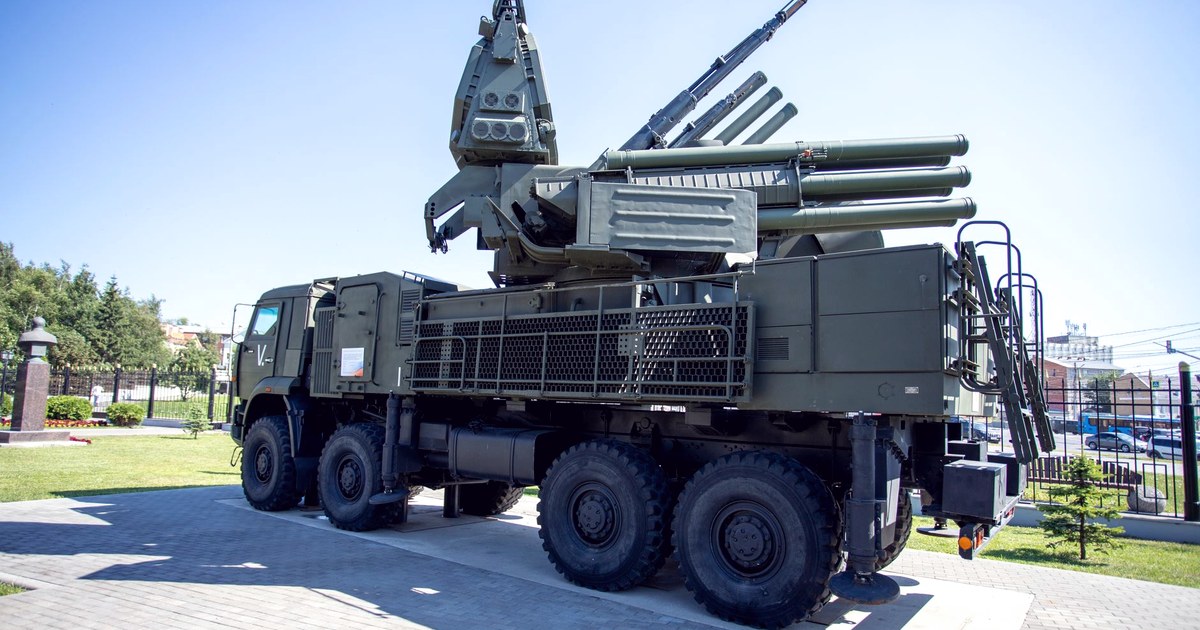
India's single biggest recent air-defense purchase is the S-400 Triumf, a Russian long-range system bought in a $5.4 billion contract for five squadrons signed in October 2018. It is built to shoot down high-value, high-speed threats: fighter jets, cruise missiles, ballistic missiles. Russia is the country that sold it to India, and Russia is currently fighting the war that is rewriting what a modern air-defense rupee should actually buy.
It is worth slowing down on that war.
A US Patriot interceptor costs over $3 million. The drone it is often fired at costs about $35,000.
That is not a rounding gap. It is the kind of mismatch that decides whether an air-defense system is winning or losing, even when every intercept succeeds.
The trade a cheap drone forces
Ukraine and, separately, the Middle East have spent the past two years learning the same lesson: shooting down a mass-produced attack drone with an exquisite interceptor is not a symmetric fight. A CSIS analysis of Russia's drone-strike economics puts a Shahed-type drone (the model Russia licenses and mass-produces as the Geran-2) at a conservative $35,000 per unit, while a single US Patriot PAC-3 interceptor costs over $3 million. Fire one interceptor at one drone and, in the CSIS analysis's own words, that carries "a significant loss of value (over $600,000 per interceptor)", even when the intercept works exactly as designed.
Ukraine's answer has been to stop using expensive interceptors on cheap targets. A typical Ukrainian interceptor drone, the Wild Hornets STING, costs around $2,300, which flips the same trade into a profit: destroy a $35,000 drone for a few thousand dollars, instead of losing millions.
The same drone produces a $600,000 loss or a $32,700 gain, depending only on what you fire at it.
| System | Role | Unit cost |
|---|---|---|
| Ukraine's cheap interceptor drone (Wild Hornets STING) | Interceptor | About $2,300 |
| Russian Shahed/Geran-2 attack drone | Attack drone | About $35,000 |
| US Patriot PAC-3 | Interceptor | Over $3,000,000 |
Source: The Kyiv Independent (STING cost); CSIS analysis (drone and Patriot costs). The $32,700 net-value figure is The Signal's calculation ($35,000 minus $2,300).
Russia keeps moving the target
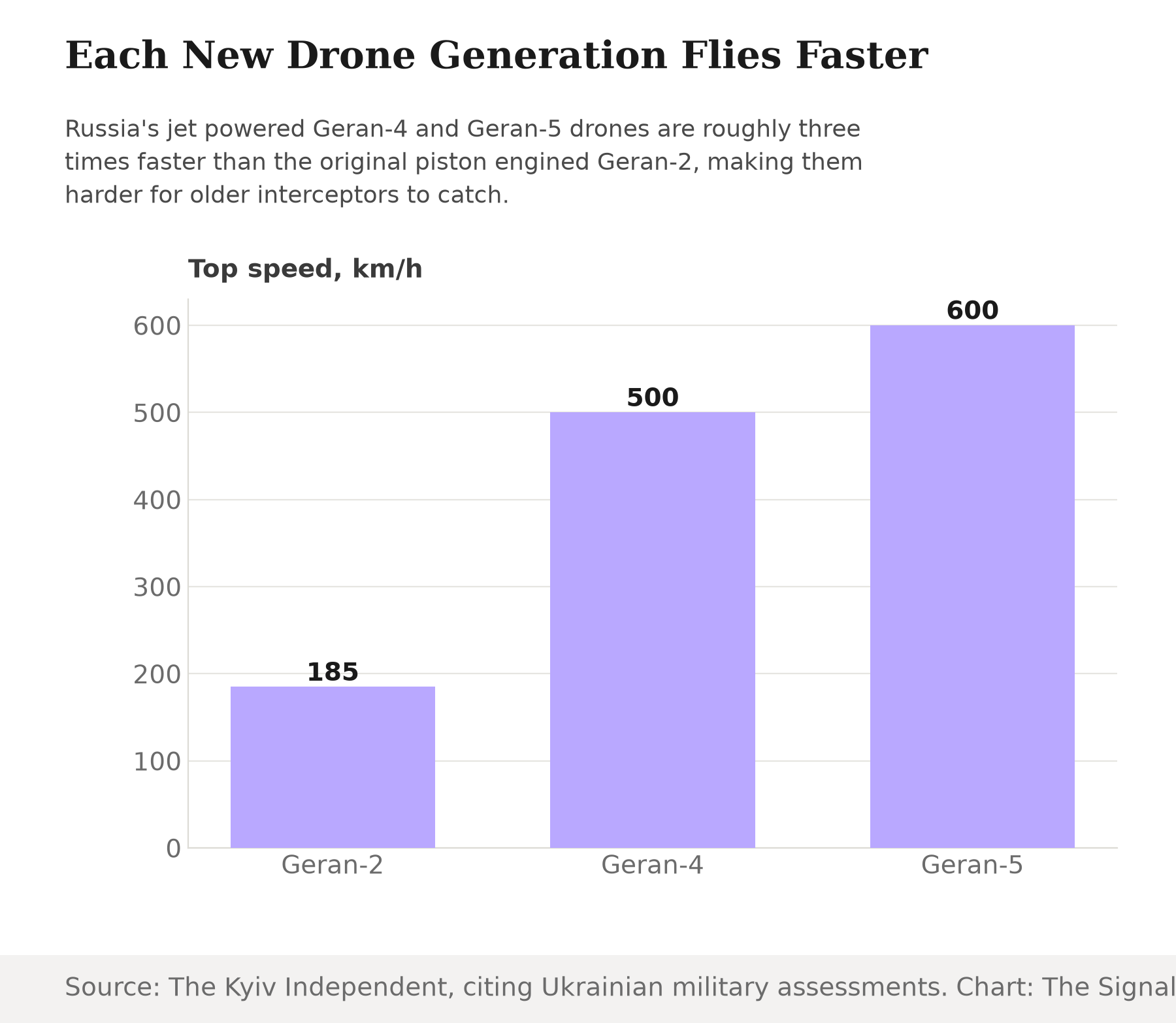
The drone side of that trade is not standing still. Russia has spent 2026 fielding jet-powered variants, the Geran-4 and Geran-5, that fly far faster than the original Shahed design. The piston-engined Geran-2 tops out around 185 km/h; the jet-powered Geran-4 reaches 500 km/h and the Geran-5 reaches 600 km/h, roughly triple the older drone's speed and fast enough to outrun some of the cheap interceptors built to catch it.
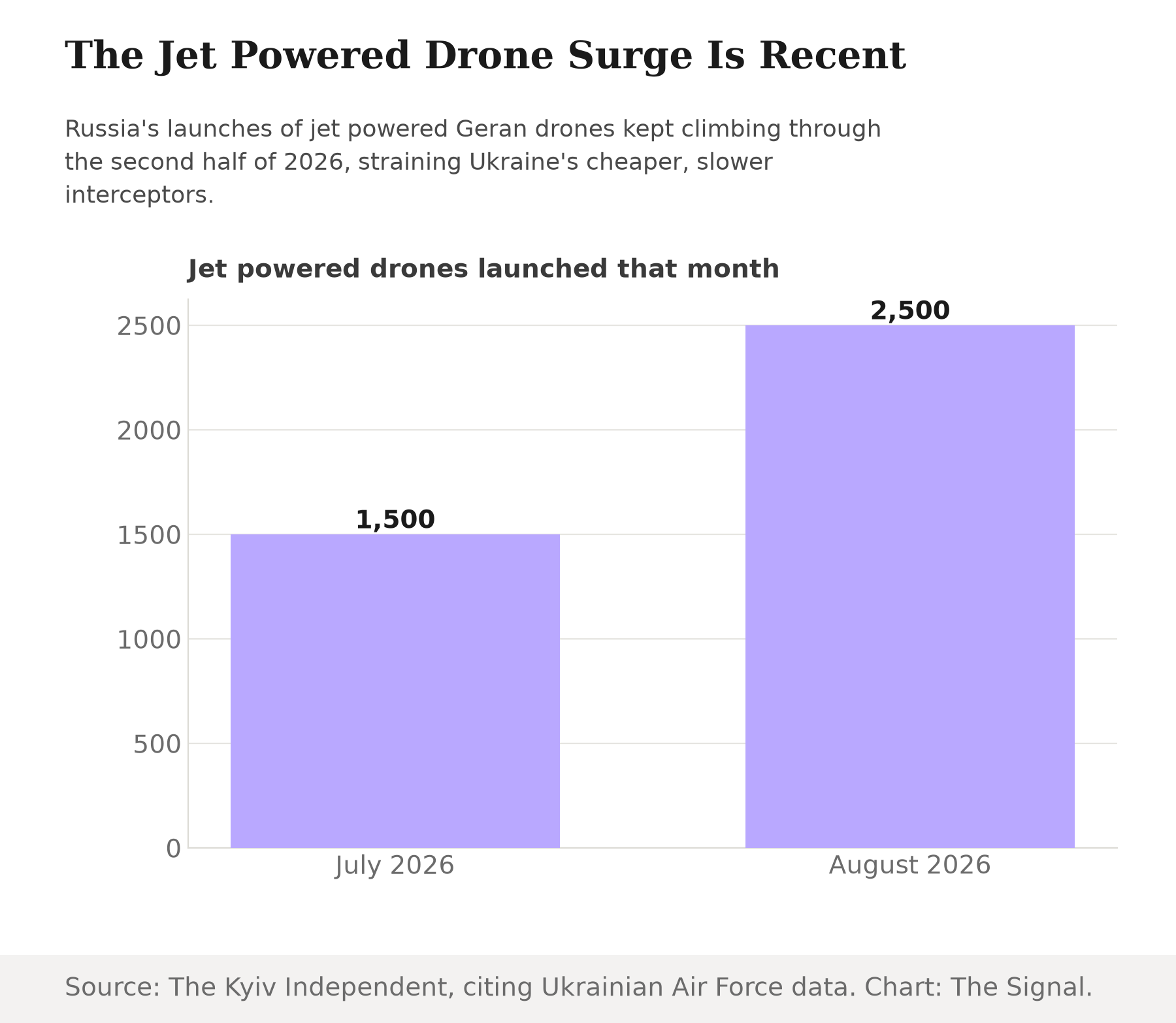
Production has scaled with the speed. Ukraine's military intelligence assesses Russia is now producing around 3,000 jet-powered Geran-4 and Geran-5 drones a month, and the pace of use kept climbing through the second half of the year: Russia launched roughly 2,500 jet-powered drones in August 2026, up from about 1,500 in July.
By the start of September, the shift had become the norm rather than the exception. On the night of September 2 to 3, 2026, roughly half of Russia's targets were the faster jet-powered type, while Ukraine's own cheap FPV interceptor drones travel at only about 350 km/h and cost an average of $3,000, against $20,000 to $70,000 for the drones they are chasing. The cheap-interceptor strategy that made the economics work in Ukraine's favor depends on the interceptor being fast enough to catch the target. Russia's newest drones are testing that assumption directly.
India's own shopping list already knows this
India is not a spectator to this argument. When Pakistan attacked with drones and loitering munitions during Operation Sindoor in May 2025, India's Chief of Defence Staff, Gen. Anil Chauhan, said the drones and loitering munitions were fully neutralised by the Indian Armed Forces, with none inflicting damage on Indian military or civilian infrastructure. India stopped a real drone attack. It has also kept building for the next one: on 3 July 2026, India's Defence Acquisition Council approved fresh capital acquisitions worth about Rs 52,000 crore, including the Army's "Akash Tarang" anti-UAV electronic warfare system, alongside MRSAM, V-SHORADS, an Active Protection System for tanks, and a Jet Based Kamikaze Drone System.
That is a real, dated commitment to the cheaper, drone-specific layer of air defense. It is also one line inside a six-item basket sharing a single Rs 52,000 crore approval, next to a legacy program, the original S-400 contract, that got a dedicated $5.4 billion of its own for just five squadrons. India's overall defense budget has room for both: the Ministry of Defence received a record Rs 7.85 lakh crore for FY2026-27, 15% higher than the previous year, with Rs 2.19 lakh crore of that under the Capital Head, a 24% jump in the capital-acquisition budget. The question the Russia-Ukraine war keeps sharpening is not whether India can afford a drone-specific layer. It is whether that layer is scaling as fast as the threat it exists to answer, next to a marquee program still priced for a different one.
The honest objection
None of this makes the S-400, or systems like it, obsolete. Cheap drones have not replaced manned aircraft, cruise missiles, or ballistic missiles as threats, and an air-defense network that only had cheap interceptors would be defenseless against exactly those. The S-400's job is real and distinct from a jet-powered Geran-5's job. India's defense budget is also large and growing, not fixed: a Rs 7.85 lakh crore budget for FY2026-27, with capital spending up 24% in a single year, is not a zero-sum choice between one system and another. It is entirely possible to fund both tiers at once, and the July 2026 acquisitions suggest India is trying to.
That case is real, but it does not erase the asymmetry underneath it. A $3 million-plus interceptor spent on a $35,000 drone is a bad trade regardless of how large the overall budget is, and a war that is actively field-testing that exact math, with the same country that sold India its S-400s, is not a hypothetical. It is happening in the same year India is deciding how the next tranche of its own air-defense money gets divided.
The Signal
The war supplying India's newest air-defense purchases is also the live laboratory proving which threat is cheaper to lose the economics of, night after night. India has the money, the recent combat experience, and, as of July 2026, a real line item aimed at the drone-specific layer. What to watch next is whether that line item keeps pace with the next exquisite-system purchase, because the lesson sitting inside Russia's own drone data is narrower than it sounds: big interceptors are not worthless, but a defense leaning mainly on them is exactly the kind a swarm of $35,000 drones is designed to bankrupt first.
Reporting basis: the jet-powered Geran-4 and Geran-5 speed, production and monthly-launch figures are as reported by The Kyiv Independent, citing Ukrainian Air Force data, Ukrainian military intelligence (HUR) assessments, and Ukrainian Air Force spokesperson Col. Yurii Ihnat; the September 2, 2026 nightly-strike composition and Ukrainian FPV interceptor cost and speed figures are per Tech Times, citing Ukraine's Air Force. The Patriot and Shahed/Geran-2 unit-cost figures and the per-interceptor loss figure are from a CSIS analysis. The 2018 S-400 contract value is as reported by the Arms Control Association. The Operation Sindoor neutralisation statement is Gen. Anil Chauhan's, via News on AIR. The July 2026 Defence Acquisition Council approval and the FY2026-27 defense budget figures are both from Press Information Bureau releases. The $32,700 net-value comparison is The Signal's own calculation from the CSIS and Kyiv Independent figures cited above.