On September 16, 2026, the US House of Representatives voted 262 to 159 to send President Trump a bill that threatens India's biggest trading relationship with the United States. The Office of the Clerk's official roll call record shows the motion passing 262 yea to 159 nay, clearing the last legislative hurdle for the Lindsey O. Graham Sanctioning Russia and Iran Act of 2026, known as H.R. 5334. The headline number is the one everyone will quote: a tariff of up to 100 percent on goods from any country still buying Russian energy. Section 113 of the bill's engrossed text authorizes the president to increase the rate of duty on all goods imported from such a country to a rate of up to 100 percent ad valorem. Read only that line, and this looks like the most severe trade weapon Washington has pointed at India yet.
It is worth slowing down on that. The same bill that builds the tariff also builds the president an off switch. Section 115 of the engrossed text lets the president waive any duty under the title, including this one, simply by certifying in writing to Congress that the waiver serves the national interest of the United States. There is no congressional vote required to activate the waiver, and no fixed expiration on it. Strip that clause out and the 100 percent figure is a mandate. Leave it in, and the number is a ceiling Congress built, that only one person gets to decide whether to use.
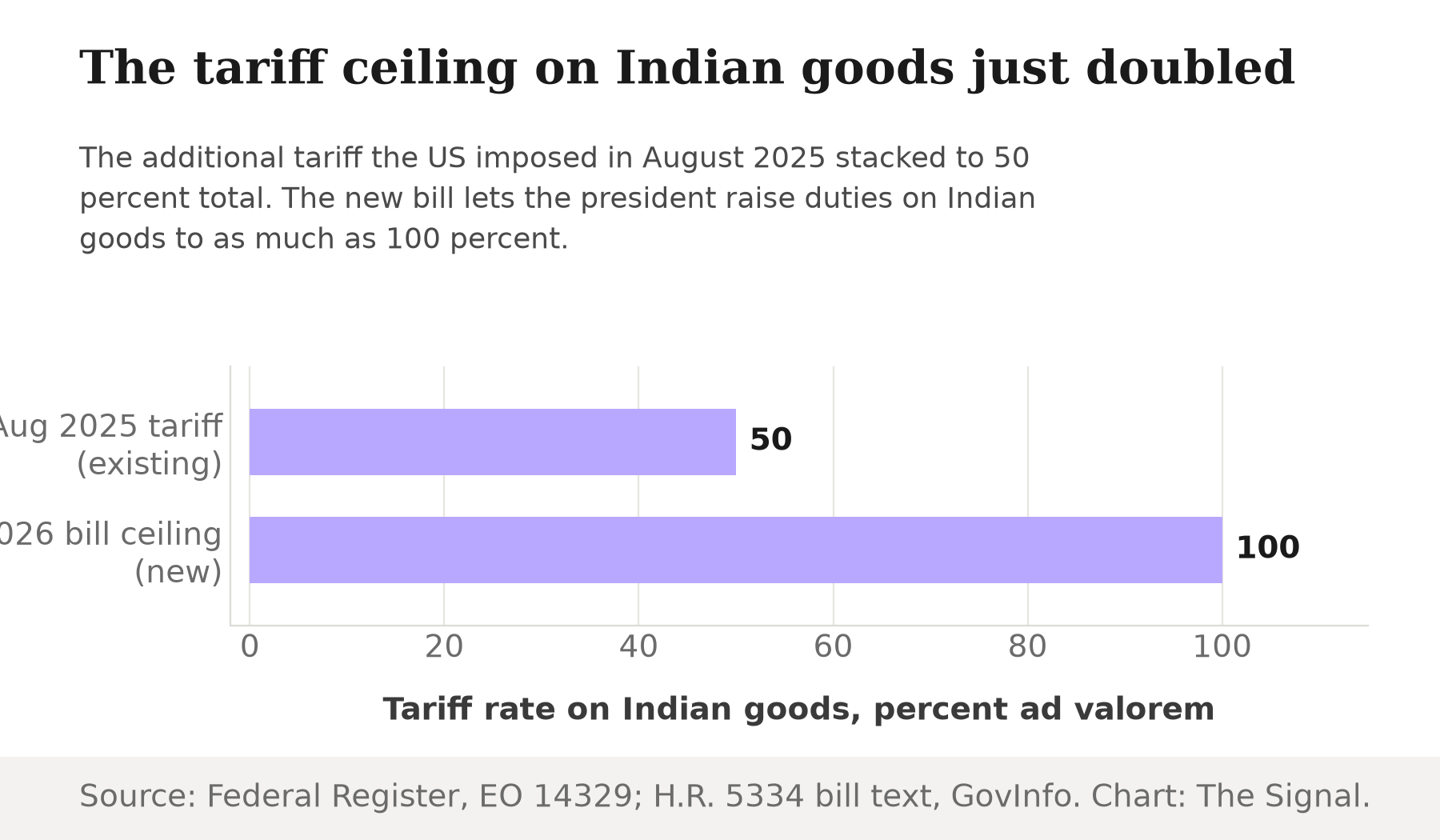
Source: H.R. 5334, Section 113 (engrossed bill text); Federal Register notice implementing Executive Order 14329. Chart: The Signal.
This is not the first time Washington has reached for this lever. A Federal Register notice implementing Executive Order 14329 already imposed an additional 25 percent ad valorem duty on Indian goods in August 2025 over Russian oil purchases, stacking onto an existing 25 percent tariff for a combined 50 percent. H.R. 5334's up-to-100-percent authority would not be a new kind of pressure on India. It would be the same lever, pulled twice as hard, if the president chooses to pull it at all.
The votes were not close, in either chamber
The waiver clause did not stop either chamber from passing this bill by a wide margin. The Senate passed H.R. 5334 86 to 11 on August 7, 2026, a month before the House's own lopsided vote. Bipartisan majorities that large do not typically attach themselves to a bill they expect to sit unused.
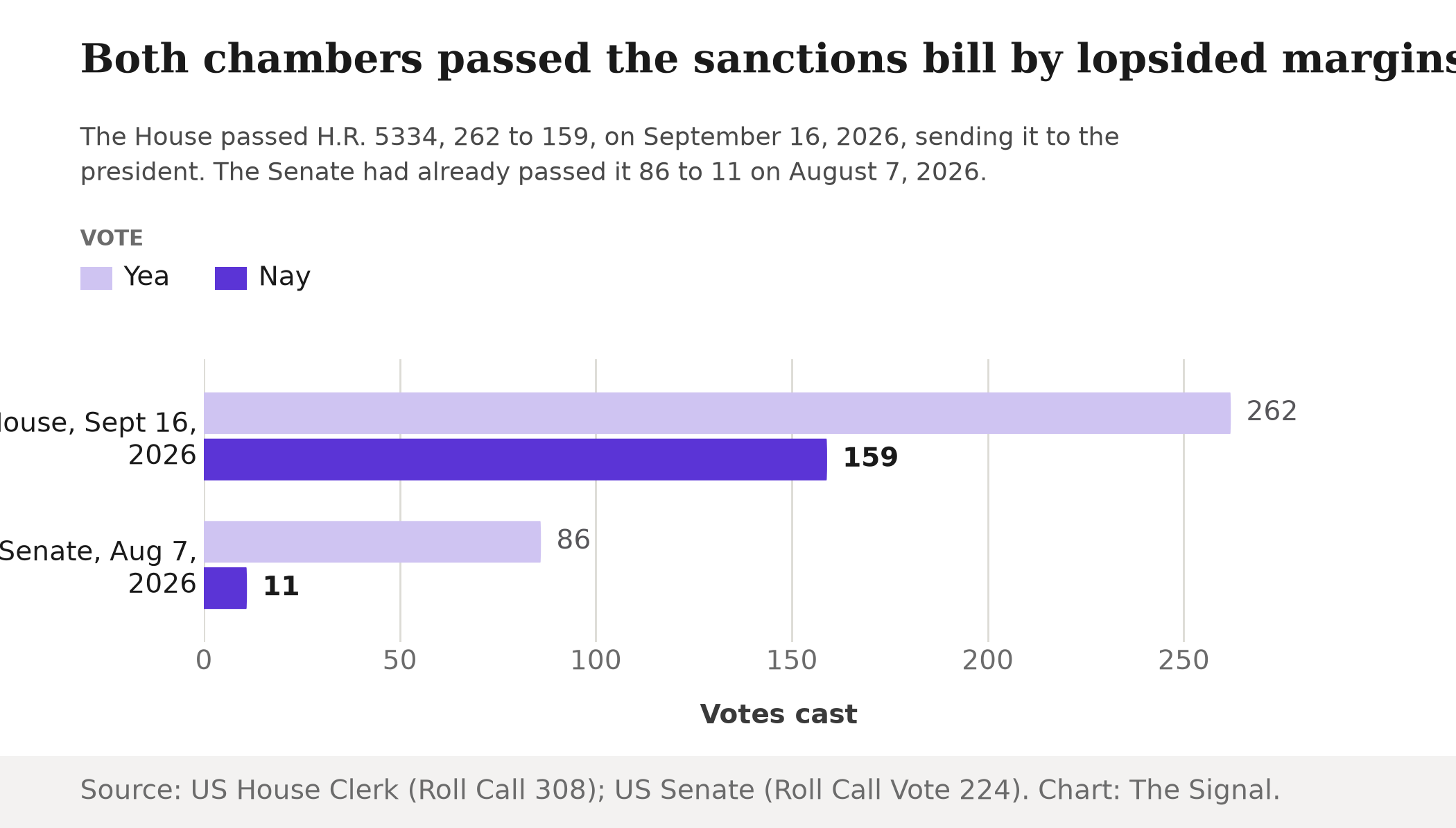
Source: Office of the Clerk of the House, roll call vote 308; US Senate, roll call vote 224. Chart: The Signal.
The bill's tone was set as much by its sponsors as by its text. Democratic Senator Richard Blumenthal, a co-sponsor, told reporters after the Senate vote that "China and India, you better buy your oil and gas somewhere else", a line aimed squarely at the two largest buyers of discounted Russian crude. That is the political signal underneath the legal mechanism: lawmakers who built in a presidential escape hatch are simultaneously daring the president not to use it.
What is actually on the table
The trade exposed to any future tariff is not small. US Census Bureau data show total US-India goods trade reached $149.1 billion in 2025, split between $103.8 billion of US imports from India and $45.4 billion of US exports to India.
| US-India goods trade, 2025 | US$ billion |
|---|---|
| US imports from India | 103.8 |
| US exports to India | 45.4 |
| Total goods trade | 149.1 |
Source: US Census Bureau, Foreign Trade Division.
A duty applied at the top of that authority would shock the $149.1 billion trade relationship the Census Bureau counted for 2025. A waived duty changes none of it. The gap between those two outcomes is entirely at the discretion of one office, not a function of how the bill was written or how it was passed.
India's oil habit is not waiting for Washington's answer
New Delhi's own statement kept its options open rather than closing them. India's Ministry of External Affairs said the bill's "potential implications for not just the bilateral relationship but also the international energy market have been very clearly articulated by the Indian side", a formulation that registers objection without committing to any change in behavior.
Behavior is already shifting anyway, for reasons that have little to do with Congress. Kpler vessel-tracking data reported that Russia remained India's largest crude supplier in August 2026 at around 2.1 million barrels a day, more than 40 percent of India's imports, down from about 2.6 million barrels a day in July. Russian oil is still India's single largest source by a wide margin. It is also a smaller share of a smaller number than it was one month earlier, as of August 2026, the most recent Kpler figures reported.
The reason is arithmetic, not politics. Russian crude was ever worth the sanctions risk because it was cheap. Reuters reported that cargoes of Urals crude offered to Indian refiners traded at discounts of just $1 to $2 a barrel below dated Brent in late July 2026, down from more than $10 a barrel earlier in the same month.
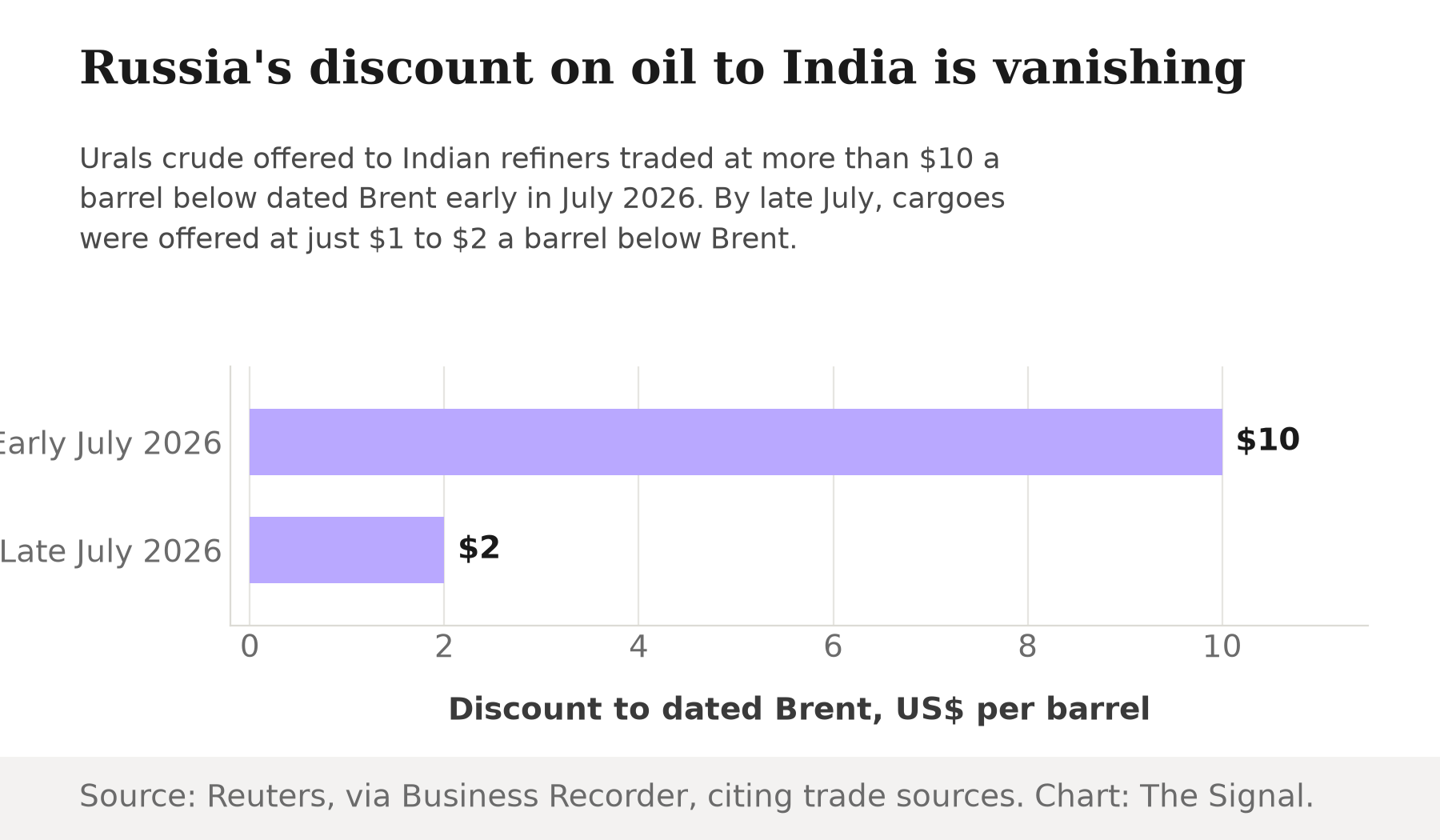
Source: Business Recorder, on Reuters reporting. Chart: The Signal.
That discount is the entire economic case for the trade Congress is threatening to tax. As it narrows, the tariff bill needs to do less work to change India's calculus, because the market is already doing part of that work on its own.
The honest objection
The strongest case that the waiver clause does not matter is that the House's 262 to 159 vote and the Senate's 86 to 11 vote represent a level of political consensus a president crosses at real cost. Congress does not need to force the tariff's use if the threat of an override, or simply the political price of visibly protecting Russia's two largest oil customers, does the coercing instead. On this reading, the waiver is a formality that lets the administration claim flexibility while the authority itself, and Blumenthal's public warning, already pressure India's buying decisions.
That case has real force, but it proves too much. The waiver's design gives the decision to one office, on one signed certification, with no vote required to invoke it and none to sustain it. However lopsided the vote that created the tariff, ending it requires nothing from Congress at all. A statute daring the president to act is still a statute the president is free to leave sitting on the shelf, and every recent administration has treated tariff waivers as instruments to trade away in bilateral talks rather than threats to fully execute against a large trading partner.
The Signal
The figure worth watching is not the tariff ceiling itself. It is which of two documents gets signed next: an order invoking Section 113, or a certification invoking Section 115. If it is the waiver, the bill becomes leverage for whatever trade or security concession Washington wants from New Delhi next, not a tariff that ever touches a shipment. If it is the tariff order, the trade relationship those Census figures describe absorbs a shock that Congress built with lopsided votes in both chambers but only one person had the power to trigger. Either way, India's Russian oil trade is already adjusting to a shrinking discount, tariff bill or not. Congress built the largest tariff aimed at India yet. Whether it ever fires depends on one signature, not on how either chamber voted.
Reporting basis: the bill's tariff and waiver provisions are per the engrossed text of H.R. 5334 published by the US Government Publishing Office. The House and Senate vote counts are from the official roll call records of the Office of the Clerk of the House and the US Senate respectively. The prior 2025 tariff is from the Federal Register notice implementing Executive Order 14329. US-India trade totals are US Census Bureau data. Senator Blumenthal's remarks and India's Ministry of External Affairs statement are as reported by The Week. The Russian crude import volume is Kpler vessel-tracking data as reported by Hellenic Shipping News, citing Business Standard; the Urals discount figures are Reuters reporting, via Business Recorder, citing trade sources. The tariff-rate comparison chart is The Signal's compilation from the GovInfo and Federal Register figures above.