Bangladesh has spent the past two months rationing electricity by the mill and by the neighborhood. More than 900 of Bangladesh's roughly 1,800 member textile mills were completely shut by August 2026 because of the gas supply disruption, the clearest industrial toll of a crisis officials describe as a shortage of generating capacity. The assumed fix, inside Bangladesh and out, is the power line to India next door: a bigger, richer neighbor with grid capacity to spare.
It is worth slowing down on that. Bangladesh is not short of power plants. Under the state utility's own summer 2026 plan, about 60 percent of Bangladesh's 12,204 MW of gas-fired power capacity was expected to sit unused, because gas supply to the power sector ran to only about 900 MMcf/d: the constraint is fuel and pipeline gas, not installed generation. That gas fleet is itself only part of the picture: Bangladesh's 136 grid-connected power plants, across every fuel type, had a combined installed capacity of 28,919 MW as of April 2026, so the idle gas-fired capacity alone equals roughly a quarter of everything the country can generate from gas, coal, oil and hydro put together.
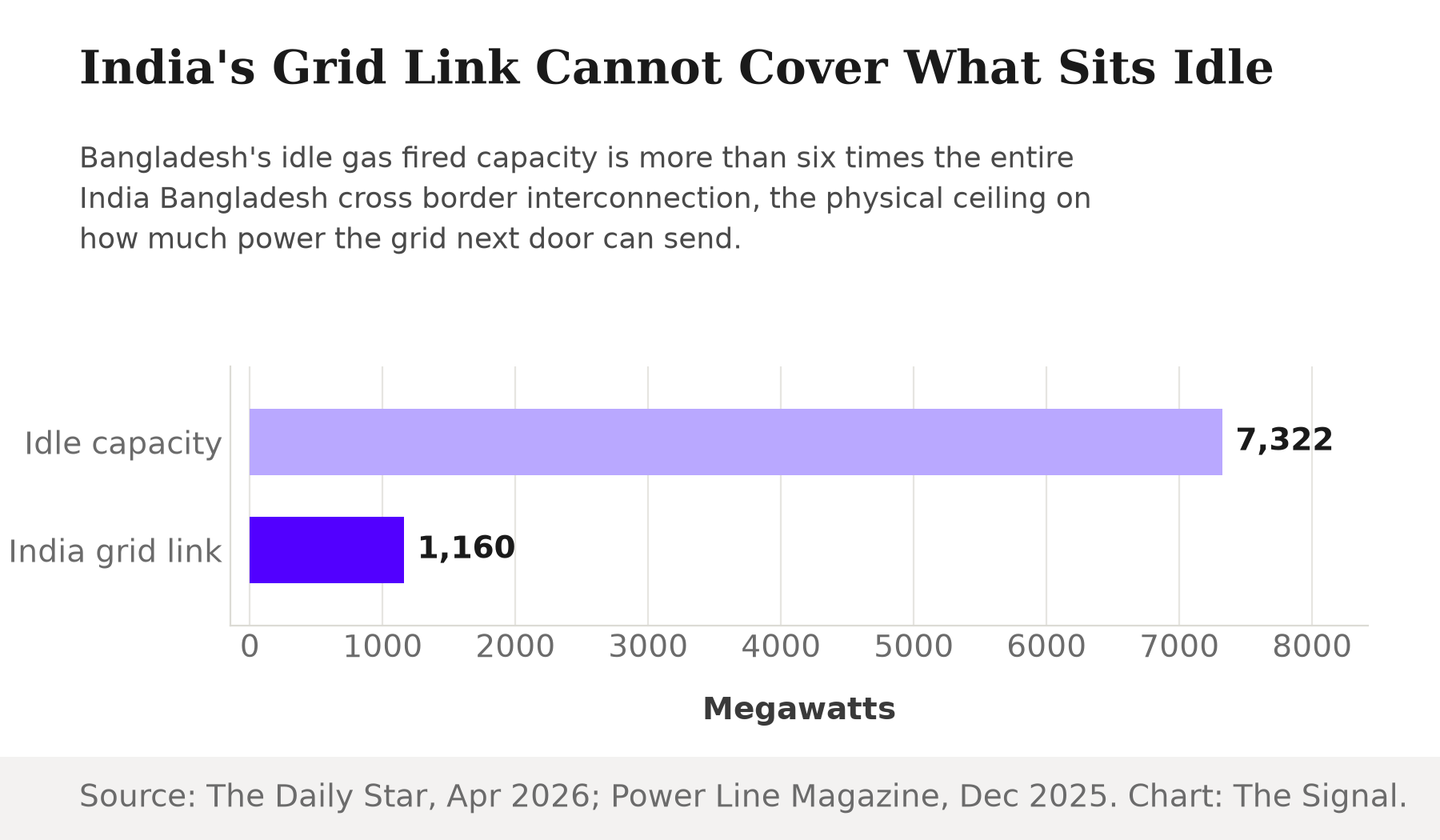
Idle gas-fired capacity dwarfs the grid link everyone points to as the fix.
That 60 percent share of 12,204 MW works out to roughly 7,322 MW of stranded capacity, more than six times the size of the 1,160 MW that India's grid can send across the two cross-border interconnections that link the two countries. Even if Bangladesh imported every spare megawatt that link can carry, it would replace only a small fraction of what its own plants could produce if they had fuel.
Where the gas went
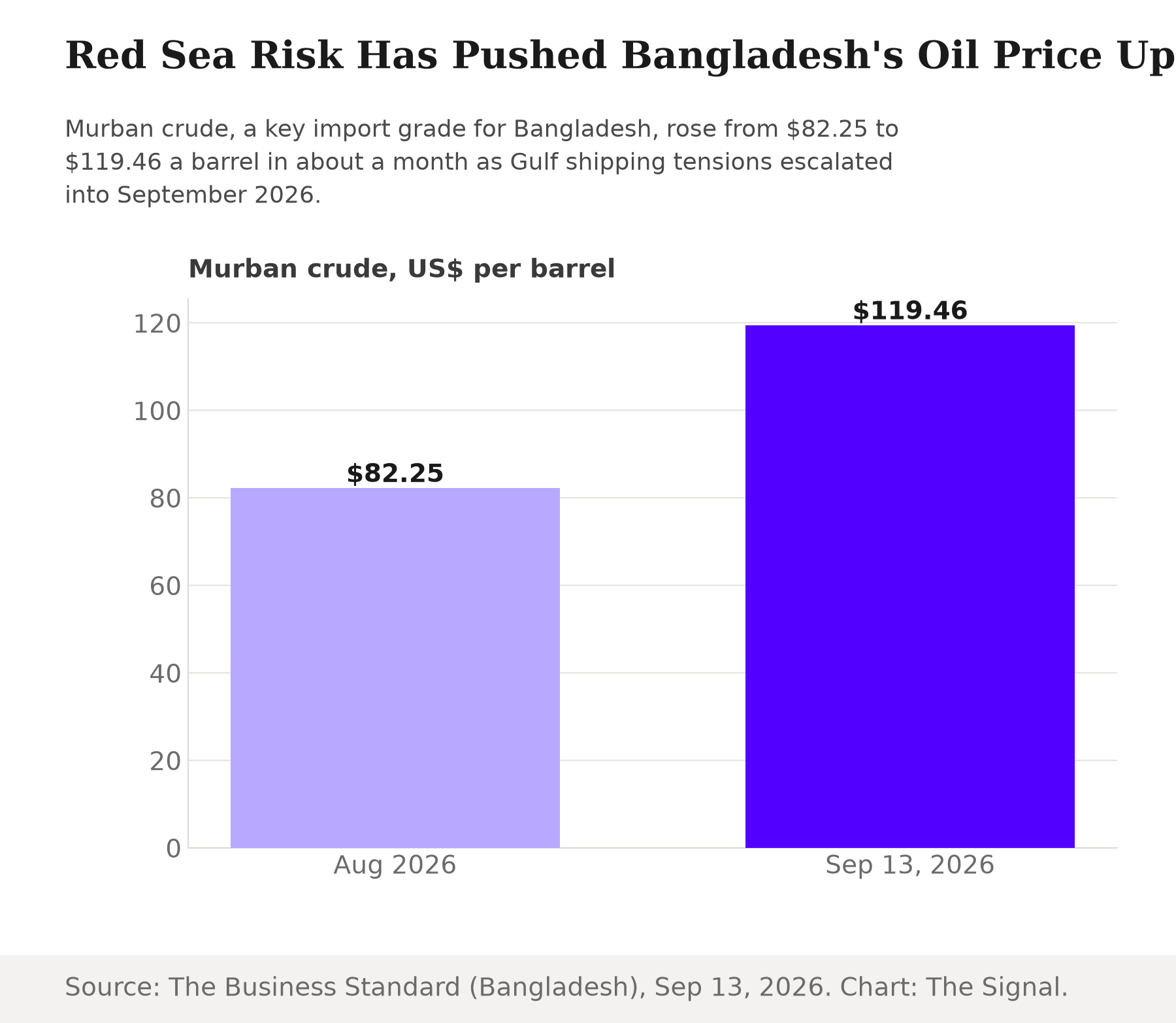
Bangladesh's total national gas supply had fallen to about 1,930 mmcfd against daily demand of around 3,800 mmcfd by mid-August 2026, a gap of roughly 1,870 mmcfd. A fire at Excelerate Energy's floating LNG terminal off Moheshkhali on July 21, 2026 knocked out a unit capable of supplying up to 600 mmcfd, which on its own accounts for just under a third of that gap, our calculation from the two reported figures. The rest of the shortfall is a pricing problem, not an accident. Bangladesh's annual fossil-fuel import bill was projected in March 2026 to surge by $4.8 billion, a 40 percent jump from 2025, because of the Middle East crisis, with Qatar, the source of 75 percent of Bangladesh's LNG, suspending shipments. That suspension did not resolve quietly: QatarEnergy's force majeure on Bangladesh cargoes was still in force and had been extended through early November 2026 as of September 1, six months after it began. The price pressure had only sharpened over the same stretch: Murban crude, Bangladesh's key import grade, had risen to $119.46 a barrel from $82.25 a month earlier, and the Asian LNG benchmark JKM had climbed to $24.82 per MMBtu, by mid-September 2026, a roughly 45 percent jump in the oil price alone in about a month. All of that traces back to one chokepoint. The Bab el-Mandeb Strait, the Red Sea passage Bangladesh's Gulf-sourced oil and LNG cargoes must transit, historically carried an estimated 6.2 million barrels a day of oil and refined products at its last normal-year peak, in 2018, the baseline flow Houthi attacks now put at risk.
A neighbor with a small pipe, and an unpaid bill
Even setting fuel aside, the India fix has its own ceiling. The India-Bangladesh grid is limited to about 1,160 MW of interconnection capacity across two links, a number set by transmission infrastructure, regardless of how much power either side wants to trade. Widen the lens and the ceiling is a little higher: Bangladesh's total contracted import capacity from India, including a separate dedicated line from Adani Power's Godda plant, comes to about 2,656 MW, still barely a third of the idle gas-fired capacity sitting at home for lack of fuel. And the capacity that does exist has been strained by money, not megawatts. Bangladesh's outstanding electricity payment arrears to India's Adani Power stood at about $400 million in July 2026, down from about $900 million a year earlier, a chronic bilateral dispute with real teeth: Adani Power warned as recently as late October 2025 that it would suspend supply from November 11 unless dues it put at $496 million were cleared, the kind of leverage that has periodically constrained the link even as Bangladesh works the balance down. The buffer for financing emergency purchases at crisis prices is real, though finite: Bangladesh's gross foreign exchange reserves stood at about $37.35 billion in August 2026, against the $4.8 billion annual increase in the import bill projected in March 2026: the extra fuel cost alone would run to roughly 13 percent of reserves, before any other call on the same dollars.
Bangladesh's idle capacity dwarfs the fix everyone points to.
| Indicator | Figure | As of |
|---|---|---|
| National gas supply vs. demand | 1,930 mmcfd supplied vs. 3,800 mmcfd demand | Aug 2026 |
| Gas-fired capacity sitting idle | 60% of 12,204 MW | Apr 2026 |
| Total grid-connected capacity, all fuels | 28,919 MW | Apr 2026 |
| India grid interconnection capacity | 1,160 MW | Dec 2025 |
| Total India import capacity, all channels | 2,656 MW | Aug 2026 |
| Outstanding Adani Power arrears | $400 million (down from $900 million) | Jul 2026 |
| Textile mills completely shut | 900+ of roughly 1,800 | Aug 2026 |
| Foreign exchange reserves | $37.35 billion | Aug 2026 |
Source: The Daily Star; The Daily Star; Energy Bangla; Power Line Magazine; The Financial Express (Bangladesh); The Business Standard (Bangladesh); Bangladesh Bank.
The honest objection
The strongest case against this reading is that both halves of the fix are moving in the right direction. Arrears to Adani Power have fallen by more than half in a year, and India has been actively expanding its side of the cross-border connection rather than letting it stagnate. On that view, the payments dispute is resolving itself and more transmission capacity is only a matter of time and continued goodwill.
That case understates the scale mismatch. Even a fully paid-up Bangladesh drawing every megawatt India can currently send it, all 2,656 MW across every channel including Adani's dedicated line, would still be importing barely a third of the capacity sitting idle at home for lack of gas. And the newer problem, the Gulf shipping shock pushing crude and LNG prices higher through September 2026, has nothing to do with the bilateral relationship at all: it raises the cost of the fuel Bangladesh's own plants need, regardless of how the India account is settled. Paying down a bill does not widen a wire or reopen a shipping lane.
The Signal
Bangladesh's blackouts look like a generation problem because the visible symptom, dark mills and rationed households, is what a generation problem looks like from the outside. But the plants mostly exist and mostly sit still. What is missing is affordable gas, delivered through a Red Sea route now priced for risk, and a cross-border grid link too small to make up the difference even debt-free. The number to watch is not the next blackout schedule. It is whether the gap between demand and supply, 1,870 mmcfd as of mid-August 2026, narrows because new LNG cargoes get bought at today's prices, or because the crisis in the Gulf eases and makes that gas affordable again. India's grid was never going to close a gap that size. It was only ever going to matter at the margin.
Reporting basis: the gas supply and demand figures, the idle gas-fired capacity share, and the import bill forecast are all as reported by The Daily Star. The terminal fire, the textile mill closures, the QatarEnergy suspension's extension to November, the total India import capacity, and the Adani supply-cut warning are as reported by The Business Standard (Bangladesh), and the Murban crude and JKM benchmark price figures are as reported by the same paper's economy desk. The Adani Power arrears figure is per The Financial Express (Bangladesh). The India-Bangladesh grid interconnection capacity is per Power Line Magazine, an Indian power-sector trade publication. Bangladesh's total grid-connected generation capacity across all fuel types is per Energy Bangla, a Bangladesh energy-sector trade publication, reporting the power minister's own parliamentary statement. Bangladesh's foreign exchange reserves are Bangladesh Bank's own published monthly data. The Bab el-Mandeb Strait's historical peak flow is the US Energy Information Administration's figure for 2018, the most recent normal-year baseline available, and predates the current Houthi threat. The idle-capacity total in megawatts, the terminal fire's share of the supply gap, the idle capacity's share of total installed capacity, and the import bill's share of reserves are The Signal's own calculations from those reported figures.