Home Affairs Minister Tony Burke used a National Press Club address on September 17 to confirm the numbers behind Australia's long-flagged migration overhaul: ABC News reports the government wants to cut net overseas migration from about 300,000 to 225,000 a year by 2028, with most international students barred from bringing family members as part of the package. The starting point is not a rounded guess. Net overseas migration added 306,000 people in the year to 30 June 2025, the Australian Bureau of Statistics reports, so the target amounts to a cut of close to a quarter from where the country actually stands.
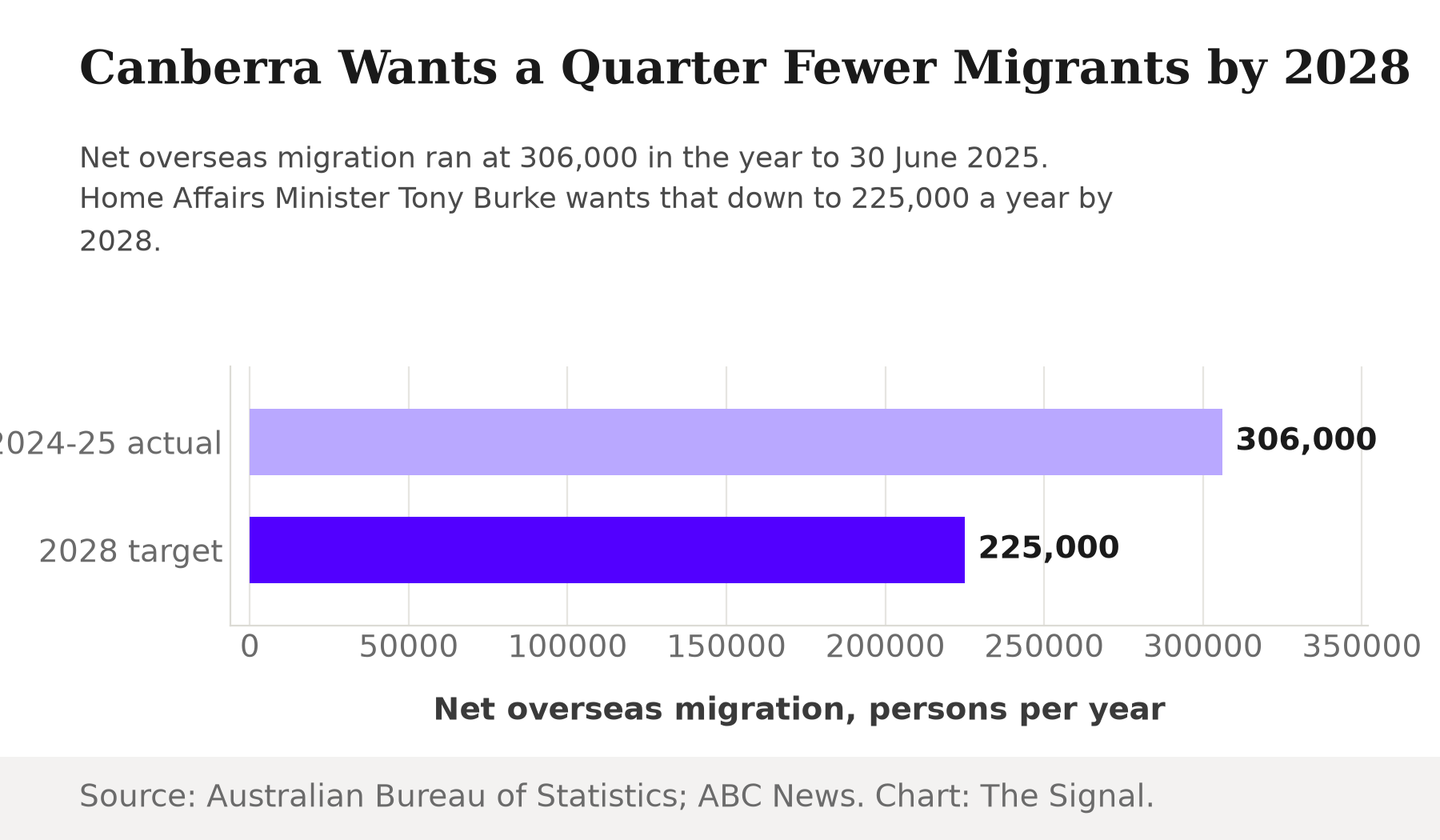
Source: ABC News; Australian Bureau of Statistics. Chart: The Signal.
Read as a headline, this is a story about a topline number: too many arrivals, a lower target, pressure on housing eased. It is worth slowing down on the specific lever the government pulled to get there. The cut does not apply to every student visa route the same way. It targets the one dependants travel through, and the exemptions that soften it do not extend to India.
In the year to 30 June 2025, ABC News reports, Australia granted 337,427 student visas, of which 45,991 went to secondary applicants: partners and dependent children riding on a student's application. That is the exact route the new rule restricts. Only PhD candidates, government-sponsored students and Pacific or ASEAN nationals are exempt from the restriction, The Indian Sun reports, citing Home Affairs data, and India is not in any of those groups. India was the second-largest student visa cohort in the country, with 107,038 Indian student visa holders as of 30 June 2025, narrowly behind China.
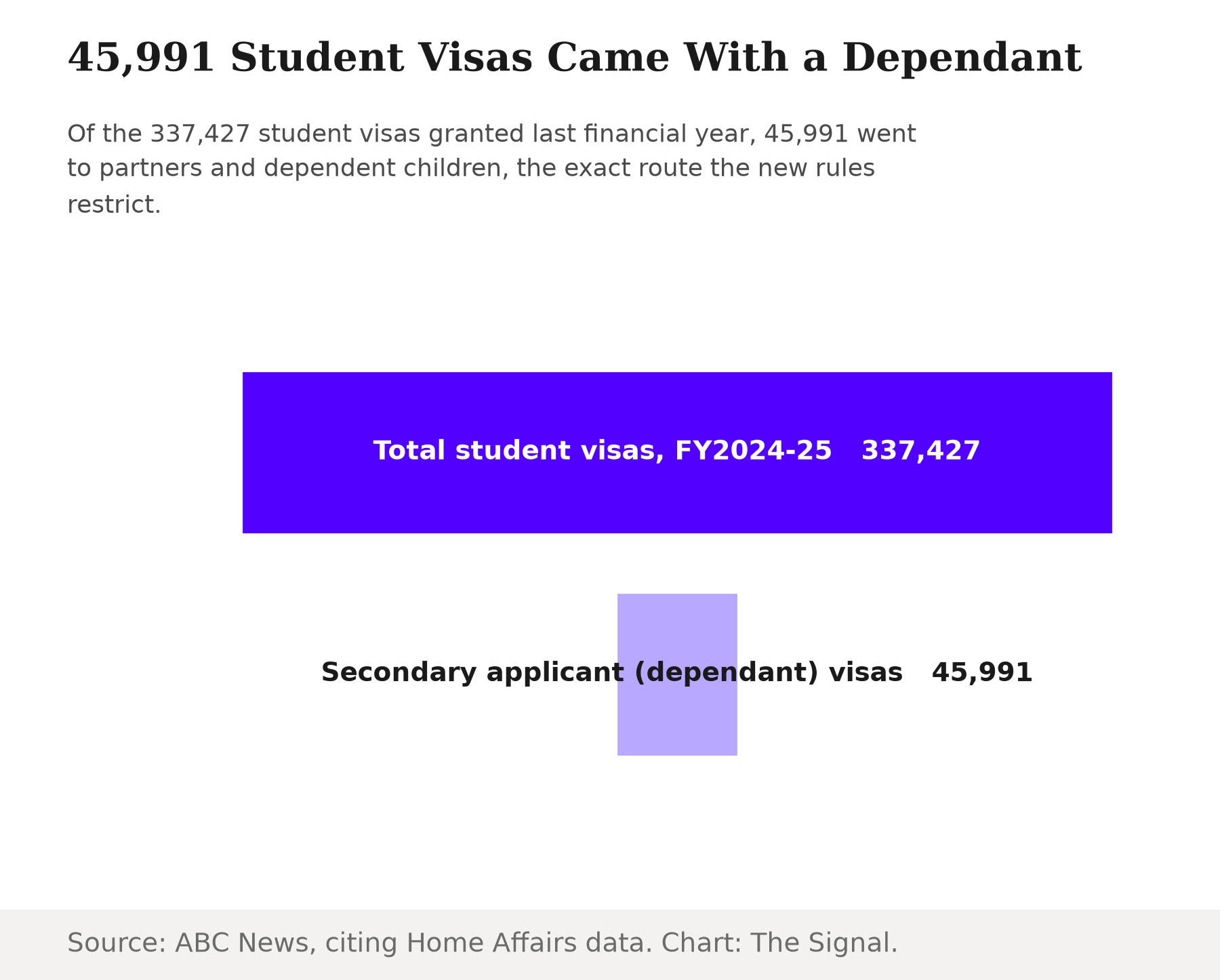
Source: ABC News. Chart: The Signal.
Why the ban lands harder on India
The exemption list is not the only place the asymmetry shows up. A Reserve Bank of Australia Bulletin analysis states that students from India and Nepal typically have higher rates of labour force participation than students from China. In plain terms, Indian students are more likely to be working, or to have a working partner, while they study. A rule that removes the partner-visa route strips out more of the actual household arrangement Indian students use than it does for a cohort less reliant on that income.
Only Pacific and ASEAN nationals, government-sponsored students and PhD candidates are exempt from the new dependant ban. India is not in any of those groups.
| Category | Status under the new rule |
|---|---|
| Pacific and ASEAN nationals | Exempt |
| Government-sponsored students | Exempt |
| PhD candidates, any nationality | Exempt |
| Indian students below PhD level (107,038 visa holders as of 30 June 2025) | Not exempt |
Source: The Indian Sun, citing Home Affairs data.
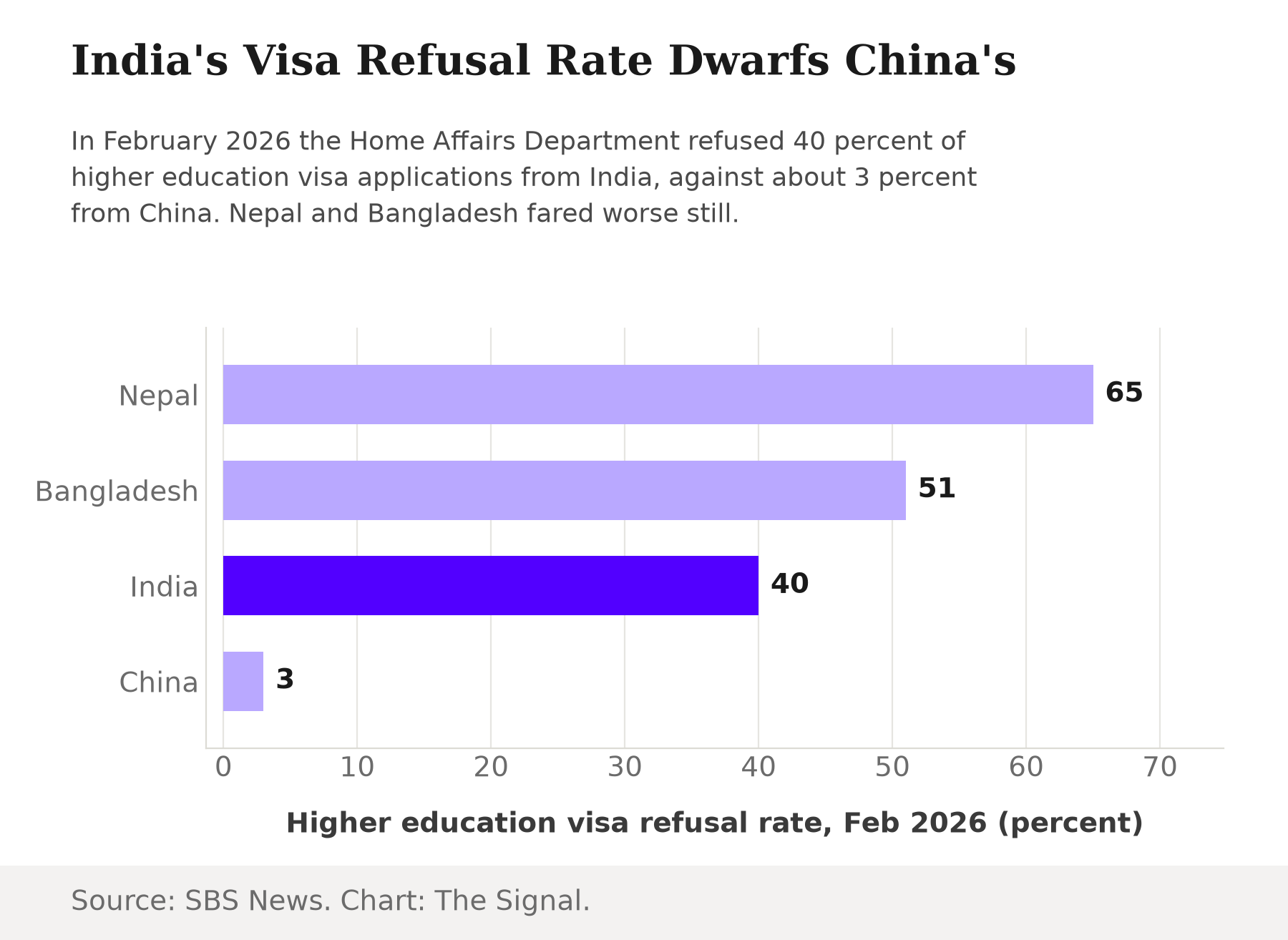
Source: SBS News. Chart: The Signal.
The disparity was already visible before this week's announcement. In February 2026, SBS News reports, the department refused 40 percent of higher education visa applications from India and about 3 percent from China; Nepal and Bangladesh fared worse, at 65 percent and 51 percent. That gap reflects screening the department was already doing by country, months before Burke's address, not something this week's package created. What the new rule adds is a second filter, on top of a screening gap that was already this wide.
The other cost: a frozen farm-labour route
The same package reaches beyond students. ABC News reports that working holiday visa applications have been paused from 24 of 29 eligible countries, a route that had 206,187 people in Australia as of 30 June 2025. As part of the same overhaul, a ballot system will be introduced for working holiday visa holders who want to stay longer than a year, ABC News reports.
The visa route Australian farms depend on is also the one being frozen.
| Metric | Figure | As of |
|---|---|---|
| Working holiday makers in Australia | 206,187 people | 30 June 2025 |
| Countries with paused working holiday visa applications | 24 of 29 eligible countries | September 2026 |
| Farm jobs nationally filled by working holiday makers | About 1 in 7 | 2026 |
| Share of the horticulture workforce | About 44 percent | 2026 |
| Estimated annual contribution to the economy | $4.68 billion | 2026 |
| Direct spending in regional communities | $726 million a year | 2026 |
Source: ABC News; National Farmers' Federation.
Australia's National Farmers' Federation says Working Holiday Makers fill roughly one in seven farm jobs nationally and about 44 percent of the horticulture workforce, contributing an estimated $4.68 billion a year to the economy, including $726 million directly in regional communities. Its horticulture council has drawn a direct parallel to the pandemic-era labour shortage, warning that leaving farmers short of labour puts upward pressure on food prices, just as it did through COVID.
The honest objection
The strongest case for the government is that none of this is aimed at India specifically. This is a general migration cut, and the exemption categories (Pacific and ASEAN nationals, government-sponsored students, PhD candidates) are defined independent of any one country's caseload. Indian PhD candidates remain exempt even as most other Indian students do not, The Indian Sun reports, which is hard to square with a policy built to single India out. And the refusal-rate gap between India and China was already running at 40 percent versus 3 percent in February 2026, SBS News reports, months before Burke's announcement: whatever produces that gap, it did not start with this week's package.
That case is real, and it explains why the disparity is not a new invention. It does not explain why a government aware of an existing 40-versus-3 screening gap chose an exemption structure that leaves it untouched rather than one that narrows it. A general migration cut still has to decide, line by line, who is spared its detail. This one spares Australia's regional neighbours and leaves out the country's second-largest student visa cohort from every carve-out on the list.
The Signal
The overhaul is genuinely about the topline number: fewer net arrivals, pressure on housing eased. But an exemption list is never neutral by accident. It is a series of choices about which groups absorb a cut, and this one leaves out the cohort that already faced a wide visa scrutiny gap against China, and that relies heavily on the dependant route now being closed. Watch two things in the coming months: whether India's share of new student grants shrinks faster than the overall migration target implies, and whether the farm sector's food-price warning shows up in grocery data the way it did through COVID. A migration target is easy to announce. Which country actually bears the cost is a design choice, not an accident.
Reporting basis: the migration overhaul, the size of the cut, the student visa and secondary-applicant grant numbers, the working holiday visa pause and the ballot system are per ABC News's coverage of Tony Burke's National Press Club address and the department's related announcements. The net-overseas-migration baseline is from the Australian Bureau of Statistics's 2024-25 overseas migration release. The count of Indian student visa holders and the shape of the exemption list are per The Indian Sun, reporting Home Affairs data. The gap in labour-force participation between Indian, Nepali and Chinese students is from a Reserve Bank of Australia Bulletin analysis. The country-by-country visa refusal rates are per SBS News. The working-holiday-maker contribution to farm labour and the regional economy, and the food-price warning, are the National Farmers' Federation's own figures and statements, cited as its position rather than a neutral figure. The one-quarter reduction implied by the migration target is arithmetic from the cited ABS and ABC figures.