
Data For India's analysis of NCRB and Census data found that young men aged 18 to 30 in Punjab and Delhi are incarcerated at a rate of more than 400 per 100,000, meaning roughly one in every 250 young men in these two states is in prison, about ten times the national average. The obvious explanation sits right next to it. Punjab logged 11,589 cases under the Narcotic Drugs and Psychotropic Substances Act in 2023, and its rate of 37.6 cases per lakh population, with 25.3 per lakh for trafficking alone, was the highest of any state in the country. Read the two facts together and the story writes itself: a state gripped by narcotics, filling its jails with dealers and addicts.
It is worth slowing down on that story before accepting it. An arrest for trafficking is not the same thing as a conviction for it, and the gap between the two is where Punjab's, and Delhi's, prison numbers actually live.
Most of the people behind bars in both states have not been convicted of anything.
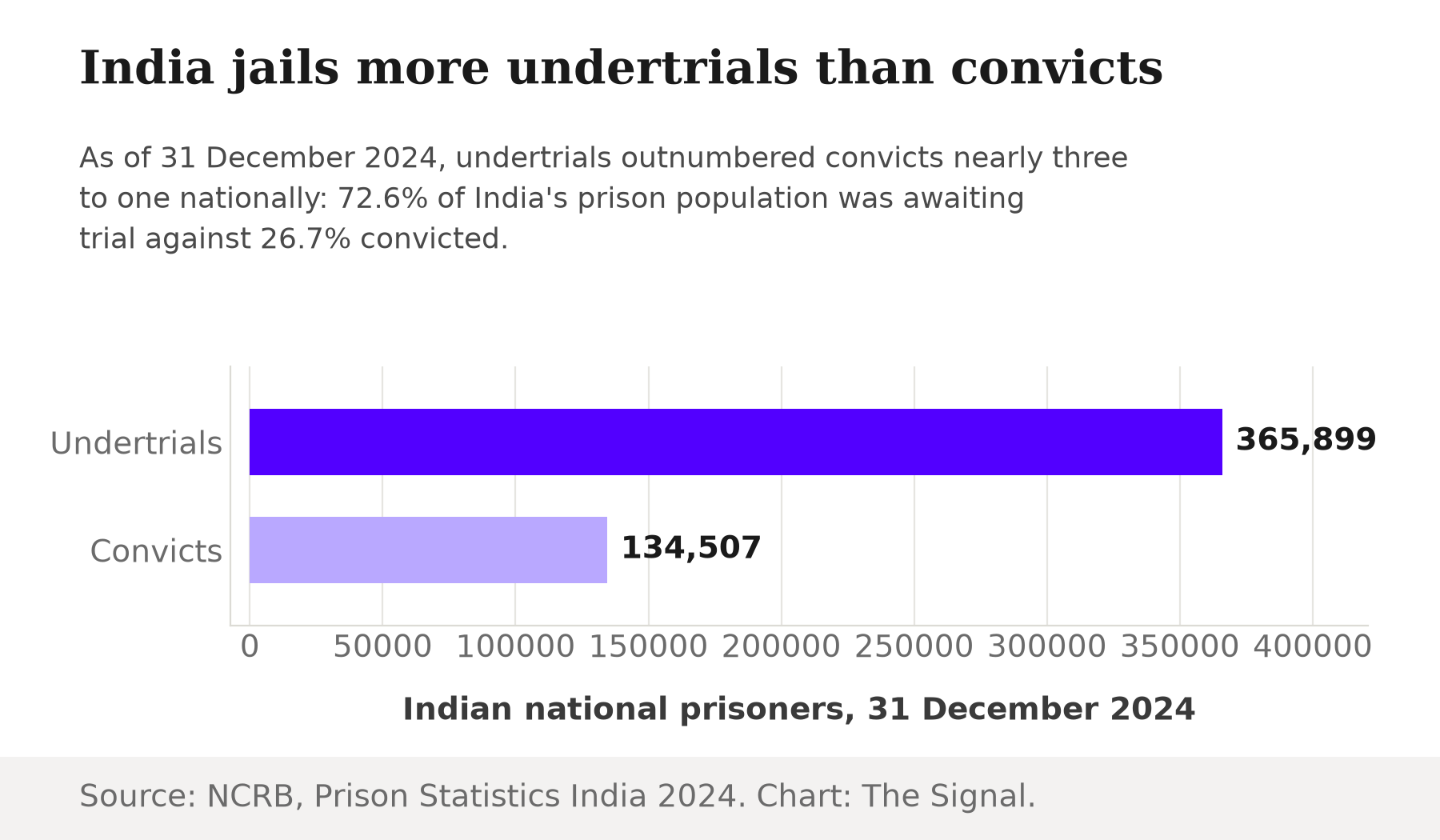
Nationally, 72.6% of India's Indian-national prison population, 3,65,899 of 5,04,049 inmates, were undertrials awaiting trial as of 31 December 2024, against just 26.7% who had actually been convicted. Punjab and Delhi sit at the extreme end of that split, not outside it.
As of 31 December 2024, Punjab held 23,844 undertrial prisoners and Delhi held 16,501, while over the same period Punjab held just 6,657 convicted prisoners and Delhi held 2,193. That works out to roughly 78% of everyone in a Punjab cell and nearly 88% of everyone in a Delhi cell not having been found guilty of anything. The "1 in 250" statistic is not about how many young men are locked up. It is about how few of them have had a verdict.
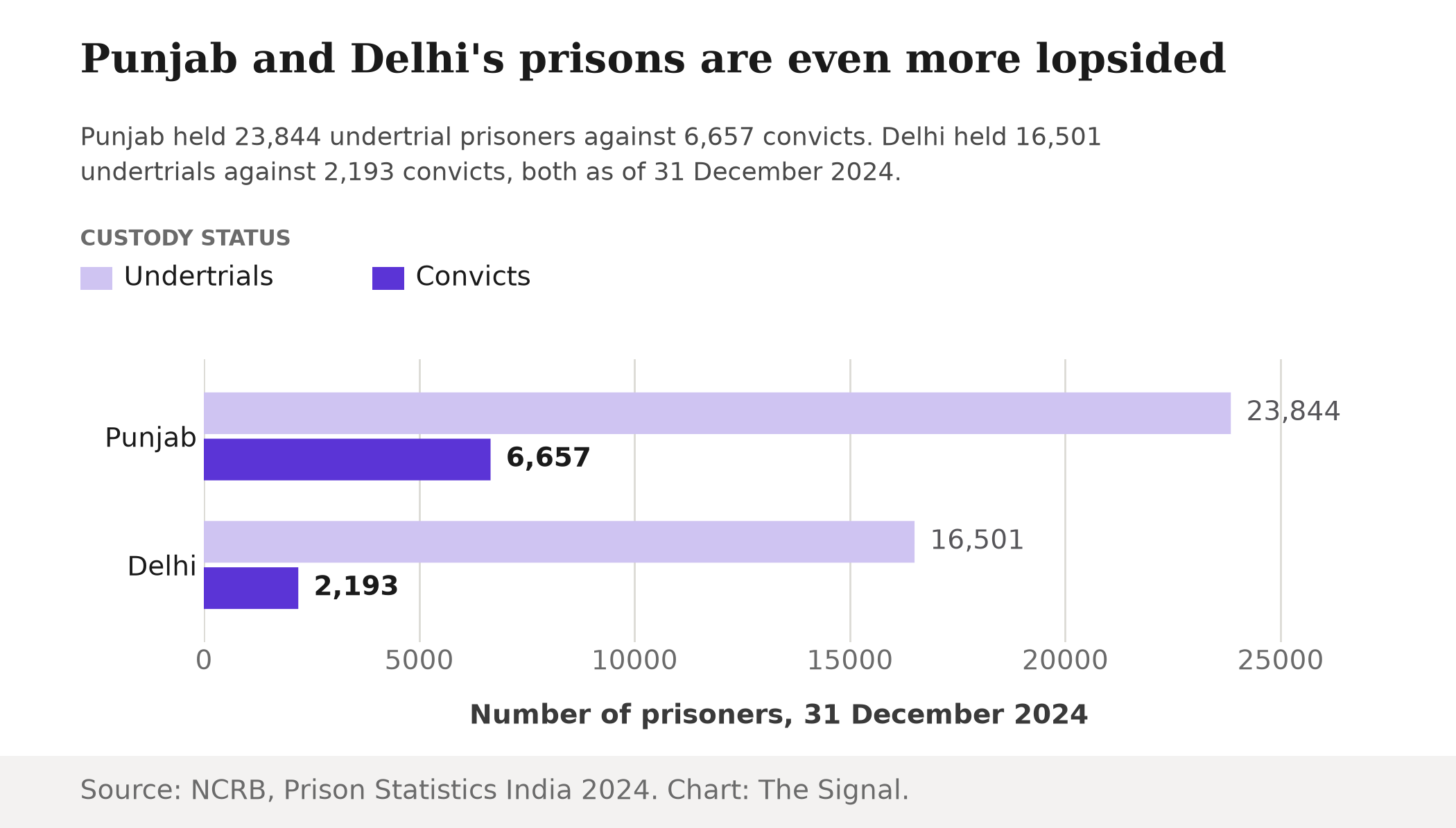
The crowding is worse in the state with less crime pressure
Delhi's jails ran at 194.6% of rated capacity as of 31 December 2024, the highest overcrowding rate of any state or union territory in India; Punjab's ran at 115.5%. Delhi is not a narcotics-trafficking hub on Punjab's scale, yet its jails are more crowded and its undertrial share is higher. If the drug crisis alone explained the pattern, Punjab's numbers should look distinct from Delhi's. They do not.
Delhi runs the most overcrowded prisons in the country, and both states hold mostly the unconvicted.
| Jurisdiction | Undertrial prisoners | Convicted prisoners | Undertrial share | Jail occupancy |
|---|---|---|---|---|
| Punjab | 23,844 | 6,657 | ~78% | 115.5% |
| Delhi | 16,501 | 2,193 | ~88% | 194.6% (highest in India) |
| India (national) | 3,65,899 | 1,34,507 | 72.6% | n/a |
Source: NCRB, Prison Statistics India 2024, Chapters 1 and 3. Undertrial-share percentages are The Signal's calculations from NCRB's state-wise convict and undertrial counts. Figures as of 31 December 2024.
The undertrial count does not describe a brief wait either. Punjab has the highest state-level share, of any state in the country, of its own undertrial population held for 6 to 12 months (23.2%), and the third-highest share held for 1 to 2 years (20.7%), as of 31 December 2024. Nationally, most undertrials clear the system faster than that. In Punjab, a disproportionate share do not.
The young men behind the numbers
Nationally, 48.2% of India's undertrial prisoners, 1,76,261 of 3,65,899 people, were aged 18 to below 30 as of 31 December 2024, the single largest age band by a wide margin. That is the same age group the "1 in 250" rate is built on: Data For India's calculation isolates men aged 18 to 30 because that is where India's incarceration concentrates. The age skew and the undertrial skew are not two separate facts about Punjab and Delhi's prisons. They describe the same population moving through the same bottleneck, arrested young and then waiting.
A trend that predates the drug story
India's national undertrial count rose 10.8% between 2019 and 2024, while the number of convicted prisoners fell 5.6% over the same five years. Whatever is driving the growth in India's prison population, it is not a rising conviction rate running ahead of it. It is a rising rate of people entering custody and staying there before a court has heard their case, a trend already five years old before Punjab's 2023 drug numbers entered the conversation at all.
Where the backlog comes from
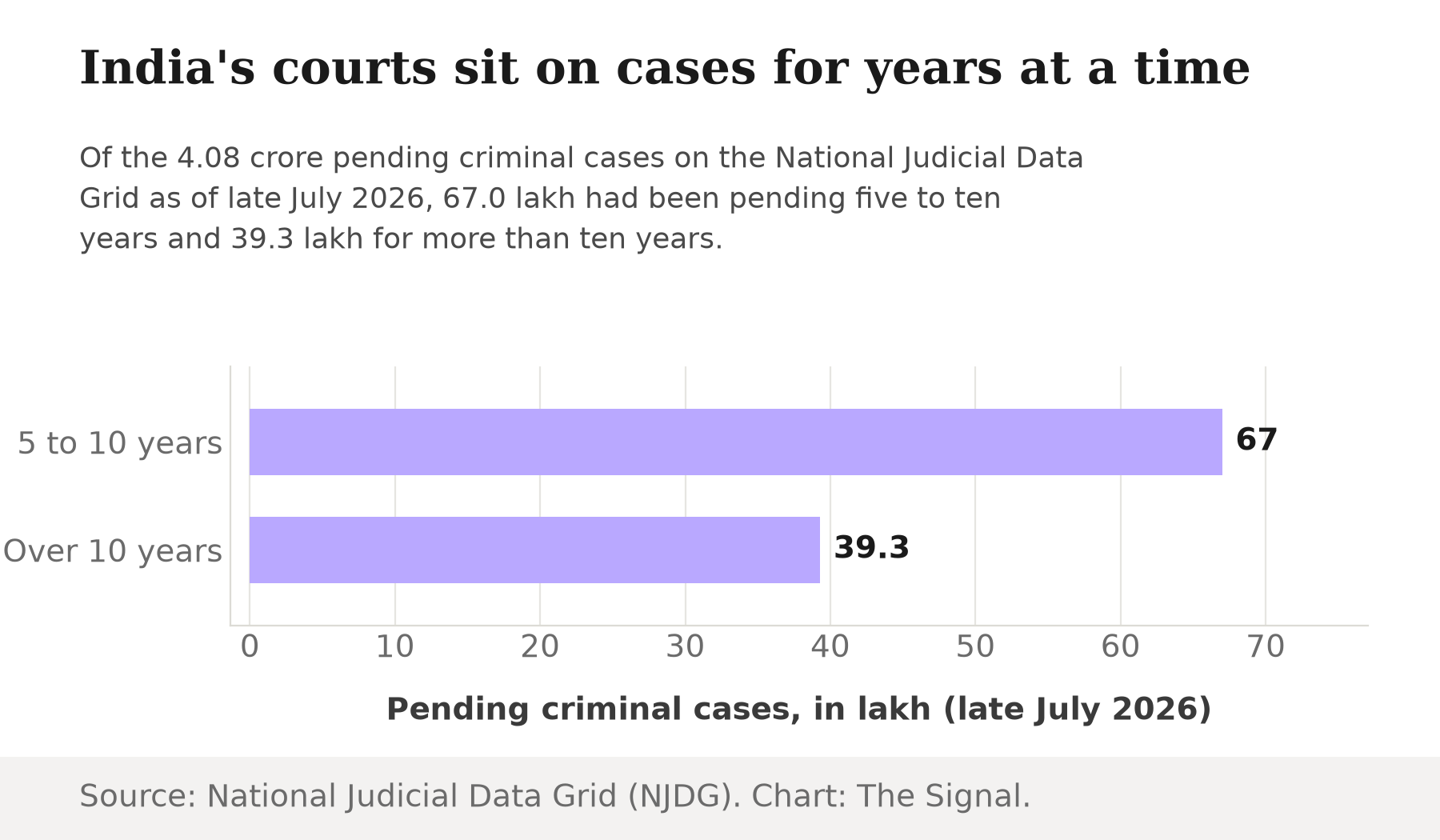
The mechanism is not mysterious. India's courts had 4,08,31,469 pending criminal cases as of the National Judicial Data Grid's late-July 2026 update, of which 67,00,604 had been pending five to ten years and another 39,26,738 for more than a decade. A system moving that slowly cannot sort the accused from the convicted fast enough to keep custody proportionate to guilt. It sorts them slowly, and prison is where people wait while it does.
Understaffing is a direct part of that mechanism, and it is worse in Punjab than in Delhi. As of 1 December 2025, Punjab's district and subordinate courts had 106 judicial-officer vacancies against a sanctioned strength of 811 posts, a 13.1% vacancy rate, while Delhi's had 57 vacancies against a sanctioned strength of 897 posts, a 6.4% vacancy rate. Punjab is trying to clear its backlog with roughly twice Delhi's share of judge posts sitting empty.
The honest objection
The strongest case for the drug-crisis reading is that Punjab's narcotics numbers are genuinely unusual, not just large in absolute terms. Punjab logged the third-highest NDPS case count in the country in 2023, behind Kerala and Maharashtra, but its rate of 37.6 cases per lakh population, and 25.3 per lakh for trafficking specifically, was the highest of any state. A state with the country's worst trafficking rate should, on any reasonable account, show unusually high incarceration. That case is real, and it is not something this piece disputes.
But it explains why Punjab's police make more narcotics arrests. It does not explain why so few of the people arrested have been convicted of anything, or why Delhi, which has no comparable drug-trafficking problem, shows an even higher undertrial share and the worst prison overcrowding in the country. If narcotics enforcement alone drove Punjab's numbers, its custody math should look different from a Delhi jail holding a mix of ordinary criminal cases and no drug epidemic behind it, but it looks the same. Both states run on the same undertrial math, which points at capacity and process, not at what the original arrest was for.
The Signal
Punjab's drug numbers are real, and Delhi's overcrowding has nothing to do with narcotics at all, yet both states show the same signature: most of the people inside are waiting, not serving a sentence. What they share is not the crime. It is a justice system that arrests faster than it tries. Watch the ratio, not the headline count. If Punjab or Delhi's undertrial share starts falling relative to convicts, cases are actually clearing. If the country's pending caseload keeps growing while the "1 in 250" rate for young men holds steady or climbs, the prison is doing the court's waiting for it. A cell is not a punishment until a judge says so. For most of the people inside these two states' prisons right now, no judge has.
Reporting basis: national and state-level prisoner counts, custody status, age breakdowns and jail-occupancy figures are all from NCRB's Prison Statistics India 2024 report (Ministry of Home Affairs), the newest edition of that annual series, as of 31 December 2024. Pending-case figures are from the National Judicial Data Grid, the e-Committee of the Supreme Court of India's live case-pendency dashboard, as of its late-July 2026 update. Punjab's 2023 NDPS Act case data are as reported by The Tribune, citing NCRB's Crime in India 2023 report. The "1 in 250" incarceration rate for young men in Punjab and Delhi is Data For India's own analysis of NCRB and Census/RGI population data, a single source for that specific rate. The undertrial-share percentages for Punjab, Delhi and the national total are The Signal's calculations from NCRB's state-wise convict and undertrial counts.