
Read the last year of headlines on the India-China border and the story is de-escalation. India and China completed disengagement of their forces at the Depsang Plains and Demchok in eastern Ladakh in October 2024, ending a four-and-a-half-year military standoff that began with the 2020 Galwan clash. Diplomacy kept moving after that. India and China held the 24th round of Special Representatives talks on the boundary question in New Delhi on 19 August 2025, National Security Advisor Ajit Doval hosting Chinese Foreign Minister Wang Yi. And in its own account of the year, India's Ministry of Defence says 2025 saw reduced deployment levels of the Chinese People's Liberation Army, both opposite the Northern borders and in its traditional training areas. Four years after Galwan, the standoff finally looks like it is winding down, and this time it is New Delhi's own ministry saying so.
It is worth slowing down on that. The drawdown is real. But look at what India did with its own money and its own machinery while the drawdown was happening, not just what China stopped doing. In the same twelve months the Ministry of Defence was describing a lighter Chinese posture, India's defense budget hit a record, its capital spending on the armed forces was used down to the rupee, and its border-road agency logged its highest-ever expenditure. A country that believed the reduction was durable would have some room to ease off. India spent 2025 like it had none.
What the drawdown actually was
Start with the number the Ministry of Defence itself put on the page. Before 2025's reduction, a November 2024 US Department of War assessment, reported by The Tribune, found the PLA had deployed 1.2 lakh troops along the LAC, with more than 20 combined-arms brigades still in forward locations across the western, middle and eastern sectors. A year later, the Ministry of Defence's Year End Review 2025 states that the PLA maintained 10 Combined Arms Brigade size forces opposite India's Northern borders, plus another 10 in tactical and operational depth and training areas.
Forward-deployed Chinese brigades roughly halved in a year, by India's own count.
| Snapshot | Combined-arms brigades in forward positions |
|---|---|
| November 2024 (US assessment, via The Tribune) | More than 20 |
| December 2025 (India's Ministry of Defence) | 10 |
Source: The Tribune, citing a November 2024 US Department of War assessment; Ministry of Defence, Year End Review 2025.
That is not a token gesture. Going from more than 20 forward brigades to 10 is a real cut, and it lines up with the diplomatic calendar: disengagement at two friction points in October 2024, then a full year of talks culminating in the August 2025 Special Representatives round. The Ministry of Defence had no reason to describe a smaller PLA footprint if the reduction had not happened, so its account of a genuine drawdown deserves to be taken at face value.
That account is not only Delhi's. China's own Ministry of National Defense confirmed in December 2024 that the two militaries were "comprehensively and effectively implementing" the October 2024 disengagement resolution, its spokesperson Zhang Xiaogang describing "steady progress" on the border situation. Beijing did not put a brigade count on the record the way India's Ministry of Defence later did, but it is an independent Chinese-side acknowledgment that the pullback process was real and under way, not a claim resting on Indian and US sourcing alone.
The money did not follow the troops down
Here is where the story stops being simple. Union Budget 2025-26, presented in February 2025, allocated a record ₹6.81 lakh crore to the Ministry of Defence, a 9.53% increase over the prior financial year, including ₹1.80 lakh crore under the Capital Budget of the Armed Forces. That budget was set after the Depsang and Demchok disengagement was already public knowledge. It did not shrink to reflect a lighter Chinese posture. It grew to a record, up from the Rs 6,21,940.85 crore the Ministry of Defence had been allocated the previous year, in the Regular Union Budget for FY2024-25, an increase of roughly ₹59,000 crore in a single year.
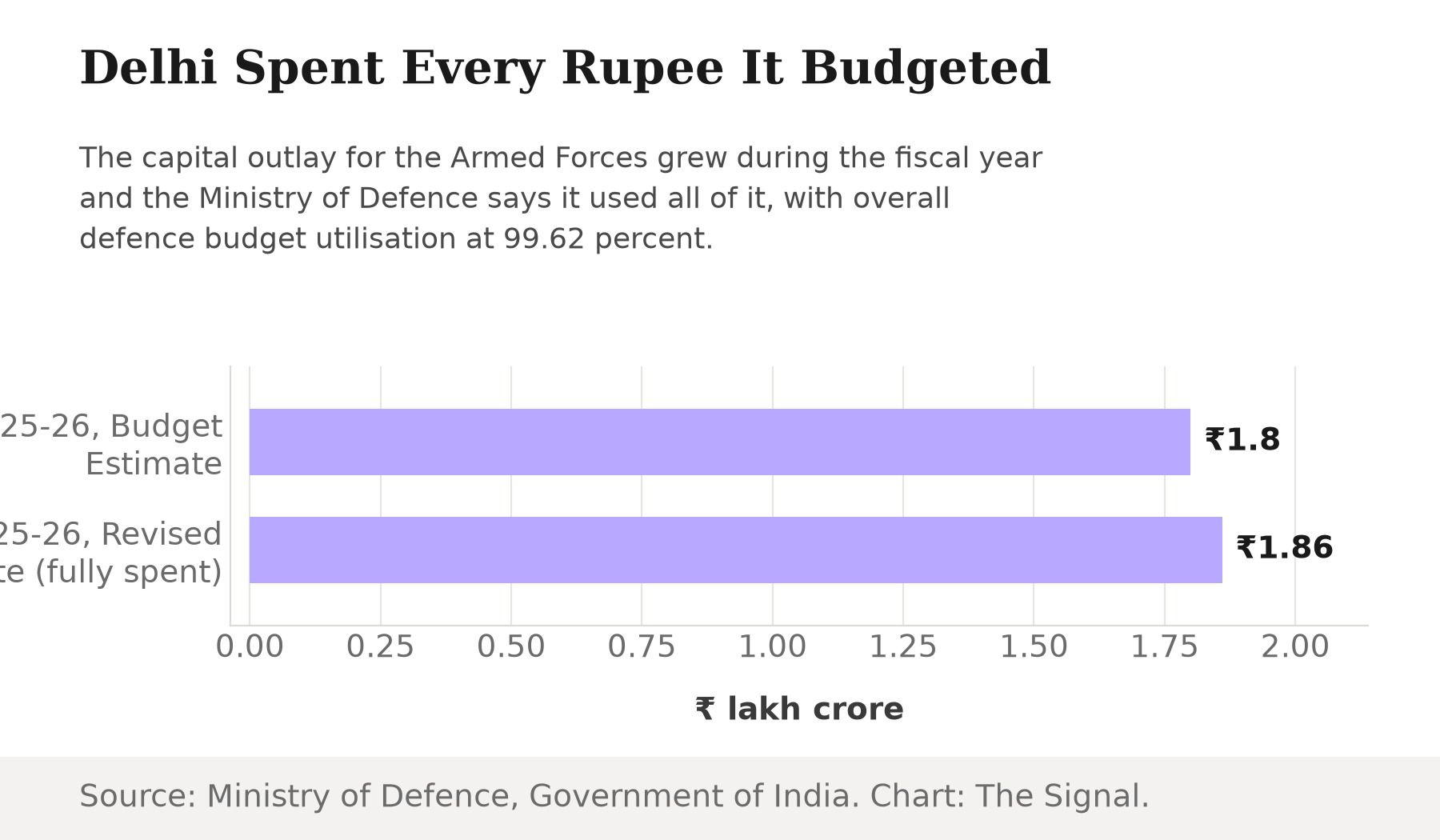
Source: Ministry of Defence, Union Budget 2025-26 allocation; Ministry of Defence, capital outlay utilisation FY2025-26, via Press Information Bureau. Chart: The Signal.
The follow-through matters as much as the headline number. The Ministry of Defence reports that it fully utilised its ₹1.86 lakh crore capital outlay for the Armed Forces in FY2025-26 at the revised estimates stage, continuing complete utilisation from FY2024-25, with overall defence budget utilisation at 99.62% against the final allocation. The capital line did not just get approved at a record level in February 2025. It grew again over the course of the year, from ₹1.80 lakh crore budgeted to ₹1.86 lakh crore at the revised stage, and the ministry says essentially all of it was spent. That is the behavior of a buyer who expects to keep needing the hardware, not one winding down a modernisation drive because the other side pulled back.
Border infrastructure did not get the memo either
The clearest single data point sits with the agency that builds the roads, not the ministry that buys the equipment. The Press Information Bureau reports that the Border Roads Organisation posted its highest-ever expenditure of ₹16,690 crore in FY2024-25, and that its Union Budget allocation was raised further, from ₹6,500 crore to ₹7,146 crore, for FY2025-26. BRO spent more than double the ₹6,500 crore Parliament had originally approved for FY2024-25, and Parliament then gave it a higher starting budget again the following year.
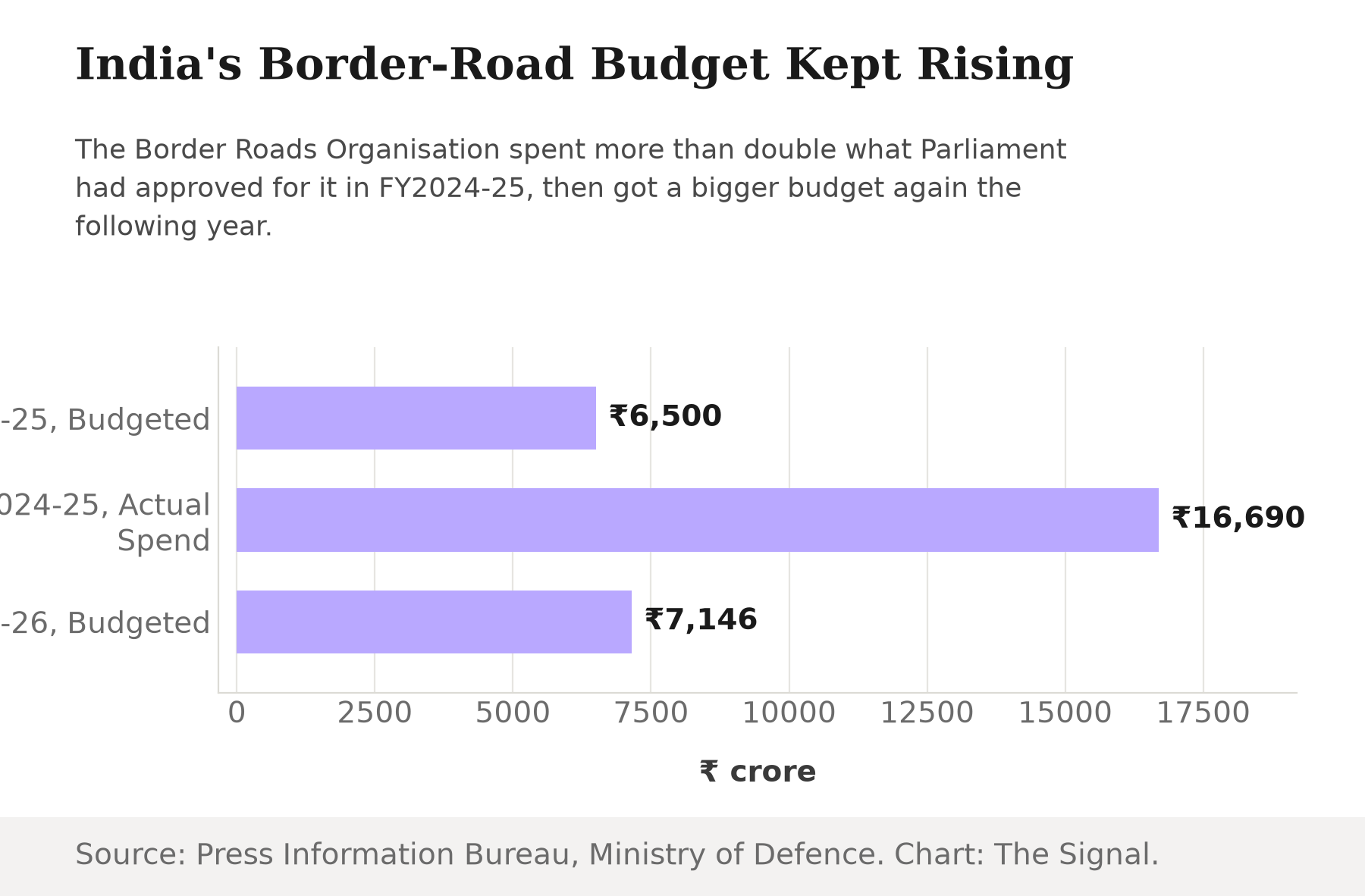
Source: Border Roads Organisation press note, Press Information Bureau. Chart: The Signal.
Roads, unlike troop rotations, are not something a country ramps down quickly even if it wanted to: a mountain highway or an all-weather tunnel takes years to finish once started, and BRO's FY2024-25 outlays were largely locked in before the Depsang-Demchok deal closed. But the FY2025-26 allocation was set after that deal, after a year of talks, and after the ministry's own description of a lighter Chinese deployment. It still went up.
The honest objection
The strongest case against reading any of this as skepticism toward China's drawdown is that Indian defense and infrastructure budgets simply do not track troop counts on a one-year lag. Budgets are drafted many months ahead of the fiscal year, modernisation programs run on multi-year procurement cycles regardless of any single adversary's posture, and BRO's mandate covers roads facing Pakistan and internal connectivity needs, not just the China front. A rising budget in the same year as a Chinese drawdown could simply be two unrelated trends that happen to share a calendar.
That case is fair, and it is likely true of at least some of the increase. But it does not explain the specific pattern here: every major line, the total defense allocation, the capital outlay actually spent, and the border-road budget, moved in the same direction, at the same time, to a record, in the very year India's own Ministry of Defence was describing a smaller PLA footprint. If the reduction were seen as durable, the ordinary expectation would be some slack somewhere. There is none in the numbers India has published about itself.
The Signal
None of this contradicts the Ministry of Defence's account of a real Chinese drawdown. Ten forward brigades instead of more than 20 is a meaningful change, and the diplomatic track behind it, from the 2024 disengagement to the 24th round of Special Representatives talks in 2025, is genuine progress after Galwan. What it contradicts is the idea that India is treating the reduction as settled. A government confident the other side had permanently thinned its forward presence would have some fiscal room to show for it. Instead, every number India controls, the total defense budget, the capital it actually spent, and what it paid to build roads to the border, went to a record in the same year the PLA's own footprint shrank. India is not arguing with the Ministry of Defence's numbers on China. It is just not betting its own budget on them holding.
Reporting basis: the disengagement at Depsang and Demchok and the 24th round of Special Representatives talks are from the Government of India's All India Radio News Services Division, two separate reports covering distinct events roughly ten months apart. The November 2024 estimate of more than 20 forward Chinese combined-arms brigades is a US Department of War assessment, as reported by The Tribune, and rests on that single relay. The 2025 count of 10 forward brigades and 10 more in depth and training areas is from the Ministry of Defence's own Year End Review 2025. China's confirmation that the disengagement resolution was being implemented is from the Chinese Ministry of National Defense's own December 2024 press conference transcript, published on its official China Military Online site. The Union Budget 2025-26 allocation to the Ministry of Defence, the prior year's Regular Union Budget 2024-25 allocation, and the FY2025-26 capital-outlay utilisation figures come from three separate Ministry of Defence releases via the Press Information Bureau, covering the two budgeted years and the actually-spent stage. The Border Roads Organisation's expenditure and allocation figures are from a Press Information Bureau press note. The characterisation of forward brigades as roughly halved, of BRO's actual spend as more than double its original FY2024-25 allocation, and of the year-on-year defense budget increase in absolute rupees, are The Signal's calculations from those figures.