On September 4, 2026, nine employee associations at ISRO centres, representing thousands of staff under the Department of Space, sent a joint written representation to Chairman V Narayanan asking for written clarity on where the space privatisation programme is headed. It was the first such formal move since the government began opening the sector to private industry six years ago. The same week, ISRO was preparing its return to flight with the GSLV-F17/EOS-05 mission. The same day, Chairman Narayanan went public to defend the private-sector shift, arguing the space economy has to grow because ISRO alone cannot meet the country's needs. Read only the headlines and this looks like routine friction: a workforce anxious about change, a chairman reassuring them.
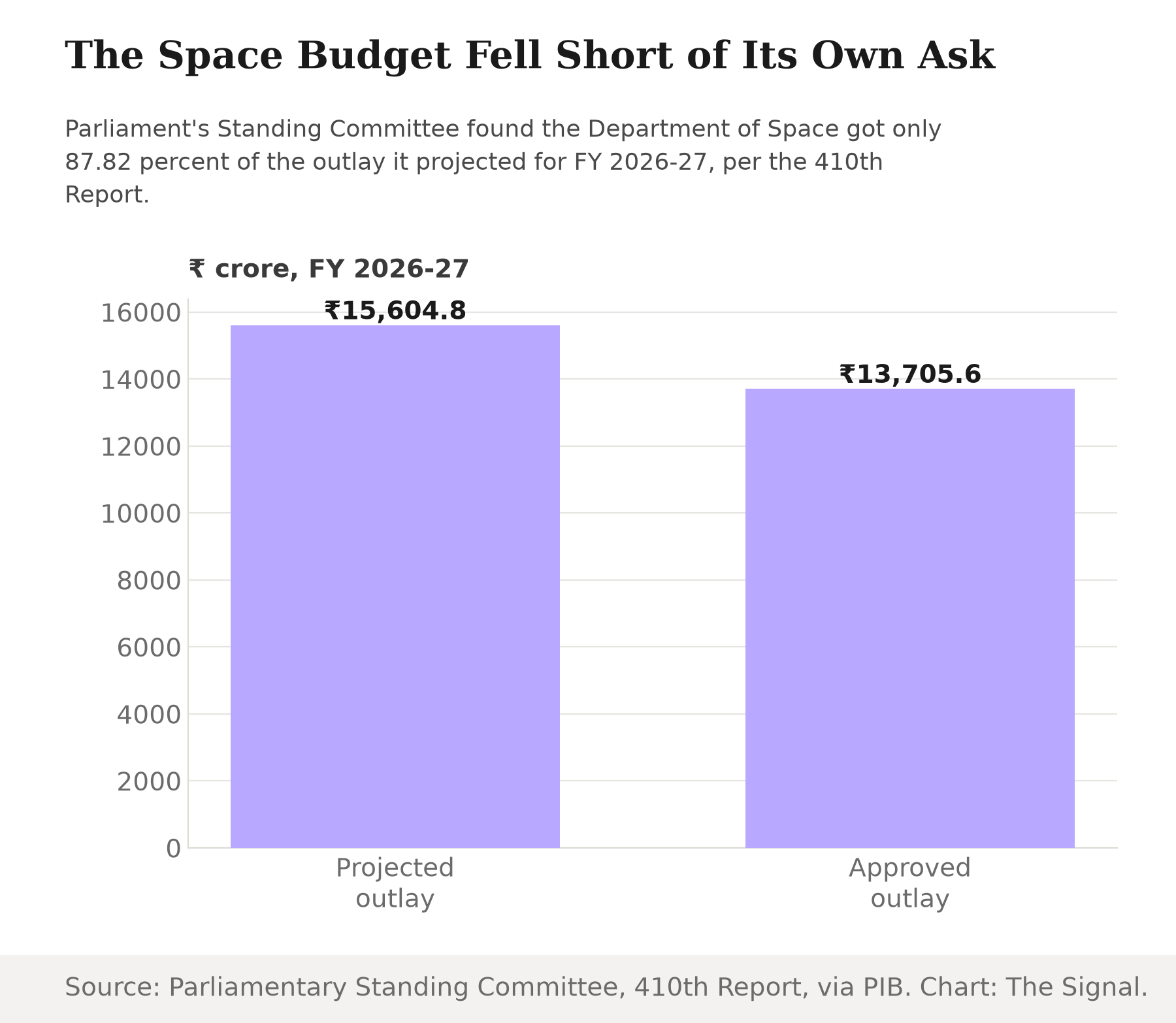
Parliament's own committee found the space budget got 88 percent of what it asked for.
It is worth slowing down on that reassurance. The written representation did not come from outsiders skeptical of privatisation; it came from the nine associations representing the people who are supposed to carry the policy out, and it landed the same week the numbers show the institution meant to run that transition is being funded less, not more.
What the staff are actually objecting to
The nine associations did not ask ISRO to reverse course. Their written representation objects to a specific outcome: a policy that reduces ISRO to a "residual R&D boutique" while the realisation of the country's launch vehicles and the operation of its launch infrastructure pass out of public hands. That fear is precise: not that private firms enter the sector, but that ISRO itself is left holding research work while manufacturing and operations, the parts of the business that generate revenue and jobs, move elsewhere without ISRO staff ever being told the plan in writing.
The government's own public statements support the direction the associations are worried about, even as officials frame it as necessary growth. IN-SPACe chairman Pawan Goenka told a media summit in late August 2026 that ISRO will not manufacture any launch vehicles going forward, with that work passing entirely to the private sector or public sector undertakings, as part of a push meant to grow the Indian space sector from about $9 billion to $44 billion by 2033. Chairman Narayanan's own defence leans on the same logic: India currently operates 56 satellites against a requirement for hundreds, so the sector has to grow beyond what one state agency can build alone. Both officials are describing the same shift the associations flagged. The disagreement is not about facts. It is about whether ISRO's staff get a written say in how it happens.
The transfer has already started
None of this is hypothetical policy still on paper. As of August 12, 2026, NSIL had signed 118 Technology Transfer Agreements conveying 83 ISRO and Department of Space technologies, including the SSLV, to Indian industry, and IN-SPACe confirmed it is taking forward the planned transfer of PSLV and LVM3 technology as well.
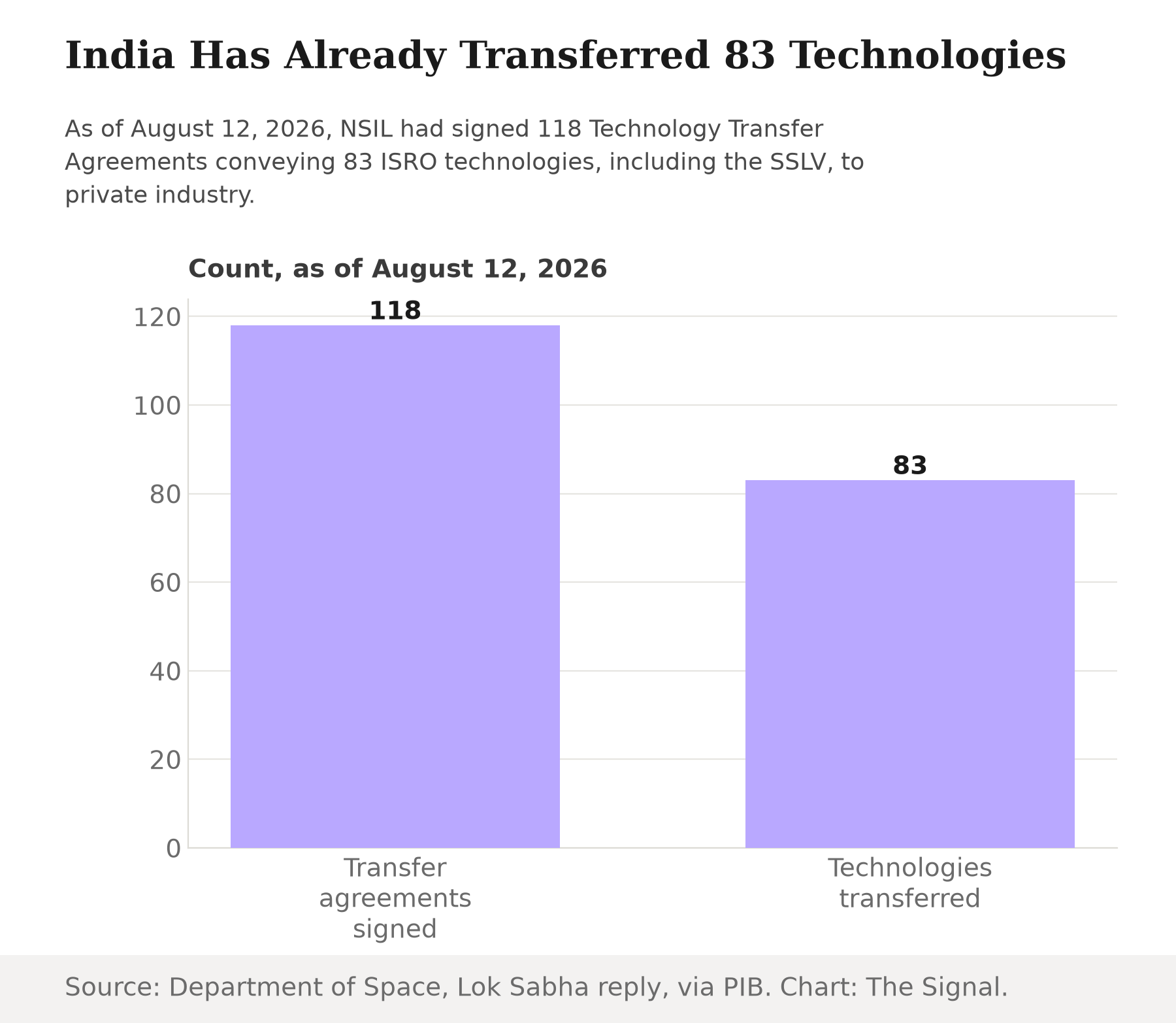
One of those agreements shows how long the runway actually is. Hindustan Aeronautics Limited signed a Technology Transfer Agreement with ISRO, IN-SPACe and NSIL on September 10, 2025 for SSLV production, the 100th such agreement, under which HAL absorbs the technology over 24 months before entering a 10-year production phase. A year on from that signing, HAL is still inside its absorption window. The scale of paper transfer is real. Actual production handed over is still small and slow by design.
The money is not following the rhetoric
This is where the associations' specific fear, a shrinking ISRO next to a growing private mandate, gets a number attached to it. The body coordinating that private-sector build-out is IN-SPACe, and its own budget has moved the opposite way from the ambition officials describe for it.
| Budget line | BE 2025-26 | RE 2025-26 | BE 2026-27 |
|---|---|---|---|
| IN-SPACe allocation | ₹70.00 crore | ₹45.00 crore | ₹43.00 crore |
| NSIL extra-budgetary investment support | ₹1,030 crore | ₹1,030 crore | ₹1,403 crore |
The agency meant to authorise, promote and referee the private sector's entry is getting a smaller line item every cycle, even as the entity meant to route capital toward that same private sector gets more. Parliament's own Standing Committee on Science and Technology flagged the wider pattern, finding the Department of Space received only about 87.82 percent of the ₹15,604.80 crore outlay it had projected for FY 2026-27, ending up with ₹13,705.63 crore, and noting that IN-SPACe's own allocation for BE 2026-27 sits below even the revised 2025-26 level. That is a parliamentary committee, not a disgruntled union, reaching the same conclusion the nine associations did: the institutions carrying out privatisation are not resourced to match the scale of what officials say they are building.
The pace does not match the pitch either
The staff associations' letter and the funding numbers both point to the same gap between announced ambition and what is actually moving. The government told the Rajya Sabha on August 13, 2026 that Indian private companies are slated to launch only two commercial rockets in FY 2026-27, with the FY 2027-28 manifest not yet approved though more than six launches are expected, out of 113 IN-SPACe authorisations granted to 52 non-government entities, only 18 of them startups.
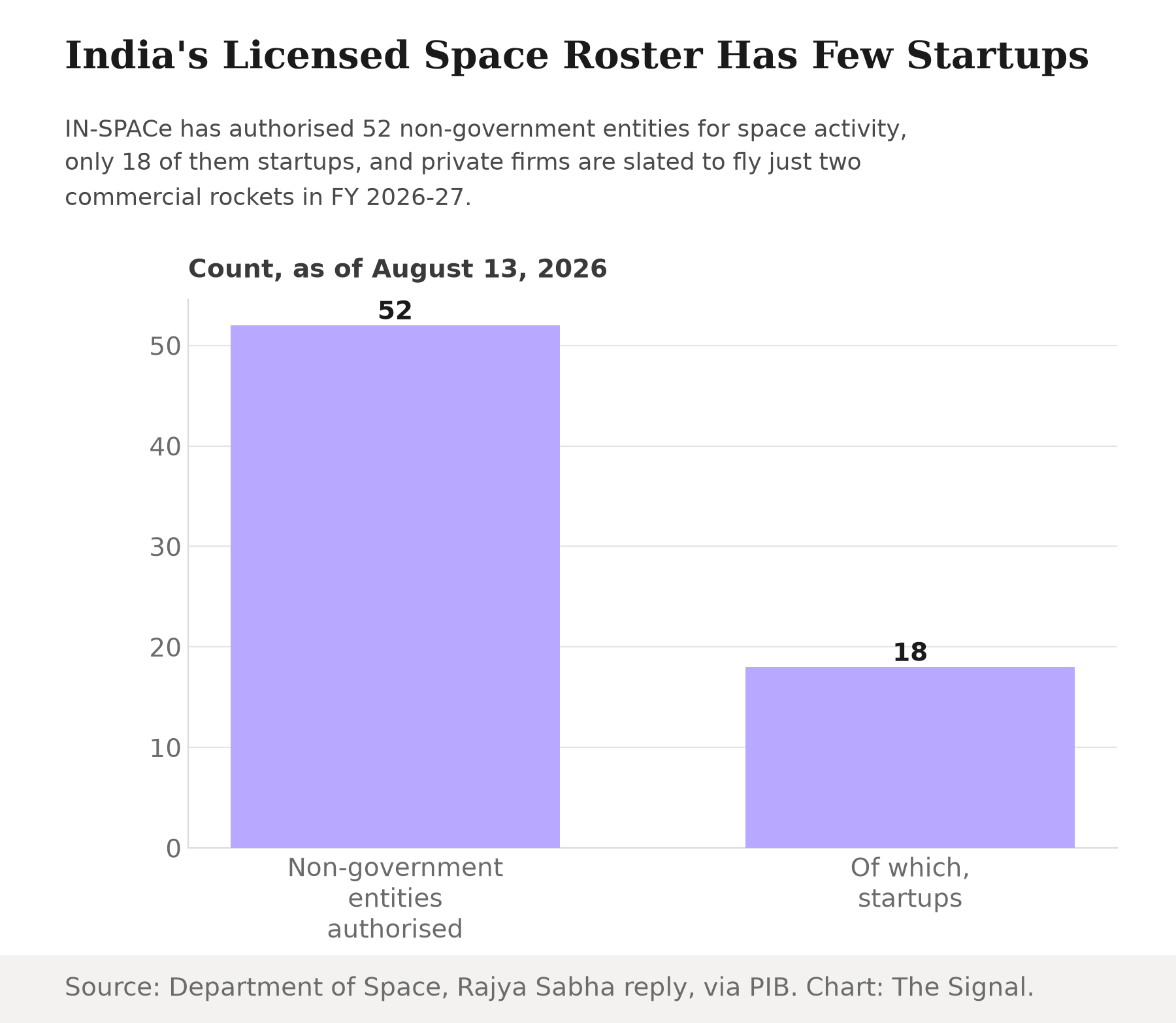
A $9 billion to $44 billion growth story and a launch-vehicle handover that removes ISRO from manufacturing entirely are both being built on a base of two private commercial launches a year. That is not proof the strategy is wrong. It is proof the strategy is still mostly paperwork, agreements signed and authorisations granted, well ahead of hardware actually leaving the pad.
The honest objection
The strongest case against reading any of this as crisis is timing. Technology transfer of this complexity is not supposed to move fast: HAL's own SSLV agreement builds in a two-year absorption period before a decade of production, which argues privatisation was always going to look thin on launches in its early years regardless of how well it is funded. And ISRO has its own reasons to want private capacity built out carefully rather than rushed. The agency's first mission of 2026, the PSLV-C62/EOS-N1 launch, failed on January 12, and ISRO went without a successful launch for nearly seven months until targeting a September 2026 return to flight with GSLV-F17/EOS-05. An agency mid-recovery from its own launch failure has a real argument for not handing untested private manufacturers the whole launch-vehicle line overnight.
That case explains a slow handover. It does not explain a shrinking IN-SPACe budget. A deliberately gradual technology transfer and a starved coordinating body are different problems, and conflating them is exactly what leaves ISRO's own staff writing letters asking which one they are actually living through.
The Signal
Two things are true in the same week and neither one is being said out loud together. The people who must execute India's space privatisation are asking, in writing, what the plan actually is. The money behind the body meant to run that plan is falling, not rising, even as officials describe a nearly fivefold expansion of the sector by 2033. A workforce letter is easy to read as internal politics. But it is much harder to wave away a parliamentary committee finding the same funding shortfall. Watch IN-SPACe's next budget cycle, not the next speech: if its own allocation keeps falling while the private launch manifest stays in the single digits, the associations' fear of a "residual R&D boutique" will have moved from a complaint to a description.
Reporting basis: the ISRO staff associations' written representation and its wording are as reported by The Hans India and The Federal, both carrying direct quotes from the letter, which is the sole documented source for its contents. Chairman V Narayanan's public response is per IANS, as carried by The Hans India. IN-SPACe chairman Pawan Goenka's remarks on launch-vehicle manufacturing and the sector's growth target, and the account of ISRO's January 2026 launch failure and its return to flight, are per Business Standard's reporting. The technology-transfer figures, the private-launch and authorisation counts, and the Department of Space's budget shortfall are all from the Department of Space's written replies to Parliament and the Parliamentary Standing Committee's 410th Report, via Press Information Bureau releases. The HAL-ISRO technology transfer agreement is per DD News, Government of India. The IN-SPACe and NSIL budget figures are from the Union Budget's Notes on Demands for Grants for the Department of Space. The comparison table drawing IN-SPACe's allocation and NSIL's investment support together across three budget cycles is The Signal's own compilation from that single budget document.