On 1 September 2026, the Supreme Court got seven states, Chhattisgarh, Karnataka, Madhya Pradesh, Maharashtra, Sikkim, Tamil Nadu and West Bengal, to agree to formally raise the retirement age of their subordinate judicial officers from 60 to 62. It also asked every remaining state and Union Territory to decide within two weeks and file compliance reports. Read quickly, it looks like the country's top court has finally moved to fix a judiciary starved of staff: keep experienced officers on the bench two years longer, and the shortage eases.
It is worth slowing down on that. The Supreme Court did not order those two extra years. It asked for them, and it can only ask, because the retirement age of a state's judicial officers is not the Supreme Court's rule to write.
A request, not a ruling
Article 309 of the Constitution gives that power to the Governor of each state: rules on recruitment and conditions of service, including retirement age, for state services rest with the state government until its legislature enacts a law of its own. The Supreme Court sits above every High Court and every subordinate court in the country. On this one question, whether a district judge in Karnataka works to 60 or 62, it has no rule-making authority at all.
That is why the process has moved in stages instead of a single order. On 22 July 2026 the Supreme Court passed only an interim measure: officers due to retire at 60 could continue to 61, while the Court issued notice to the Union, every state and UT, and every High Court, asking them to take a call in consultation with their jurisdictional High Court. Six weeks later, seven states said yes to 62. The rest now have a two-week clock and a compliance report to file, not a verdict to obey.
Seven states have agreed. The Supreme Court cannot compel the rest.
Every other state and UT can simply decline, and at the same 1 September hearing, ten of them, Punjab, Haryana, Rajasthan, Kerala, Manipur, Meghalaya, Nagaland, Uttarakhand, Uttar Pradesh and Odisha, were on record doing exactly that, citing grounds including the added cost to the state exchequer. The Court was unmoved: it found no merit in the argument that raising the retirement age would create a financial burden. That answers the objection, not the objectors, who remain free to keep declining. The Court's remaining lever is the one built into its own order: keep asking, and require the states that have not yet agreed to file a compliance report within two weeks.
The number the age fix does not move
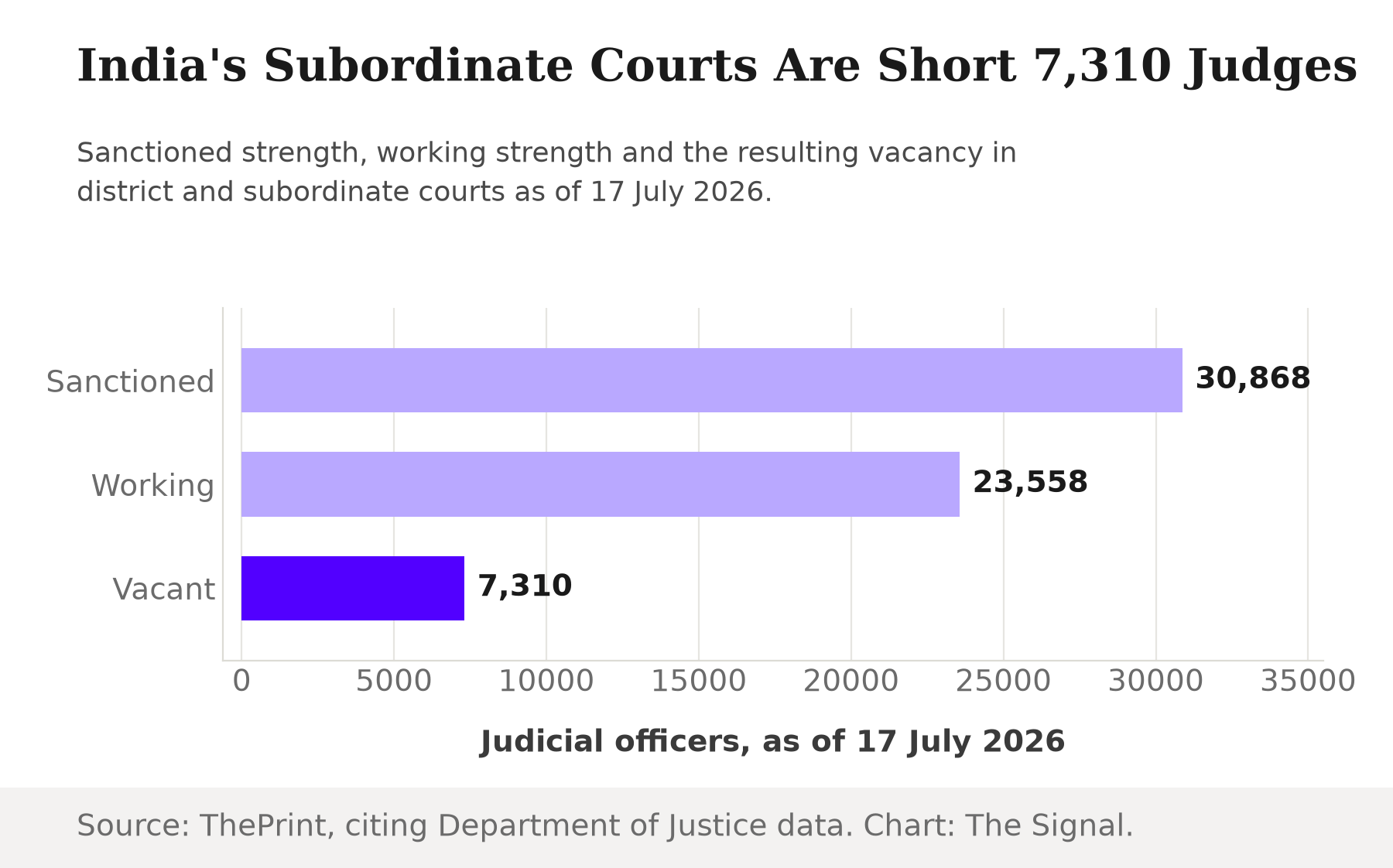
As of 17 July 2026, district and subordinate courts had a sanctioned strength of 30,868 judicial officers against a working strength of 23,558, a gap of 7,310 posts, or 23.68 percent. Karnataka's own vacancy rate is above 58 percent, the worst of any large state, which is a pointed detail given Karnataka is one of the seven that just agreed to the retirement-age change.
Raising the retirement age does not touch that number. It keeps officers already holding a post working two years longer; it adds nobody to the 23,558 currently working, and it does nothing to the 7,310 vacant seats. The fix and the problem are aimed at different parts of the same system: one is about exits, the other is about intake.
A shortage two governments already measured
The vacancy count has been getting worse even as the headline numbers moved around. In November 2024, the Law Minister told the Lok Sabha that more than 5,600 judge posts were vacant nationwide: 2 in the Supreme Court, 364 in the High Courts, and over 5,000 in the district and subordinate courts. Thirteen months later, the picture for the lower courts alone had a different shape.
Sanctioned posts grew nearly 5,000 in seven and a half months, faster than they could be filled.
| As of | Sanctioned posts (district & subordinate) | Vacant posts | Vacancy rate |
|---|---|---|---|
| 1 December 2025 | 25,886 | 4,855 | 18.8%* |
| 17 July 2026 | 30,868 | 7,310 | 23.68% |
The 18.8% figure for December 2025 is The Signal's calculation from the sanctioned and vacant figures in that row; the 23.68% figure for July 2026 is as reported.
Source: The Pioneer, relaying the Law Minister's Rajya Sabha reply; ThePrint, citing Department of Justice data.
In seven and a half months, the sanctioned strength of district and subordinate courts rose by nearly 5,000 posts, states creating capacity on paper, and the vacancy count rose with it rather than closing. Andhra Pradesh had already raised its own judicial officers' retirement age from 60 to 61, effective 1 November 2024, nearly two years before the Supreme Court's September 2026 push for a uniform 62. States were already moving on their own timelines, in their own direction, before the Court asked anyone to.
Long benches, short intake
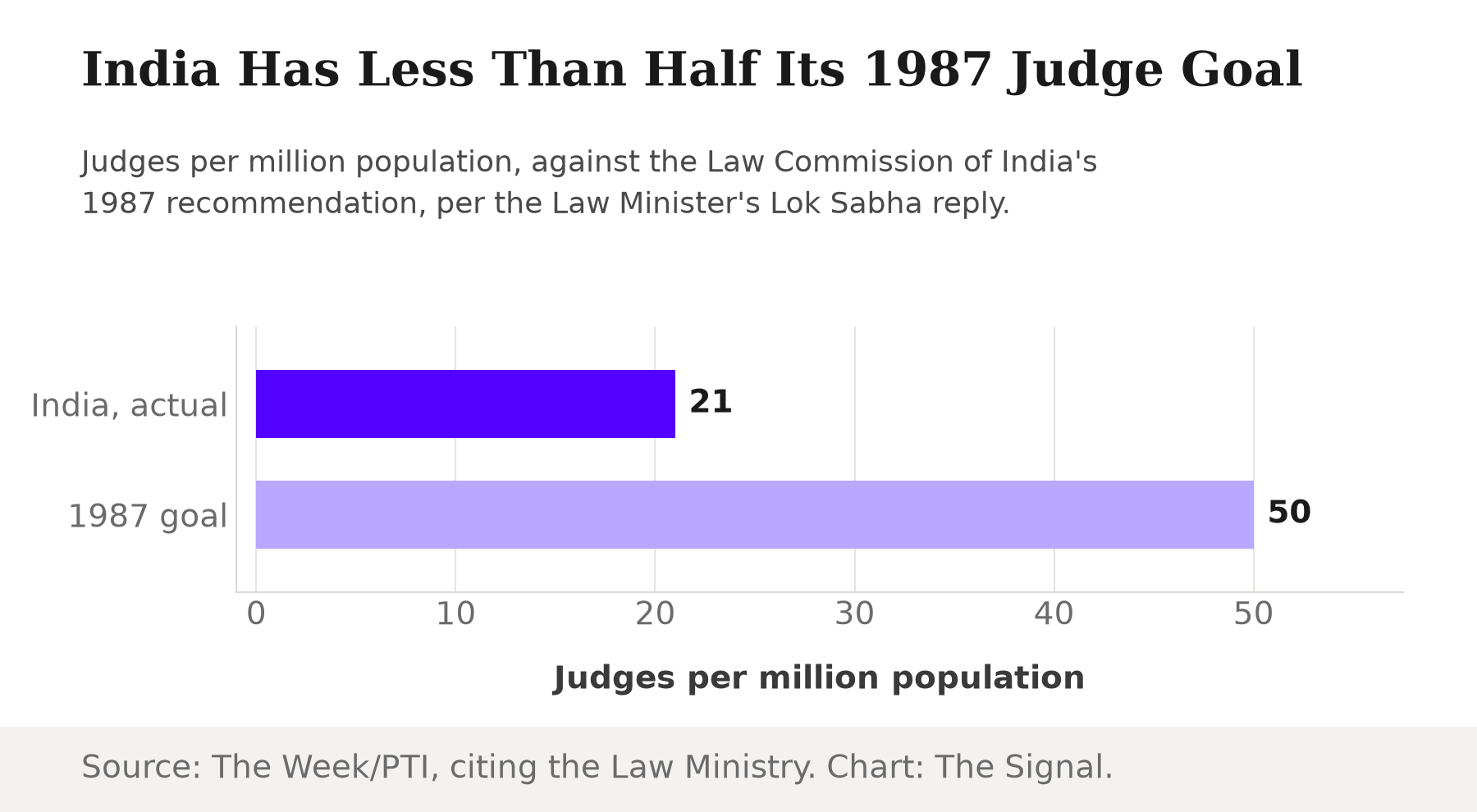
The retention fix sits on top of a deeper capacity problem. India has about 21 judges per million people, against the Law Commission of India's own 1987 recommendation of 50 judges per million, a benchmark the Law Minister cited in a Lok Sabha reply in December 2023, the last such figure on the record and now nearly three years old. Whatever the exact number today, a country running at roughly two-fifths of a target it set for itself in 1987 has an intake problem that two extra years of service cannot solve by itself.
The backlog that results sits overwhelmingly at the level the retirement-age order targets. As of 31 December 2025, 5.39 crore cases were pending across the Supreme Court, High Courts and district courts, and 4.76 crore of them, the bulk, were sitting in district and subordinate courts alone, against 63.66 lakh in the 25 High Courts.
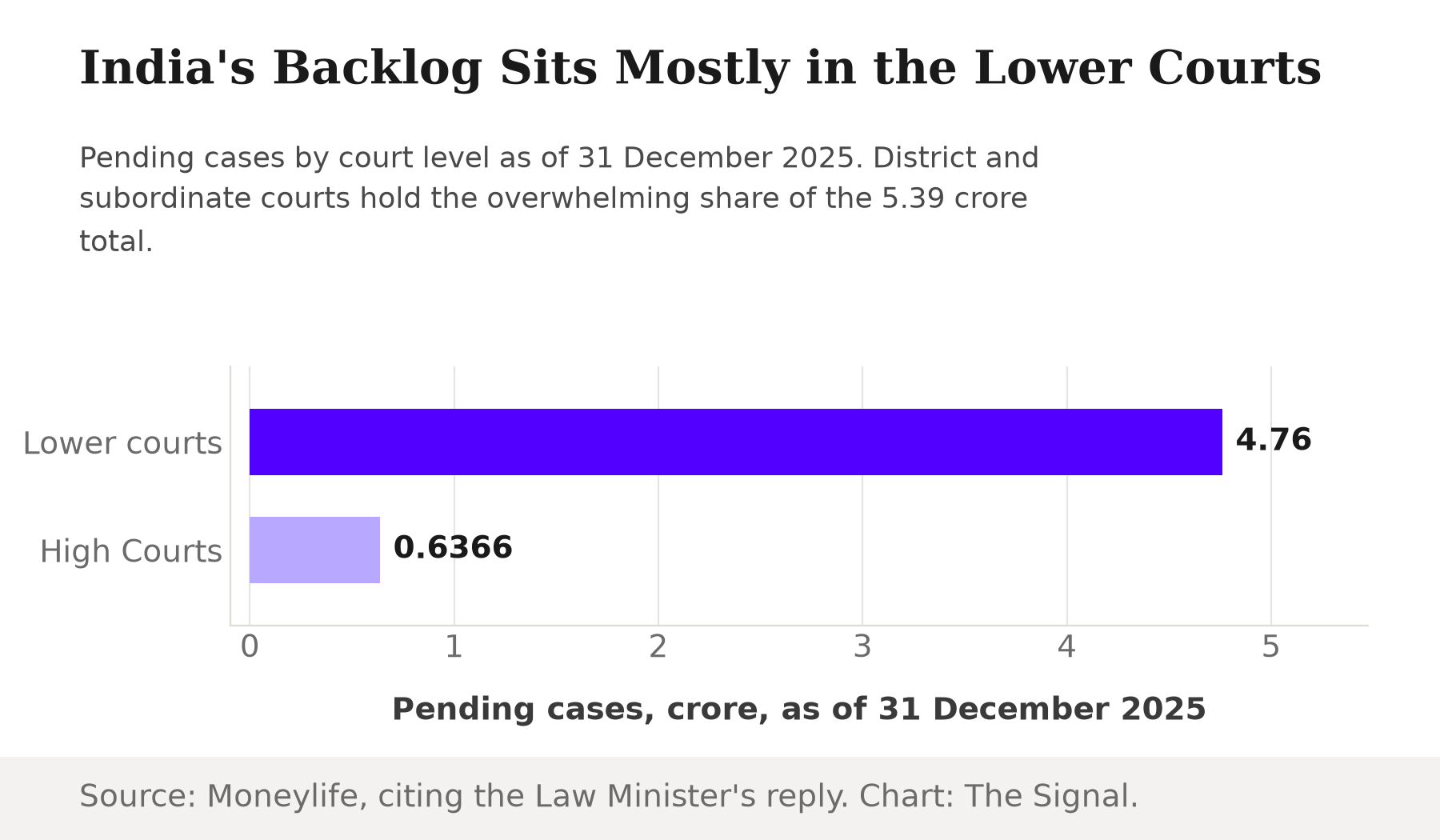
That is where the retirement-age push actually lands, the level with nearly nine-tenths of the country's case backlog and, per ThePrint's mid-2026 count, close to a quarter of its posts empty.
The honest objection
The strongest case for the retirement-age route is speed. Recruiting, training and seating a new judicial officer takes years: a state judicial service exam, an interview process, and time on the bench before an officer can handle a complex docket alone. Extending an officer already trained and already sitting adds usable capacity the moment the rule changes, no exam cycle required. On that view, raising the retirement age is not a substitute for recruitment, it is a bridge that buys time while recruitment catches up, and getting seven states to agree within six weeks of the interim order is real movement against a problem the courts have flagged for years.
That case holds for the officers already on the bench, but it does not reach the 7,310 seats with nobody in them. Extending a serving officer's tenure cannot fill a post that has no incumbent to extend, and every state's vacancy rate, from Karnataka's more than 58 percent down, is a measure of exactly that: seats, not people close to retiring. A bridge helps the traffic already on the road, not the lanes with no cars in them at all.
The Signal
The two-week clock the Supreme Court set on 1 September 2026 will produce a tally soon: some number of states will have agreed to 62, some will have stalled, and the Court's only tool for the holdouts will remain the same public request it has already made twice this year. Watch that tally, but watch the vacancy count more closely. If it is still near 7,310 once every state has answered, the retirement-age campaign will have succeeded on its own terms and left the actual shortage exactly where it was. The two problems only look like one because they showed up in the same court order.
Reporting basis: the 1 September 2026 order and the seven-state tally are per Bar and Bench's court reporting. The ten-state opposition tally and the Court's rejection of the financial-burden argument, from the same hearing, are per LiveLaw's court reporting. The 22 July 2026 interim order is per Akashvani News, All India Radio, which also reported Andhra Pradesh's 2024 retirement-age change. The district and subordinate court staffing figures for July 2026, including Karnataka's vacancy rate, are per ThePrint, citing Department of Justice data. The November 2024 nationwide vacancy figure is per Akashvani News and the December 2025 lower-court figure is per The Pioneer, each relaying a Law Minister's reply to Parliament. The case-pendency figures are per Moneylife, relaying a Law Minister's Lok Sabha reply sourced to the National Judicial Data Grid. The judges-per-million figure is per The Week's PTI wire report of a December 2023 Lok Sabha reply, the most recent such figure available. The Article 309 text is drawn from IndianKanoon's reproduction of the Constitution. The December 2025 vacancy rate and the sanctioned-post increase to July 2026 are The Signal's calculations from those figures.