On August 31, the United Nations Secretary-General presented a report to the General Assembly stating that global sea level rose 4.7 mm a year on average between 2014 and 2023, then jumped to a record 5.9 mm in 2024 alone, driven primarily by exceptional ocean warming. Measured over the longer 2012 to 2025 stretch, the annual average sits at 4.75 mm. That means the 2024 spike is not a one-year anomaly. It is the acceleration the report is built around. Read as a global bulletin, this is the story every climate report tells: the sea is rising, and rising faster than before.
It is worth slowing down on which places the report actually names. Nearly 770 million people, about 10 percent of the world's population, already live in coastal areas less than 5 metres above the high tide line, placing them at acute risk. Citing the World Meteorological Organization and the IPCC's sixth assessment, the same report projects that at least 0.5 metres of sea level rise is now unavoidable by 2100 even under a Paris Agreement-consistent emissions path, and a flood that used to arrive once a century is projected to hit at least once a year at more than half the world's tide gauge locations by 2100 under every scenario considered. That is the global ceiling. The report's sharper line is about who reaches it first, and how.
The UN measures Kolkata and Mumbai's exposure in people, not dollars.
In the low-lying deltas of South Asia, including Kolkata and Mumbai in India and Dhaka in Bangladesh, the report counts more than 14 million people at immediate risk of losing their homes to permanent inundation. It draws the contrast explicitly: in high-income coastal cities such as Miami, New York and Guangzhou, the same rising seas put $2 trillion to $3.5 trillion of financial and infrastructure assets at risk, assets that can be insured, relocated or hardened against. For Kolkata and Mumbai, the UN's own framing is blunter. The defining impact is not asset value on a balance sheet. It is people losing homes.
What Mumbai and Kolkata are actually facing
A 2025 peer-reviewed modelling study of India's major coastal cities finds that Mumbai and Kolkata face the highest flood risks of the cities studied, particularly under high emission scenarios. For Mumbai specifically, the same study's own projections put the city's sea level rise at 0.2 to 0.4 metres by 2100 under a low-emissions pathway, against 0.6 to 1.2 metres under a high-emissions pathway, a sixfold spread between the best and worst case that depends entirely on which emissions path the world actually takes.
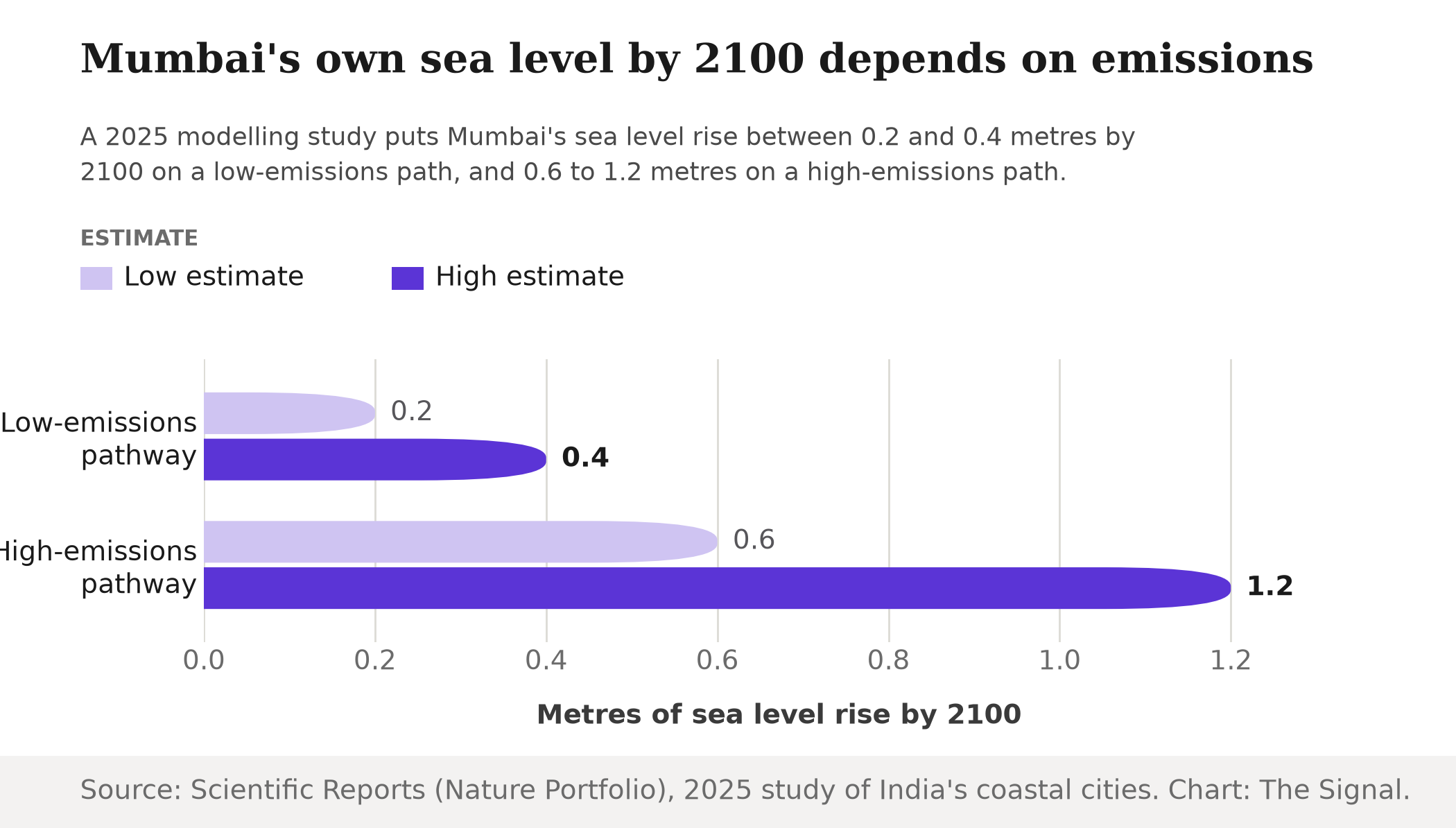
Source: Scientific Reports (Nature Portfolio), 2025. Chart: The Signal.
The global bill nobody is paying
Money is supposed to sit behind that exposure. It mostly does not. Developing states' adaptation finance needs are estimated at $310 billion to $365 billion a year, while the most recent tally of actual adaptation financing flows stood at just $26 billion, in 2023. That gap, using the report's own two figures, runs to $284 billion to $339 billion a year, our calculation from the numbers already cited. This is the global pool that Kolkata's and Mumbai's own coastal programs would, in principle, be able to draw on.
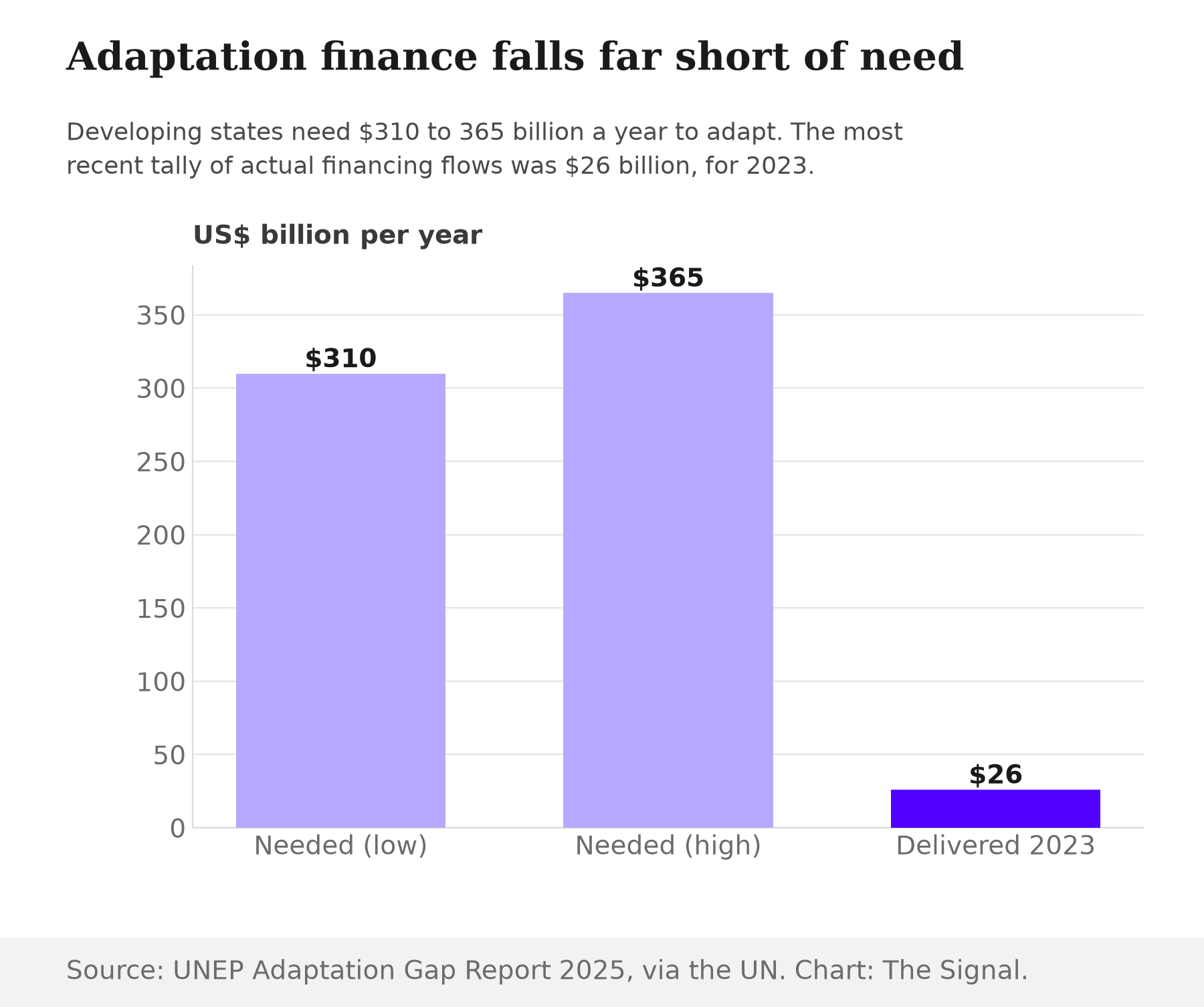
Source: UN Secretary-General's report on sea level rise (A/81/74). Chart: The Signal.
India's own bet on self-funded resilience
India is not simply waiting on that pool. India's own adaptation and resilience-related domestic spending rose from 3.7 percent of GDP in FY16 to 5.6 percent of GDP in FY22, a strategic pivot the government frames as self-funded resilience rather than dependence on international climate finance. That is a real and rising number, and it is the government's case for confidence: India is choosing to pay for its own adaptation rather than wait for a global fund that, on the UN's own accounting, is running more than ten times short.
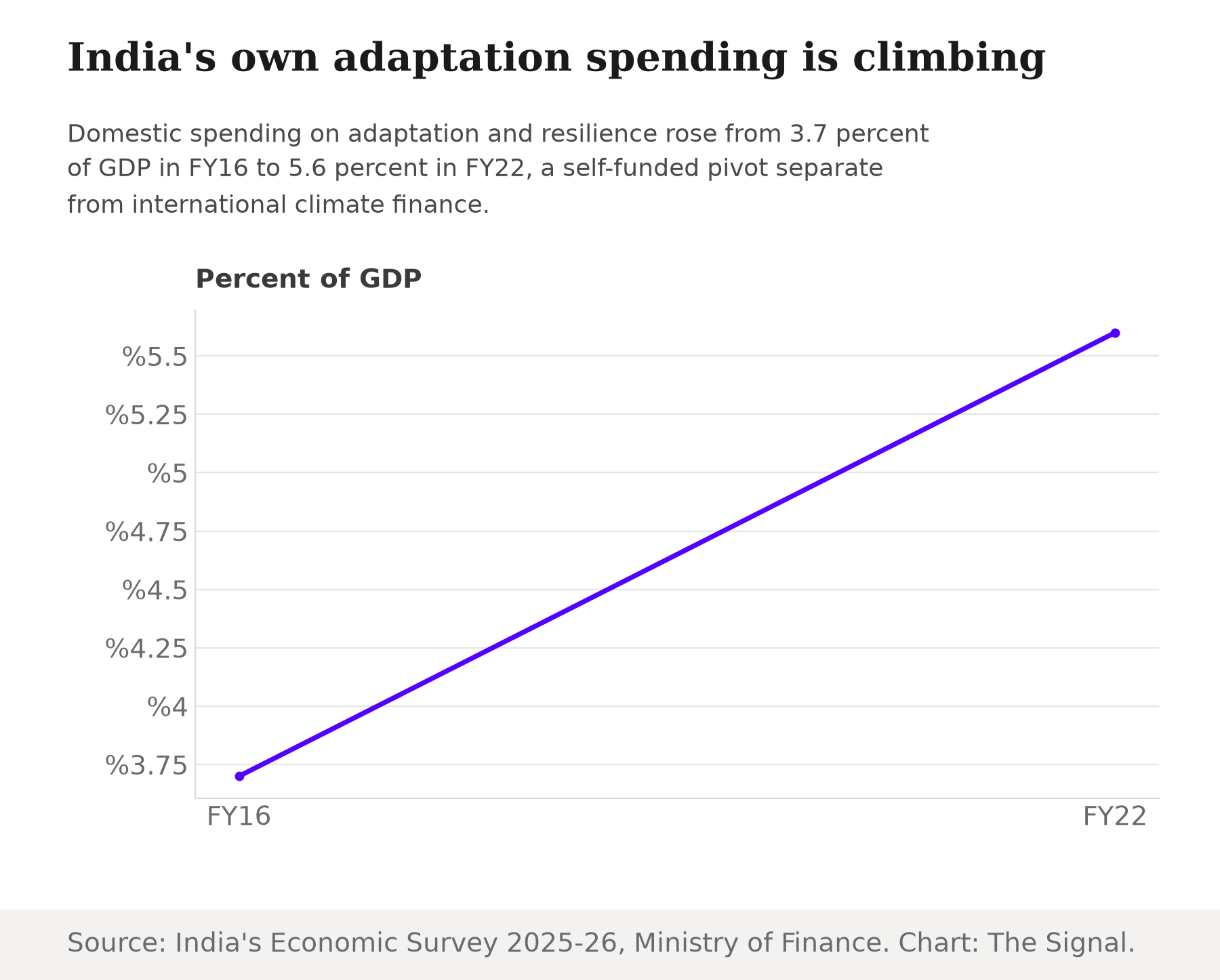
Source: India's Economic Survey 2025-26. Chart: The Signal.
What that money actually buys on the coast
A rising national spending share is not the same as a coastal defense budget for Kolkata or Mumbai specifically. The two named programs that do reach the coast are narrower than the exposure numbers above suggest.
Neither of India's flagship coastal programs is built as hard sea defense.
| Program | Backed by | Committed funding | Geographic scope | What it actually funds |
|---|---|---|---|---|
| MISHTI | Ministry of Environment, Forest and Climate Change | Mangrove restoration across approximately 540 sq km | 11 states and 2 union territories, over FY2023-24 to FY2027-28 | Mangrove habitat and livelihoods, not flood barriers |
| ENCORE | World Bank | $400 million multi-phase envelope, of which $180 million was committed in phase one | 8 coastal states including West Bengal | Beach and mangrove rehabilitation, pollution and erosion control |
Source: Press Information Bureau, Ministry of Environment, Forest and Climate Change; World Bank.
MISHTI, launched to run from FY2023-24, envisages developing mangroves across approximately 540 square kilometres spanning 11 states and 2 union territories over five years. It is an ecological and livelihoods program: mangroves buffer storm surge and slow erosion, but they are not designed to hold back a metre of permanent sea level rise on their own. The World Bank's ENCORE program, approved in April 2020, is a $400 million multi-phase financing envelope for India's coastal states, of which only $180 million was committed in its first phase, spread across eight states including West Bengal, aimed at protecting coastal populations from pollution, erosion and sea level rise through beach and mangrove rehabilitation. Sea walls and flood barriers do not appear in the World Bank's own description of what the money funds.
The honest objection
The strongest case against calling this a mismatch is that ecological buffers are a recognized, lower-cost first line of coastal defense, not a lesser one, and that a rising national adaptation-spending share need not show up inside two named flagship programs. State governments and municipal bodies may be funding drainage, embankments and cyclone shelters that this evidence does not capture. Both flagship programs are also mid-course: MISHTI's five-year window runs to FY2027-28, and ENCORE remains a multi-phase envelope with more of its $400 million still to be committed beyond the $180 million already in phase one.
That case holds up to a point, but it strains against the scale of what the UN report actually names. Even reading both programs generously, as first tranches rather than finished totals, approximately 540 square kilometres of mangrove restoration and $180 million of confirmed World Bank financing are set against a report that puts more than 14 million people in these specific deltas at immediate risk of losing their homes. Mangroves slow erosion; they do not stop a sea that the UN's own report says rose at a record 5.9 mm in 2024 alone. Nothing in either program's own description resembles the sea walls, storm barriers or managed retreat that a threat measured in millions of displaced residents, rather than dollars of insurable property, would seem to call for.
The Signal
The UN report's most consequential choice was not to say seas are rising. Every recent report says that. It was to measure Kolkata's and Mumbai's exposure the way it measures Dhaka's, in people who lose their homes, while measuring Miami's, New York's and Guangzhou's in dollars of assets at risk. That distinction has no matching line item yet in India's coastal budget: a mangrove program scaled in square kilometres and a World Bank envelope still half committed. Watch what happens to ENCORE's uncommitted balance and to MISHTI's mangrove hectares as their multi-year windows run out, and watch whether India's rising domestic adaptation share of GDP ever produces a hard-infrastructure program with Kolkata's or Mumbai's name on it, the way Miami's flood-protection dollars have their own line. A mangrove is not a sea wall. Until the money is counted the way the exposure now is, in the same units and at the same scale, more than 14 million people are named in a UN report that no budget yet matches.
Reporting basis: the global sea level figures, the coastal exposure counts, the Miami/New York/Guangzhou asset comparison and the adaptation finance gap all come from a single primary source, the UN Secretary-General's report to the General Assembly on sea level rise (A/81/74), which in turn cites the World Meteorological Organization, the IPCC's sixth assessment report and the UNEP Adaptation Gap Report 2025 for those specific figures. India's domestic adaptation spending is from the Ministry of Finance's Economic Survey 2025-26. The MISHTI program details are from a Press Information Bureau release by the Ministry of Environment, Forest and Climate Change, and the ENCORE program details are from the World Bank's own press release announcing it. Mumbai and Kolkata's flood-risk ranking and Mumbai's sea level projections are from a single 2025 peer-reviewed study in Scientific Reports. The adaptation finance gap range and the India-only chart figures are as reported in those sources; the dollar range of the global financing shortfall is The Signal's calculation from the UN report's own two cited figures.