Filed today, a labor certification or immigrant petition for a high skilled Indian professional faces a projected wait of up to 179 years in the EB-2 employment based category, according to a National Foundation for American Policy analysis of USCIS data published in August 2026. EB-3 carries a 38 year wait, EB-1 a five year one. That is not the artifact of one bad month. The September 2026 Visa Bulletin, the newest available, leaves EB-2 India listed as unavailable altogether, with every other category's cutoff date frozen exactly where it stood in August.
The easy read is that this is simply what an oversubscribed system looks like: a long line, and an unlucky cohort of professionals stuck near the back of it. The scale of that cohort is real. Indians made up 79 percent of the entire U.S. employment based green card backlog as of December 2025, an estimated 996,599 of 1,264,495 people, with 731,566 of them sitting in EB-2 alone. Read as a queue, the story is about patience.
79 percent of the entire backlog is Indian nationals.
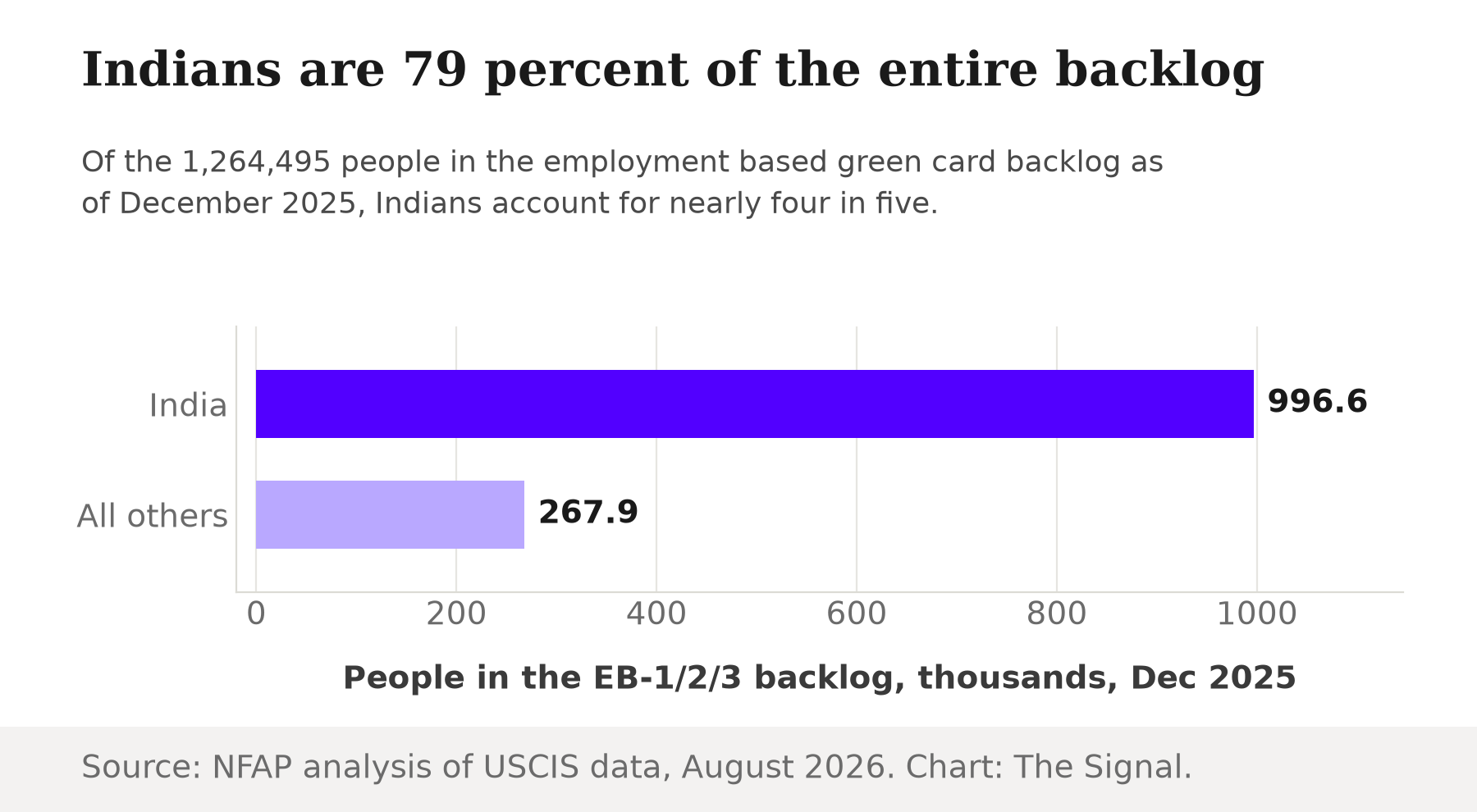
It is worth slowing down on that framing. A queue implies motion, an eventual turn. What the newest numbers describe is closer to a wall. As of the August 2026 Visa Bulletin, EB-2 was listed as unavailable for India outright, having been stuck at a September 1, 2013 priority date cutoff as recently as the June 2026 bulletin: nobody who filed after that date, more than a decade ago, is currently in line for a visa at all. For the people this affects, the practical function of a green card petition stops being a future green card. It becomes something else: a document that lets an employer keep renewing a work visa that would otherwise expire.
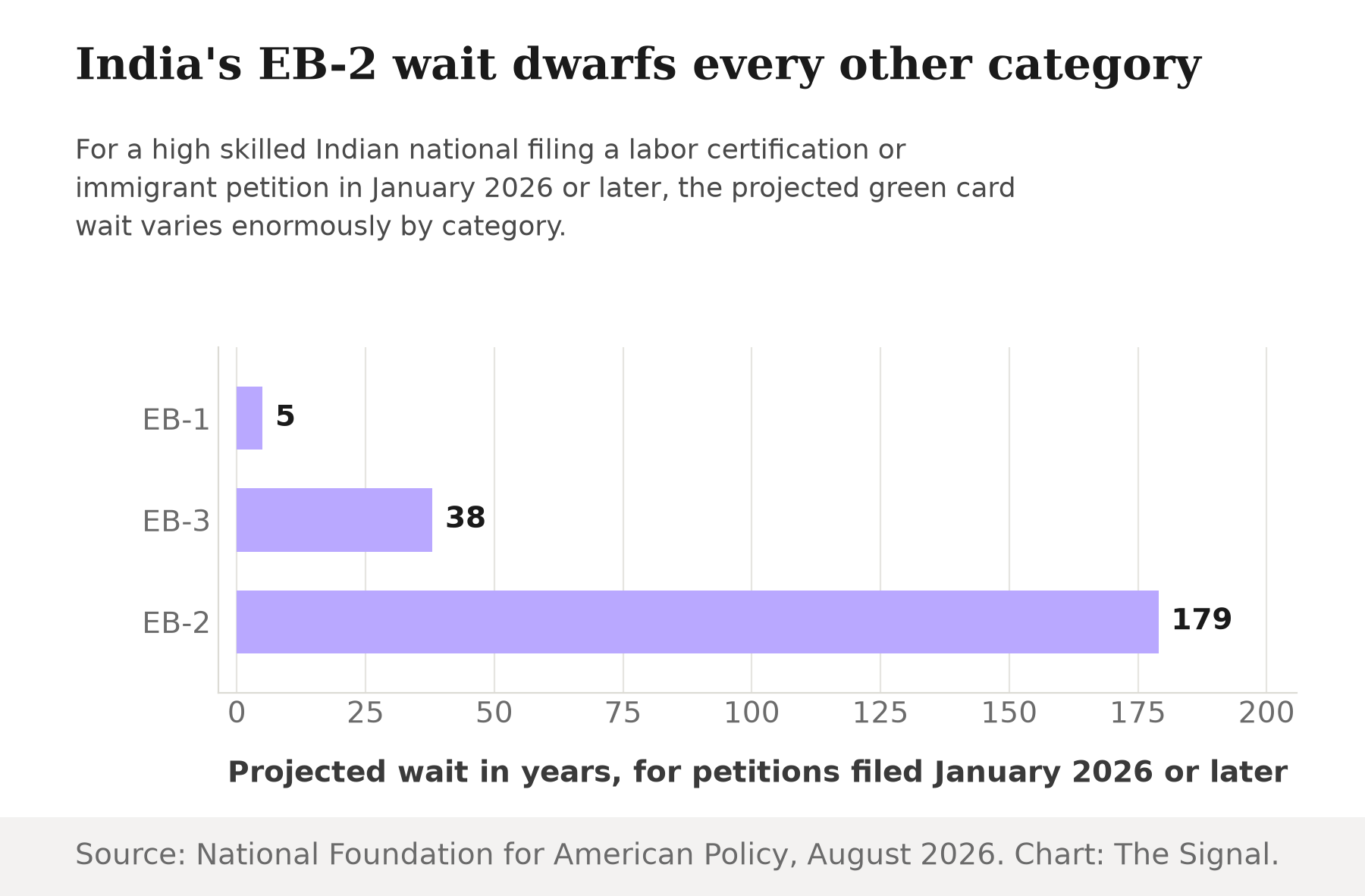
Why the number is 179 and not something smaller
Congress last set the worldwide ceiling on employment based immigrant visas at 140,000 a year, a figure that has to stretch across principal applicants and their spouses and children together. On top of that ceiling sits a second constraint that does the specific damage to India: no single country's natives can receive more than 7 percent of the visas issued under that ceiling in a given fiscal year, the same limit applied to a nation of 1.4 billion people as to Iceland or Luxembourg. The EB-2 category runs current, meaning no wait at all, for every country in the world except China and India: the 7 percent cap is not a rounding constraint for Indian applicants, it is the entire bottleneck. NFAP's analysis found that in a typical year, the gap between how many India-born professionals get approved for EB-2 and how many green cards the per-country cap actually allows adds roughly 90,000 people to the backlog.
That gap compounds year over year. The overall employment based backlog across EB-1, EB-2 and EB-3, all nationalities combined, rose from 1,048,342 people in April 2020 to 1,264,495 by December 2025, a 20.6 percent increase of 216,153 people in five years, even though the worldwide ceiling itself never moved.
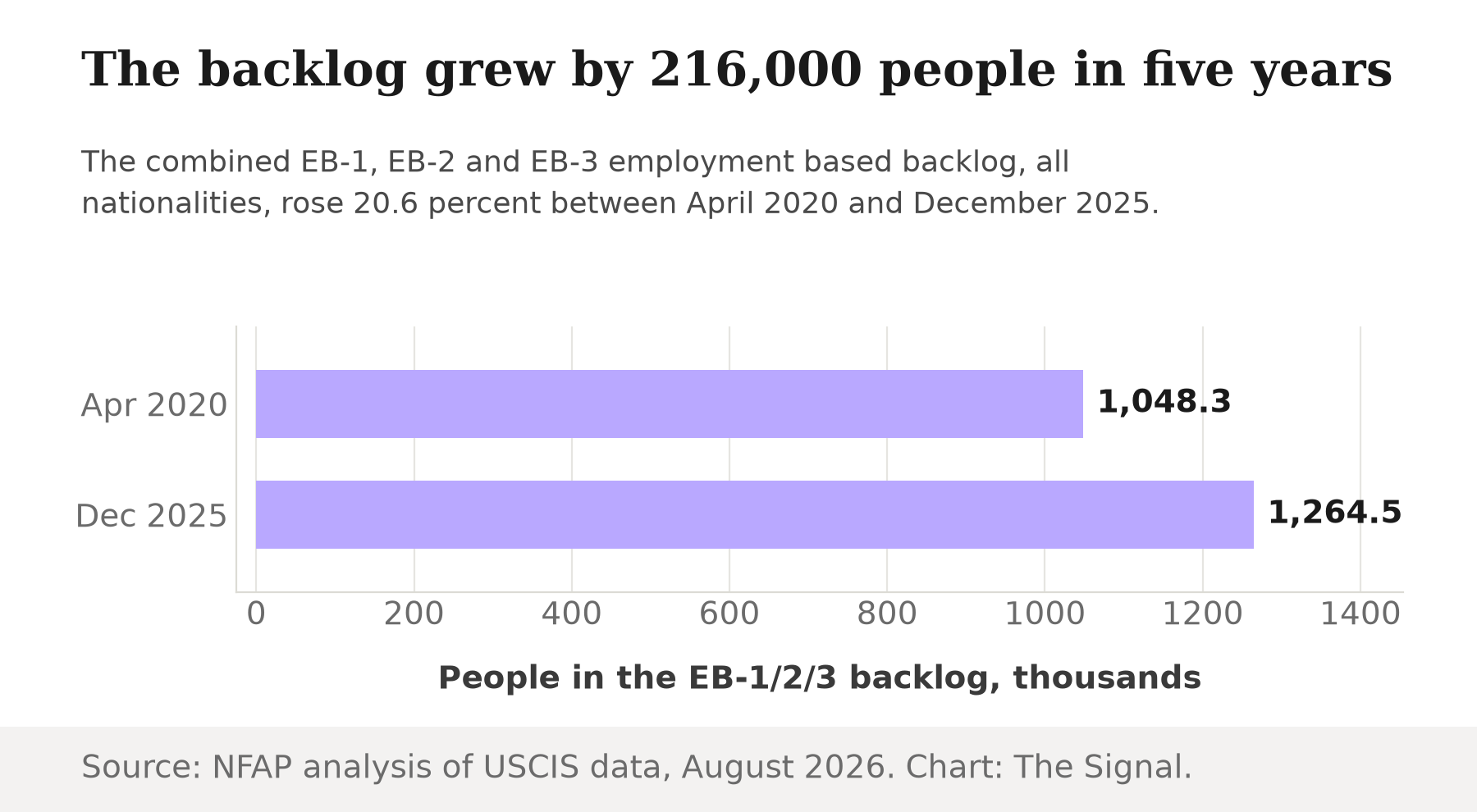
The line has stopped moving, not just moved slowly
By the August 2026 Visa Bulletin, an Indian applicant needed a priority date earlier than October 15, 2022 to file for adjustment of status in EB-1, and earlier than January 1, 2014 in EB-3. EB-2 carried no cutoff date to clear at all, because it was not accepting new filers.
| Category | Priority date needed to file (August 2026) |
|---|---|
| EB-1 | October 15, 2022 |
| EB-2 | Unavailable (was September 1, 2013 in June 2026) |
| EB-3 | January 1, 2014 |
Source: NFAP, citing the U.S. State Department Visa Bulletin. Table: The Signal.
The September 2026 Visa Bulletin, published in late August, confirms the freeze rather than reversing it: EB-2 India remains listed as unauthorized, and final action dates for EB-1, EB-2, EB-3 and EB-5 are unchanged from August. It is not merely holding steady, either. The State Department has separately warned that EB-1 India, EB-2 for every country, and EB-5 Unreserved may retrogress or become entirely unavailable before the fiscal year closes on September 30, 2026: the categories could move backward within weeks of publication, not merely stay frozen.
What the petition actually buys while it waits
This is where the arithmetic stops being the whole story. An H-1B work visa is normally capped at six years. Under AC21, a 2000 law, an H-1B holder whose employer has an approved employment based petition, but who cannot yet file for the green card itself because no visa number is available in their category, can keep extending the H-1B in three-year increments indefinitely, rather than being forced to leave at year six. Against a 179 year queue, that provision is not a footnote. It is the actual mechanism doing the work.
An Indian engineer whose employer filed an EB-2 petition this year is not, in any meaningful sense, working toward a green card that arrives in year 179 of a career nobody has. They are working toward continuous eligibility to keep renewing a visa that was written to expire. The petition's real output is not a future grant of permanent residence. It is a present, renewable, employer-tied permission to keep working, indefinitely, without one.
The honest objection
The strongest case against this reading is that it leans on the worst case category. EB-1, reserved for people with extraordinary ability, outstanding researchers and multinational executives, clears for India in five years, not 179, and EB-3 clears in 38: both real waits, but waits that plausibly end within a working career, unlike EB-2's. Not every Indian green card applicant is trapped the same way.
That case is real but it describes a small share of the queue. Of the 996,599 Indians in the entire backlog, 731,566 sit in EB-2 and 213,414 more sit in EB-3: together, 944,980 people, or about 95 percent of Indians in the backlog, our calculation from NFAP's category totals. EB-1's five year wait is the exception the system offers, not the rule most people in the queue actually experience.
The Signal
The debate over this backlog usually asks when it will clear. That is the wrong question for the roughly 945,000 Indians sitting in EB-2 and EB-3 specifically: under the current per-country math, most of them will not live to see their own category clear on paper, and the system does not require them to. AC21 already gives their employers exactly what they need without it clearing: permission to keep them indefinitely, one three-year renewal at a time. Watch what would actually change the picture, and it is not a friendlier number in a future Visa Bulletin. The State Department has already flagged that the category is more likely to retrogress further before this fiscal year ends than to advance. The only things that move this number are the worldwide cap and the per-country limit that built it, both untouched since Congress last wrote them. Until one of those two numbers changes, 179 is not a forecast. It is a description of how the system already works.
Reporting basis: the wait time projections, backlog totals, per-country cap dynamics, priority date cutoffs and India's share of the backlog are all from a single National Foundation for American Policy policy brief published in August 2026, which computes its own backlog and wait-time estimates from USCIS data rather than these being figures the government publishes directly, so they should be read as NFAP's calculation, not raw official output. The worldwide visa ceiling and the per-country limit are from the Immigration and Nationality Act itself, via Cornell Law School's Legal Information Institute. The AC21 renewal mechanism is per Temple University's international scholar office's summary of the statute. The September 2026 Visa Bulletin's unchanged final action dates are as reported by The National Law Review, and the State Department's retrogression warning is as reported by Ogletree Deakins; both are law firm publications describing the same underlying government notice rather than independent data sources. The combined EB-2 and EB-3 share of India's backlog is The Signal's calculation from NFAP's category totals.