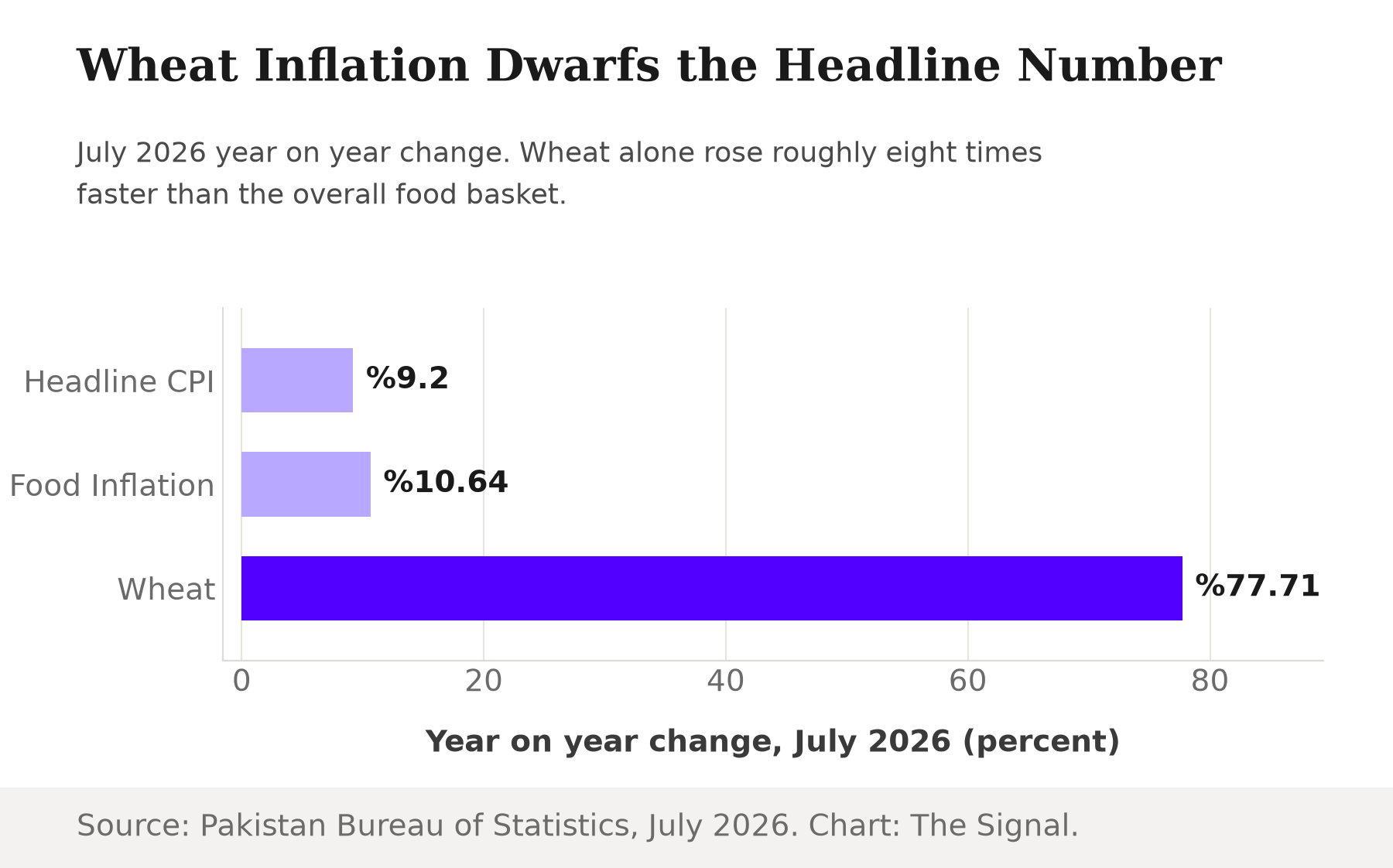
Pakistan's inflation numbers for July 2026 read like the opening of a familiar story. Headline consumer prices rose 9.20 percent year on year, up from just 4.1 percent the same month a year earlier, and food and non-alcoholic beverage prices climbed even faster, up 10.64 percent over the same period. In a country that has spent much of the last decade cycling through dollar shortages and import controls, that combination reads as one more currency-driven cost-of-living shock working through household budgets.
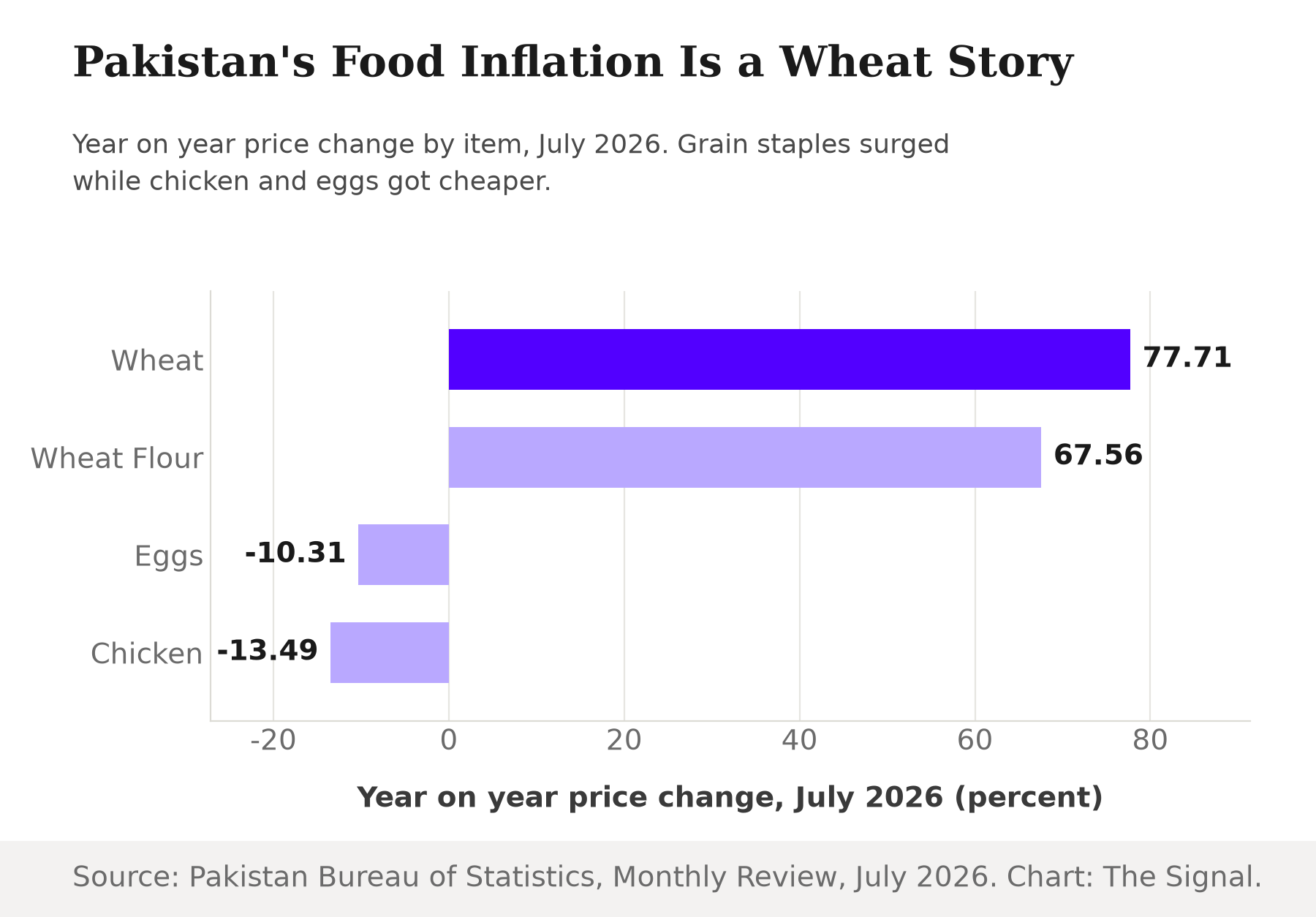
It is worth slowing down on that framing. The Pakistan Bureau of Statistics' own July data shows the food number was not a broad-based surge: wheat prices rose 77.71 percent and wheat flour rose 67.56 percent year on year, while chicken fell 13.49 percent and eggs fell 10.31 percent over the same twelve months. Wheat alone rose 77.71 percent while chicken fell 13.49 percent, a spread of more than 90 percentage points inside the same official food basket in the same month.
The rupee did not do this
If a dollar shortage were driving the food basket, it should show up in every imported input at once, not in one grain and not in poultry feed that gets cheaper in the same month. The Pakistani rupee has been stable to slightly stronger through 2026, trading near 277.6 to the dollar and up 1.84 percent over the past twelve months. Pakistan's total liquid foreign exchange reserves rose to $22.474 billion at the end of July 2026, with the State Bank of Pakistan's own holdings at $17.043 billion, and reserves edged higher again to about $22.5 billion by the first week of August, though they still cover only 2.51 months of imports. A rupee that is flat to firmer, with reserves rising rather than draining, does not explain a price swing this lopsided. Something else pushed wheat up while chicken fell, and it was not the exchange rate.
What actually happened to wheat
Punjab's wheat harvest for the 2025-26 season fell short by three to ten percent, and Pakistan's national wheat crop may be more than 20 percent below annual requirements, Dawn reported in May 2026. Pakistan's food security minister told Dawn in May 2026 that the wheat production target for 2025-26 had initially been set at 30 million tonnes before being revised downward because of climate impacts. A shortfall of that size, on the country's single most important staple, is enough on its own to move prices without any currency mechanism involved.
The shortfall also arrived the same season Islamabad was already required to step back from the wheat market. Dawn reported in September 2024 that, under Pakistan's IMF Extended Fund Facility, the federal and provincial governments were required to phase out the wheat minimum support price system by June 2026, a condition tied to wheat-procurement debt that had ballooned to Rs680 billion by June 2023. The government's usual buffer against a bad harvest, buying grain at a guaranteed floor price and releasing it later to cap what consumers pay, was being wound down under the same IMF program that also oversees Pakistan's currency and reserves position. A weak crop met a shrinking cushion in the same season. This is not just coincident timing: the USDA's Foreign Agricultural Service names the withdrawal of the guaranteed support price, alongside the dry weather, as a primary reason for the decline in Pakistan's 2025/26 wheat output, the policy shift acting directly on the supply side rather than merely lining up with it in the calendar.
The same USDA forecast put Pakistan's 2025/26 wheat consumption at 31.9 million tons against production of only 27.5 million tons, a gap of more than 4 million tons. Pakistan is covering that gap on both fronts at once: a 1.7-million-ton import forecast and a drawdown of carry-over stocks to around 2 million tons, from nearly 5 million tons the year before. That import component means the wheat story is not fully insulated from the currency after all. It has just not been tested yet: this year's shortfall is still being absorbed mostly out of stock, not the dollar market.
The investment gap behind it
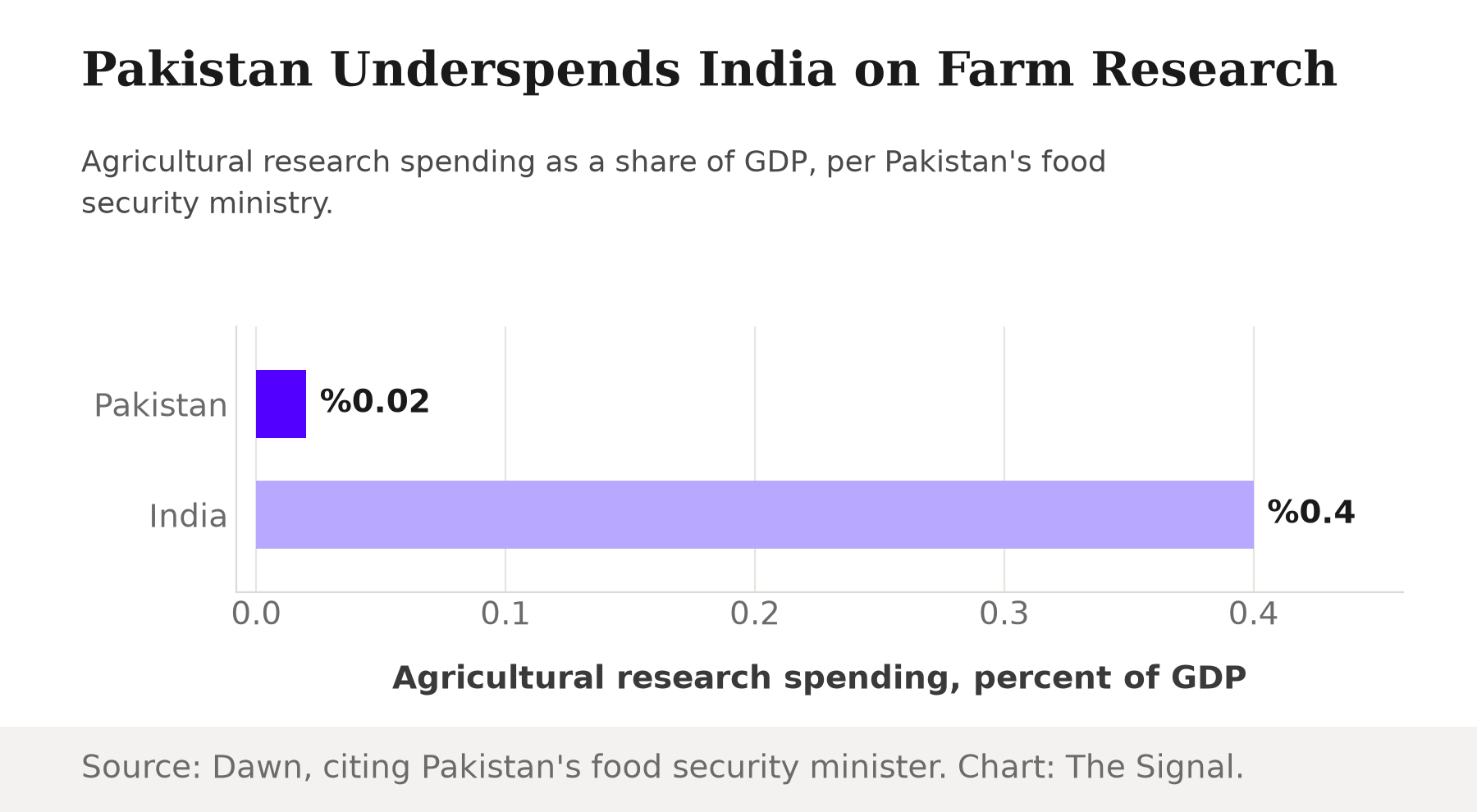
Pakistan spends just 0.02 percent of GDP on agricultural research, against 0.4 percent of GDP in India, the same food security minister told Dawn in May 2026, a twentyfold gap. Crop resilience, drought-tolerant seed varieties and yield gains are built up over years of research spending, not restored in a single procurement season. A country investing at a fraction of its neighbor's rate has less capacity to absorb a bad harvest the next time one arrives, whether or not the price-support system survives.
The outcome gap shows up in the same month's numbers. India's own Consumer Food Price Index rose just 5.52 percent year on year in July 2026, roughly half the pace of Pakistan's 10.64 percent food inflation, even though both countries were exposed to the same regional growing season. That is not proof the research-spending gap alone explains the difference, but it is the concrete outcome the investment gap predicts: a food system with deeper buffers absorbs a bad season without the price spikes the thinner one produces.
The honest objection
The strongest case against calling this a wheat story rather than a currency story is that Pakistan's currency stability may itself be thin and borrowed. Reserve cover of 2.51 months of imports is short by any conventional standard, and the State Bank's own holdings of $17.043 billion are a fraction of a year's import bill. Pakistan still imported $877.64 million worth of coffee, tea, mate and spices in 2025 alone, a reminder that everyday consumption, tea most visibly, still depends on the same dollars the central bank is short of. A currency crisis has not been ruled out. It has simply not shown up in July's numbers.
That case is real, but it does not fit the timing. The rupee was already near its current level a year ago and has strengthened modestly since, across the exact months when wheat and flour prices were rising 68 to 78 percent. A currency that is not moving cannot be the mechanism behind a price move this large, however fragile the reserves behind it look on paper.
The Signal
Pakistan's July inflation print will get read, again, as evidence of a currency-driven cost-of-living crisis, because that is the familiar Pakistani story and the headline number fits it. The actual mechanism this time is narrower and more fixable: a bad wheat harvest colliding with the planned withdrawal of the state's own price buffer, in a country that spends a fraction of what its neighbor spends on the agricultural research that might have cushioned the shortfall. Wheat and wheat flour rose 77.71 and 67.56 percent while chicken and eggs got cheaper in the same month, a pattern that only a shock to one crop produces, not a shock to the currency that prices every import. Watch the 2026-27 wheat sowing season and whether the IMF program's price-support phase-out survives a second bad harvest intact. If one crop can still move Pakistan's headline inflation rate this much, the country's food security rests on that crop's yield, not on the health of the rupee.
Reporting basis: the July 2026 headline and food inflation rates, and the item-level price changes for wheat, wheat flour, chicken and eggs, are from the Pakistan Bureau of Statistics' own July 2026 press release and monthly review, as also carried by The Express Tribune. Foreign exchange reserves and the State Bank of Pakistan's own holdings are from the State Bank's weekly reserves data, as reported by Dawn and The Express Tribune; exchange-rate levels are from Trading Economics market data. The wheat harvest shortfall, the IMF's wheat price-support phase-out condition, the associated procurement debt, the revised production target and the agricultural research spending comparison are all as reported by Dawn, the last two citing Pakistan's food security minister. Pakistan's wheat production, consumption, import and stock-drawdown forecasts, and the attribution of the output decline partly to the withdrawal of the guaranteed support price, are from the USDA Foreign Agricultural Service's Grain and Feed Annual for Pakistan. India's July 2026 food inflation rate is from the Ministry of Statistics and Programme Implementation's Consumer Price Index press release. The coffee, tea, mate and spices import figure is from Trading Economics, citing UN Comtrade data. The multiple between wheat's price rise and the headline inflation rate, the percentage-point spread between wheat and chicken price changes, the gap between Pakistan's wheat production and consumption, and the multiple between Pakistan's and India's agricultural research spending are The Signal's calculations from those figures.