On August 31, 2026, the Hague-based Court of Arbitration ruled that the 1960 Indus Waters Treaty remains legally binding and contains no provision allowing either country to suspend or terminate it unilaterally. The same award ordered India to limit construction on the Ratle hydroelectric plant in Kashmir, prohibiting work on the dam wall and power intake structure above certain levels. Those restrictions stay in force until 90 days after a World Bank-appointed Neutral Expert's final decision, expected in July 2027. India rejected the ruling the same day. Its Ministry of External Affairs said the tribunal was constituted by the World Bank in patent breach of the treaty and that India categorically rejects the award, just as it has firmly rejected all prior pronouncements by this illegally constituted body. Read as a single headline, this is a familiar genre: a state waving off a ruling meant to bind it.
It is worth slowing down on that framing. India is not a country that treats binding international adjudication as illegitimate in general. In the Jadhav case, the International Court of Justice ruled by fifteen votes to one in India's favor in July 2019, ordering Pakistan to provide effective review and reconsideration of Kulbhushan Jadhav's conviction and death sentence. And on this exact treaty, the record runs the other way. In 2013, the same Court-of-Arbitration mechanism the treaty created ruled largely in India's favor, holding that its inter-tributary diversions for the Kishenganga hydroelectric project were permissible under the treaty. Nobody in New Delhi called that body illegally constituted.
The same treaty mechanism that ruled for India in 2013 is the one India calls illegal in 2026.
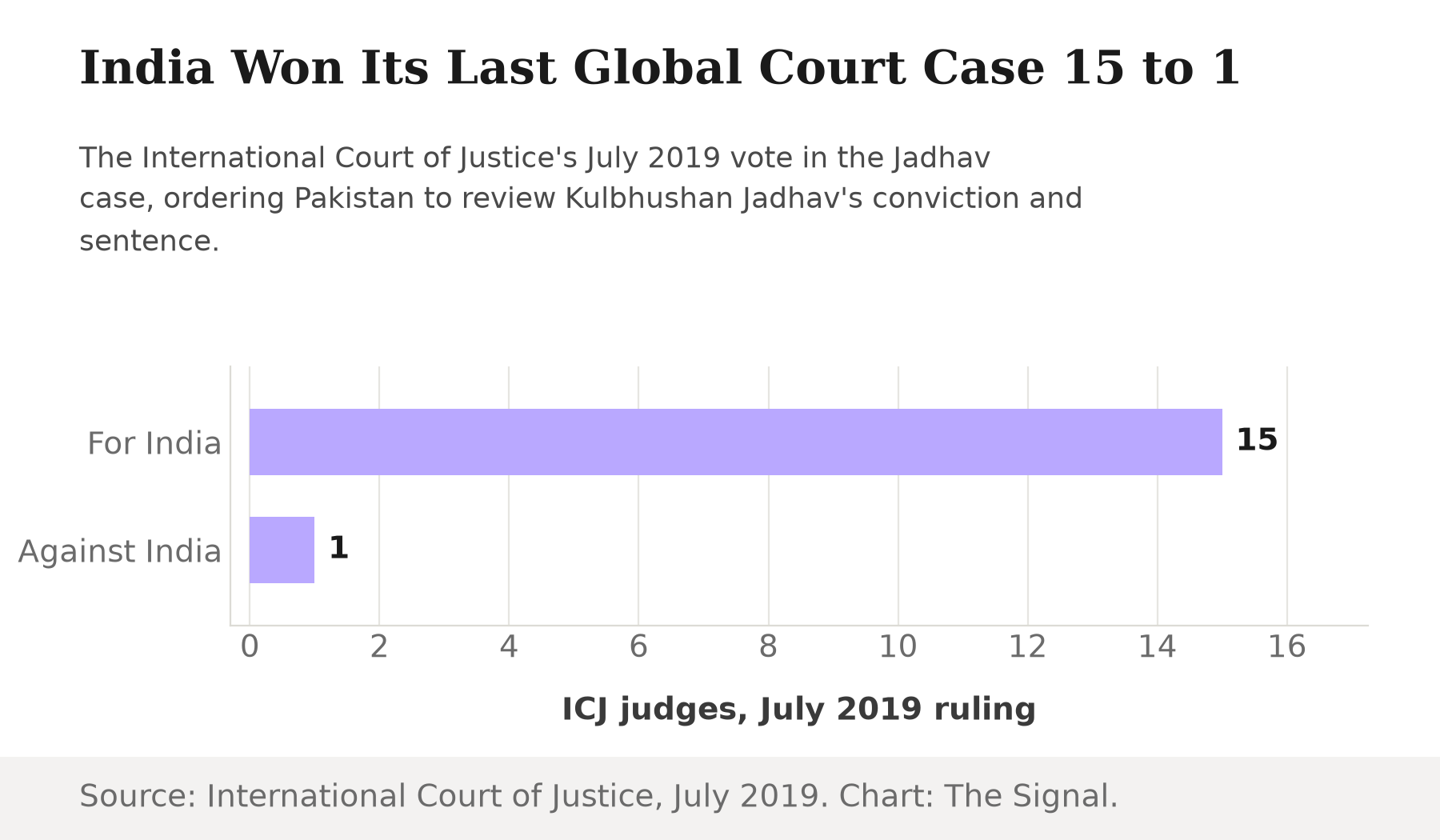
Source: International Court of Justice, Jadhav judgment, July 2019. Chart: The Signal.
A treaty already in abeyance
The current standoff did not start with the August ruling. India placed the Indus Waters Treaty in abeyance after the April 2025 Pahalgam terror attack, and its Ministry of External Affairs has repeatedly reaffirmed that the treaty remains suspended. The August 31 award does not accept that suspension. The tribunal held the treaty binding regardless of India's abeyance declaration, and it went further: it named a specific, physical constraint. The concreting limits on Ratle's dam wall and intake structure stay in force until the Neutral Expert rules, no earlier than July 2027. That is not an abstract disagreement about legal status. It is a construction schedule with a date attached, and India has already said it will not observe the ruling that sets it.
The 2013 precedent nobody argued with
The Indus Waters Treaty gives disputing parties access to a Court of Arbitration as one of its formal mechanisms. That mechanism has now produced two outcomes for India: a win in 2013 and a loss in 2026. Only the second one gets called illegitimate.
India accepted the mechanism when it worked, and rejects it now that it hasn't.
| Case | Year | Body | Outcome for India | India's stated response |
|---|---|---|---|---|
| Kishenganga Partial Award | 2013 | Court of Arbitration (Indus Waters Treaty) | Ruled largely in India's favor | Accepted; no challenge to the body's legitimacy |
| Jadhav case | 2019 | International Court of Justice | Ruled 15 to 1 for India | Welcomed the judgment |
| Indus Waters award | 2026 | Court of Arbitration (Indus Waters Treaty) | Ordered India to restore the treaty and limit Ratle construction | Rejected as "illegally constituted" |
Sources: EJIL:Talk!'s analysis of the 2013 Kishenganga Partial Award; International Court of Justice, Jadhav judgment; The Tribune, on the 2026 award and India's rejection.
Why Pakistan cannot shrug this off
The treaty being fought over is not a symbolic document. It was signed in 1960 after nine years of World Bank-brokered negotiations, with the World Bank itself a signatory, allocating the western rivers, the Indus, Jhelum and Chenab, to Pakistan and the eastern rivers, the Ravi, Beas and Sutlej, to India. Pakistan's dependence on the water it settles runs deep: groundwater within the Indus basin supplies 90 percent of rural domestic water, 70 percent of domestic water nationally, and over half of agricultural water, figures reported by the World Bank in 2021.
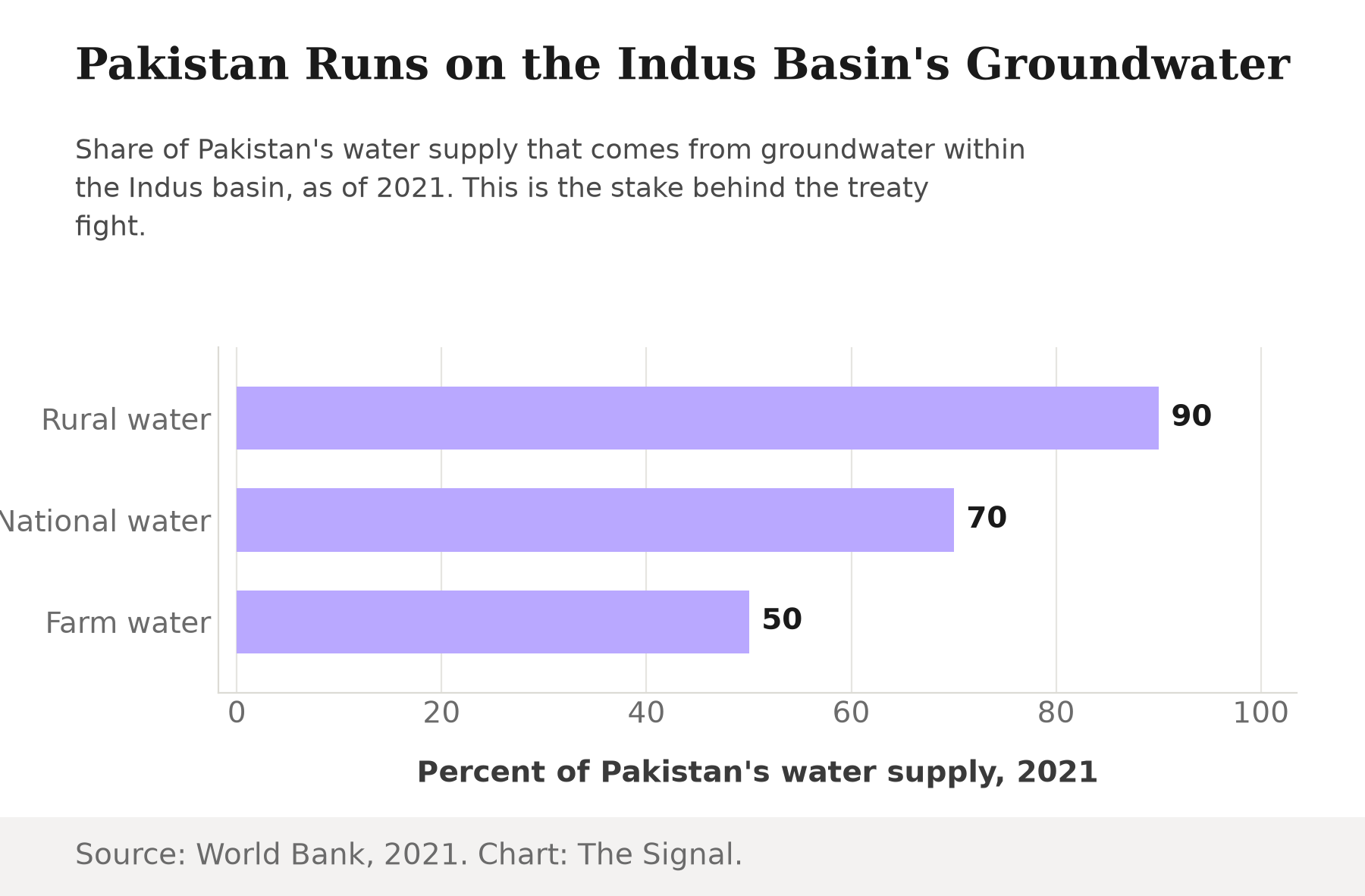
Source: World Bank, 2021. Chart: The Signal.
Against that dependence, an India that keeps the treaty in abeyance and ignores construction limits on an upstream dam is not a legal abstraction for Pakistan. It is a question of water supply for a population with no easy substitute for the basin.
The honest objection
The strongest case for India's position is that its objection is not a reaction to losing. The Ministry of External Affairs' own language frames the 2026 rejection as consistent, not new: it says it has firmly rejected all prior pronouncements by this illegally constituted body, implying a standing procedural objection to how this particular arbitration was set in motion, not a one-off complaint filed only after an unfavorable result. On that reading, India is not selectively honoring international law. It is applying one consistent rule: it will not recognize a specific proceeding it considers improperly constituted, regardless of outcome.
That case would be stronger if India's history with the treaty's own Court-of-Arbitration mechanism did not already include a result it kept. The 2013 Kishenganga ruling came from the same kind of body, under the same treaty, and India did not dispute its legitimacy when it won. A consistent, principled objection to a flawed process is one thing. A body that is illegitimate exactly when it rules against India and unremarked when it rules for India looks, from the outside, like a rule that tracks outcomes rather than process.
The Signal
The number that matters here is not on either side's press release. It is July 2027, the date the World Bank-appointed Neutral Expert is due to rule on the Ratle construction limits. If India halts concreting on the dam wall and intake structure until then, it is honoring the substance of the award while contesting its source. If construction continues regardless, the abeyance is not a legal position, it is a fact on the ground that outlasts the arguments made to justify it. Either way, the next time a Court of Arbitration under this treaty rules in India's favor, and the 2013 precedent says that is a real possibility, watch whether anyone in New Delhi raises the question of how that body was constituted.
Reporting basis: India's placement of the Indus Waters Treaty in abeyance and its response to the 2026 award are per statements from India's Ministry of External Affairs, as carried by News on Air and The Tribune. The August 31, 2026 Court of Arbitration ruling and its construction restrictions on the Ratle plant are per Associated Press wire reporting carried by WTOP and per Al Jazeera's reporting. The 2013 Kishenganga Partial Award is per EJIL:Talk!'s legal analysis of that award. The 2019 Jadhav judgment is from the International Court of Justice's own case record. The 1960 treaty's origin and terms, and Pakistan's Indus basin groundwater dependence, are from World Bank publications.