On 30 August 2026, during Prime Minister Modi's visit to Tashkent, India and Uzbekistan agreed to a long-term framework for uranium supply and elevated ties to a Comprehensive Strategic Partnership. Read as fuel diplomacy, the story is simple: India is locking down fresh uranium supply from an existing partner, on top of its other contracts, to feed its nuclear ambitions. A more secure fuel pipeline should mean a bigger reactor fleet.
It is worth slowing down on that. India's installed nuclear capacity today is a small fraction of where the government says it wants to be, and fuel was never the reason for the gap.
The number that actually gates the target
India's installed nuclear capacity stands at 8,780 MW, and the Department of Atomic Energy told Parliament in April 2026 that it expects this to rise to 22,380 MW by 2031-32 as projects already under construction come online. The Union Budget 2025-26 set the actual ambition much higher: 100 GW of nuclear capacity by 2047, under a new Nuclear Energy Mission.
India's committed nuclear pipeline reaches barely a fifth of its own 2047 target.
Even every reactor currently under construction, once finished, leaves close to 78 GW unaccounted for against the 100 GW target (our calculation, subtracting the 22,380 MW pipeline confirmed for 2031-32 from the 100 GW target for 2047). No uranium contract closes a gap that size. Only new reactors do, and building them at anything like that scale has required money and legal cover the Indian nuclear sector spent fifteen years without.
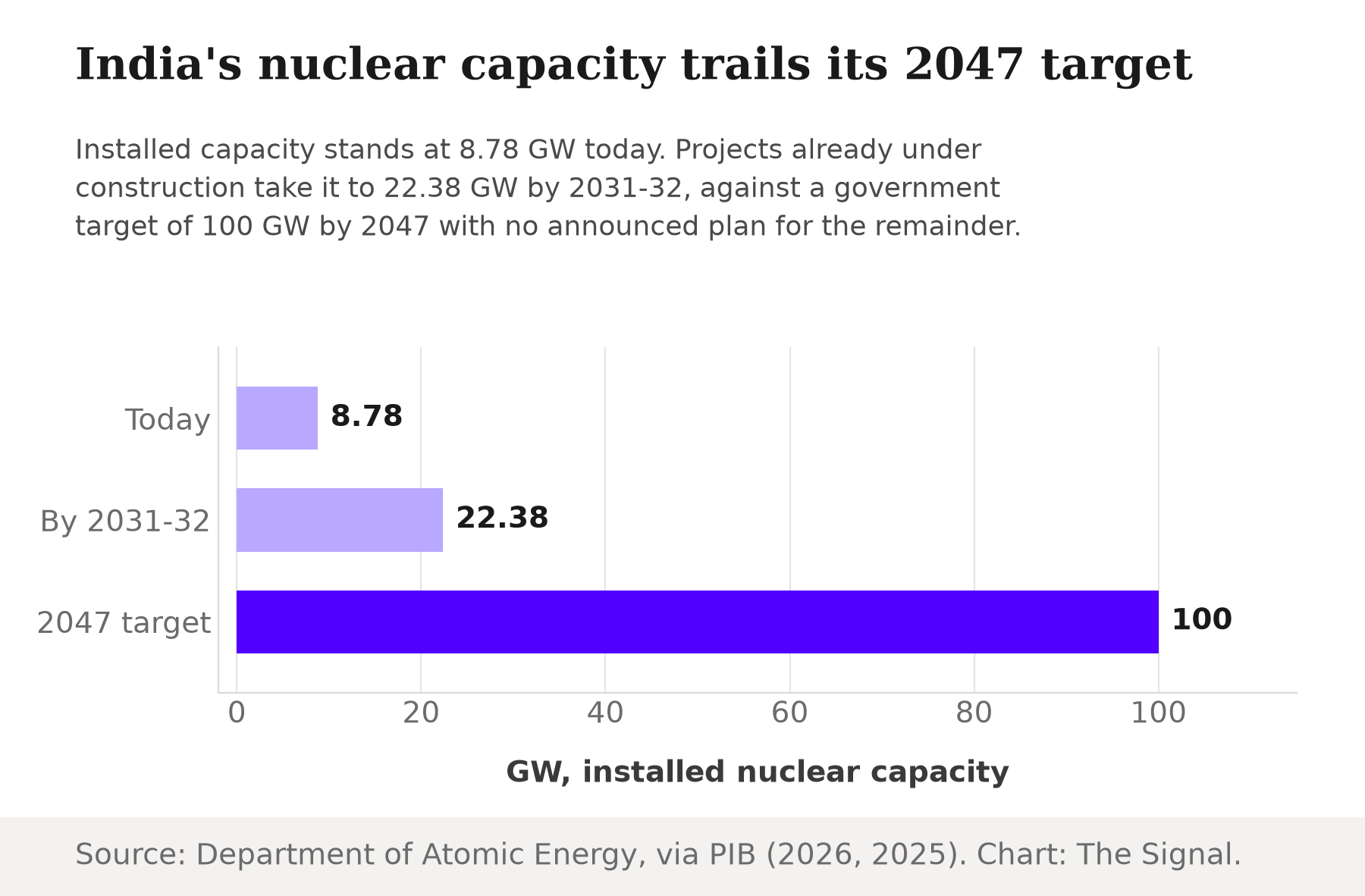
Source: Department of Atomic Energy, via PIB, April 2026; Union Budget 2025-26 Nuclear Energy Mission press release. Chart: The Signal.
The clause that kept suppliers away
Under the Civil Liability for Nuclear Damage Act, 2010, Section 17(b) gave the reactor operator a right of recourse against equipment suppliers for patent or latent defects or sub-standard services, according to the Department of Atomic Energy's own FAQ on the Act. That clause meant a foreign vendor selling India a reactor component could be sued for the cost of any accident traced to it. There was no ceiling written into the law. India tried to soften that exposure in June 2015 by launching the India Nuclear Insurance Pool, a Rs 1,500 crore facility run by GIC Re and other domestic insurers to cover operator and supplier liability.
It did not work. Reuters reported in April 2025, citing government sources, that companies including Westinghouse and General Electric had stayed away from India's nuclear market for years specifically because of that unlimited liability exposure, even with the insurance pool in place. A decade of fuel deals, budget announcements and a standing target could not substitute for the one thing large foreign reactor vendors were actually asking for: a cap on what a single defect could cost them.
The fix arrived eight months before the fuel deal
The government's own account shows it knew this. In March 2025, the Department of Atomic Energy told the Rajya Sabha that a dedicated Task Force was reviewing the CLND Act specifically to address concerns raised by private suppliers, the same month Reuters' sourcing on a draft law began circulating. That work became law in December 2025. Parliament's SHANTI Act, which received presidential assent that month, repealed both the Atomic Energy Act, 1962, and the Civil Liability for Nuclear Damage Act, 2010, opening the door to private-sector nuclear participation, according to a DAE backgrounder.
The SHANTI Act rewrote both the price of a nuclear accident and who can be sued for it.
| Provision | Civil Liability Act, 2010 | SHANTI Act, 2025 |
|---|---|---|
| Liability cap | Flat Rs 1,500 crore, any reactor | Tiered Rs 100 crore to Rs 3,000 crore, by reactor size |
| Operator's right to sue supplier over defective equipment | Yes, under Section 17(b) | Removed |
| Governing statutes | Atomic Energy Act, 1962, and CLND Act, 2010, both in force | Both repealed |
Source: PRS Legislative Research, bill summary of the SHANTI Act, 2025; Department of Atomic Energy FAQ on the CLND Act, 2010.
PRS Legislative Research's summary of the bill lays out the exchange precisely: the old flat Rs 1,500 crore cap for any reactor becomes a tiered structure of Rs 100 crore to Rs 3,000 crore depending on power capacity, and the operator's right of recourse against a supplier for defective equipment is removed outright. A small modular reactor now carries a lower ceiling than the old law ever set; a large plant's ceiling roughly doubles. Either way, a supplier can no longer be sued over the equipment.
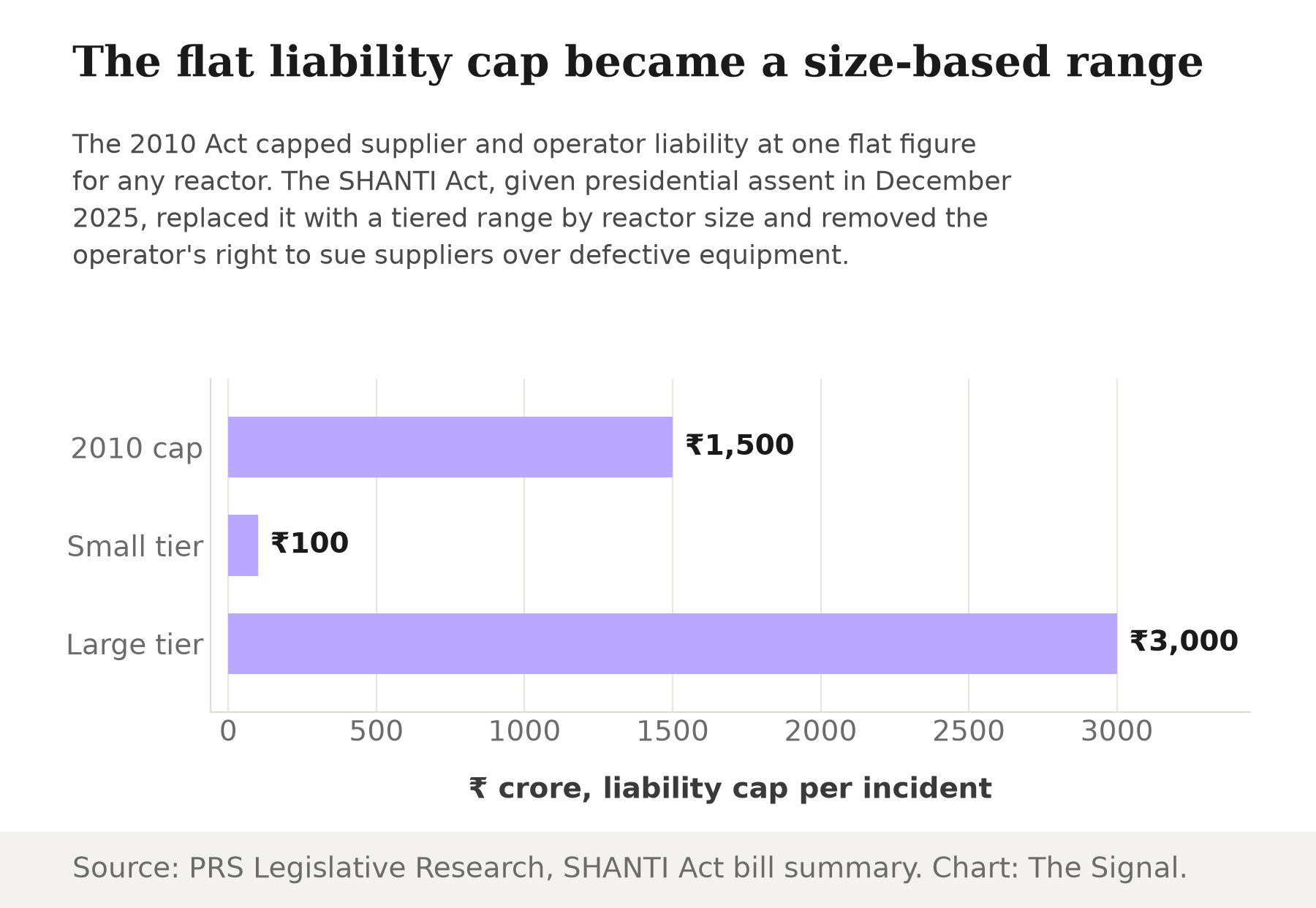
Source: PRS Legislative Research, bill summary of the SHANTI Act, 2025; Department of Atomic Energy FAQ on the CLND Act, 2010. Chart: The Signal.
That is the fix the industry had been asking for since the insurance pool launched in June 2015 failed to bring vendors in on its own. It landed eight months before Modi signed the Uzbekistan framework on 30 August 2026.
What the Uzbekistan deal actually adds
None of this makes the uranium framework meaningless. As of August 2026, a parliamentary committee found that India's uranium imports come from just four countries, Kazakhstan, Russia, Uzbekistan and Canada, and that the existing Uzbek contract runs only to 2026. That contract, signed in January 2019, covers just 1,100 MTU of uranium ore concentrate for 2022 through 2026, alongside similar agreements India struck with Canada, Kazakhstan and France. A four-country import list with one of those four contracts about to lapse is a real, narrow supply-security problem, and Uzbekistan is the world's fifth-largest uranium producer, behind Kazakhstan, Canada, Namibia and Australia, which makes it a sensible name to renew with.
What the deal does not do is add a fifth country, or a fifth megawatt of capacity. It replaces an expiring line with a new one, from a supplier India already had. The government's other big nuclear lever this year has nothing to do with fuel either: the Nuclear Energy Mission allocated Rs 20,000 crore to Small Modular Reactor R&D, targeting at least five indigenously designed SMRs operational by 2033. Every serious move India has made toward its 2047 target this year, the liability rewrite and the SMR fund, has been about capital and technology. The uranium deal is the one move that is not.
The honest objection
The strongest case for the Uzbekistan framework mattering is exactly the supply-concentration point above. Four countries is a thin list, one of those four contracts expires this year, and a reactor fleet cannot run on legal reform alone if there is no fuel to load into it. On that reading, renewing and expanding the Uzbek relationship now, before the existing contract lapses, is precisely the kind of unglamorous groundwork a serious nuclear program should be doing, whether or not it makes for a striking headline.
That case is real, but it answers a different question than the one the capacity numbers pose. A secure fuel supply keeps India's existing 8,780 MW of reactors running; it does not build the rest of the way to the 100 GW target. Even if uranium flowed into India without limit starting tomorrow, that target still needs reactors that do not exist yet, built by vendors who stayed out of India's market for years over exactly the liability exposure the SHANTI Act only just removed. Fuel security and capacity growth are different problems, and India solved the harder one first.
The Signal
The Uzbekistan framework is a real, sensible renewal of a supply line that was genuinely about to lapse. It is not the unlock. The unlock already happened in December 2025, when Parliament repealed the old liability law and rewrote who pays for a nuclear accident and by how much. The number worth watching from here is not another uranium tonnage figure: it is whether Westinghouse, General Electric or any other foreign vendor that stayed out for a decade now signs an actual India reactor contract under the new caps. If one does, the SHANTI Act will have done in months what fifteen years of fuel diplomacy could not. Without that, the law was necessary but not sufficient, and the 78 GW gap stays exactly where it is: unexplained by any shortage of uranium.
Reporting basis: India's installed and under-construction nuclear capacity figures, the 100 GW-by-2047 target, the Small Modular Reactor allocation, the DAE Task Force confirmation, the SHANTI Act's repeal of the 1962 and 2010 Acts, the 2010 Act's Section 17(b) recourse clause, the 2015 insurance pool, and the January 2019 Uzbek uranium contract's volume and India's parallel Canada, Kazakhstan and France agreements are all from Department of Atomic Energy releases and FAQs, most of them Parliament replies, via the Press Information Bureau and dae.gov.in. The SHANTI Act's specific liability-cap figures and its removal of supplier recourse are from PRS Legislative Research's published bill summary. The April 2025 reporting on Westinghouse and General Electric's liability concerns is per Business Standard, citing Reuters and government sources, and rests on that single wire report. The 30 August 2026 Uzbekistan framework is per Business Standard's own reporting of the visit. The four-country uranium import concentration and the 2026 lapse of the existing Uzbek contract are per World Nuclear News, reporting a parliamentary committee's findings. Uzbekistan's global ranking as a uranium producer is from a USGS fact sheet citing the NEA-IAEA Uranium Red Book. The 78 GW capacity gap and the small-reactor liability-cap comparison are The Signal's calculations from those figures.