For most of the past year, the story of Indian students and the US work visa system has been told through one number: $100,000. A presidential proclamation effective September 21, 2025 requires that sum to accompany new H-1B petitions, a fee big enough to reshape how employers think about sponsoring a foreign graduate. Indian nationals, who fill the H-1B category more than any other nationality, absorbed the coverage as a direct hit on their path from an American classroom to an American job.
It is worth slowing down on that. The fee does not apply to F-1 students already in the US who are changing status to H-1B, only to new petitions for beneficiaries abroad without a valid H-1B visa, which is the far more common route for a student finishing a US degree. And on June 8, 2026, a federal court in Massachusetts vacated the fee outright, ruling it functioned as an unconstitutional tax rather than a valid fee. By the summer of 2026, the headline number that defined the panic was both narrower in scope than assumed and no longer in force.
The mechanism actually worth watching sits one step earlier in a student's timeline: Curricular Practical Training, the work authorization that lets international students take paid, degree-related jobs and internships while still enrolled. It is CPT, not the H-1B fee, that a new federal memo has just moved against.
The memo that followed the fee
An ICE/SEVP memo dated August 12, 2026 warned every SEVP-certified university that CPT authorized to create employment, rather than to satisfy a genuine academic requirement, puts a school's certification to enroll international students at risk. The memo's language is blunt about what CPT is for: international students should be enrolled for the sole purpose of attending school full time, with any work authorization treated as incidental to that, not a parallel goal.
Universities moved within two weeks. UC Berkeley's International Office announced it was temporarily suspending all new applications for Course Credit CPT, the elective, job-first track that attaches academic credit to a placement a student has already lined up. Degree-Requirement CPT, the track reserved for internships a program mandates for graduation, kept processing normally. The distinction matters because it is exactly the line ICE's memo draws: off-campus work is permitted only when it is a mandatory requirement for a student's degree or graduation, not when a student has simply found a job and wants credit attached to it.
The suspension is not retroactive. Students who already hold CPT approval are unaffected; only new elective applications are paused. UCLA followed with its own pause on some work authorizations days after the memo, describing it as a response to the same federal warning.
Why this lands hardest on India
CPT and OPT, its post-graduation counterpart, are not a niche corner of the visa system for one country. They are the primary income and work-experience channel for the largest international student population in the US, and that population is Indian. India was the leading place of origin for international students in the US in 2024/25, with 363,019 students, up 10 percent from the year before, building on 331,602 Indian students the year before, in 2023/24, a gain of roughly 31,000 students in a single year. Set against that pace, the STEM fields where CPT placements concentrate are where Indian students are most represented in the work-authorization pipeline: nearly half, 48 percent, of all STEM OPT work-authorization extensions granted in 2024 went to Indian nationals, the largest single-country share by a wide margin.
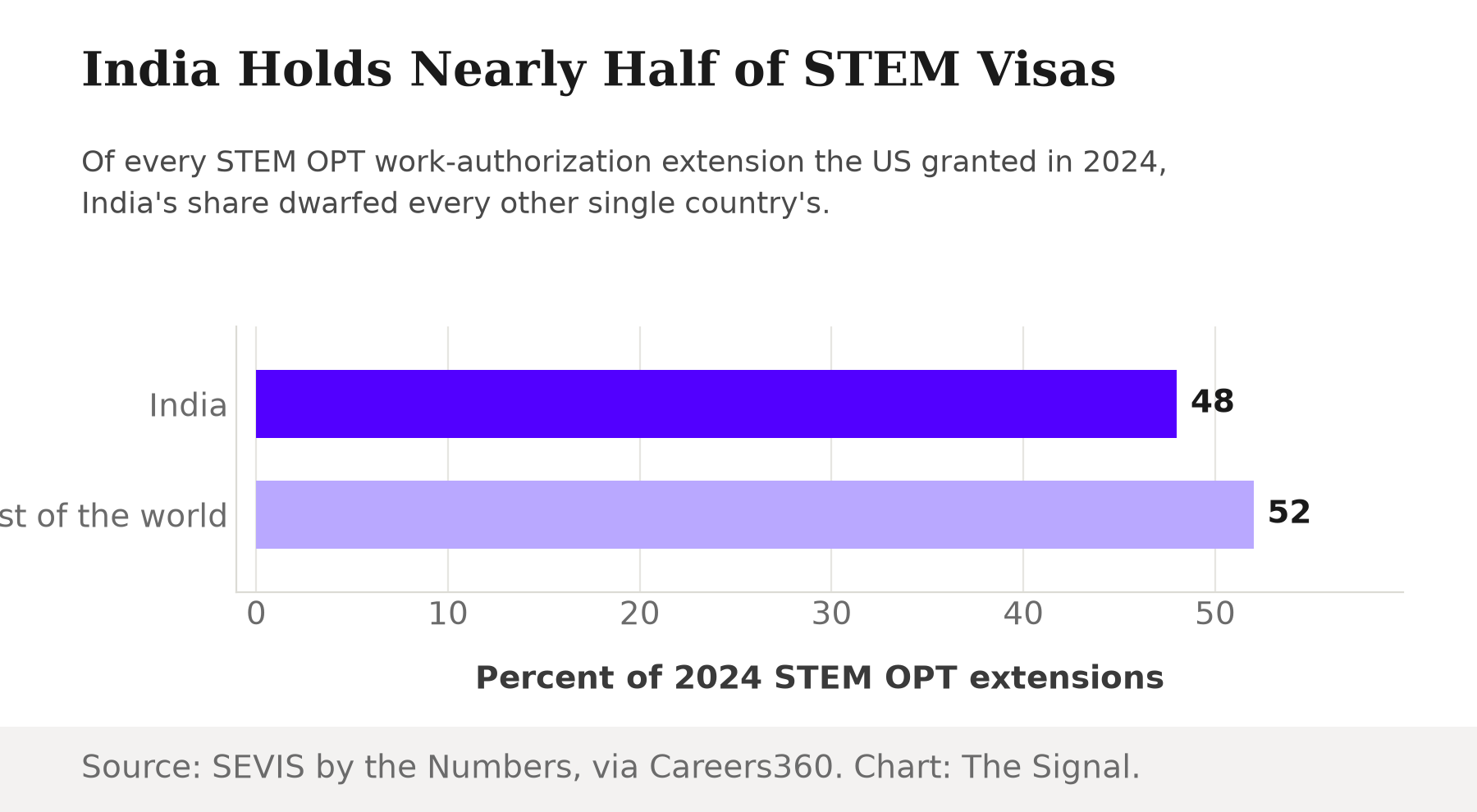
No other single country comes close to that share: China, the second-largest source, held just 20.4 percent of 2024's STEM OPT extensions, less than half India's 48 percent, out of 165,524 total participants that year. That gap is precisely why a memo aimed at tightening CPT nationwide falls disproportionately on Indian students even though it names no nationality at all. A rule written in general terms about "genuine academic requirements" still lands hardest on whichever population relies most on the general pathway, and that population is India's.
That concentration is arriving at a moment when the broader pipeline is already narrowing. New international student enrollment in the US, meaning students studying in the country for the first time, fell 17 percent in fall 2025.
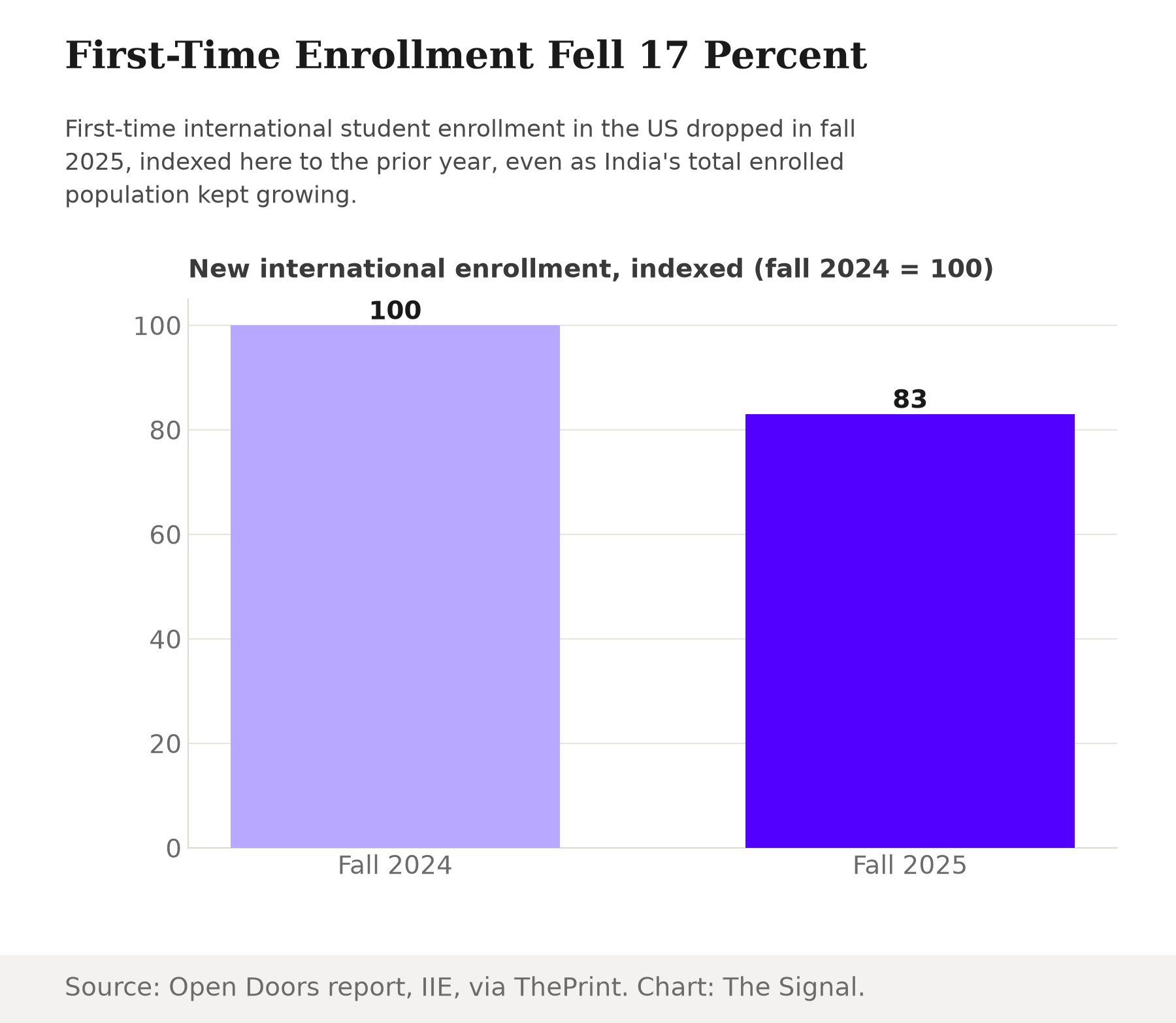
India remained the leading place of origin for international students in the US through that decline, meaning the CPT memo is squeezing a pipeline whose intake was already shrinking, not one still climbing.
The honest objection
The strongest case against reading this as a meaningful shift is scope. Only Berkeley and UCLA have confirmed suspensions so far, against a backdrop of 7,234 SEVP-certified schools nationwide eligible to enroll international students as of 2024. Two campuses out of thousands is a rounding error, not a policy shift, on scope alone. And Berkeley's is limited to new applications for one elective CPT track. Degree-Requirement CPT, the track that most closely tracks an actual academic mandate, keeps running everywhere it was already running. A memo carries no regulatory force, and a temporary pause at two California campuses is not a national shutdown of student work authorization. Read narrowly, this is two international offices getting cautious after a warning letter, not evidence that CPT itself is being dismantled.
That case holds for now, but it understates the memo's reach. The memo warns that CPT authorized for the wrong reason puts a school's SEVP certification at risk, and certification is what lets a school enroll any international student at all, not a narrow benefit tied to one visa category the way the $100,000 fee was. Two campuses moving within two weeks of the memo, without waiting for enforcement, is itself a signal of how seriously certification-holders are taking a threat aimed at every one of them.
The Signal
The number that defined 2025's visa anxiety for Indian students turned out to be a poor predictor of where the actual pressure would land. The $100,000 fee targeted a narrower slice of petitions than the coverage implied, and courts have since taken it off the table. CPT was never designed as a workaround for that fee, but it is the mechanism nearly half of India's STEM graduates in the US now depend on for paid work while they study, the very thing an August 2026 memo has now put universities on notice about. Watch which track SEVP-certified schools move on next: if Degree-Requirement CPT starts seeing the same caution Course Credit CPT just did, the squeeze has stopped being about elective placements and started being about the work authorization itself.
Reporting basis: the H-1B fee's terms and effective date are per the White House's presidential proclamation; its exemption for in-US change-of-status petitions is per USCIS guidance as summarized by Yale's Office of International Students and Scholars; the June 2026 court ruling vacating the fee is per CUPA-HR's summary of the Massachusetts district court decision. The August 12, 2026 ICE/SEVP memo and UCLA's response are per the Daily Bruin; UC Berkeley's suspension of Course Credit CPT applications is per the Daily Californian, with the scope of what remains unaffected per KTVU's report on the same story; the 7,234-school SEVP-certified base is per ICE's own 2024 SEVP annual report release. India's 2024/25 international-student count and its year-over-year change are from the Institute of International Education's Open Doors report, sponsored by the US Department of State, with the 2023/24 prior-year base per IIE's press release on the same report. The fall 2025 decline in new international enrollment is per ThePrint's reporting of the same Open Doors release. The 48 percent STEM OPT figure is per Careers360's report of SEVP's 2024 SEVIS by the Numbers data, with China's comparison share per ICE's own 2024 SEVIS by the Numbers report. The STEM OPT rest-of-world share and the enrollment index in the charts are The Signal's calculations from those figures.