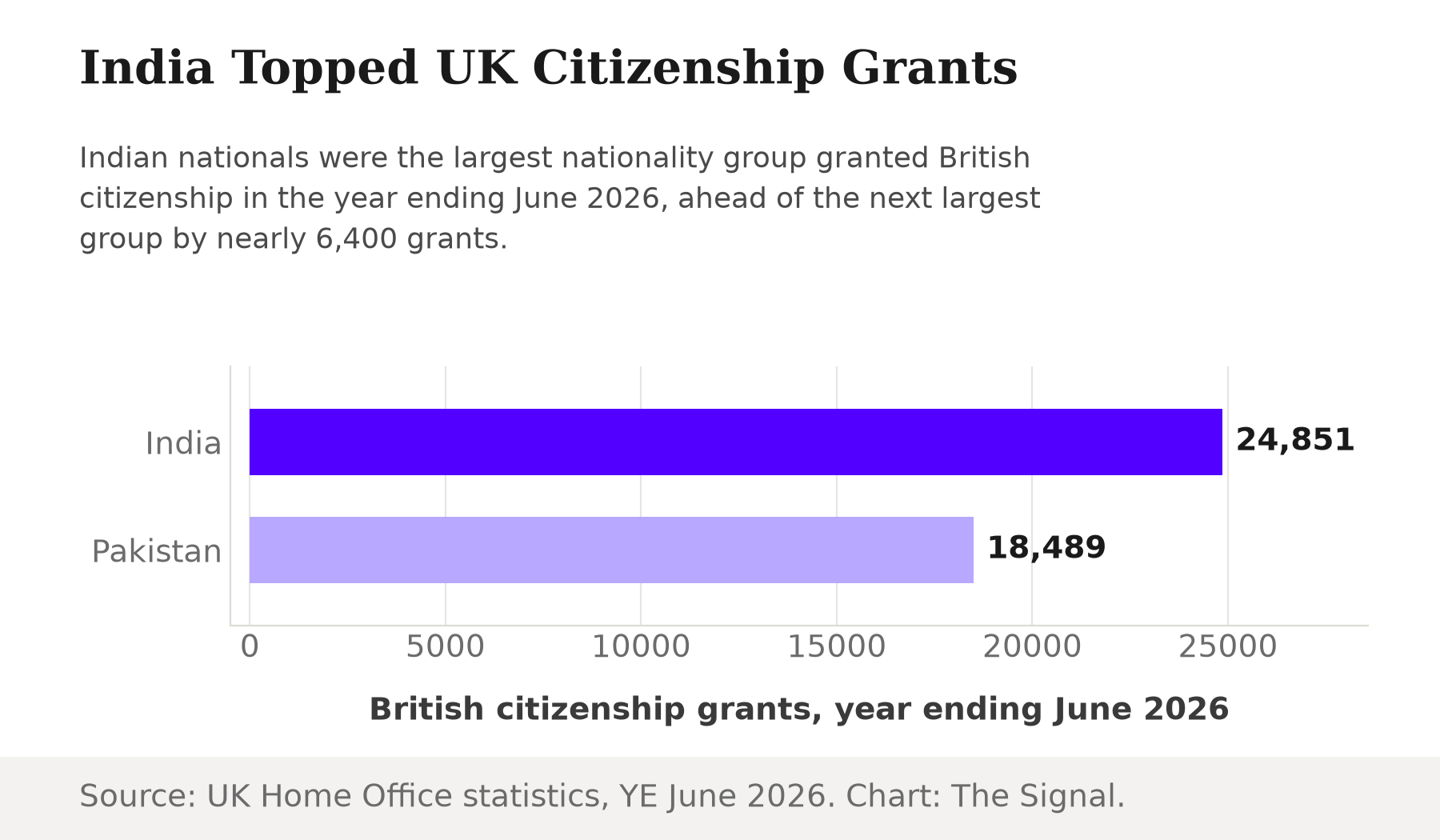
Indian nationals were granted UK settlement, or Indefinite Leave to Remain, 35,384 times in the year ending June 2026, more than any other nationality and up 51 percent on the year before. Indian nationals also topped British citizenship grants, at 24,851, ahead of Pakistani nationals at 18,489. Read as a headline number, it looks like a straightforward story of a diaspora coming of age: a decade of Indian migration to the UK, on work and study visas, finally converting into permanent status at scale.
It is worth slowing down on that framing. A jump that size in a single year is not what a maturing pipeline looks like. Visa grants, study completions and the standard qualifying clock do not suddenly compress on their own. Something outside the normal cycle has to be pulling grants forward, and the UK government has, at the same time, been running the exact kind of process that does that: a live consultation to make settlement dramatically harder to get, with no promise of protecting anyone already in the queue.
The rule the rush is racing
In November 2025, the Home Office opened a consultation proposing to raise the standard qualifying period for settlement from 5 years to 10, and to 15 years for people on the Skilled Worker or Health and Care visa routes in jobs below RQF level 6, roughly a bachelor's degree. That consultation closed on 12 February 2026.
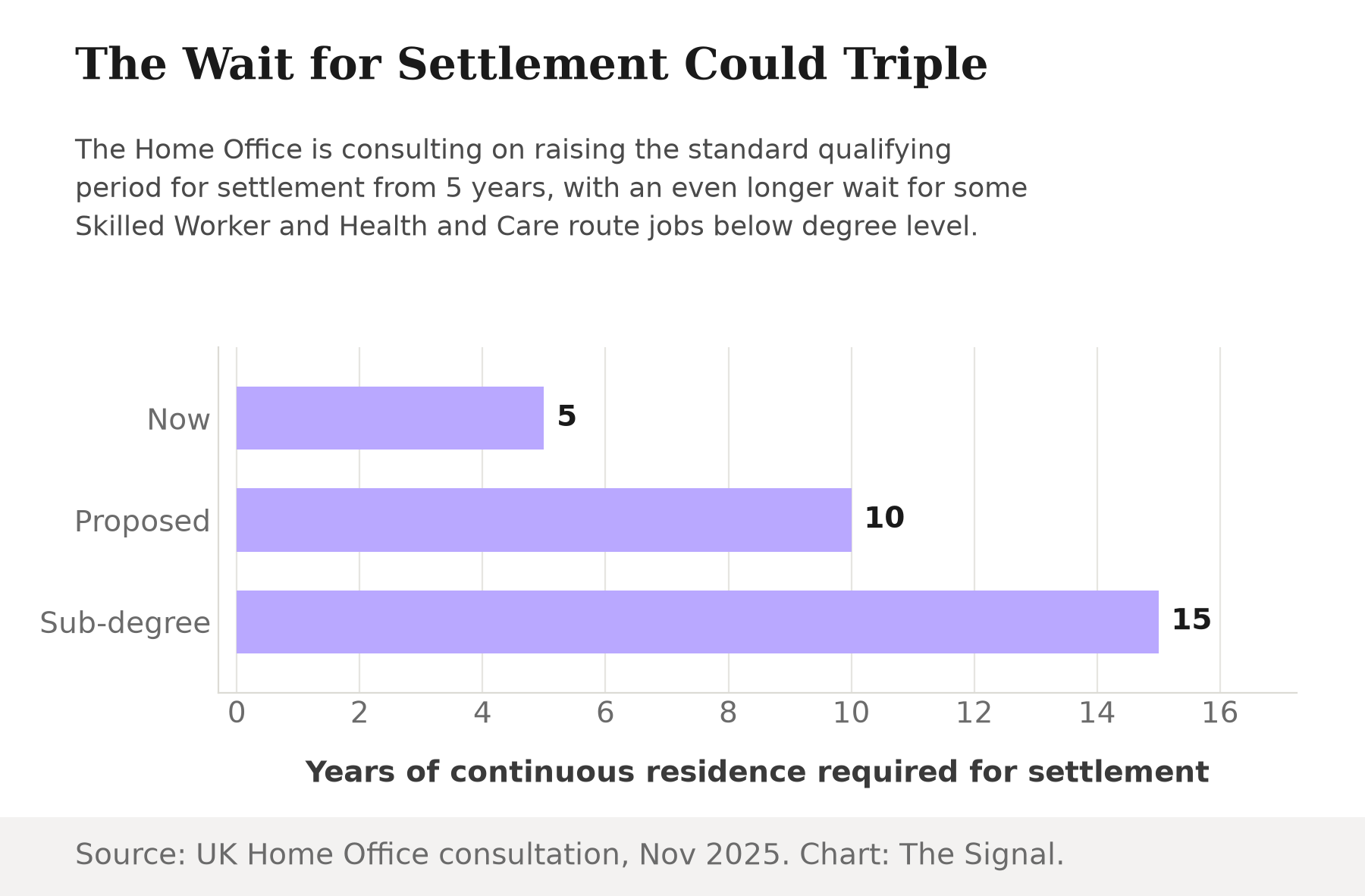
The detail that turns this from a future policy shift into a present-tense rush is who it would apply to. The Home Secretary's foreword to the consultation proposes applying the new rules to everyone in the country who has not yet been granted settlement, including people already due to reach it in the coming months and years, as soon as the immigration rules change. There is no grandfather clause on the table. Someone who arrived in 2022 expecting to qualify for settlement in 2027 under the current 5-year rule could, on this proposal, be reset to a 10 or 15-year clock overnight. The years they have already served would not count toward that longer target the way they would have under the old rule.
That is the mechanism a simple "growing diaspora" story cannot explain. More people did not simply become eligible for settlement all at once. Anyone close to eligibility, or unsure what "close" will mean once the rules change, has a direct incentive to file and get a decision before the qualifying period the consultation describes becomes the qualifying period the Home Office actually applies.
What the scale of the coming wave says
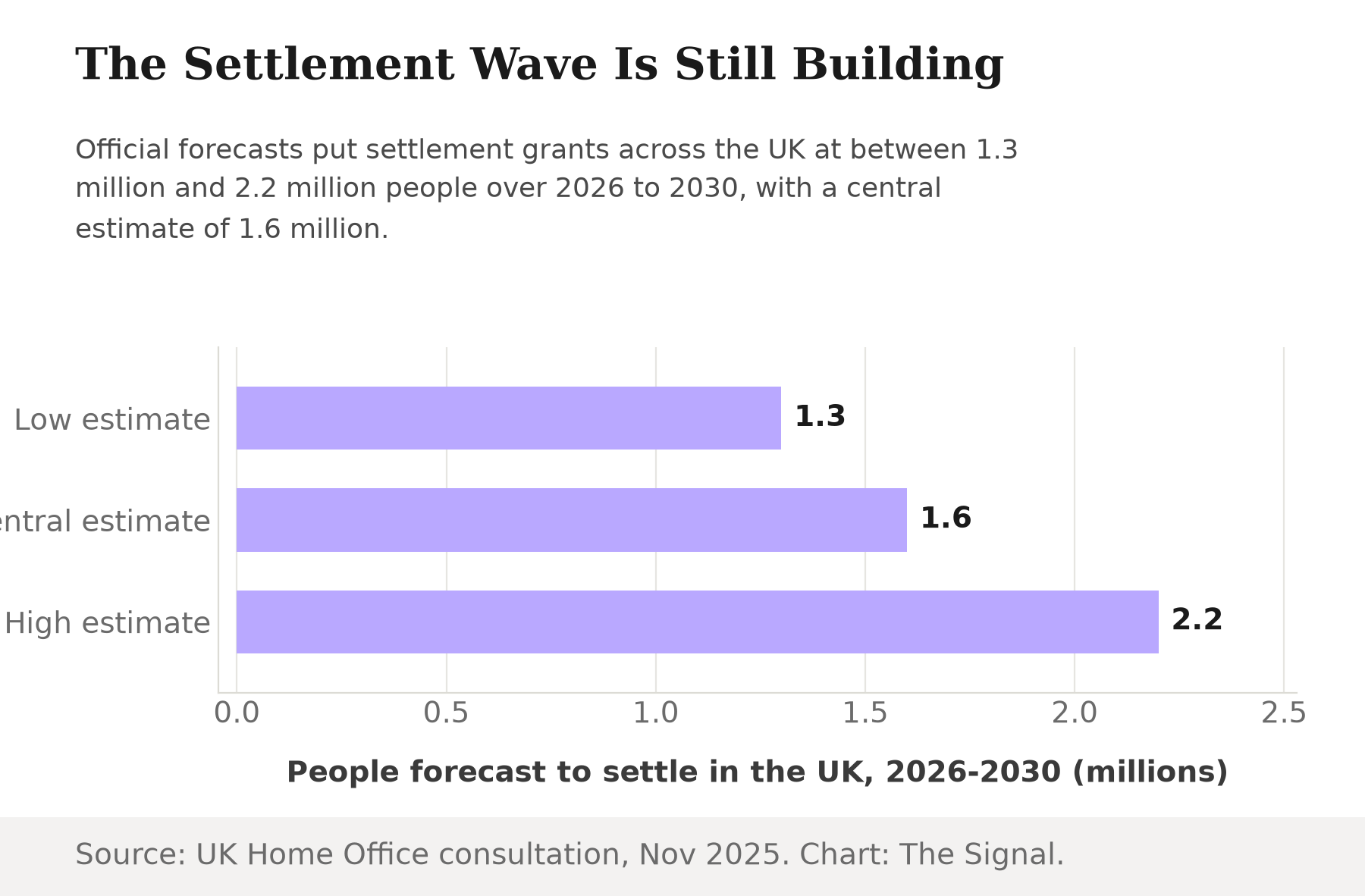
This is not a modest bureaucratic tweak. The Home Office's own forecast puts total UK settlement grants at between 1.3 million and 2.2 million people over 2026 to 2030, with a central estimate of 1.6 million, peaking at a central estimate of 450,000 grants in 2028 alone.
A government does not forecast a wave of that size, in the same document where it proposes doubling or tripling the wait to get settled, without expecting the forecast and the policy to interact. The pipeline the Home Office is describing is enormous, and the qualifying-period change is designed to sit directly in its path. For a route such as the Skilled Worker visa, which currently leads to settlement after five years of continuous residence, the government's default proposal is a 10-year qualifying period unless an applicant can show an "earned reduction" through contribution or integration criteria the consultation does not finalise. Indian nationals, as the single largest nationality group in the UK's work and study visa system, sit squarely inside that pipeline, which is why they are also the largest group visible in this year's settlement and citizenship numbers.
The overall settlement system, for scale
None of this is happening in isolation. The UK issued 537,698 total grants of indefinite leave in the year ending June 2026, up 8 percent on the year before, of which 63 percent, 336,229 grants, were EU Settlement Scheme settled-status grants rather than the work and study routes the earned-settlement consultation targets. Against that backdrop, Indian nationals' 35,384 ILR grants and 51 percent jump are not a system-wide anomaly. They are concentrated in exactly the part of the system, work and study migration, where the proposed rule change bites hardest and where a pull-forward effect would show up first.
The honest objection
The strongest case against reading this as a rush is that the timing could be coincidence rather than a trigger: settlement grants could simply be catching up after a backlog of visa holders from earlier arrivals finally reaching their qualifying point on the ordinary schedule, with the consultation's opening an unrelated event that happened to land in the same window. Applicants also cannot instantly manufacture continuous residence just because a deadline looms; a genuine rush of this kind requires a large cohort that was already near the qualifying line.
That case has real force, and an ordinary backlog effect is almost certainly part of what shows up in this jump. But it does not fully explain the size or the timing. A cohort reaching its qualifying mark on a normal schedule would show up as steady multi-year growth, not a single-year spike. That spike arrived in the same window a consultation proposing to strip away that very qualifying period, with no grandfathering, was open for comment and closed. The proposal's own design, applying the new rules to people already in the pipeline rather than only to new arrivals, is what converts an ordinary backlog effect into a rational rush: anyone who can plausibly finish sooner under the old rule now has a reason to try.
The Signal
The headline read on these numbers is that Indian migration to the UK has entered a new phase of permanence. That gets the direction right and the mechanism wrong. What the data actually shows is a government publicly weighing whether to almost triple the wait for settlement, applied retroactively to people already partway through the old one, while its own forecast describes a large multi-year wave of settlement decisions still to come. Anyone in that pipeline who could plausibly beat the new rule to the finish line had every reason to try, and Indian nationals, as the largest group in it, did so in the largest numbers. The number to watch next is not the latest grant total. It is whether the Home Office's final rule, whenever it lands, keeps that no-grandfathering clause, or drops it under the same pressure that produced this rush.
Reporting basis: the UK settlement and citizenship grant figures for the year ending June 2026, and the composition of total indefinite-leave grants, are from the UK Home Office's Immigration System Statistics release. The proposed changes to the settlement qualifying period, the no-grandfathering provision, and the 2026 to 2030 settlement forecast are from the Home Office's earned settlement consultation document and its accompanying Home Secretary foreword, with the consultation's open and close dates from the associated GOV.UK consultation page. All figures in this piece are as reported in those documents; none are The Signal's calculations.