On August 25, 2026, Indian and Chinese officials wrapped up the 25th round of Special Representatives talks on the boundary question in Beijing. The two sides agreed to two additional meeting points for their Senior Highest Military Commander mechanism and two additional border military hotline channels in the Eastern and Middle Sectors, improvements meant to keep any future face-off from turning into a repeat of 2020. China's readout describes the shared goal as a "fair, reasonable and mutually acceptable package solution" to the boundary question, and the two governments agreed to hold the 26th round of talks in India in 2027. Read quickly, this looks like steady, working diplomacy: a 25th round adding to the list of confidence measures, and a firm date already set for round 26.
It is worth slowing down on that list. A year earlier, at the 24th round in Beijing on August 19, 2025, the two sides reached what China's Foreign Ministry called ten points of consensus, including setting up an Expert Group under the Working Mechanism for Consultation and Coordination on Border Affairs to explore an "Early Harvest" of boundary delimitation in appropriate sectors, alongside reopening three traditional border trading markets. That Expert Group was the one concrete step in years aimed at actually drawing part of the line, not just managing the absence of one. The 25th round's own consensus does bring it back: point three commits the Expert Group and a companion Working Group on Border Management to advance an "Early and Substantial Harvest" of delimitation and border management, with agreeing their own Terms of Reference listed as the first task. A year after the group was created, in other words, its next assignment is still to agree on how it will work, not to report where any line might go. The rest of what the 25th round delivered was more meeting points and more hotlines: tools for managing an undrawn boundary, alongside a procedural promise about the one body meant to draw it.
The pace of contact backs that up. Presidents Xi Jinping and Narendra Modi met on the margins of the BRICS summit in Kazan on October 23, 2024, and agreed to make good use of the Special Representatives mechanism to find a fair and reasonable settlement of the boundary question; ten months later came the 24th round. Nine months after that, the Working Mechanism for Consultation and Coordination on Border Affairs held its 35th meeting in Beijing on May 27, 2026, explicitly to prepare for the 25th round. Three months after that, the 25th round happened. Each gap is shorter than the one before it, a sequence The Signal calculated from the dates in the official readouts themselves.
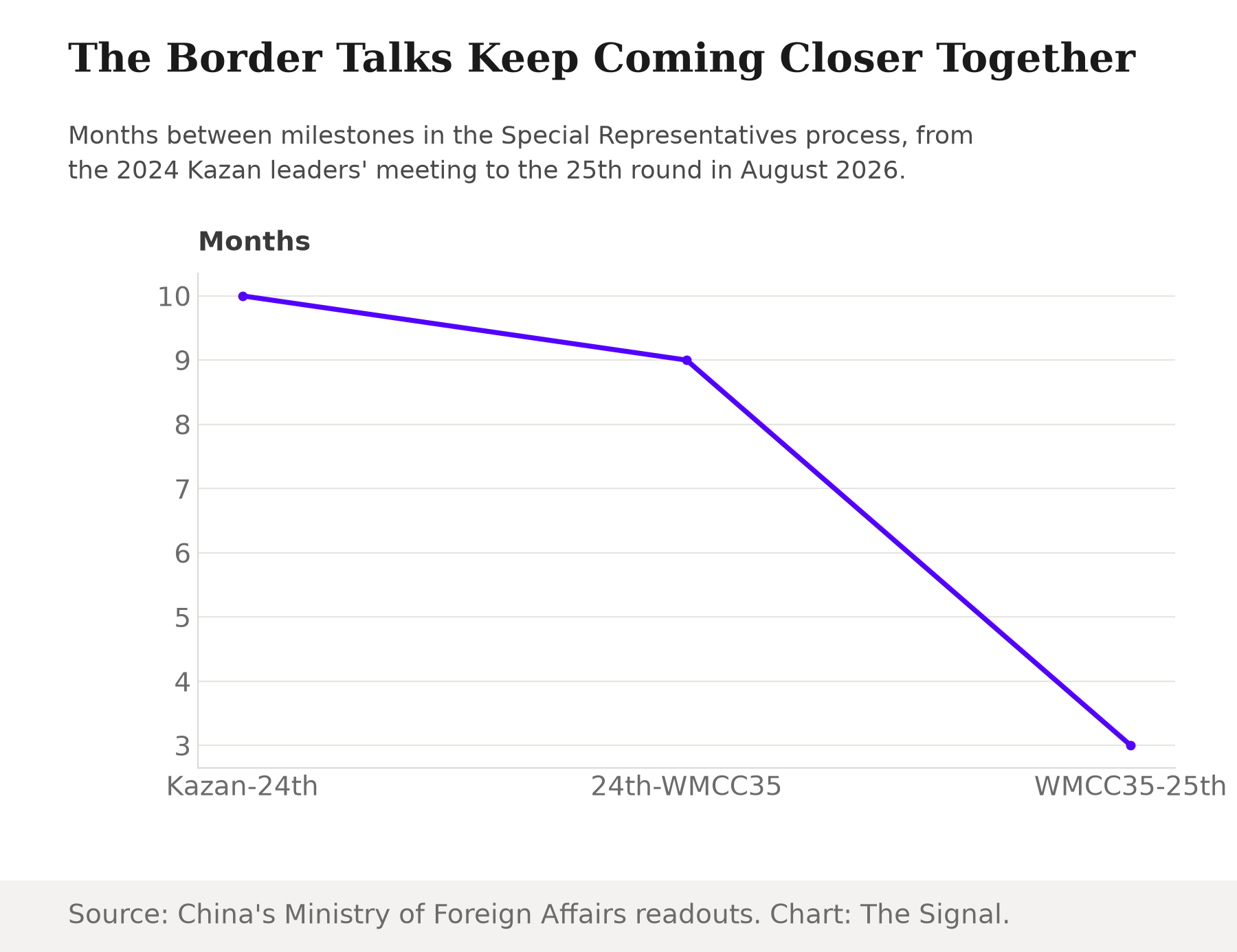
The meetings are coming closer together. The line is not.
What the last two rounds actually agreed
Laid side by side, the pattern is that the substantive item, delimitation, gets created once and then comes back a year later with nothing to show beyond a procedural task.
| Round | Date | What it agreed |
|---|---|---|
| 24th round | August 19, 2025 | Set up an Expert Group under the WMCC to explore "Early Harvest" of boundary delimitation in appropriate sectors; agreed to reopen three traditional border trading markets |
| 25th round | August 25, 2026 | Agreed two additional SHMC meeting points and two additional border military hotline channels in the Eastern and Middle Sectors; tasked the Expert Group on Boundary Delimitation with agreeing its own Terms of Reference as a first step toward an "Early and Substantial Harvest"; reaffirmed a "package solution" and scheduled the 26th round for India in 2027 |
Source: China's Ministry of Foreign Affairs, 24th round consensus statement and 25th round readouts; The Tribune's report of the 25th round's Expert Group task.
Where the caution comes from
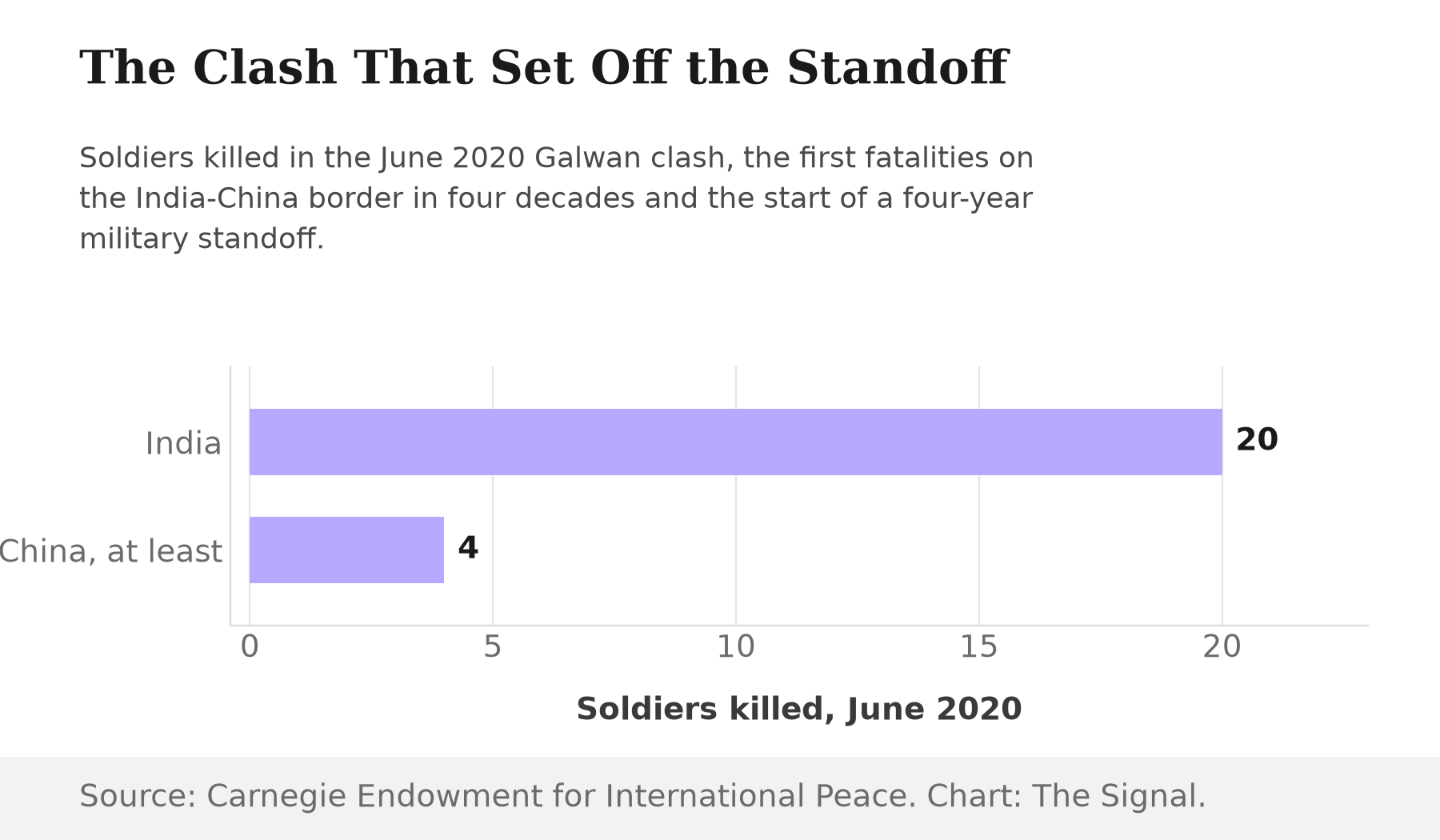
The reason any of this counts as progress at all is the decade sitting behind it. India and China share a roughly 3,800-kilometer, largely undemarcated and disputed border in the Himalayas. A June 2020 clash in the Galwan Valley killed twenty Indian soldiers and at least four Chinese soldiers, the first fatalities on the border in four decades, and it set off a four-year military standoff before a disengagement agreement was finally reached in October 2024. At the standoff's peak, both sides had deployed more than 100,000 troops along the frontier, according to a Carnegie Endowment for International Peace analysis.
Talking softly, building hard infrastructure
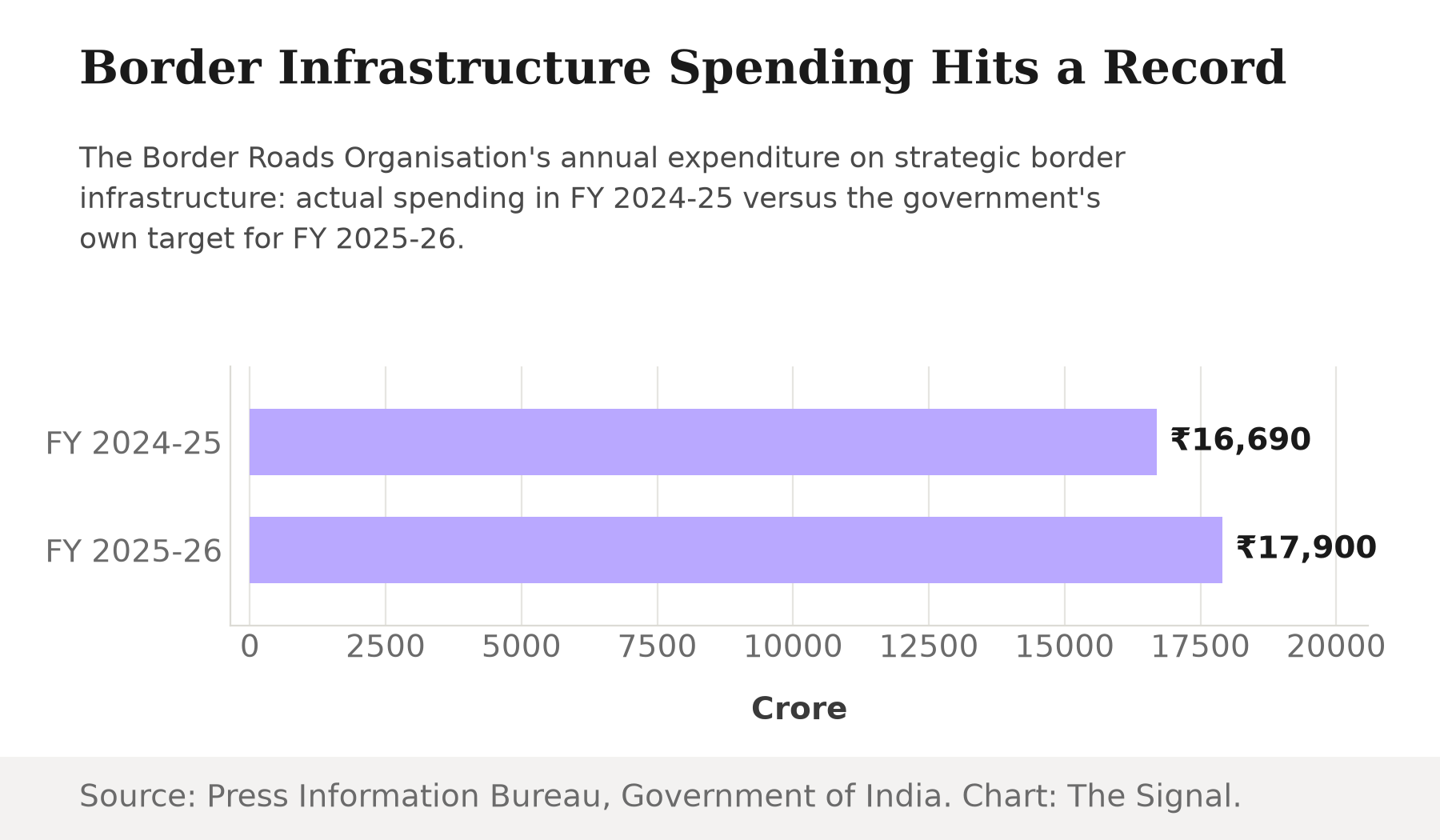
Diplomacy is not the only track moving. India's Border Roads Organisation recorded its highest-ever annual expenditure of ₹16,690 crore on strategic border infrastructure in the financial year that ended March 2025, with an even higher target of ₹17,900 crore set for FY 2025-26. That spending line does not pause for a round of talks, and it does not need the delimitation channel to reopen in order to keep growing.
The honest objection
The strongest case for reading the 25th round as real progress is that hotlines and additional command-level meeting points are exactly the groundwork that has to exist before anyone can safely discuss where a line goes. The two sides only reached a disengagement agreement in October 2024, four years after Galwan; judged against that timeline, moving from a leaders' meeting in Kazan to two new hotline channels in under two years, with the gaps between milestones shrinking each time, counts as fast. A dispute that went decades without a working military hotline now has two more of them, specifically covering the Eastern and Middle Sectors.
That case explains why the mechanism should keep meeting. It says much less about why the Expert Group the 24th round created specifically to pursue delimitation spent its first year without, on the record, doing more than being told to agree on its own Terms of Reference. If the "Early Harvest" channel had produced even a preliminary finding on any sector, the 25th round's own consensus had every reason to say so; instead it restated the mandate and added a word, "Substantial," to the target. A body a year into its mission that is still writing its own rulebook looks less like a channel building toward a result and more like a placeholder that lets both governments say the delimitation track is alive without having to show what it has actually drawn.
The Signal
Twenty-five rounds in, a mechanism the two countries created back in June 2003, the Special Representatives track keeps doing what it has always done well: producing hotlines, meeting points, reopened markets and a fresh date on the calendar. What it has not done, this round or the one before it, is move any stretch of the boundary from disputed to defined. The 26th round is already scheduled, for India sometime in 2027. Watch what that round's readout says about the Expert Group's Terms of Reference. If they are finally agreed and the group reports even one sector under discussion, the delimitation channel has started to move. Repeat the 25th round's language instead, an "Early and Substantial Harvest" still waiting on its own paperwork, for a third straight year, and the pattern holds: the mechanism will keep meeting, more often each time, and the line will keep waiting.
Reporting basis: the readouts of the 24th and 25th rounds of Special Representatives talks, the Xi-Modi meeting in Kazan and the 35th WMCC meeting are China's Ministry of Foreign Affairs' own official statements. The Galwan clash toll and the standoff's peak troop deployment are from a Carnegie Endowment for International Peace analysis. The border's length and the October 2024 disengagement date are as reported by Reuters, via The Kathmandu Post. The Border Roads Organisation's expenditure figures are from a Press Information Bureau release. The 25th round's assignment of Terms of Reference to the Expert Group on Boundary Delimitation is as reported by The Tribune. The Special Representatives mechanism's June 2003 origin is as reported by The Wire. The month-by-month gaps between diplomatic milestones are The Signal's calculations from the dates given in those official readouts.