Between August 2025 and August 2026, the Indian Army ran a routine slice of its procurement: tenders on the Government e-Marketplace for Hesco bastions and UG FSC bunkers, the wire-and-fabric barriers that harden a forward post against blast and small-arms fire. Read only the outcomes and the system looks like it did its job. Bids came in, the portal ranked them by price, contracts got signed to the winning bidder. Thirty-three such tenders closed in that window, each one, on paper, a contest among independent suppliers.
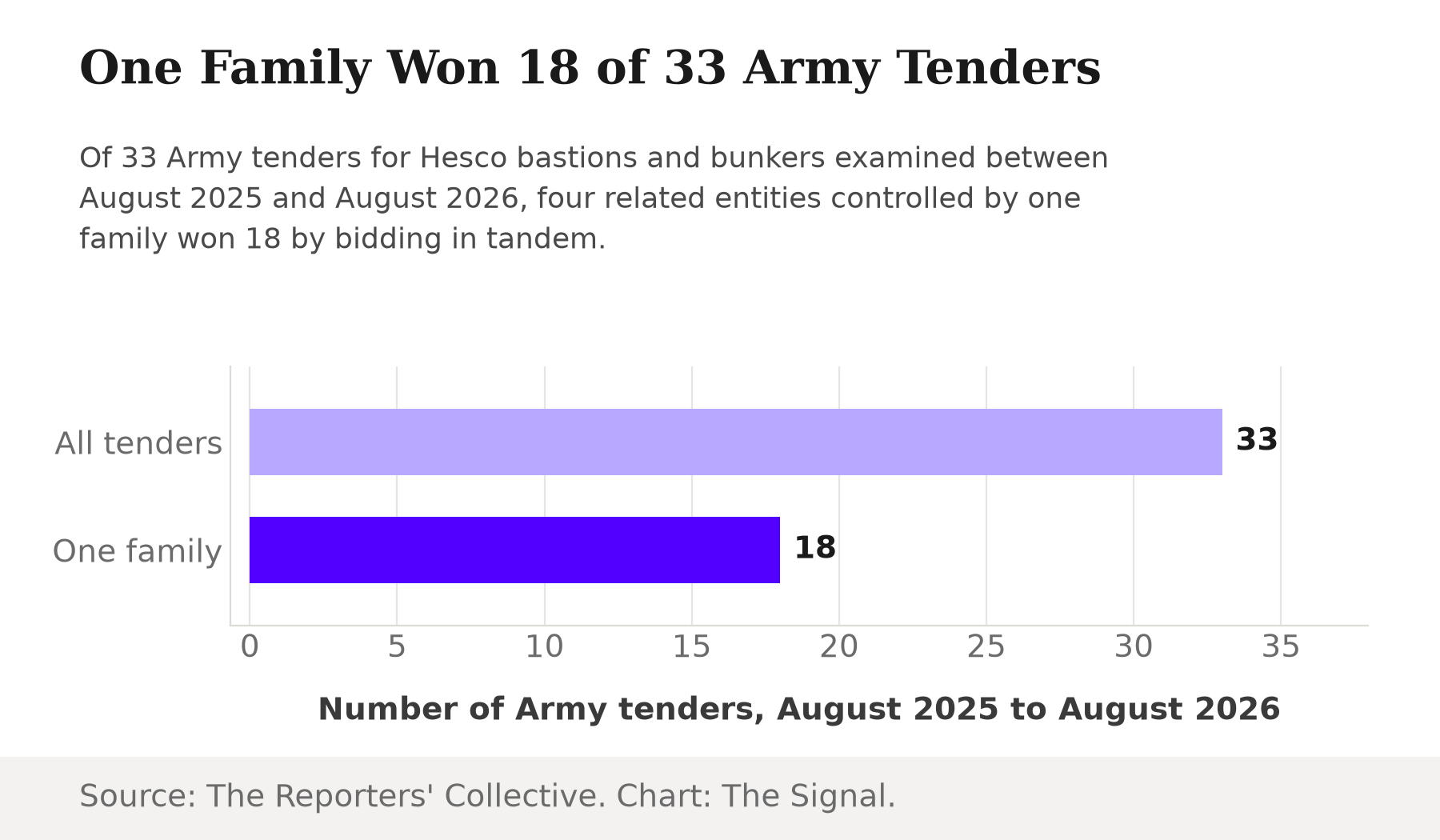
It is worth slowing down on who was actually competing. The Reporters' Collective's investigation found that four separately registered companies, all controlled by one family, won 18 of those 33 tenders by bidding in tandem, and in contracts worth around Rs 9 crore, at least two of the four related entities bid directly against each other for the same job.
Eighteen of thirty-three: a single family's entities did not just win occasionally; they took the majority of the contracts the investigation checked, in a market that is supposed to run on rival firms undercutting one another.
The rule that was already on the books
This is not a grey area GeM's own terms left open. GeM's own Terms and Conditions, reproduced in The Reporters' Collective's investigation, state under Clause 29, "One Bid per Bidder," that closely related sister or associated concerns, or firms sharing a common director, partner, member or owner, cannot bid against each other in the same tender, and that doing so disqualifies the bids. The rule anticipates precisely the pattern the investigation found: it is written for the case where what looks like four rivals is actually one economic actor spread across four registrations.
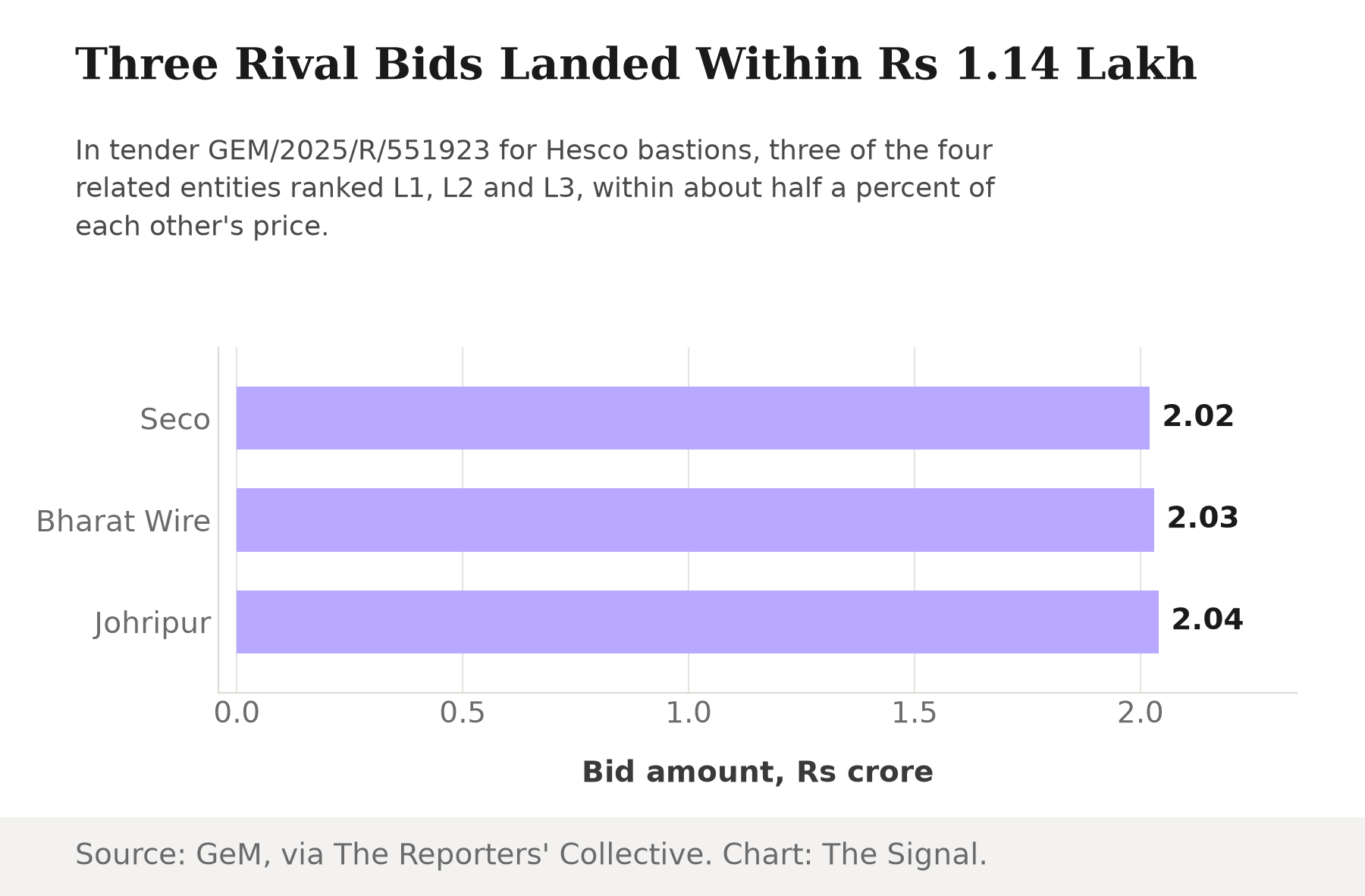
One tender shows how tight that spread can get in practice. In a GeM tender for Hesco bastions, tender number GEM/2025/R/551923, whose financial-evaluation table is reproduced in the same investigation, the three financially qualified bidders were Seco Machines Private Limited at Rs 2,02,45,946 (ranked L1), Bharat Wire Mesh Private Limited at Rs 2,02,72,160 (ranked L2), and Johripur Steel & Alloys at Rs 2,03,59,540 (ranked L3), three of the four related entities the investigation identified. The gap between the lowest and highest of those three bids works out to about Rs 1.14 lakh, under one percent of the lowest price. On a reverse-auction portal designed to reward the sharpest undercut, three supposed competitors landed within a rounding error of each other.
The family behind the filings
The link is not circumstantial; it is in the companies' own paperwork. Bharat Wire Mesh's audited financial statement, filed with the Ministry of Corporate Affairs and also reproduced in the investigation, discloses under Accounting Standard AS-18 that Mohit Gupta and Ashish Gupta are its Key Management Personnel as directors, that Johripur Steel & Alloys and Kansal Wirenetting are entities in which those two have "significant influence," and that Kaushlya Devi is a director's relative. That single disclosure, made for tax and audit purposes and not for a tender file, is what ties three of the four supposedly independent bidders in the GEM/2025/R/551923 tender back to the same two people.
Not an isolated case
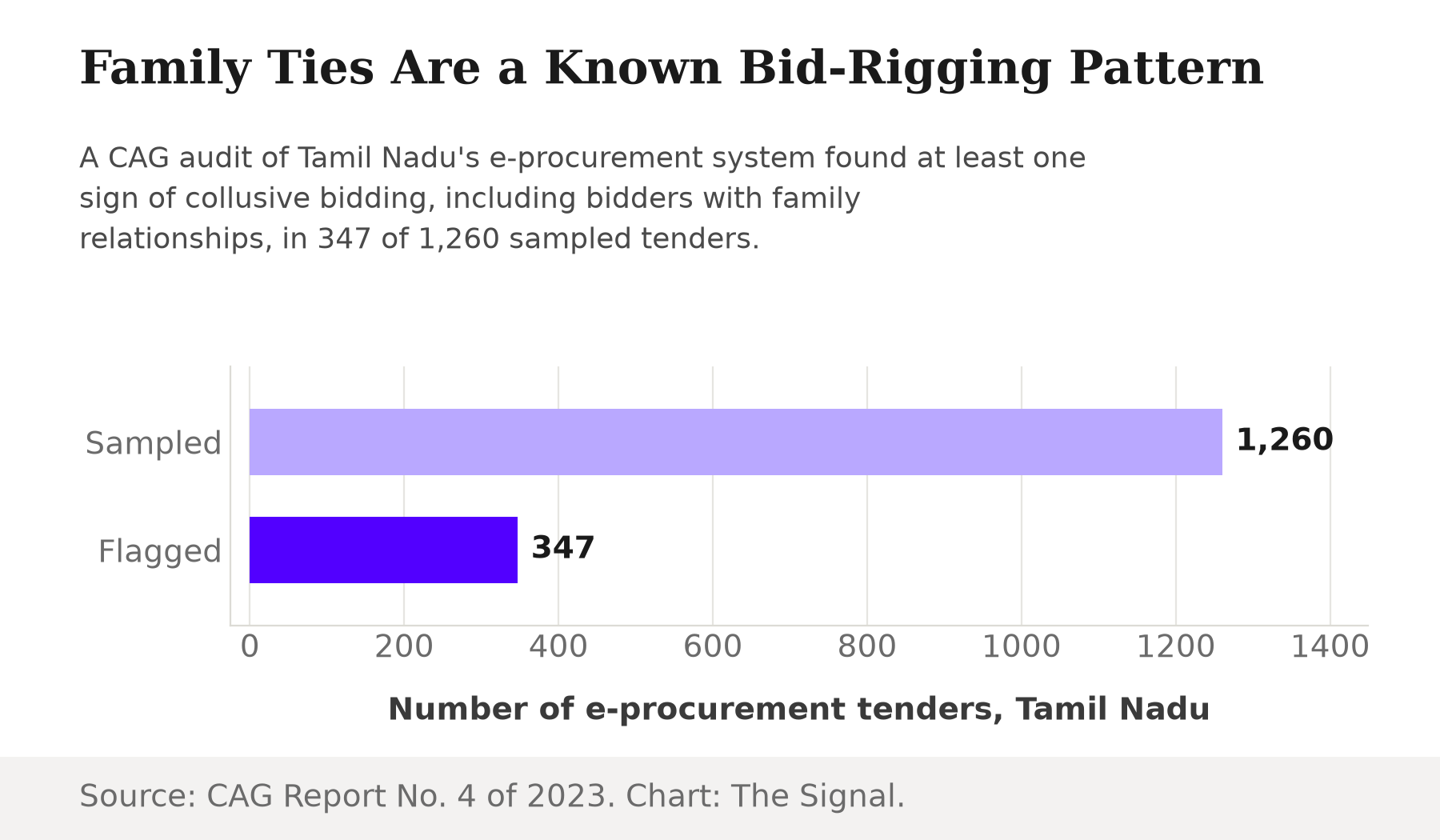
Family ties among rival bidders are not a one-off quirk of this particular tender; auditors have already mapped the pattern nationally. A CAG performance audit of e-procurement found "bidders with family relationship" to be one of seven documented patterns of bid rigging and cartelisation, alongside things like bid rotation and bids submitted from the same IP address, with at least one such collusive-bidding pattern detected in 347 of 1,260 sampled tenders.
Defence tenders specifically have already produced a prosecuted case of exactly this pattern. In a January 2026 order, the Competition Commission of India found two Ludhiana-based textile firms guilty of collusive bidding on a Directorate General of Ordnance Services tender for woollen underpants, relying on evidence including email exchanges, call data records and business linkages with related entities, on top of identical pricing and near-simultaneous bid submissions. Two different categories of Army supply, two different sets of firms, the same underlying move: related companies posing as rivals inside a defence procurement process.
The honest objection
The strongest case against reading this as a systemic failure is that the rule already exists and already works when it is checked. Clause 29 does not need rewriting; it already bans exactly what the investigation found and already disqualifies bids on that basis. GeM has also told the government that it is deploying advanced analytical tools to flag "suspected collusive bidding behaviour" and other anomalies, across a platform that had by April 2026 reached a cumulative Gross Merchandise Value of Rs 18.4 lakh crore. On that reading, this is a system catching up to its own scale, not a system that has failed to design for the problem.
That case holds up only until you ask who actually caught this one. Clause 29 disqualifies a bid once a shared director or owner is established; it does not describe a check that runs automatically before a contract is signed. The GEM/2025/R/551923 tender ran its full course, from bid submission through to a ranked, financially evaluated result, before The Reporters' Collective flagged that three of the "competitors" traced back to two people. The Ludhiana case took email records and call data, the kind of evidence a competition regulator assembles after the fact, not something a bidding portal checks in real time. GeM's own AI tools are new and their track record against a case like this one is untested. Even with those tools running, the pattern that caught this particular family's four entities was, once again, an outside investigation, not the platform itself.
The Signal
Clause 29 already says what happened in these 18 tenders should not have been possible. The gap is not the rule; it is that nothing at the moment bids are ranked cross-checks a company's declared directors against the same corporate filings The Reporters' Collective pulled after the contracts were signed. That check is not exotic. The information already sits in the Ministry of Corporate Affairs' own records, the same records that named Mohit Gupta, Ashish Gupta and their relatives across three of these bidders. Watch what GeM does next: whether its new analytics start catching a case like this one before the award, or whether the next four names that look like four rivals are only unmasked by a reporter, an auditor or a competition case, months or years after the contract is signed.
Reporting basis: the tender-winning pattern, the number of related entities, and the value of the contracts in which they bid against each other are from The Reporters' Collective's investigation, published 27 August 2026, which also reproduces GeM's own Clause 29 terms and conditions, the financial-evaluation table for tender GEM/2025/R/551923, and Bharat Wire Mesh's Ministry of Corporate Affairs filing inline in its story; all four rest on that single newsroom's reporting and document retrieval. The nationwide bid-rigging pattern data is from the Comptroller and Auditor General's 2023 performance audit of Tamil Nadu's e-procurement system. GeM's cumulative transaction volume and its use of analytics against suspected collusive bidding are from a Press Information Bureau release quoting GeM's chief executive. The Ludhiana defence-tender collusion order is per LiveLaw's report on the Competition Commission of India's ruling; only LiveLaw's account of that order was checked, not the order itself. The roughly Rs 1.14 lakh gap between the tightest and widest of the three bids on tender GEM/2025/R/551923, and its share of the lowest bid, are The Signal's calculations from that tender's own financial-evaluation figures.