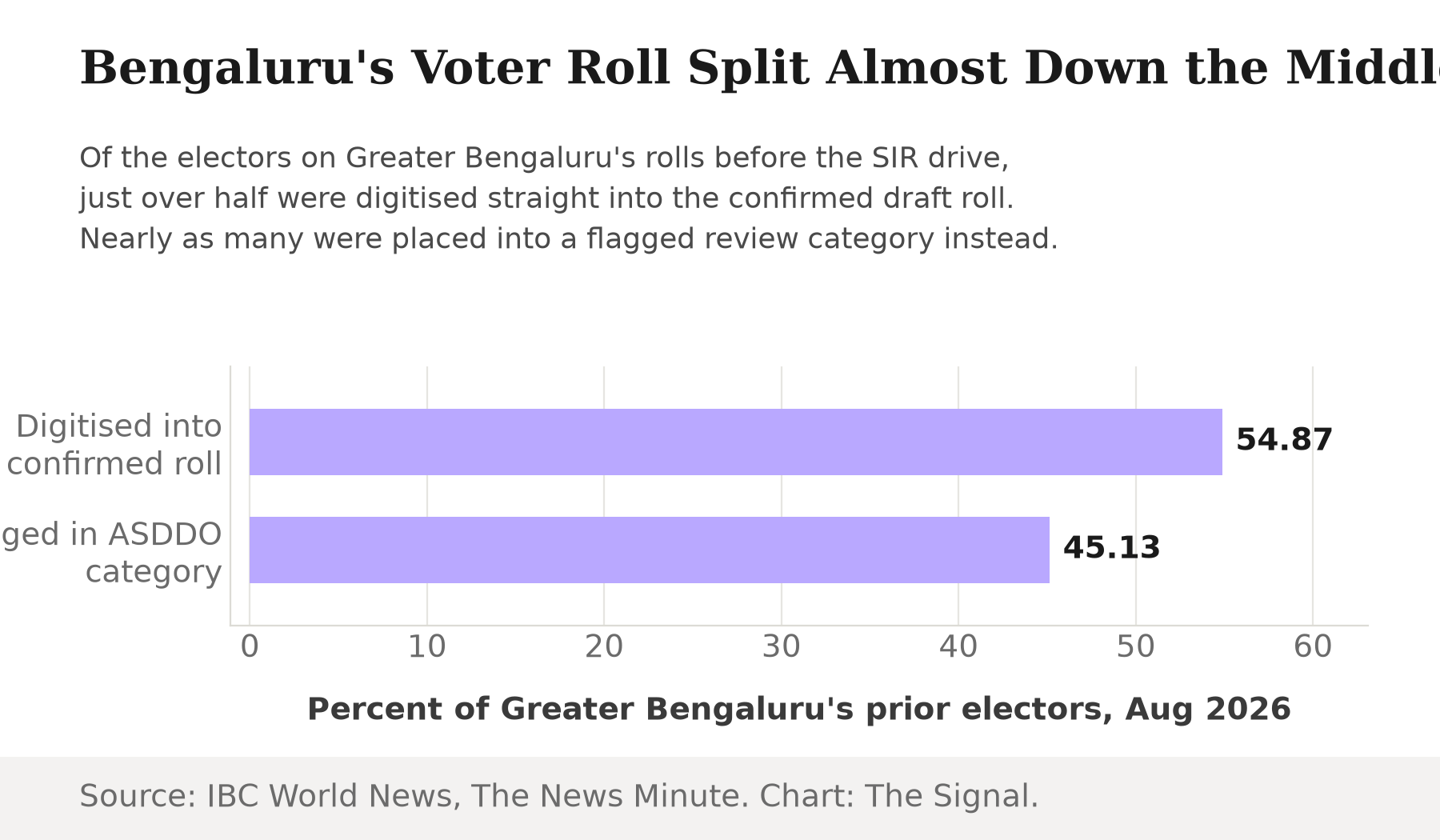
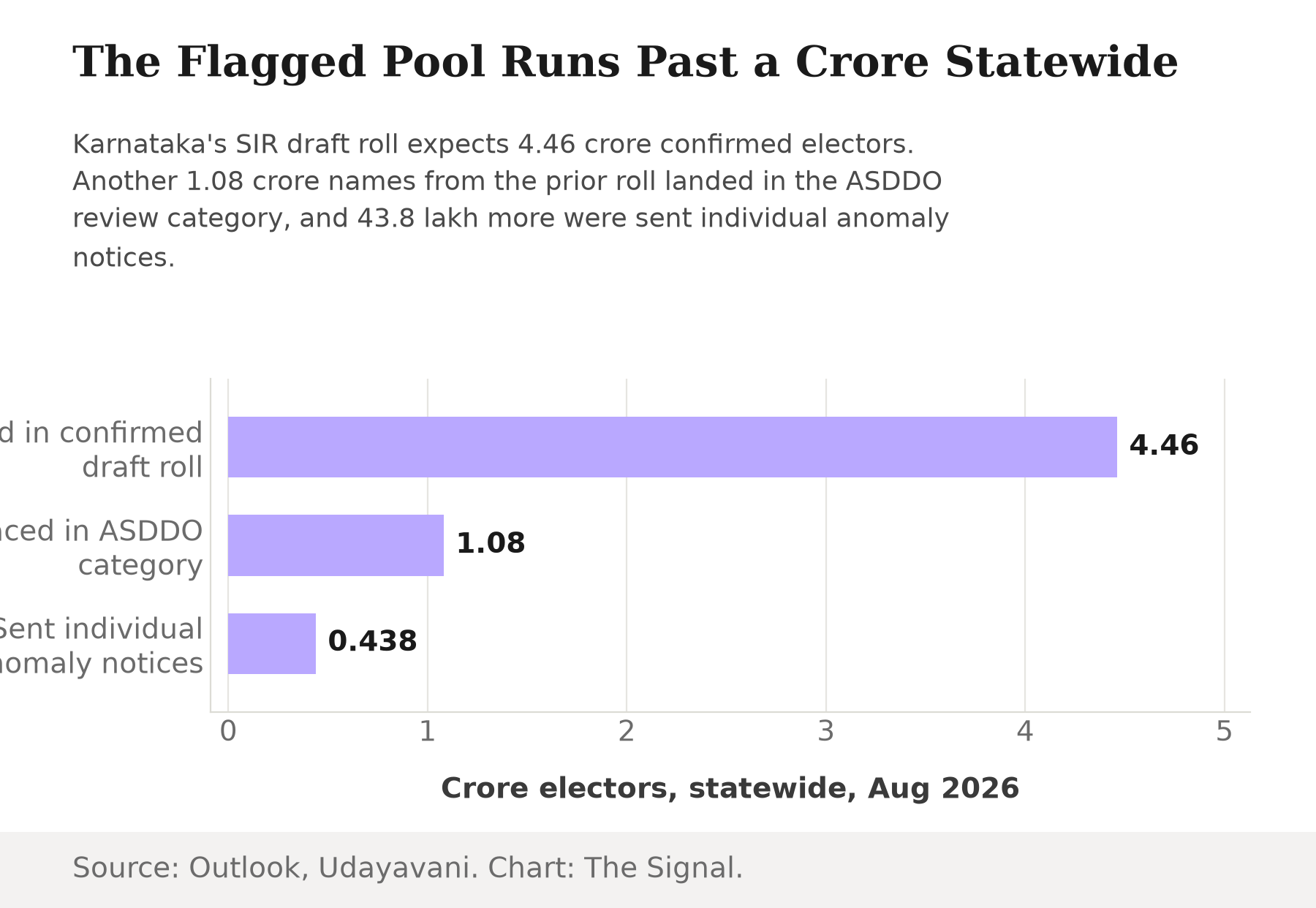
Karnataka published the draft electoral roll from its Special Intensive Revision on August 24, 2026, the output of a 49-day door-to-door enumeration drive that closed on August 17. Statewide, the Chief Electoral Officer's office expects about 4.46 crore electors to carry into the confirmed roll, while roughly 1.08 crore names from the existing list have been placed in the Absent, Shifted, Duplicate, Dead and Others (ASDDO) category. In Greater Bengaluru specifically, just 56,99,660 of the 1,03,88,363 voters recorded on June 16, 2026, or 54.87 percent, have been digitised into the confirmed draft roll. The official framing is straightforward: a revision drive clearing years of accumulated duplicate, dead and moved-away entries off the rolls before Karnataka's next state election.
It is worth slowing down on how a name actually lands in that ASDDO bucket. Across Greater Bengaluru, 46.88 lakh electors, about 45.13 percent of the roll recorded on June 16, 2026, were classified under the ASDDO categories, almost the mirror image of the 54.87 percent who cleared into the confirmed roll.
That even split invites a question the "duplicates and dead entries" framing does not answer: how does a Booth Level Officer (BLO) actually decide which bucket a name falls into? Under the Election Commission's SIR order, for electors whose enumeration forms are not returned, the BLO may identify a probable cause, such as Absent, Shifted or Death/Duplicate, based on an inquiry from nearby electors, not from the elector's own documents. That comes from the order as relayed in an October 2025 press note by Goa's Chief Electoral Officer, describing the same national SIR order applied in Karnataka. In other words, when a household is not home to accept a form, the decision on whether that person is a genuine duplicate, a death or simply away, runs on a neighbor's best guess, not on a document at all.
That matters because the document test itself was never built around residence. To be included via the enumeration form, a voter may submit any two documents from a list built around identity, birth, education or caste, a birth certificate, passport, SSLC or educational certificate, Forest Rights Certificate, an OBC/SC/ST or other caste certificate, or the National Register of Citizens where it exists, not a tenancy agreement or proof of current address. So the system asks for identity, not tenancy, and then, for anyone it cannot reach in person, falls back on what the neighbors say instead of the identity documents it asked for in the first place.
Who a missed knock catches
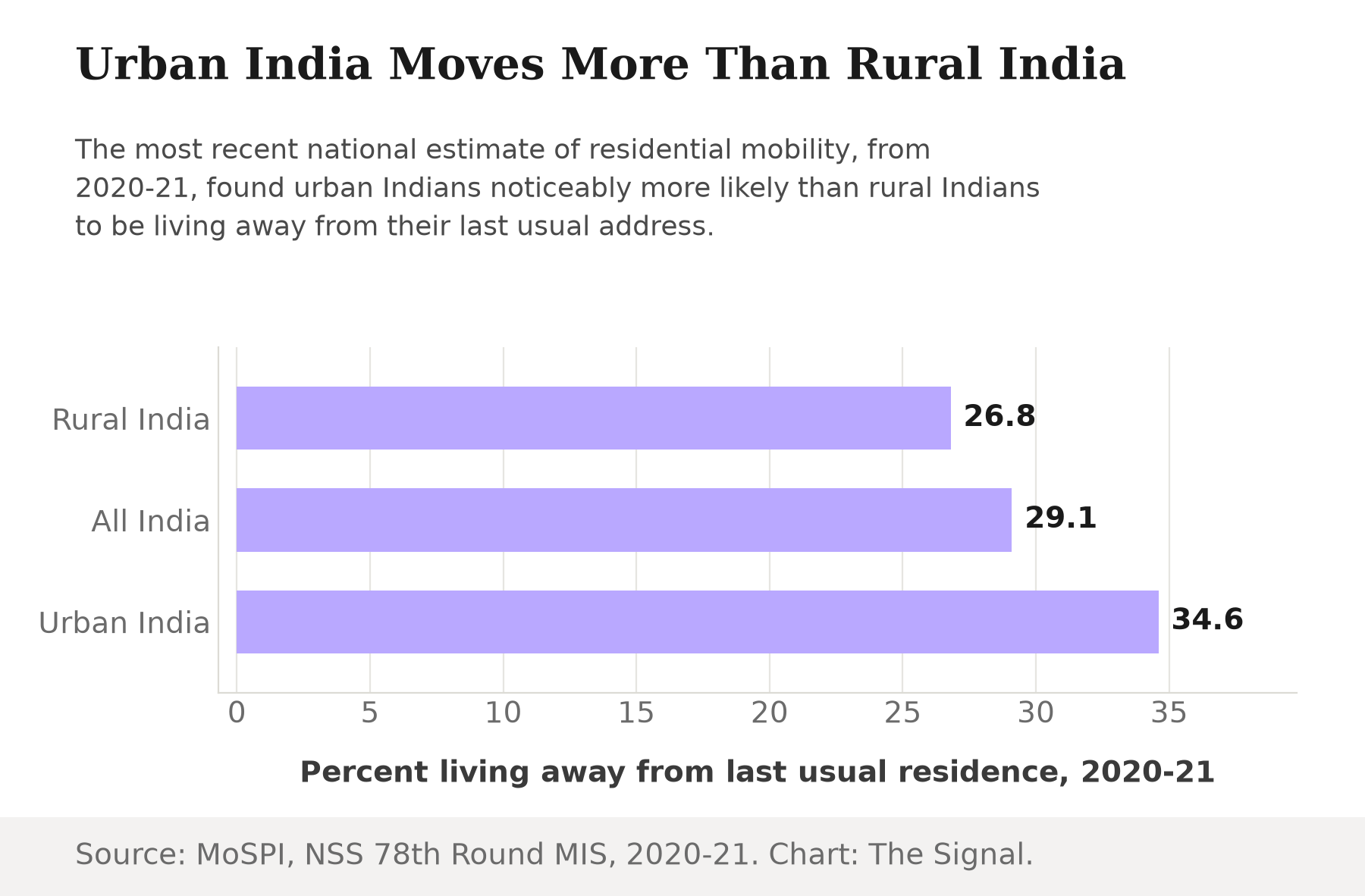
Nationally, the most recent government estimate of residential mobility, from the 2020-21 survey year, found 29.1 percent of Indians reporting a current residence different from their last usual residence, 34.6 percent in urban areas against 26.8 percent in rural areas. That gap does not, on its own, explain Greater Bengaluru's 45.13 percent ASDDO rate, which runs well above even the highest of those 2020-21 figures. But it identifies who the neighbor-inquiry mechanism is built to catch: not the person the roll accidentally recorded twice, but the renter, tenant or migrant worker who has moved since the roll was last checked and was not standing at the door when the BLO called.
Statewide, the same CEO figures imply the prior Karnataka roll held about 5.54 crore electors, the 4.46 crore expected to remain plus the 1.08 crore now in ASDDO. That works out to a statewide ASDDO rate of roughly 19.5 percent, both figures our calculation from the CEO's own numbers. That is less than half of Greater Bengaluru's 45.13 percent. A single, unusually urban authority carrying more than double the state's own flagged rate is consistent with an urban-mobility effect, though the CEO's office has not published a mechanism breakdown that would confirm it. The spread inside Greater Bengaluru itself points the same way: Bommanahalli carried the highest ASDDO share of any assembly constituency in the city, 55.06 percent, or 2,67,014 of its 4,84,973 voters, with four more constituencies also crossing the halfway mark, well above the citywide 45.13 percent average.
| Level | Prior roll (est.) | Expected in confirmed draft roll | Placed in ASDDO |
|---|---|---|---|
| Greater Bengaluru Authority | 1,03,88,363 (June 16, 2026) | 56,99,660 (54.87%) | 46.88 lakh (45.13%) |
| Karnataka, statewide | ~5.54 crore (est.) | 4.46 crore | 1.08 crore (~19.5%) |
Source: IBC World News; The News Minute; Outlook. Statewide prior-roll estimate and share flagged are The Signal's calculations from those figures.
The state's corrective machinery is not small either. Beyond the 1.08 crore in ASDDO, the CEO's office will separately issue verification notices to 43.8 lakh voters statewide whose enumeration forms carried anomalies or could not be mapped to the existing roll, a distinct pool from those already flagged ASDDO.
Two parties, one design choice
The political fight over the draft roll runs in both directions. Karnataka Chief Minister DK Shivakumar said the SIR process is an attempt to delete 1 crore voters in the state, calling for a "Quit Vote Chori" movement on August 10, 2026. Going the other way, BJP and JD(S) leaders, including three Union ministers, formally told the Election Commission in a July 6, 2026 letter that Booth Level Officers deviated from mandatory door-to-door verification, instead filling enumeration forms at community halls, mosques and BLO residences, calling it a process that shows "zero regard" for its own rules. Karnataka Congress president BK Hariprasad defended the practice on record rather than denying it: community halls, mosques and temples were being used to help people fill enumeration forms because BLOs said they could not reach slum areas, he said, so that illiterate and economically weaker voters were not deprived of their franchise.
Both accusations, deliberate suppression on one side, corner-cutting fieldwork now admitted on the other, point at the same single design choice: a form not personally collected gets resolved by inference rather than documentation. Whether the failure to reach a voter is systemic or just sloppy, the ECI's own order lets that gap close itself with a guess, and the guess always resolves toward removal, never toward confirmation.
The honest objection
The strongest case for the process as designed is scale. Verifying 5.54 crore-odd electors by document, one by one, inside a 49-day window is not achievable, and some degree of on-ground inference is a practical necessity, not a targeting mechanism. That is precisely why a notice-and-claims stage exists at all: the 43.8 lakh anomaly notices, and the wider ASDDO pool, are not final deletions, they are flags a voter can contest before the roll is confirmed.
That case is real, but it does not erase the asymmetry it rests on. Once a name lands in ASDDO on a neighbor's inference rather than a document, the burden flips: the state no longer has to document a removal, the individual now has to notice, understand and act on a notice tied to an address they may no longer occupy. The national mobility data points to the same population: the people least likely to be reliably reachable at that old address are also the people least likely to catch the notice in time.
The Signal
Karnataka's SIR draft roll is not being contested over whether duplicates and dead entries needed clearing, both sides agree that work was overdue. It is being contested over what happens when a BLO's knock goes unanswered, and on that point the Election Commission's own order already picked a side: infer, don't confirm. Renters, tenants and migrant workers are structurally the group most likely to not be home when that knock comes, not because anyone targeted them, but because the rule treats absence and duplication as the same input. Watch the claims-and-objections window, open August 24 to September 23, 2026, ahead of the final roll due October 27: if the corrections skew toward people who simply moved, that confirms the mechanism read. A skew toward genuine duplicates and deaths instead would back the purge framing. Either way, the number that will settle the argument is not how many names were flagged. It is how many of them come back.
Reporting basis: the Greater Bengaluru digitisation figure is per IBC World News, citing the Karnataka CEO's SIR draft roll data; the Greater Bengaluru ASDDO share is per The News Minute, citing the same CEO data. The statewide draft-roll and ASDDO totals are per Outlook, and the statewide anomaly-notice count is per Udayavani, both citing the CEO's office. The enumeration form's document list is per Star of Mysore's account of the Election Commission's order. The BLO inference procedure for non-returned forms is per the Election Commission's SIR order, as relayed in an October 2025 press note by the Chief Electoral Officer of Goa, the same national order applied in Karnataka. Chief Minister DK Shivakumar's allegation is per The Hans India; the BJP and JD(S) leaders' joint letter is per The News Minute; KPCC president BK Hariprasad's on-record defense of the practice is per Mangalorean.com. The Bommanahalli constituency figure is per Siasat Daily, citing the Greater Bengaluru Authority's Chief Commissioner. The claims-and-objections and final-roll dates are per All About Belgaum's account of the Election Commission's SIR schedule. The national residential-mobility figures are from the Ministry of Statistics and Programme Implementation's press note on the NSS 78th Round Multiple Indicator Survey, 2020-21, the most recent nationwide estimate available. The prior statewide roll size, the statewide ASDDO share and the urban-versus-statewide comparison are The Signal's calculations from those figures.