On 20 August 2026, a nine-judge bench of India's Supreme Court delivered the ruling everyone in the country's labour-law world had waited years for: a reformulated test for what counts as an "industry" under the Industrial Disputes Act. The judgment, authored by Chief Justice Surya Kant, restates the test that decides which employers, from factories to hospitals to charities, must extend the Act's protections to their workers. Nine judges, the largest bench India convenes short of a full constitutional bench, sat specifically to end decades of lower courts pulling that definition in different directions. The story wrote itself: after a wait this long, India finally has a settled answer.
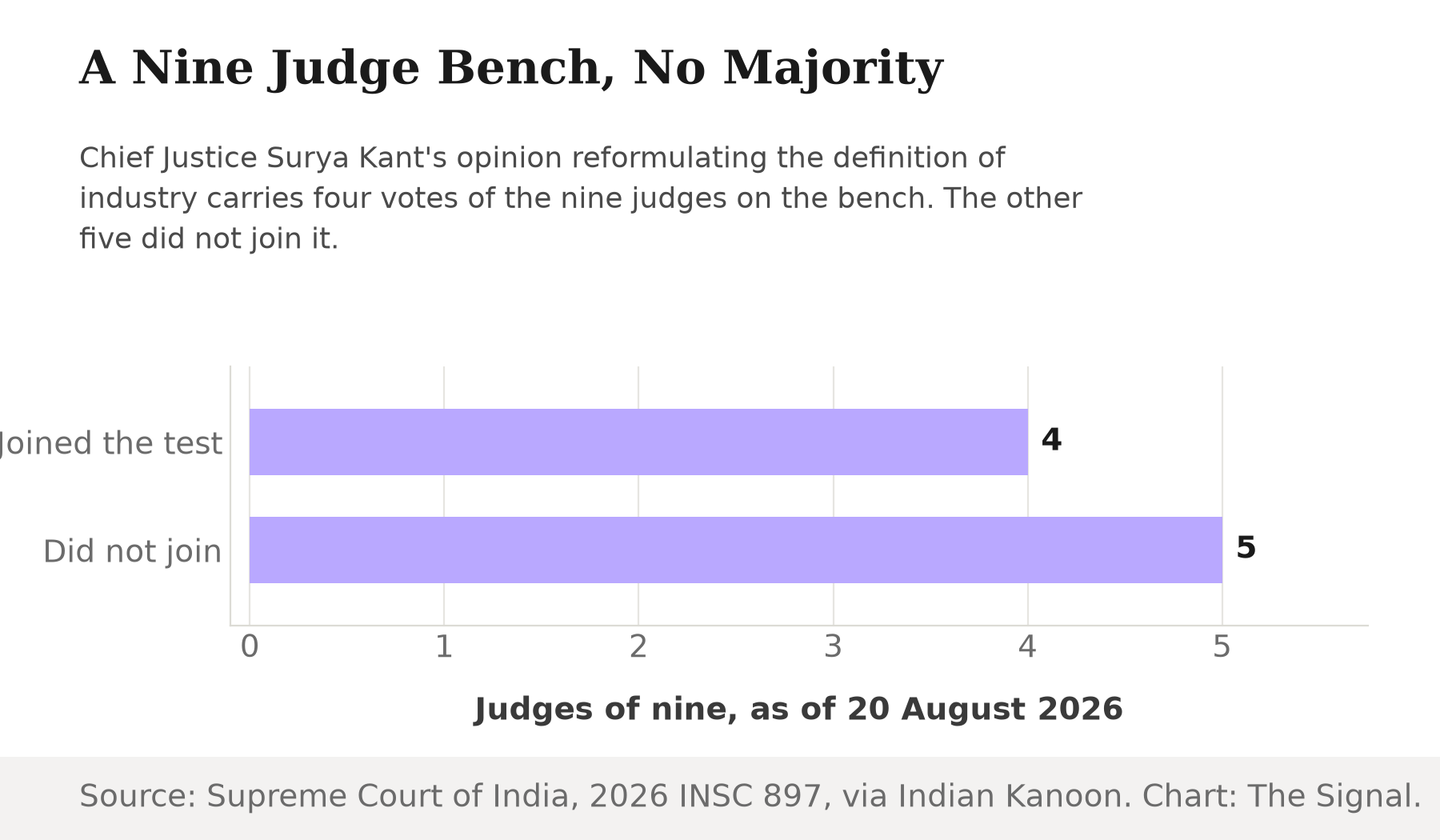
It is worth slowing down on that framing. Chief Justice Surya Kant's opinion reformulating the test speaks for himself and only three other judges, Satish Chandra Sharma, Alok Aradhe and Vipul M. Pancholi. Nine judges heard the case. Four signed the opinion that rewrites the rule.
Four of the bench's nine judges backed the reformulated test.
That is not a majority. Five of the nine judges did not join the opinion that rewrites the test, leaving the reformulation without the backing a controlling ruling needs.
A question the Court has been trying to close since 2005
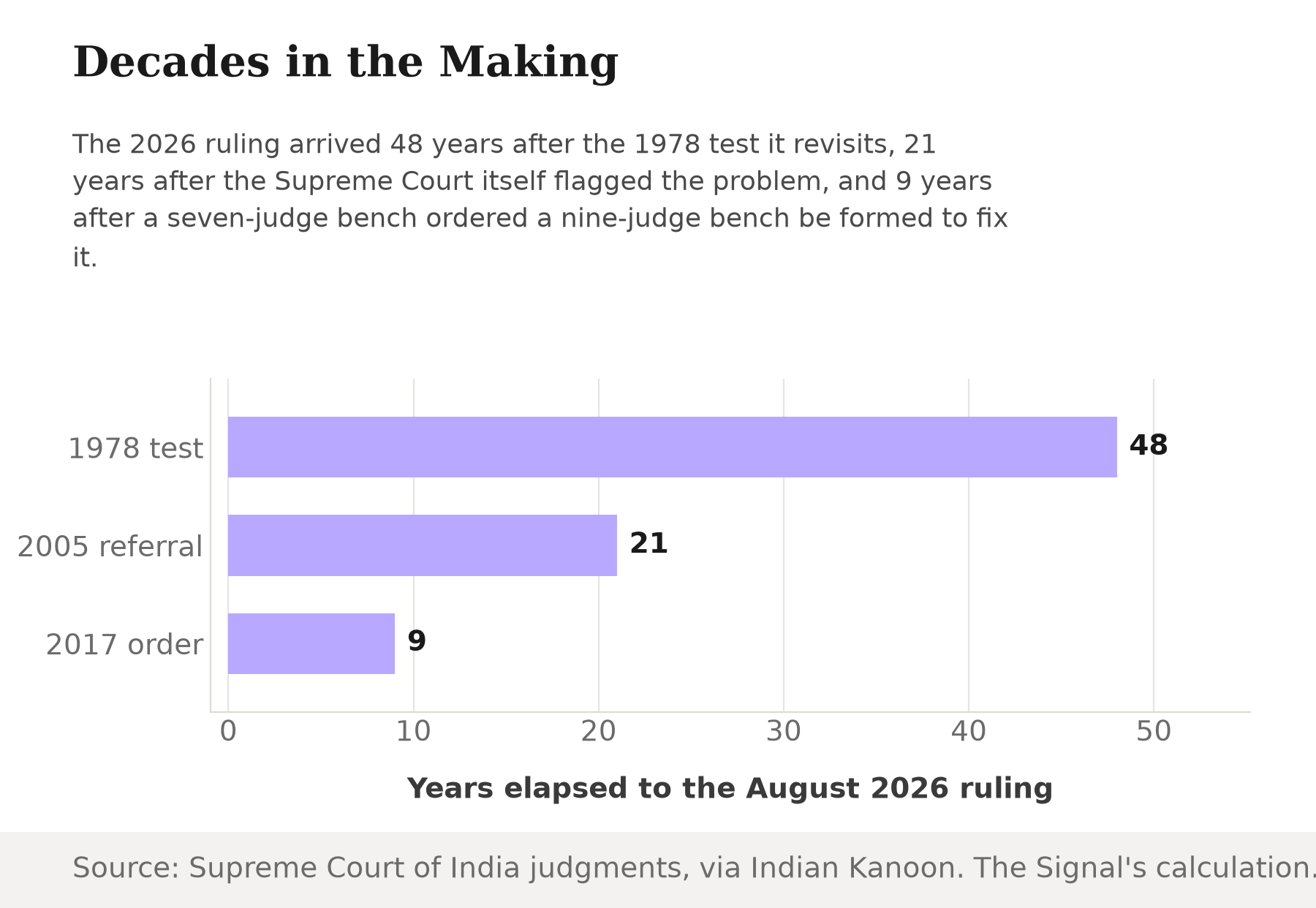
This bench did not convene on a whim. The five-judge bench that first referred the question in 2005 quoted Justice Krishna Iyer's own warning that Parliament's failure to amend the relevant section of the Industrial Disputes Act had caused a "docket explosion" in tribunals and courts, as lower courts kept reaching different conclusions about which workplaces the law covered. A seven-judge bench led by then Chief Justice T.S. Thakur ordered on 2 January 2017 that the question be placed before a nine-judge bench to settle it for good. That order alone sat for more than nine years before the nine-judge bench actually ruled.
The 2026 ruling followed a chain of orders going back to 2005.
Stack the dates and the same case took decades to move from flagged problem to final bench, only to arrive at a plurality rather than a majority.
The rule that caused the pile-up in the first place
The test the 2026 bench was asked to revisit is nearly half a century old. A seven-judge bench in Bangalore Water Supply & Sewerage Board v. R. Rajappa laid down the "triple test" in 1978, holding explicitly that the absence of a profit motive is irrelevant to whether an activity is an industry. That single holding did most of the work of expanding the law's reach. Supreme Court Observer's case background explains that the 1978 test effectively swept hospitals, universities and charitable institutions into the definition, because none of them chase profit yet all of them look, in the Court's 1978 reasoning, organised enough to qualify. That is what made the question worth nine judges' time: get the definition wrong and a hospital either owes its staff industrial-dispute protections or it does not, with no room in between.
What the fragmented ruling actually changes
Even where the four-judge opinion does apply, it does not reach backward. The bench held that judgments, awards, settlements and determinations that had already attained finality under the 1978 test remain undisturbed, so no case already decided reopens because the test has shifted. And the reformulation was not the only reading on offer even among judges who agreed the bench had the right to rule at all. Justice Joymalya Bagchi's separate opinion concurred that the reference was maintainable but dissented on reformulating the triple test, meaning the disagreement is not simply four judges against a united remaining five. It is fragmentation on the substance, from a bench convened specifically to end it.
There is a second, sharper limit on what this ruling touches going forward. The judgment expressly does not extend to the Industrial Relations Code, 2020, which came into force on 21 November 2025 and replaced the 1947 Act, holding that the newer Code's own definition of "industry" must be construed on its own text, independent of both the 1978 ruling and this reformulation. The law that will actually govern most future labour disputes has its own definition, and this ruling deliberately leaves it alone.
The honest objection
The strongest case for treating this as settled anyway is that a four-judge plurality authored by the Chief Justice is still the largest bloc a nine-judge bench produced, and courts routinely work from pluralities when no single opinion commands a majority. On that reading, the four-judge opinion becomes the operative statement of the law for disputes still arising under the 1947 Act's framework, exactly as the bench intended, and the absence of a bare majority is a technicality that lower courts will route around by simply following the Chief Justice's opinion as the most authoritative available.
That case has force, but it restates the exact problem this reference existed to solve. The 2005 referral order itself invoked the Court's own warning that an unresolved definition, left to tribunals and lower courts to interpret case by case, causes a docket explosion. A plurality opinion, however senior its author, is precisely the kind of unsettled precedent that invites exactly that same case-by-case drift, only now with the added confusion of judges like Justice Bagchi agreeing the bench should rule while declining to join the rule it produced. Twenty one years after the Court flagged the risk of fragmented interpretation, the fix for fragmented interpretation is, on the numbers, itself fragmented.
The Signal
A nine-judge bench is India's tool for manufacturing certainty: enough judges that whatever they produce is supposed to bind everyone beneath them without argument. This one produced a plurality that does not bind retroactively, does not command a majority, and does not even govern the statute that will decide most disputes going forward. The people this case was actually about, workers and employers at hospitals, clubs, educational and charitable bodies wondering whether the Industrial Disputes Act covers them, are exactly where they were before the bench sat: waiting on lower courts to decide, case by case, which opinion to follow. Watch whether a larger bench is ever asked to settle the plurality itself, and whether the early cases under the Industrial Relations Code converge on a single reading faster than this one did. A rule four judges write is still a rule five judges did not.
Reporting basis: the text of the 2026 nine-judge bench judgment, the 2005 five-judge referral order, the 2017 seven-judge bench order and the 1978 seven-judge Bangalore Water Supply judgment are all drawn directly from the Supreme Court's own judgment text, via Indian Kanoon. The prospective-only holding and Justice Bagchi's separate opinion are as reported by Supreme Court Observer, a specialised judgment-tracking outlet, in two separate reports. The 1978 test's effect on hospitals, universities and charitable institutions is per Supreme Court Observer's case background. The judgment's carve-out for the Industrial Relations Code, 2020 is per Verdictum's report, quoting the judgment directly. The count of judges who did not join the lead opinion and the years elapsed between the 1978, 2005, 2017 and 2026 dates are The Signal's calculations from those primary dates.