On 7 August 2026, PM-CARES' auditors signed off on two years of accounts at once, FY2023-24 and FY2024-25 together (PM-CARES Fund's own audited Receipts and Payments Account). It was the fund's first public disclosure since FY2022-23, and Indian outlets began covering the numbers from 18 August 2026. The headline figure looks reassuring. The fund's corpus grew to Rs 8,452.07 crore in FY2024-25, up from Rs 7,173.03 crore the year before, even as domestic donations fell to Rs 479.05 crore from Rs 681.81 crore. Read only that line, and PM-CARES looks like exactly what its name promises: a fund still growing, still active, still there.
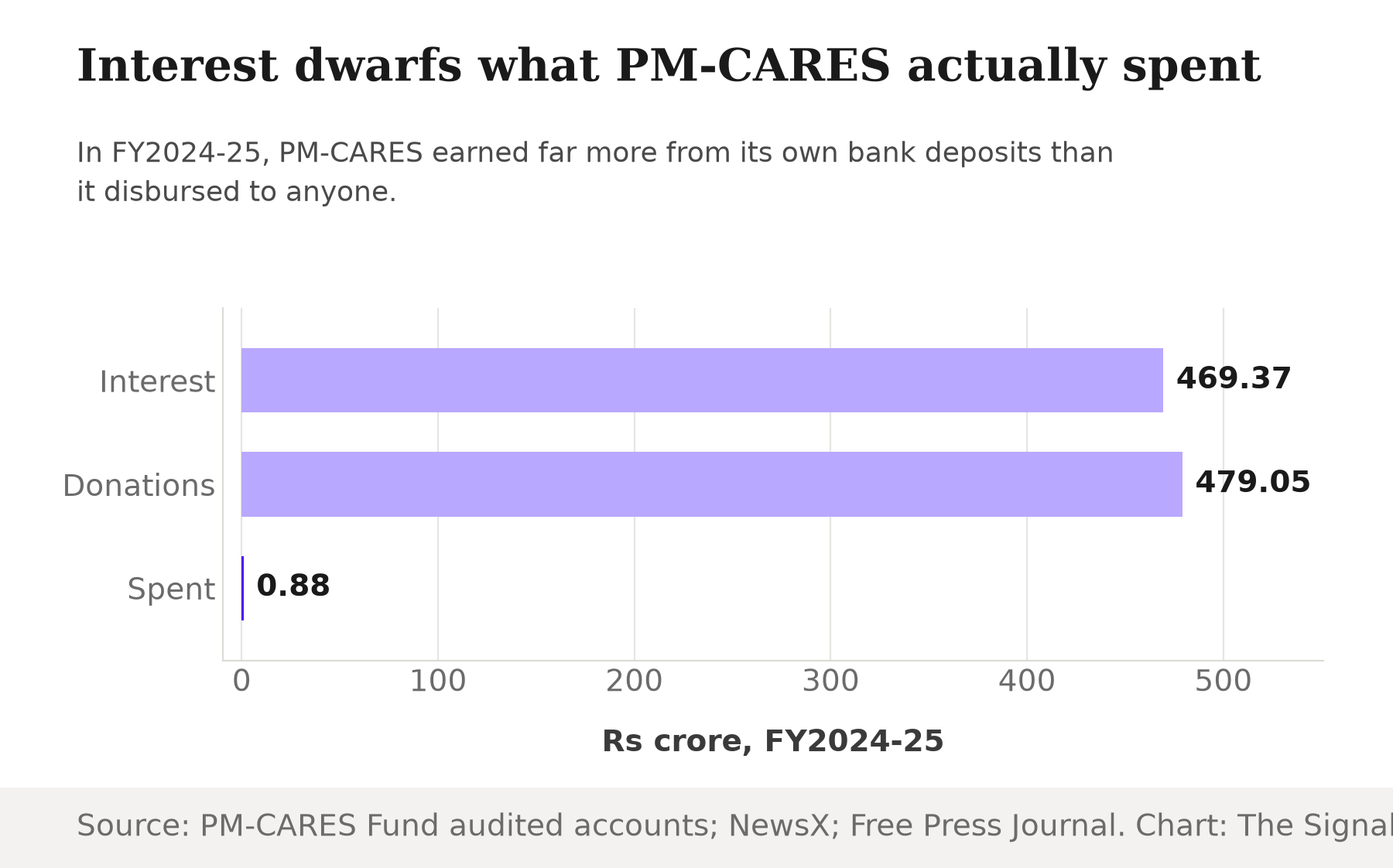
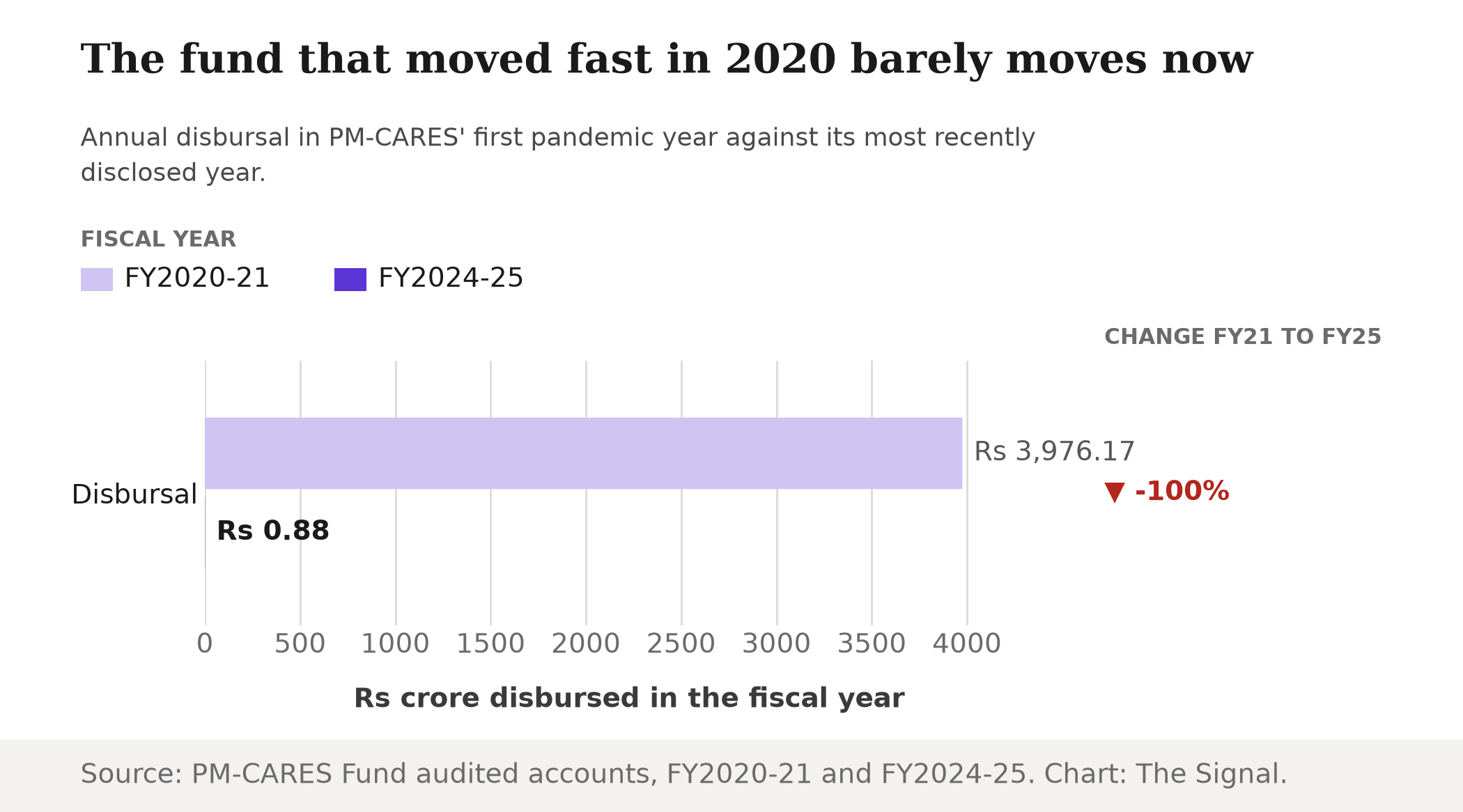
It is worth slowing down on that. In FY2024-25, the same year its corpus grew by more than a thousand crore, PM-CARES spent just Rs 87.85 lakh, almost all of it going to the PM CARES for Children Scheme, with the rest eaten by bank and SMS charges. Rs 87.85 lakh against a Rs 8,452.07 crore corpus works out to roughly 0.01 percent of the fund actually reaching anyone in FY2024-25.
The sharper number sits one line down in the same accounts. PM-CARES earned Rs 469.37 crore in interest on its fixed deposits in FY2024-25, which is, by our calculation, 534 times the roughly Rs 88 lakh it spent that same year. It is also within 2 percent of the Rs 479.05 crore the fund collected in fresh donations. A trust built to move money to people is now making almost as much lying still as it raises by asking.
Where the corpus actually sits
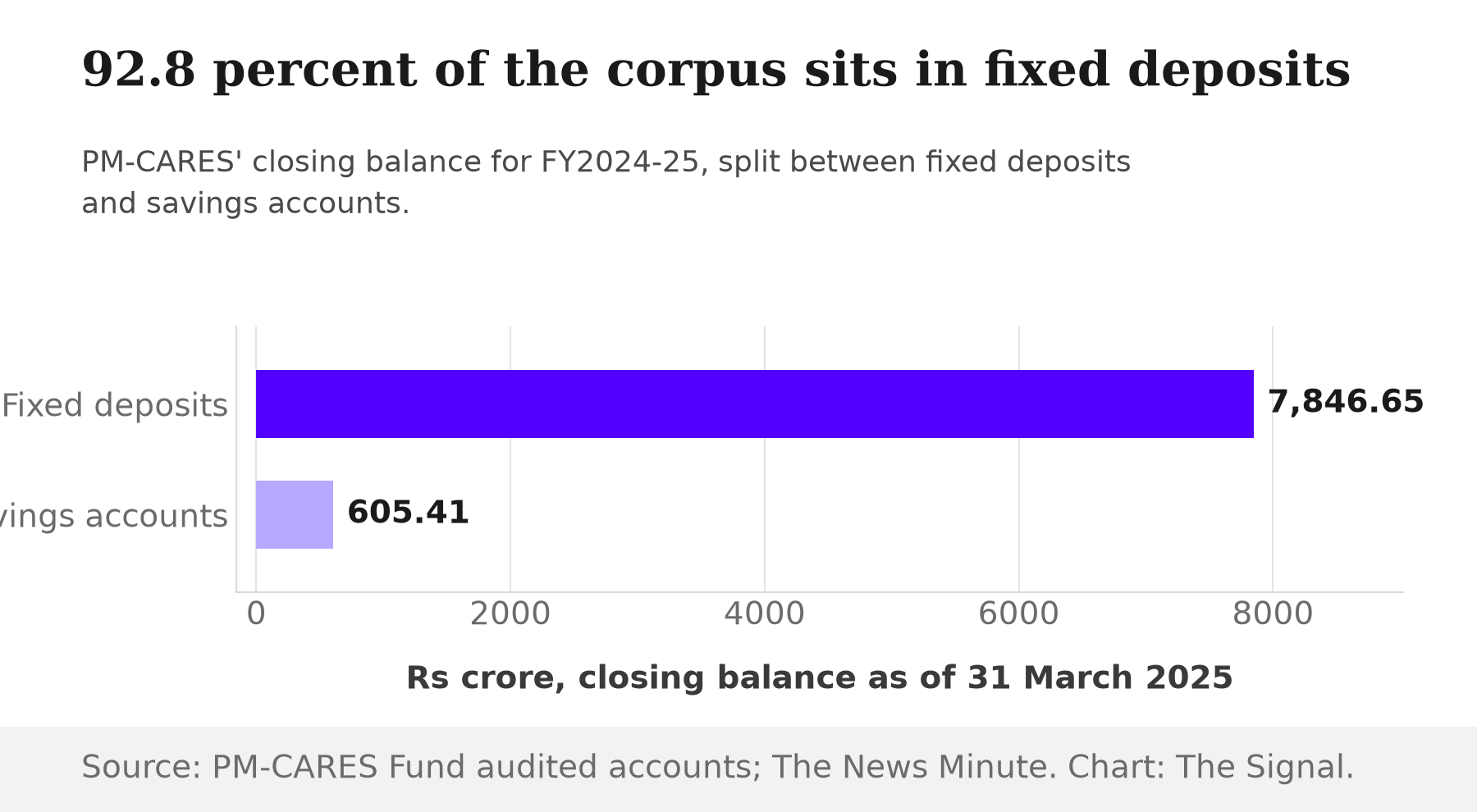
The interest figure is not a one-off. 92.8 percent of PM-CARES' Rs 8,452.07 crore closing balance for FY2024-25, roughly Rs 7,846.65 crore, was parked in fixed deposits with scheduled banks rather than disbursed, a split The News Minute cross-checked against the fund's own Receipts and Payments Account. The remaining Rs 605.41 crore sits in ordinary savings accounts. Only the tiniest sliver, that Rs 87.85 lakh, ever left the building.
The fund did not always sit this still. In its first full pandemic year, FY2020-21, PM-CARES disbursed Rs 3,976.17 crore, including Rs 1,392.83 crore to procure 6.6 crore doses of Covid-19 vaccine and Rs 1,000 crore for migrant welfare routed through states and union territories. That is a trust moving at the speed an emergency demands. No pandemic-scale emergency has recurred since, which is part of the explanation for FY2024-25's near-silence. It is not the whole one.
The design nobody can test
The reason PM-CARES could move Rs 3,976.17 crore in FY2020-21 without the delays that usually slow Indian government spending is close to the reason nobody outside the trust can force it to move money now. PM-CARES is registered as a Public Charitable Trust, with the Prime Minister as ex-officio Chairperson and the Ministers of Defence, Home Affairs and Finance as ex-officio Trustees, and it is audited by an independent chartered accountancy firm rather than a government auditor. That structure sits outside the ordinary machinery of government procurement and audit, which is what let it write large cheques fast in 2020. It also means no external body compels disclosure or spending on any fixed timetable: FY2023-24 and FY2024-25 were only made public together, on 7 August 2026, the fund's first accounting since FY2022-23.
Compare that to India's other central emergency fund. The National Disaster Response Fund is audited every year by the Comptroller and Auditor General of India, unlike PM-CARES. And when petitioners asked the courts to bring PM-CARES under the Right to Information Act, the Prime Minister's Office told the Delhi High Court in an affidavit that the trust is "neither intended to be or is in fact owned, controlled or substantially financed by any Government" and that its corpus has "no remote nexus with the Consolidated Fund of India", LiveLaw reported, quoting the PMO's filing. Whatever the legal merits of that position, its practical effect is that the same design choice that let PM-CARES skip red tape in an emergency also lets it skip RTI requests and CAG audits in peacetime.
The honest objection
The strongest case for PM-CARES' current stillness is that a standing emergency fund should hold reserves, not spend for the sake of spending. No pandemic-scale emergency of the kind that drove the Rs 3,976.17 crore FY2020-21 disbursal has recurred, and a trust earning interest on undeployed capital while it waits is arguably doing what a reserve fund should: preserving value, ready to deploy at scale the next time it is needed. An independent chartered accountant still signs the accounts every year, which is a real audit even if it is not the CAG's.
That case would be more persuasive if PM-CARES' own design let anyone test it. A reserve fund waiting for the next emergency and a reserve fund that has simply stopped being used look identical from the outside. The same structure that let PM-CARES spend fast in an emergency also blocks the RTI requests and CAG review that would otherwise show which one this is. The PMO's own position, that the fund has no nexus with the Consolidated Fund of India, is also what keeps Parliament and auditors from demanding answers. Nobody can compel the fund to explain why 92.8 percent of a corpus built from public donations sits in fixed deposits at scheduled banks while it waits.
The Signal
PM-CARES' busiest year and its quietest year share the same trust deed, the same chairperson, the same private auditor. Only the emergency changed. The fund's oversight never did, because RTI exposure and CAG review were never part of the design in the first place, in a crisis or out of one. Watch what the next disclosure shows, whenever it arrives: if the fixed-deposit share keeps climbing and the disbursal stays near zero, "waiting for the next emergency" starts to look less like a reserve strategy and more like a fund that has quietly become a bank account nobody has to explain. The Rs 8,452.07 crore is real money. The accounts do not say who decides when it moves again.
Reporting basis: the FY2024-25 corpus, closing-balance composition and donation figures, the FY2020-21 disbursal figures, and the trust's governance structure are from PM-CARES Fund's own audited Receipts and Payments Accounts and its FAQ page. The fixed-deposit share is per The News Minute, the spending figure per Free Press Journal, and the interest income per NewsX, each cross-checked by those outlets against the fund's own audited accounts. The National Disaster Response Fund's CAG audit is per the Indian Economic Service's Arthapedia, a Ministry of Finance resource. The Prime Minister's Office's RTI position is per LiveLaw's report of the PMO's affidavit before the Delhi High Court. The 534-times interest-to-spending ratio, the 0.01 percent spending share, the near-parity between interest income and fresh donations, and the FY2020-21 to FY2024-25 disbursal comparison are The Signal's calculations from those figures.