On 18 August 2026, the Ministry of Defence notified its sixth Positive Indigenisation List, banning the future import of 405 items, 16 for the Indian Coast Guard and 389 for its own defence public sector undertakings, with an estimated business potential of ₹3,070 crore. The ministry paired the list with a bigger number: since the SRIJAN indigenisation portal opened in 2020, it has offered more than 33,000 defence items for indigenisation, of which over 15,700 have been successfully indigenised, worth an estimated ₹9,000 crore in import substitution over the last five years. Read only the announcement, and six years of policy look like they are working exactly as designed: a bigger list every twelve to twenty months, a bigger substitution total each time.
It is worth checking that read against a number the ministry does not publish. SIPRI's Trends in International Arms Transfers, 2025 fact sheet finds India remained the world's second-largest recipient of major arms in 2021-25, with an 8.2 percent share of total global arms imports. The volume of India's arms imports fell by just 4.0 percent between the 2016-20 and 2021-25 windows.
Six rounds of import bans since 2020 have moved India's global arms-import ranking by less than a rounding error.
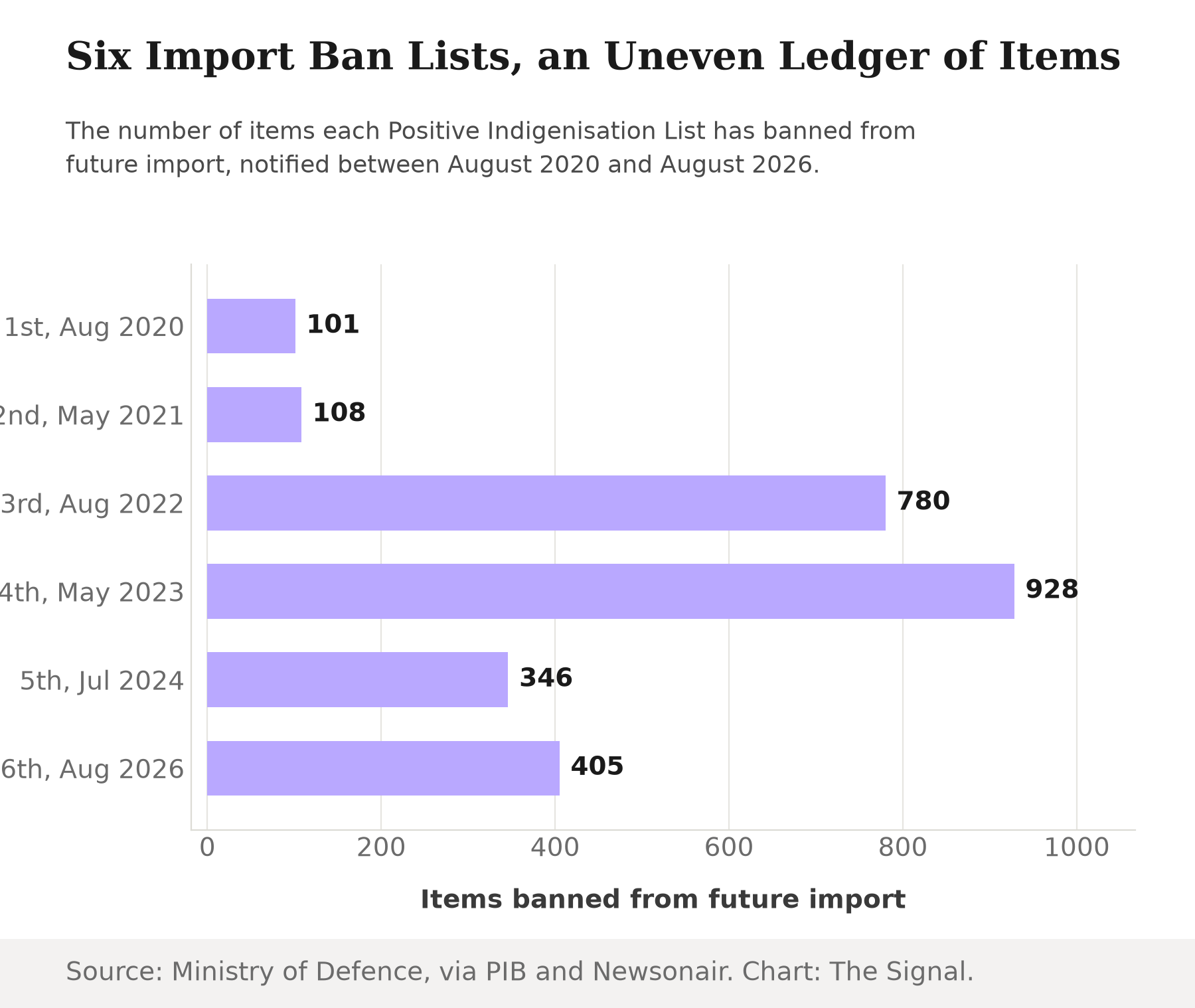
Six lists, an uneven ledger
The program has run six rounds since 2020, and the item counts do not climb in a straight line. MoD first published an import-embargo list of 101 items on 9 August 2020, with implementation planned progressively through 2024. A second list of 108 items followed on 31 May 2021, phased from December 2021 to December 2025. The third, approved 28 August 2022, added 780 line-replacement units, sub-systems and components. The fourth, notified 14 May 2023, added a further 928 items worth an estimated ₹715 crore in import substitution. The fifth, on 16 July 2024, added 346 items worth ₹1,048 crore. The sixth is this week's 405 items.
The lumpy completion curve
The share of listed items actually indigenised did not creep upward, it jumped in one window.
| Snapshot | Cumulative items named | Items indigenised | Share indigenised |
|---|---|---|---|
| After PIL 3 (May 2023) | 3,738 | 310 | 8.3%* |
| After PIL 4 (Jul 2024) | 4,666 | 2,972 | 63.7%* |
*Our calculation, dividing each snapshot's indigenised count by its cumulative item count. Source: Ministry of Defence, May 2023; Department of Defence Production, July 2024.
Between May 2023, when only 310 of the 3,738 items named across the first three lists had been indigenised, and July 2024, when 2,972 of the 4,666 items named across the first four lists had been, the completion rate went from 8.3 percent to 63.7 percent in fourteen months. That is not a program accelerating so much as a program with deadlines bunched together: the first list's embargo was phased through 2024, and the second's through December 2025, so a wave of items crossed their compliance dates in the same window and got counted as indigenised all at once.
What actually moved
What six years of policy changed was not how much India imports, but who it imports from.
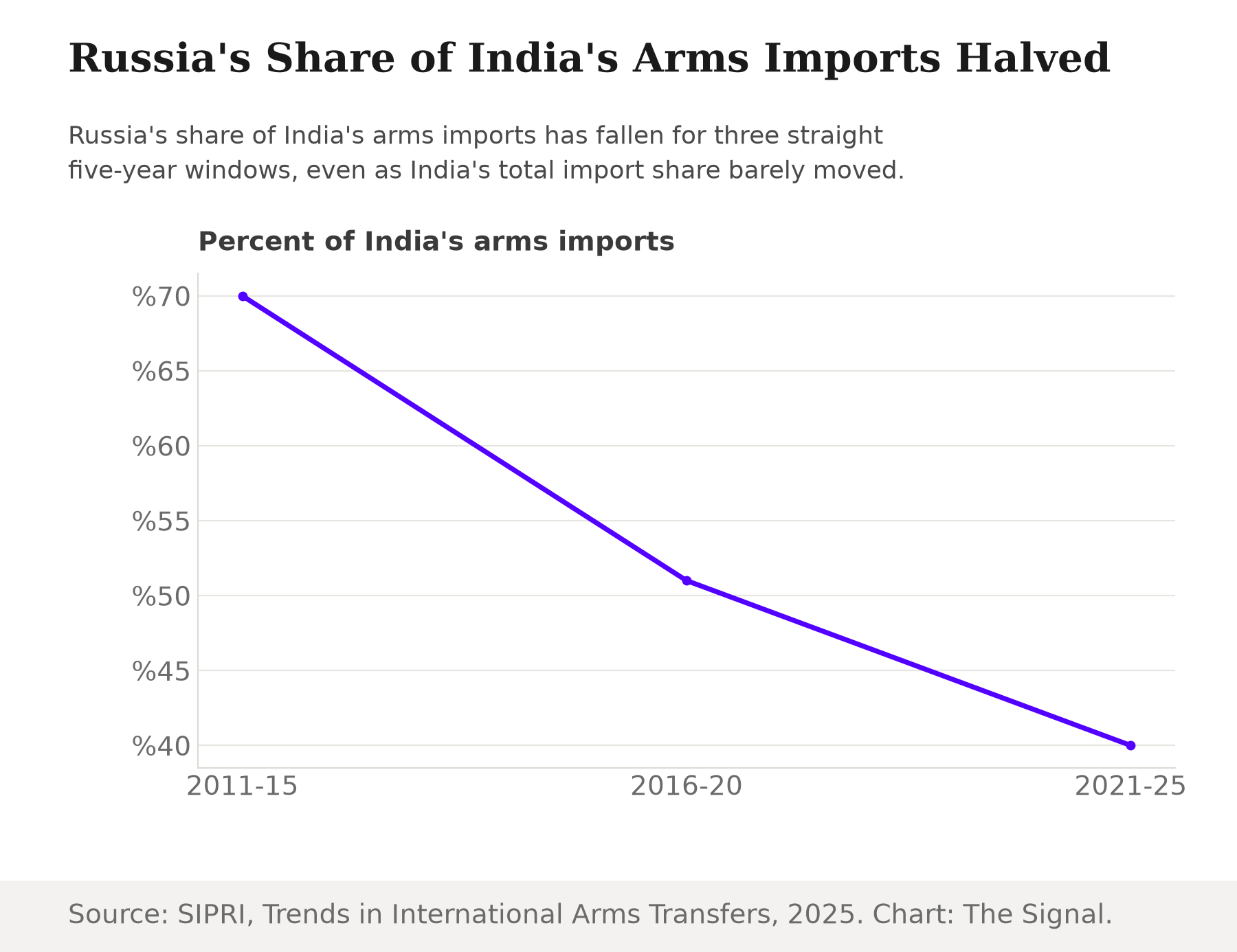
Russia's share of India's arms imports dropped from 70 percent in 2011-15 to 51 percent in 2016-20 and then to 40 percent in 2021-25, a genuine three-decade diversification even as India's total import volume barely shrank. The domestic-order pipeline also grew: portal-wide, more than 12,300 items had been indigenised by July 2024, with DPSUs placing ₹7,572 crore in domestic orders over the preceding three years, a total that climbed to more than 15,700 indigenised items by August 2026. The procurement budget shows the same shift in intent. For FY2023-24, MoD set aside a then-record 75 percent, about ₹1 lakh crore, of the capital procurement budget for domestic industry, up from 68 percent the year before. By FY2026-27, that domestic share held at roughly 75 percent of a ₹1.85 lakh crore capital acquisition budget, itself up about 24 percent over FY2025-26.
The scale problem
Set against the money moving through India's own procurement budget, six years of substitution barely register.
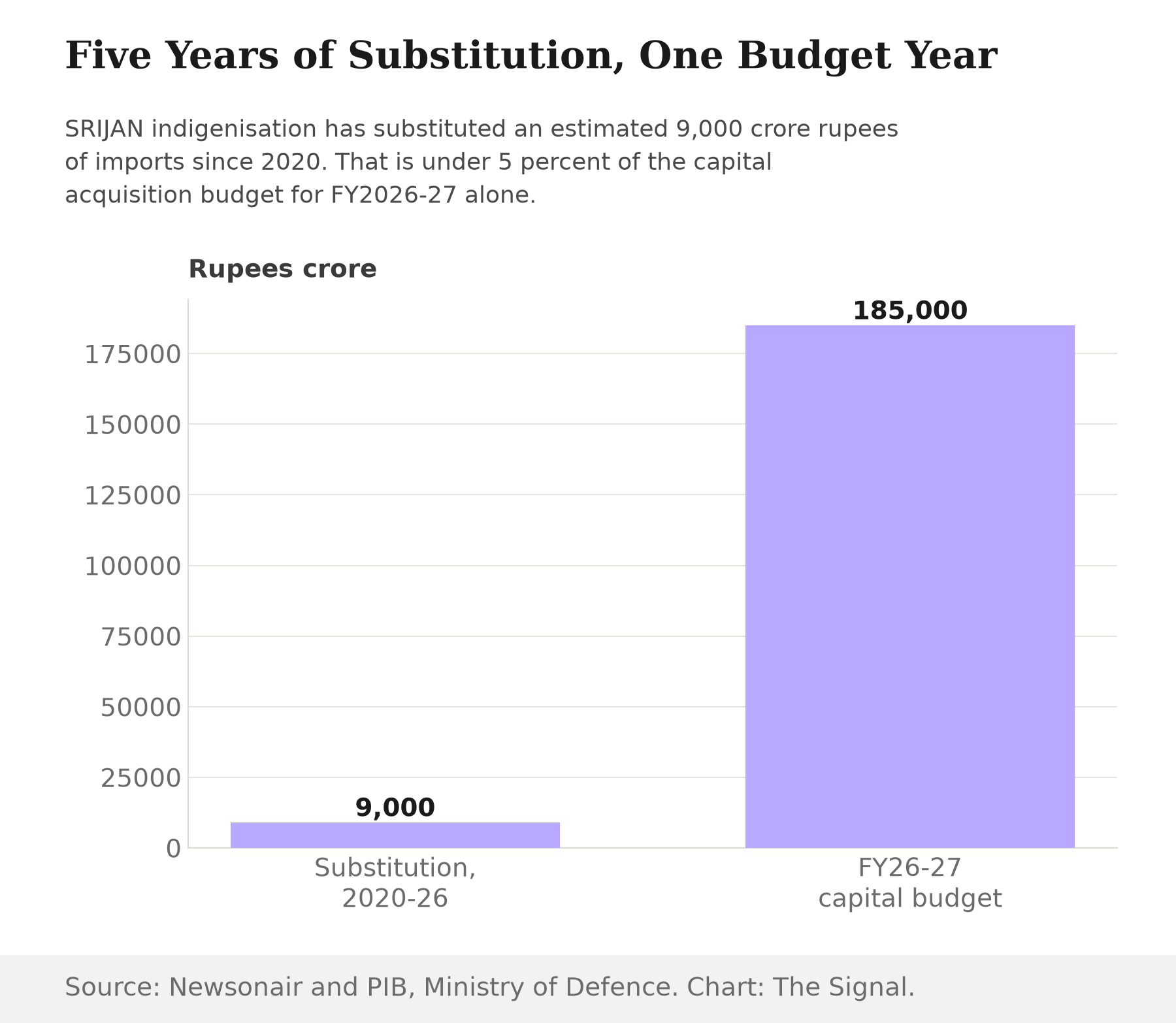
The roughly ₹9,000 crore substituted since 2020 is under 5 percent of the ₹1.85 lakh crore capital acquisition budget earmarked for FY2026-27 alone. Five years of the flagship substitution number would not cover two months of one year's equipment spending.
The honest objection
The strongest case for patience is that the Positive Indigenisation Lists were never designed to move SIPRI's number. The third and fourth lists explicitly target Line Replacement Units, sub-systems, spares and components, the smaller parts inside a weapons system, not the fighter jets, submarines and air-defence systems that dominate SIPRI's count of major arms transfers. On that view, indigenising a radar sub-assembly and cutting India's dependence on an imported aircraft carrier are different projects entirely, and it is unfair to grade the first against the second. The underlying industrial base is also visibly larger than it was: India's indigenous defence production reached a record ₹1.27 lakh crore in FY2023-24, and defence exports rose from ₹686 crore in FY2013-14 to over ₹21,000 crore in FY2023-24, a 30-fold increase over the decade.
That case holds for individual components. It weakens once the SIPRI numbers are read across three straight five-year windows rather than one. If item-level substitution were compounding into lower dependence, the import volume should be trending down, not falling just 4.0 percent in the most recent window after fifteen years in which Russia's share of India's arms imports alone dropped from 70 percent to 40 percent, a thirty-point swing. A country genuinely substituting its way out of imports would show the effect at the country level eventually, not just at the level of the parts list.
The Signal
The ministry's item counts are real, growing, and worth taking at face value: more things are banned from import, more orders are landing with domestic vendors, and Russia's grip on India's arsenal keeps loosening. But whether "indigenisation" is a fact about India's defence economy or just about India's paperwork comes down to the number SIPRI publishes, not the one MoD does. Watch the next Trends in International Arms Transfers release, expected in early 2027 covering 2022-26: if India's global import share keeps sliding past the 8.2 percent it held in 2021-25, the substitution program is finally showing up where it counts. If it holds near where it has sat for a decade, a list of banned items is not the same as a country that no longer needs to buy them.
Reporting basis: the sixth Positive Indigenisation List and SRIJAN portal totals are per All India Radio's Newsonair, citing the Department of Defence Production. Lists one through five and the FY2023-24 and FY2026-27 capital budget figures are each per individual Ministry of Defence press releases via the Press Information Bureau. The FY2023-24 domestic production and export figures are per All India Radio's Newsonair, citing the Department of Defence Production. The global arms-transfer share, the Russia-supplier share, and the import-volume change are from SIPRI's Trends in International Arms Transfers, 2025 fact sheet, the sole source for those figures. The indigenisation completion-rate percentages and the substitution-to-budget comparison are The Signal's calculations from those figures.