On 17 August 2026, the Supreme Court directed that any cash exceeding Rs 10 lakh found by Static Surveillance Teams during elections be forwarded to the income tax authorities, and gave the Election Commission and state governments until 18 November 2026 to file compliance reports. Read as a headline, it looks decisive: the country's apex court, in a ruling arising from a Karnataka case, finally putting a deadline on the cash economy that has long greased Indian campaigns. Static Surveillance Teams already patrol during every election. Now, when they find real money, it has to be reported to the taxman.
It is worth slowing down on what that order actually reaches. It targets cash, specifically the cash physically caught by roadside checks. Cash, it turns out, was not where the money concentrated.
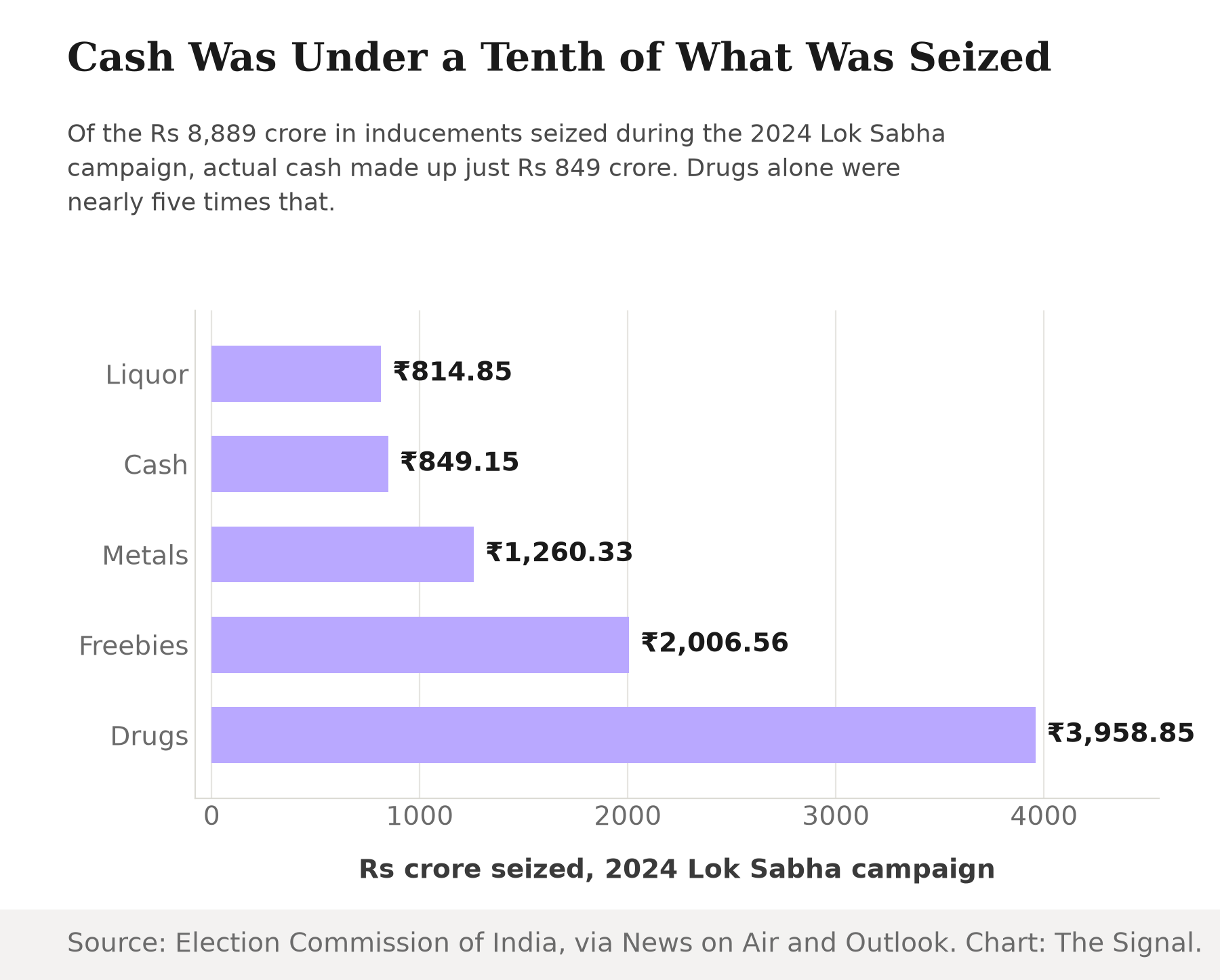
Cash was under a tenth of everything seized during the last general election.
Enforcement agencies seized Rs 8,889 crore worth of cash, drugs, liquor, precious metals and freebies during the 2024 Lok Sabha campaign, the highest inducement haul in the 75-year history of Lok Sabha elections. Of that record total, as of 18 May 2024, actual cash accounted for just Rs 849.15 crore, less than a tenth of the seizure, with drugs worth Rs 3,958.85 crore and freebies worth roughly Rs 2,006.56 crore each running well ahead of it. The new order reaches the smallest lever in the machine.
What the order does not reach
The Supreme Court's directions apply to cash that a Static Surveillance Team physically stops and counts. They say nothing about money that moves through a bank account, because none of it is illegal. That is a bigger gap than it sounds.
Over Rs 3.24 lakh crore has been disbursed to more than 11 crore farmers under the PM-KISAN direct benefit transfer scheme, the government told Parliament in a written reply in July 2024. A single instalment released in June 2024, while the Lok Sabha vote count was underway, moved more than Rs 20,000 crore to 9.26 crore farmer families in one payment. Separately, India's Direct Benefit Transfer system had identified Rs 5,14,201.92 crore in cumulative savings from eliminating duplicate and ineligible beneficiaries across welfare schemes, as of March 2025, the most recent figure the DBT Mission has published. Neither channel is cash, and neither needs a Static Surveillance Team to move. Nothing here falls under anything the Supreme Court ordered on 17 August 2026.
Legal transfer schemes moved sums the entire seizure operation cannot see.
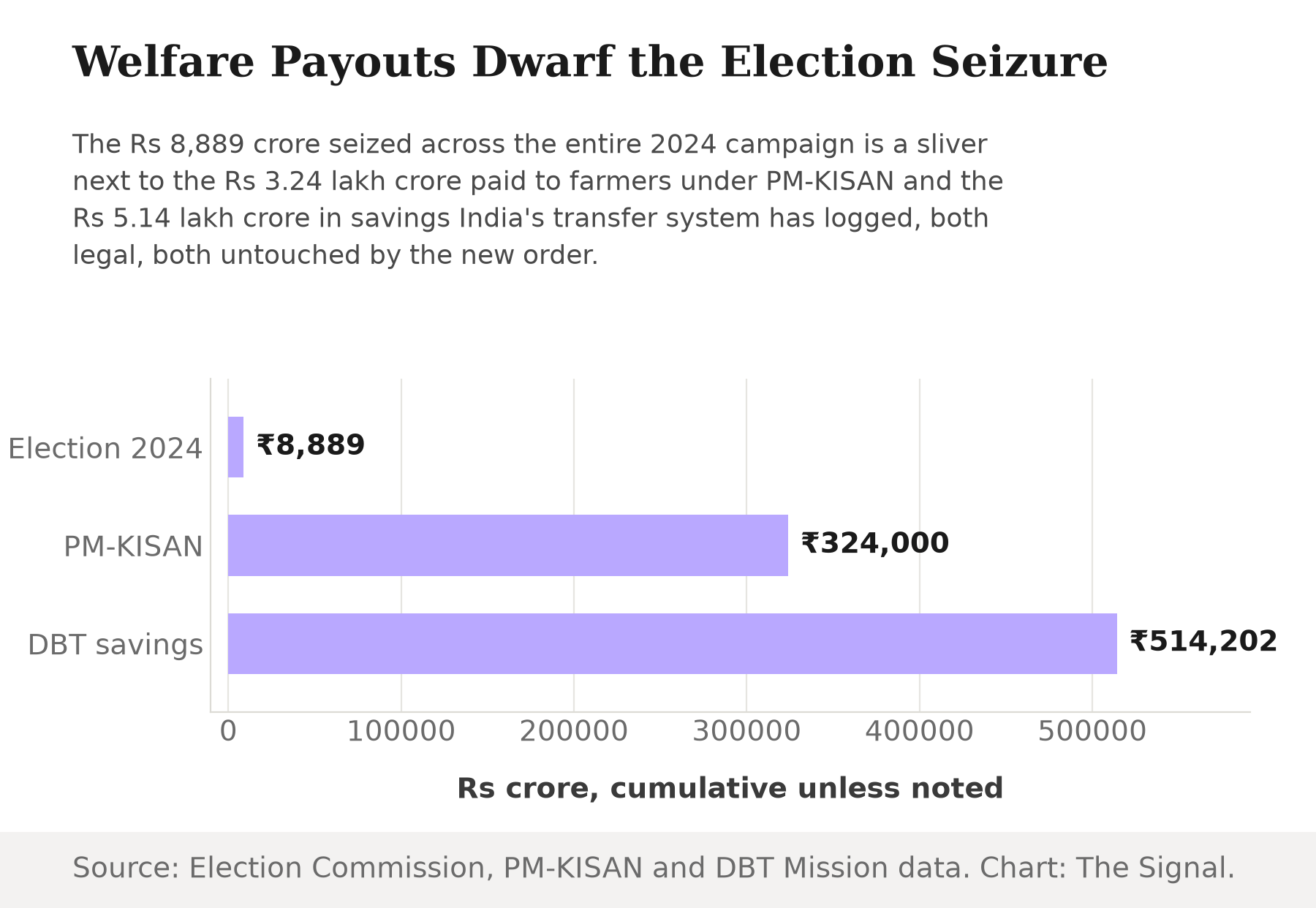
A welfare scheme moved real money before a vote too
The clearest test of the gap is not a national scheme with no single election attached to it. It is a state scheme timed to one.
Maharashtra's Ladki Bahin Yojana, a monthly cash-transfer scheme launched four months before the state's November 2024 assembly election, actually spent Rs 33,237.24 crore against an authorised budget of Rs 29,693.09 crore in FY2024-25, an excess of Rs 3,541.16 crore, according to a Comptroller and Auditor General report tabled in the state legislature on 13 July 2026, a month before the Supreme Court's order. The overrun alone, Rs 3,541.16 crore, is worth more than four times everything the entire 2024 general election's static surveillance operation found in actual cash.
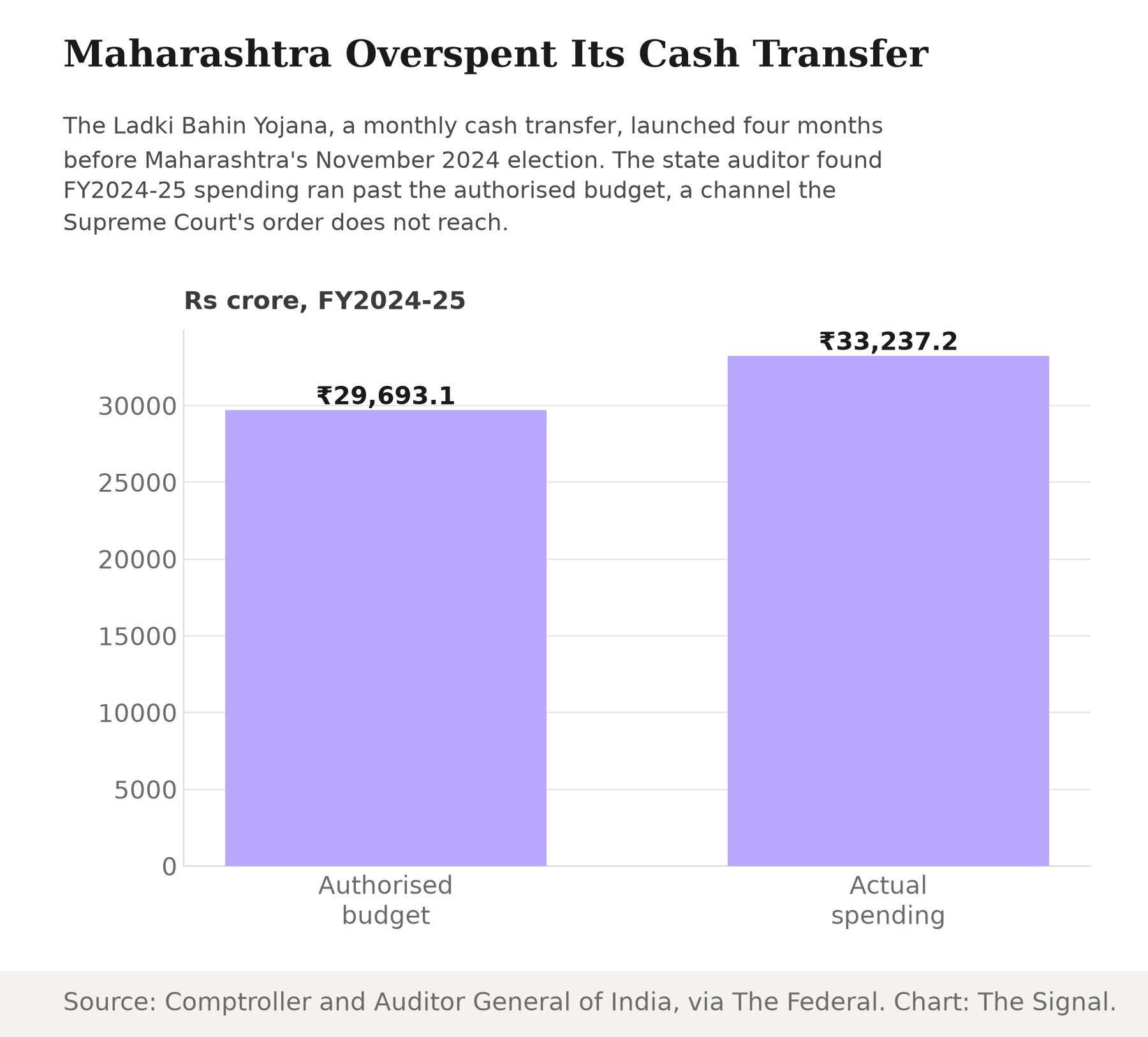
Maharashtra is not a one-off. Bihar rolled out its own version, the Mukhyamantri Mahila Rozgar Yojana, a Rs 10,000-per-woman direct transfer, ahead of its November 2025 assembly election; by early October 2025 more than one crore women had already received the payment, well over Rs 10,000 crore moved in weeks. Two states, two elections, the same sequence: a cash-transfer scheme launched months before the vote, moving a sum several times what any surveillance team caught. That is a pattern, not a coincidence.
Four numbers, four different pictures of election money
Put the seizure total next to what independent researchers and parties themselves say elections cost, and the enforcement apparatus looks smaller still.
Every measure of election money in India is bigger than what enforcement agencies catch.
| Measure | Amount | Period |
|---|---|---|
| Independent estimate of total spending, all parties and candidates | Rs 1.35 lakh crore | 2024 Lok Sabha election |
| Party expenditure declared to the Election Commission, 32 parties | Rs 3,352.81 crore | 2024 Lok Sabha and assembly polls |
| Total inducements seized by enforcement agencies | Rs 8,889 crore | 2024 Lok Sabha campaign |
| Of which, cash specifically | Rs 849.15 crore | 2024 Lok Sabha campaign |
Source: Centre for Media Studies chairman N Bhaskara Rao's estimate, via the Association for Democratic Reforms; the Association for Democratic Reforms' analysis of party filings; the Election Commission of India, via News on Air and Outlook. All four rows now share the same 2024 election cycle.
The Rs 1.35 lakh crore estimate, more than double the Rs 60,000 crore Centre for Media Studies put on the 2019 election, was revised upward after the 2024 electoral-bond disclosures, and it remains an outside estimate rather than an audited total. What it establishes, on our calculation from those two figures, is that even this one independent all-party estimate ran roughly fifteen times the entire 2024 seizure haul and more than 150 times the cash within it.
The honest objection
The strongest defence of the order is that it is not trying to be a spending audit. Cash is the one channel that is genuinely opaque, untraceable to a giver or a receiver, and structurally suited to buying an individual vote at the last mile in a way a bank transfer or a welfare scheme is not. Rs 849.15 crore in cash still bought real influence at thousands of polling booths in 2024, and closing even one loophole, cash that Static Surveillance Teams caught but that sometimes went nowhere near the tax department, is a real gain. Comparing it to PM-KISAN or Ladki Bahin is comparing a crime to a budget line; the two are not interchangeable.
That case holds for what the order is. It does not hold for what the order is worth relative to the problem it is named for. Black money in elections was never only about the cash a surveillance team can physically stop on a highway. It is about which channel actually changes a voter's calculation closest to the vote, and on that test, a scheme paying women in a state four months before its election outspent its own budget by more than four times the entire nation's seized cash. The Supreme Court closed a real gap. It closed the smallest one on the table.
The Signal
The order is not wrong, it is just narrow, and narrowness compounds when the channels it does not reach are the ones already carrying the most money. Watch two things over the next three months. First, whether the Election Commission's compliance filings, due by 18 November 2026, show tax authorities actually acting on referred cash, not just receiving it. Second, whether any court or regulator turns its attention to the timing of welfare-scheme spending around state elections, the way the Maharashtra CAG report already has for one scheme after the fact. A Static Surveillance Team can stop a car. It cannot stop a bank transfer that was never illegal to begin with.
Reporting basis: the Supreme Court's 17 August 2026 directions are per LiveLaw's report of the ruling. The 2024 Lok Sabha seizure total and its category breakdown are Election Commission of India figures, as reported by News on Air and Outlook respectively, both as of 18 May 2024. The 2019 total-election-spending estimate is the Centre for Media Studies' figure, as reported by The Quint. The 2024 total-election-spending estimate is the same Centre for Media Studies analyst's revised figure, as reported by the Association for Democratic Reforms. The 2024 declared party expenditure is an Association for Democratic Reforms analysis of parties' own Election Commission filings. The PM-KISAN disbursement figures are from the government's written reply in the Lok Sabha, as reported by News on Air. The Direct Benefit Transfer savings figure is from the DBT Mission, Cabinet Secretariat. The Maharashtra Ladki Bahin Yojana spending figures are from the Comptroller and Auditor General's audit, as reported by The Federal. The Bihar Mukhyamantri Mahila Rozgar Yojana disbursement figures are from News on Air's reporting on the scheme's own rollout. The seizure-to-cash percentage, the drugs-to-cash multiple, the welfare-to-seizure scale comparisons, and the CAG overrun's multiple of the cash total are The Signal's calculations from those figures.