PM CARES Fund's audited accounts for the year ended 31 March 2025 became public only this month, in mid-August 2026, and the headline number reads like a fund still growing into its mission. The corpus, its total closing balance, rose to Rs 8,452.07 crore in FY24-25, up from Rs 7,173.03 crore in FY23-24. That is a gain of roughly Rs 1,279 crore in twelve months. Read only that line and the fund set up in March 2020 for pandemic-scale emergency relief looks like an institution that keeps expanding, six years after the emergency it was built for peaked.
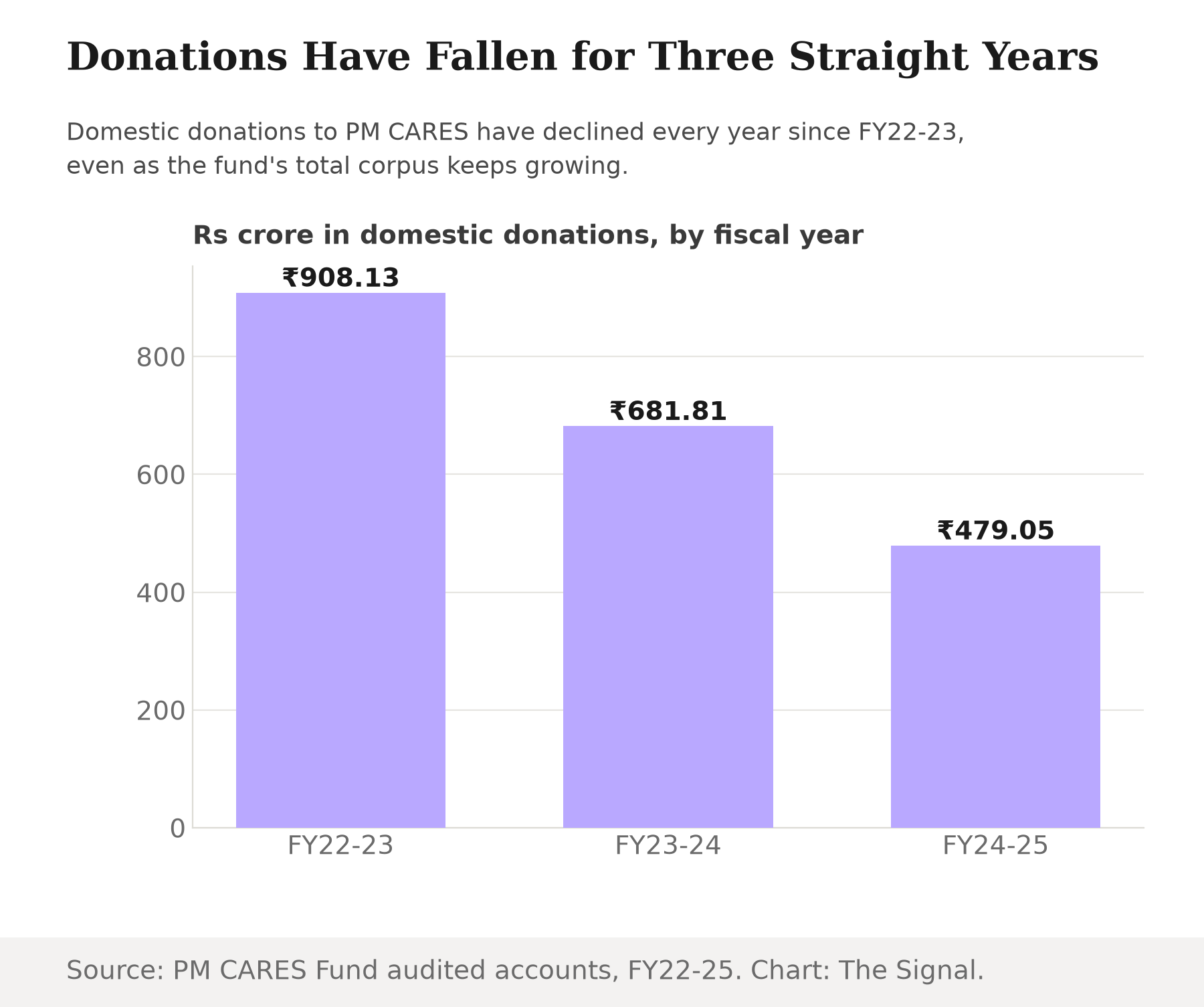
It is worth slowing down on where that extra money actually came from. Domestic donations to PM CARES fell to Rs 479.05 crore in FY24-25, down from Rs 681.81 crore in FY23-24, a decline of roughly 30 percent. Domestic donations have now fallen every year since at least FY22-23, when they stood at Rs 908.13 crore. The public gave less to PM CARES in FY24-25 than in either of the two years before it. The corpus grew anyway.
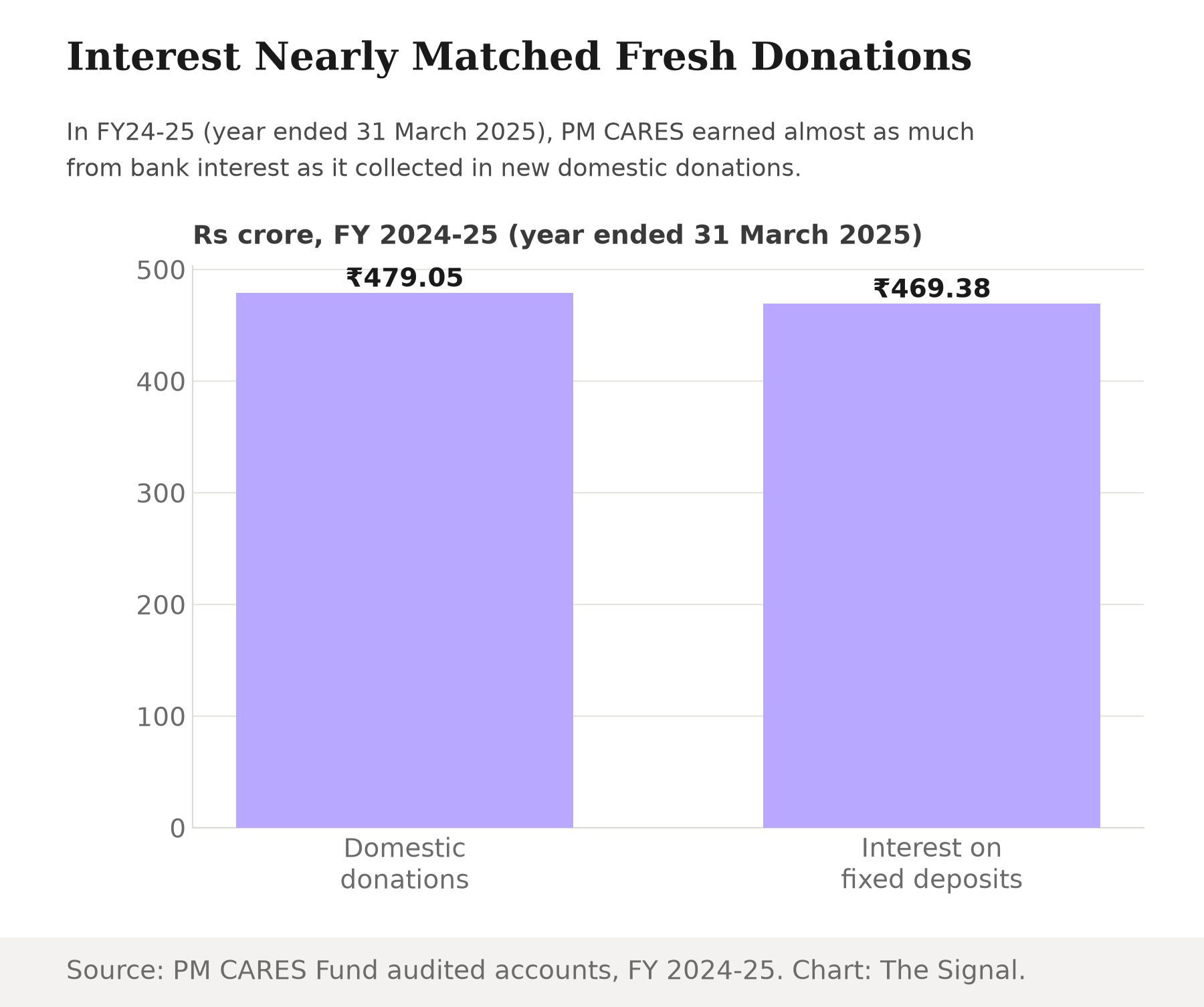
PM CARES earned almost as much from interest as it raised from donors.
The number that explains the gap is 469.38. PM CARES earned Rs 469.38 crore in interest on its fixed deposits in FY24-25 alone, against no separate fixed-deposit interest line in FY23-24. Set the two figures side by side: Rs 479.05 crore in domestic donations against Rs 469.38 crore in interest income, a gap of about 2 percent. For a fund whose entire premise is public giving, the money it earned by sitting on its own reserves now rivals the money the public chose to give it.
A fund built to sit on its money
The interest did not appear from nowhere. Nearly 93 percent of PM CARES' total corpus, about Rs 7,846.65 crore of the Rs 8,452.07 crore closing balance, sat in fixed deposits with scheduled banks at the close of FY24-25. A fund holding that much of itself in interest-bearing bank deposits is, in balance-sheet terms, closer to an endowment than a rapid-response relief pool.
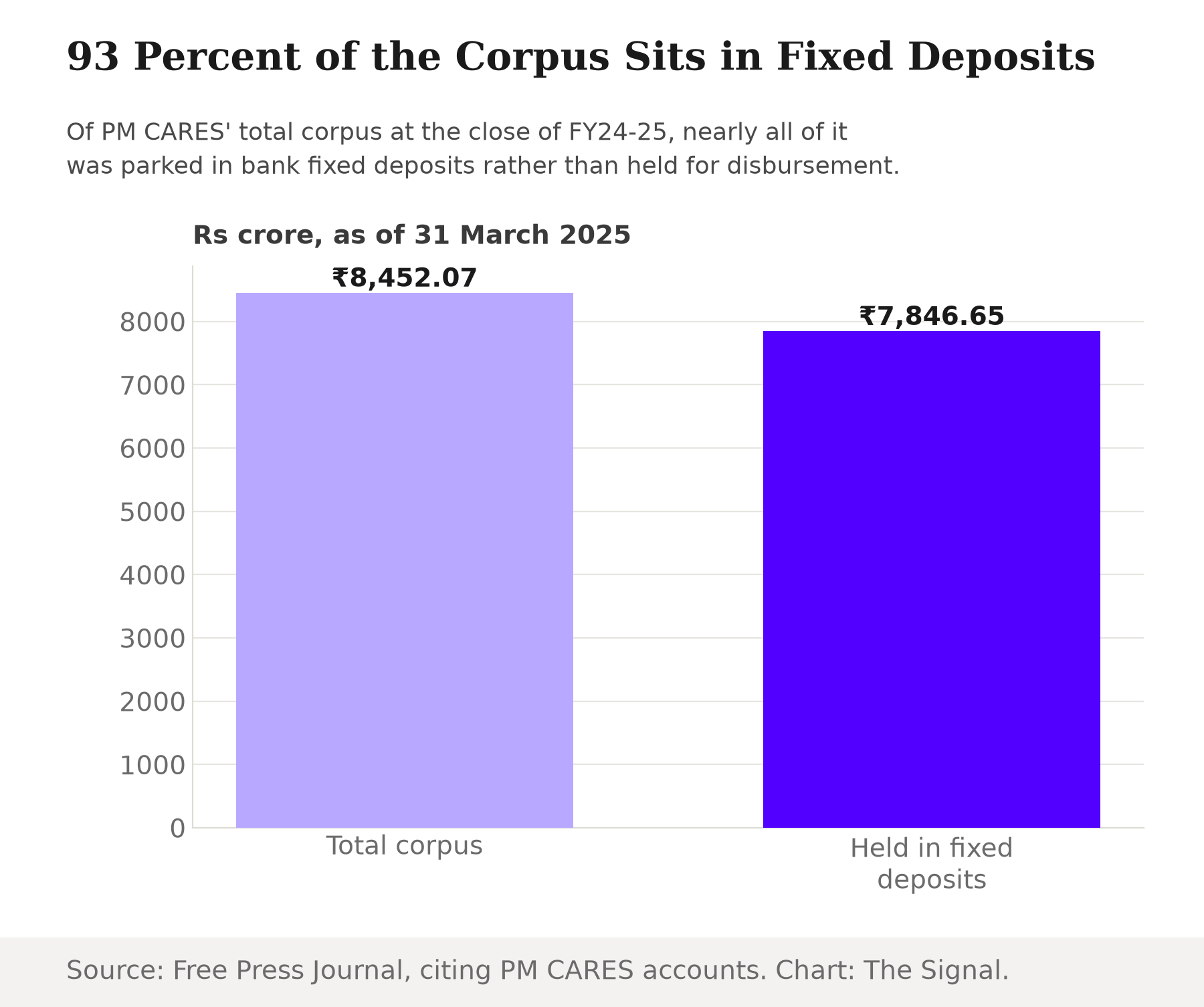
Source: The Free Press Journal, citing PM CARES Fund audited accounts.
Donations were not the only channel adding to that pile without a fresh gift changing hands. Refunds of unspent money flowing back to PM CARES from the agencies it had funded nearly quadrupled to Rs 324.66 crore in FY24-25, from Rs 84.31 crore in FY23-24. Money that had already left the fund for a specific project came back unspent, on top of the interest the fund earned on what it never sent out at all.
Spending nearly stopped
PM CARES spent under one crore rupees this year, against Rs 469 crore earned in interest alone.
PM CARES spent just Rs 87.85 lakh in FY24-25, down from Rs 15.60 crore in FY23-24, a collapse of more than 94 percent in a single year. Almost the entire year's outlay, Rs 87,84,840, went to the PM CARES for Children Scheme, down from Rs 15,37,56,360 spent under the same scheme in FY23-24. That one welfare scheme for children orphaned by the pandemic is effectively the only spending line still active, and even it shrank by roughly 94 percent.
| PM CARES, year ended 31 March | FY23-24 | FY24-25 |
|---|---|---|
| Domestic donations | Rs 681.81 crore | Rs 479.05 crore |
| Interest on fixed deposits | no separate line reported | Rs 469.38 crore |
| Refunds from implementing agencies | Rs 84.31 crore | Rs 324.66 crore |
| Total payments made | Rs 15.60 crore | Rs 87.85 lakh |
| Closing corpus | Rs 7,173.03 crore | Rs 8,452.07 crore |
Source: PM CARES Fund audited Receipts and Payments Account, FY 2023-24 and FY 2024-25.
Three straight years of shrinking public giving
The donation slide is not a one-year blip. Domestic donations have declined for at least three straight fiscal years, from Rs 908.13 crore in FY22-23 to Rs 681.81 crore in FY23-24 to Rs 479.05 crore in FY24-25, even as the fund's total corpus has kept climbing on interest and refunds instead.
The one welfare scheme still drawing on that money has been shrinking on its own terms too. New beneficiaries approved each year under the PM CARES for Children Scheme fell from 3,694 in 2021 to 651 in 2022, 186 in 2023 and just 12 in 2024, figures the government gave in a written reply to the Rajya Sabha. The rupee collapse in FY24-25 spending is not a one-year accounting quirk. It is the tail end of a scheme that has been running down its own caseload for four years straight.
Released 17 months late
PM CARES' FY24-25 accounts were signed off by fund officials on 6 August 2026 and by its chartered accountant on 7 August 2026, published alongside the older FY23-24 statement, roughly 17 months after the fiscal year they cover had ended. A reader trying to see how PM CARES had used the pandemic-era donations it still holds could not do so, by the fund's own published accounts, until this week.
That lag is not the only gap between PM CARES and how the public sector is normally checked. PM CARES, registered as a public charitable trust, is not audited by the Comptroller and Auditor General (CAG); the Supreme Court held in August 2020 that CAG audit, which the National Disaster Response Fund is statutorily subject to under the Disaster Management Act 2005 guidelines, does not apply to PM CARES, leaving it to a privately appointed chartered accountant instead. A fund built to substitute for a statutory disaster-relief fund is, by design, checked by a different and less public process than the one it stands in for.
The honest objection
The strongest case for PM CARES' fixed-deposit strategy is that a relief fund's whole purpose is to hold money in reserve for the next emergency, and idle cash earning nothing would be worse stewardship than cash earning interest safely in scheduled banks. A reserve that is 93 percent liquid and earning Rs 469.38 crore a year in interest is, on that reading, exactly what prudent trustees should build with money the public has already given.
That case explains holding reserves. It does not explain why, with no pandemic-scale emergency active in FY24-25, spending fell even on the one welfare scheme the fund still runs, down to Rs 87.85 lakh from Rs 15.37 crore in FY23-24, while the fund accumulated a further Rs 1,279 crore it evidently did not need to distribute. That justification does not extend to why the accounts documenting that choice reached the public roughly 17 months after the year they describe. Reserve-building and accountability are not in tension; a fund can do both. PM CARES' own numbers show it doing only the first.
The Signal
PM CARES was built to move money fast in a national emergency. Six years on, its audited numbers describe a fund that has gotten better at holding money than moving it: interest income nearly matched fresh donations for the first time on record, donations themselves have fallen for three straight years, and spending fell to under one percent of the corpus even as fixed deposits kept compounding. None of this requires bad faith. It is what any large pool of money left mostly in fixed deposits will do on its own, given enough time and few emergencies large enough to spend it on. What is worth watching is the next audited statement, whenever it eventually surfaces: whether it shows the fund drawing that reserve down for a real need, or simply compounding it again. The real test of a relief fund is not the balance it can show. It is the year it actually needs to empty.
Reporting basis: the FY24-25 and FY23-24 figures for PM CARES' corpus, domestic donations, interest income, refunds from implementing agencies, total payments and the accounts' signing dates are from the fund's own audited Receipts and Payments Account, certified by KKC & Associates LLP. The FY22-23 donation figure is the prior-year comparative reported inside the fund's FY23-24 audited statement. The fixed-deposit share of the corpus is as reported by The Free Press Journal, and the FY24-25 total spending figure is as reported by The Siasat Daily, both citing the same audited accounts rather than reporting independently sourced numbers of their own. The PM CARES for Children Scheme's year-by-year beneficiary counts are as the government reported them in a written Rajya Sabha reply, via The Deccan Chronicle. The CAG-audit comparison with the NDRF is from the Supreme Court's August 2020 ruling, via LiveLaw. The gap between interest income and domestic donations, and the pace of the year-on-year decline in donations and spending, are The Signal's calculations from those figures.