As of April 2026, India was described as being in the final stages of one of its largest defense deals in years: an estimated $8 billion contract with Germany for six advanced conventional submarines, needing only Cabinet Committee on Security approval to close. That deal was put at over Rs 90,000 crore in rupee terms, well above the Rs 40,000 crore the ministry originally budgeted for the program in 2021. Read that on its own and the story is a big procurement finally landing. India, a country that has struggled for decades to keep its submarine fleet current, is a signature away from six new boats.
It is worth checking how long "final stages" has actually lasted. The Ministry of Defence issued the request for proposal for six AIP fitted Project 75(I) submarines on 20 July 2021, at a project cost the ministry itself put at over Rs 40,000 crore. TKMS and Mazagon Dock did not begin formal contract negotiations with India's procurement authority until 11 September 2025, more than four years after the request went out and before a single contract term had been discussed. Seven months into those talks, the deal was still awaiting Cabinet Committee on Security sign-off as of April 2026.
The negotiating table sat empty for the request's first four years. Even the final stretch of that wait had a specific, sourced cause: a high-powered government panel cleared Project 75(I) for TKMS-MDL negotiations only in late August 2025, after resolving objections raised by rival bidder Larsen & Toubro, which had partnered with Spain's Navantia. Formal talks opened within weeks of that clearance.
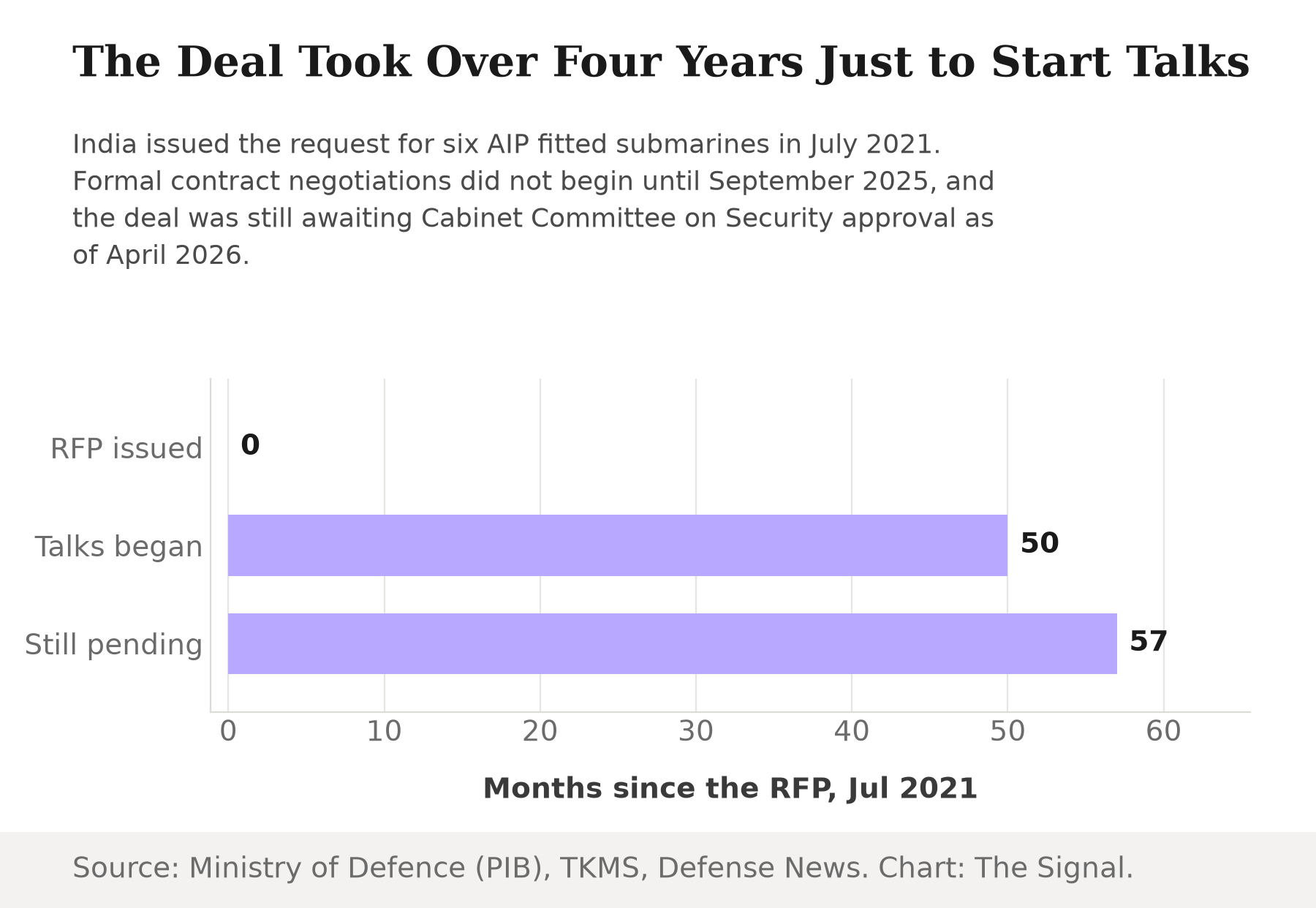
That gap, roughly 50 months from the July 2021 request to the September 2025 start of talks, is the actual pace of the program the "final stages" framing describes. By The Signal's calculation from those same dates, the wait stretches to close to 57 months against a still-pending approval as of April 2026.
A fleet that isn't being replaced as fast as it's built
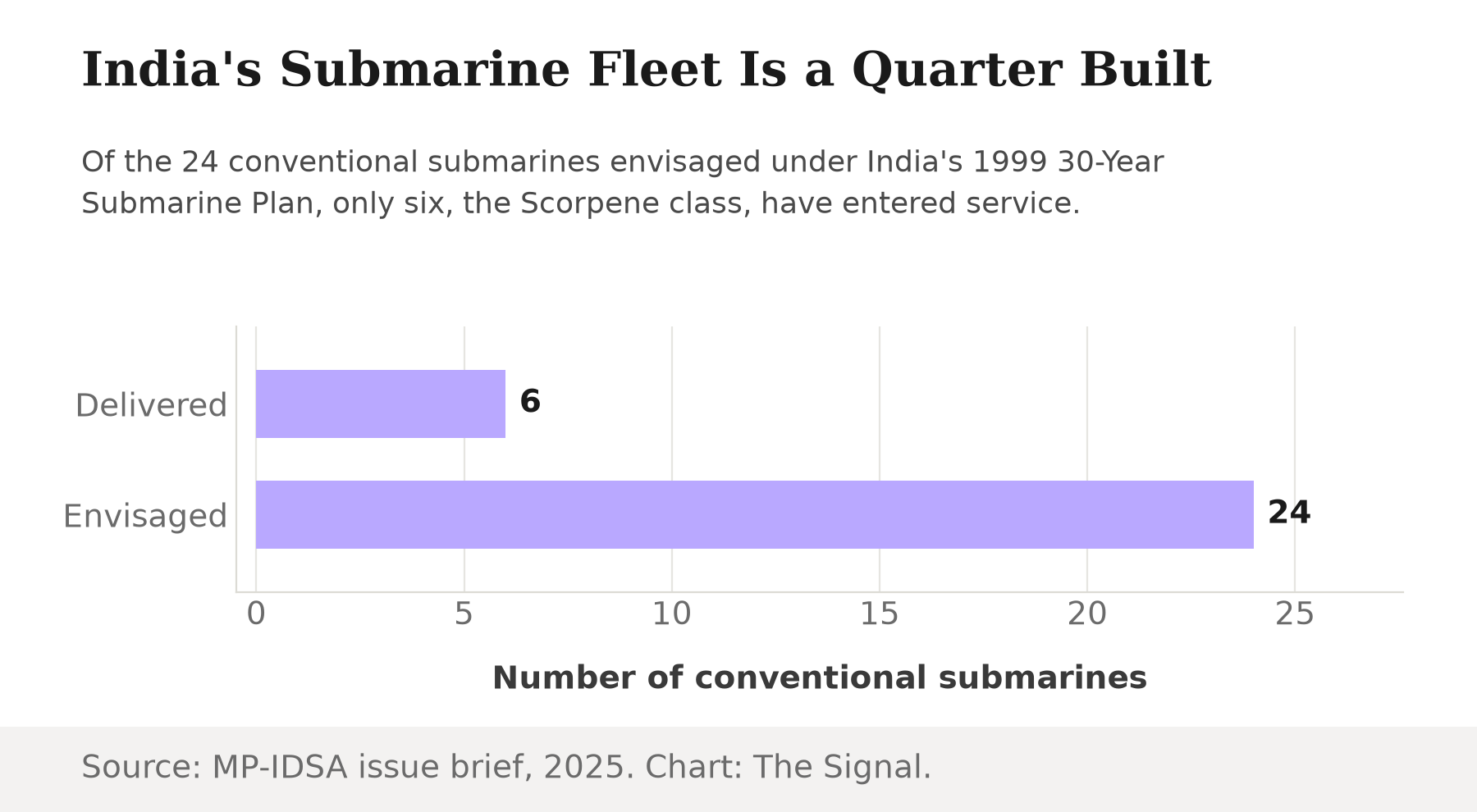
India's Navy has commissioned only six of the 24 conventional submarines envisaged under the country's 1999 30-Year Submarine Plan. Those six are the Scorpene class, and the last of them, INS Vaghsheer, was commissioned on 15 January 2025, closing out that program entirely. Twenty-seven years into a plan meant to run thirty, the navy has delivered a quarter of what it set out to build, and the next tranche, Project 75(I), is the deal stuck at the negotiating stage described above.
Just a quarter of the submarines promised in 1999 have entered service.
The Navy's workaround was to buy more of what already works
Rather than wait on Project 75(I), the navy moved on a parallel track. In February 2025, the Indian Navy finalised a separate deal worth over Rs 36,000 crore with state-run Mazagon Dock for three additional Scorpene submarines, built to 60 percent indigenous content on a design the yard already knows how to produce. That order was finalised in the same stretch of calendar time the Project 75(I) request sat without a negotiating partner. When the navy needed submarines moving quickly, it reached for the design it had already built six times, not the one it was still trying to contract for.
The region isn't waiting on India's paperwork
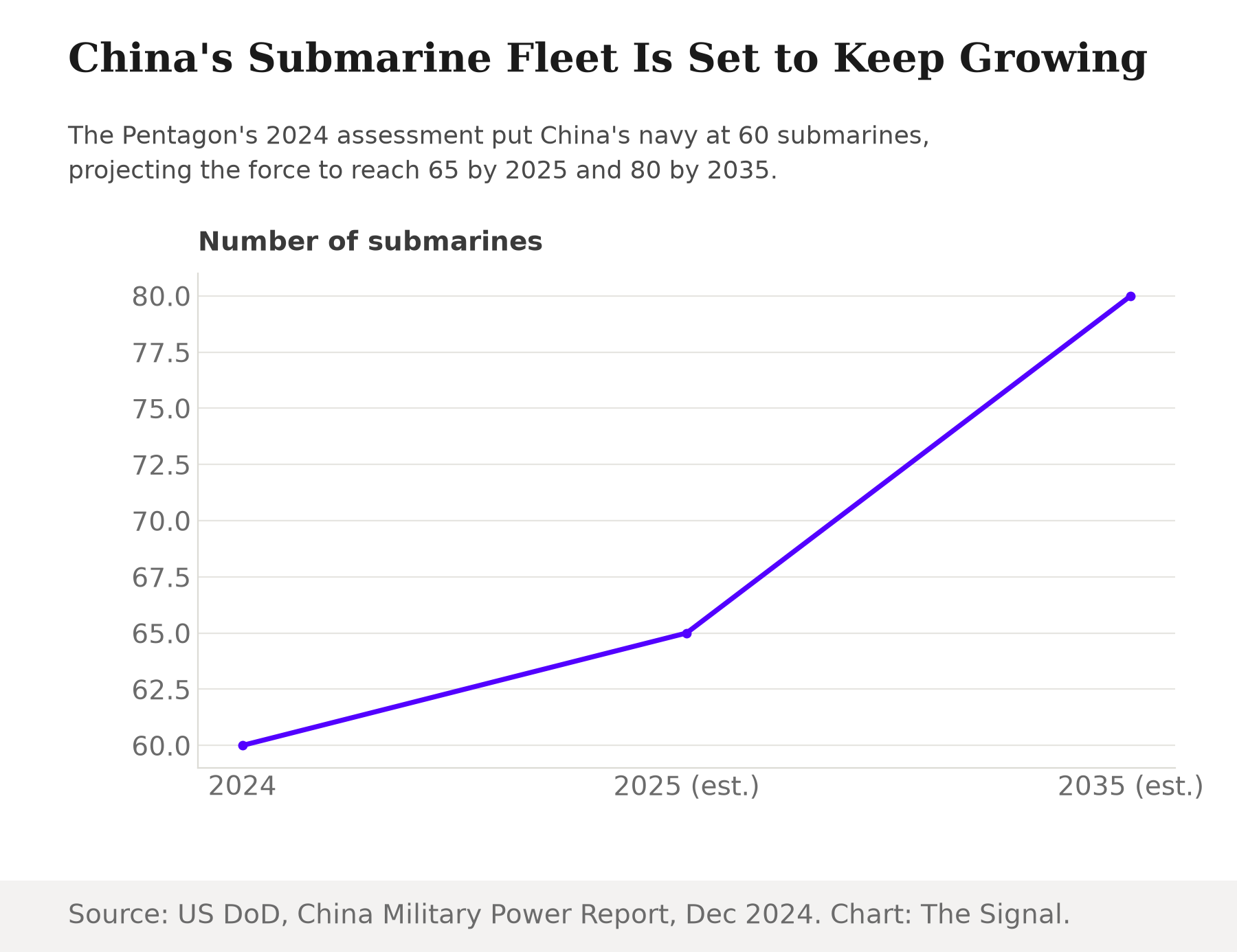
The Pentagon's 2024 assessment put China's navy at 60 submarines, six nuclear-powered ballistic missile boats, six nuclear-powered attack boats, and 48 diesel or air-independent powered attack boats, and projected the force to grow to 65 by 2025 and 80 by 2035. China is also arming India's other regional neighbor: it has delivered Pakistan's Navy the second of eight Hangor-class submarines under a deal worth roughly $5 billion, as of March 2025. That Hangor-class contract was signed in 2015, a decade ago, and Pakistan already has a boat from that program in the water. India's own P-75(I) request came six years later, in 2021, and it still doesn't have a signed contract behind it.
The money was never the constraint
India's FY2026-27 Union Budget allocates over Rs 2.19 lakh crore in capital outlay to the defence forces, up 21.84 percent over the prior year's budget estimate, and of that, Rs 1.85 lakh crore is earmarked for capital acquisition, an increase of roughly 24 percent. That acquisition budget grows every year on schedule, on a fixed government calendar, regardless of whether any single contract closes. Project 75(I)'s bottleneck has not been finding money. It has been converting an approved, funded request into a signed contract.
The honest objection
The strongest case for the delay is that Project 75(I) is not a repeat order like the Scorpene follow-on. It is, by the ministry's own description, the first acquisition programme under India's Strategic Partnership Model, a mechanism built specifically to force a foreign submarine maker and an Indian shipyard into a genuine technology-transfer partnership rather than a license-built import. Negotiating the terms of that transfer, workshare, and intellectual property for the first time, on a design as complex as an AIP-fitted submarine, is a real and defensible reason to move slower than a program the yard has already run six times.
That case holds up to a point: it explains why talks, once started, take time. It doesn't explain why formal negotiations took more than four years to begin at all, nor why the same procurement system managed to finalise the Rs 36,000 crore Scorpene follow-on within months, in the same window Project 75(I) sat idle. The four-year wait before that negotiation even opened is the harder case to defend.
The Signal
The number worth watching next is not the $8 billion price tag; it is whether Cabinet Committee on Security approval, whenever it lands, is followed by a signed contract within the same year rather than another multi-year gap. If it is, Project 75(I)'s delay was the cost of building a genuinely new procurement model, paid once. Another multi-year gap after approval would point to something else: the model itself is the bottleneck, not this one deal, and every future Strategic Partnership program inherits the same clock. Either way, the fleet math keeps running while the contract doesn't: a quarter of a thirty-year plan built with two-thirds of it still to go, and the boats meant to fill that gap still waiting on a signature.
Reporting basis: the July 2021 request for proposal and the FY2026-27 defence capital outlay are per Ministry of Defence and Ministry of Finance press releases via the Press Information Bureau. INS Vaghsheer's commissioning is per a separate Press Information Bureau release. The status of the Germany deal and its pending Cabinet Committee on Security approval, as of April 2026, is per Defense News reporting. The 30-Year Submarine Plan's delivery shortfall is per an MP-IDSA issue brief. The additional Scorpene order is per ThePrint's reporting. The September 2025 start of formal Project 75(I) contract negotiations is per a TKMS company statement, a self-reported fact about the company's own program. China's submarine fleet size and projected growth are per the US Department of Defense's China Military Power Report. The Hangor-class delivery to Pakistan is per News on Air, citing Chinese state media, and rests on that single reported account; the 2015 signing date for that contract is per separate Defense News reporting. The reason formal Project 75(I) negotiations opened when they did, and the deal's rupee value, are per ThePrint and The Hans India reporting respectively. The months-elapsed figures in the first chart are The Signal's calculations from the dates in the Ministry of Defence, TKMS, and Defense News sources above.