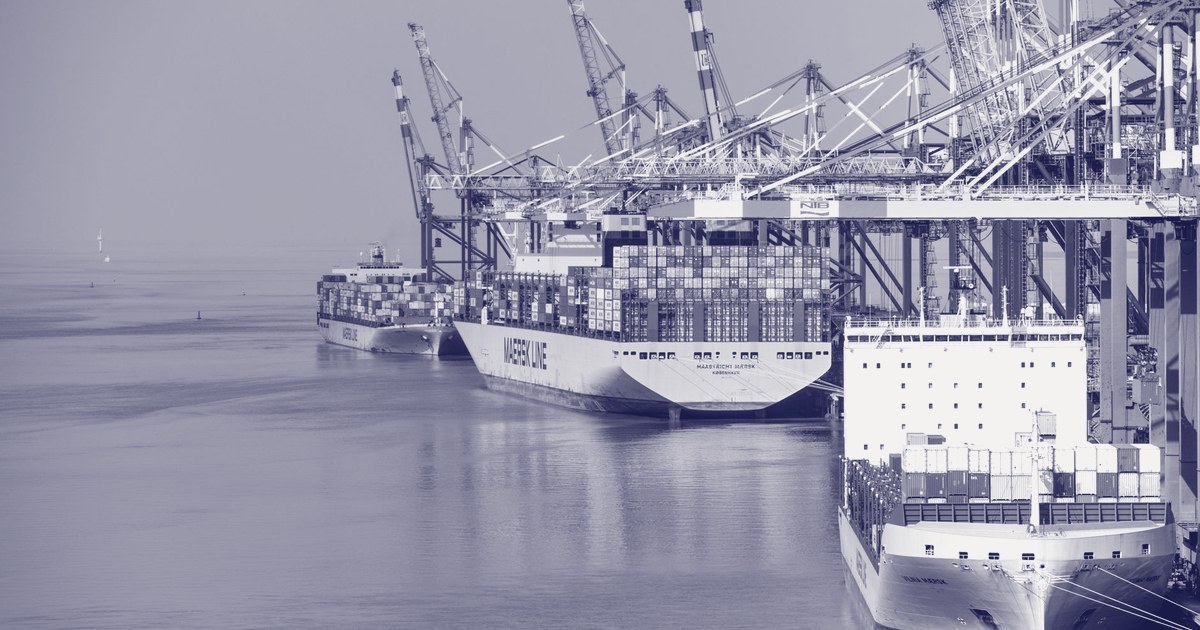
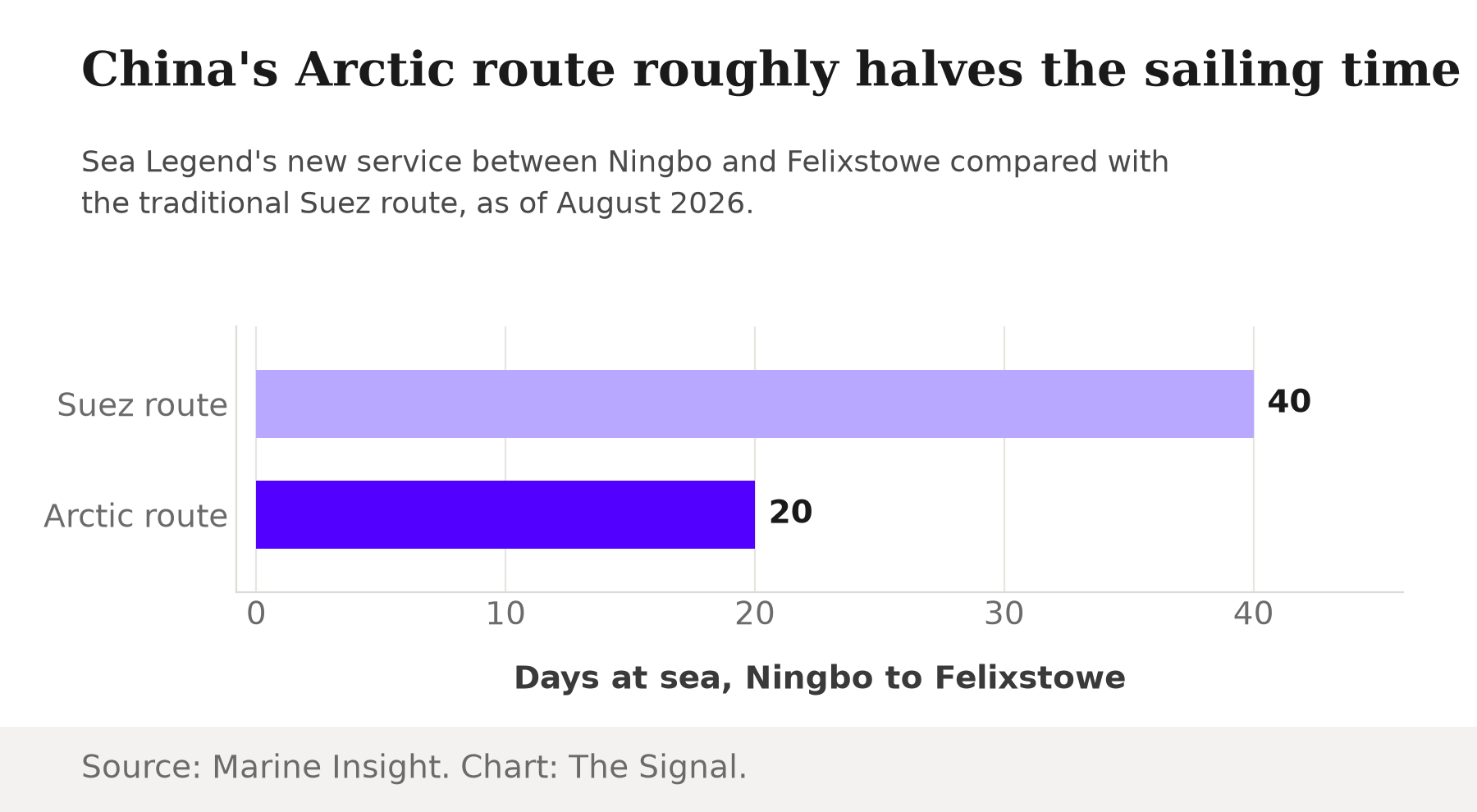
On 15 August 2026, a container ship called Dubai Tower left the Chinese port of Ningbo bound for the United Kingdom. The Maritime Executive reports the sailing is the first of Sea Legend Shipping's regularly scheduled weekly Arctic container service to Europe, and that Dubai Tower is expected to reach Felixstowe in 20 days. Marine Insight reports the new route is designed to cut the usual Ningbo-Felixstowe sailing time from about 40 days via the traditional Suez route to roughly 20. Read those two facts together and the story writes itself: China has opened a shortcut that halves the journey time to Europe, sidestepping a canal that has spent the past two and a half years absorbing missile attacks, insurance surcharges and diversions.
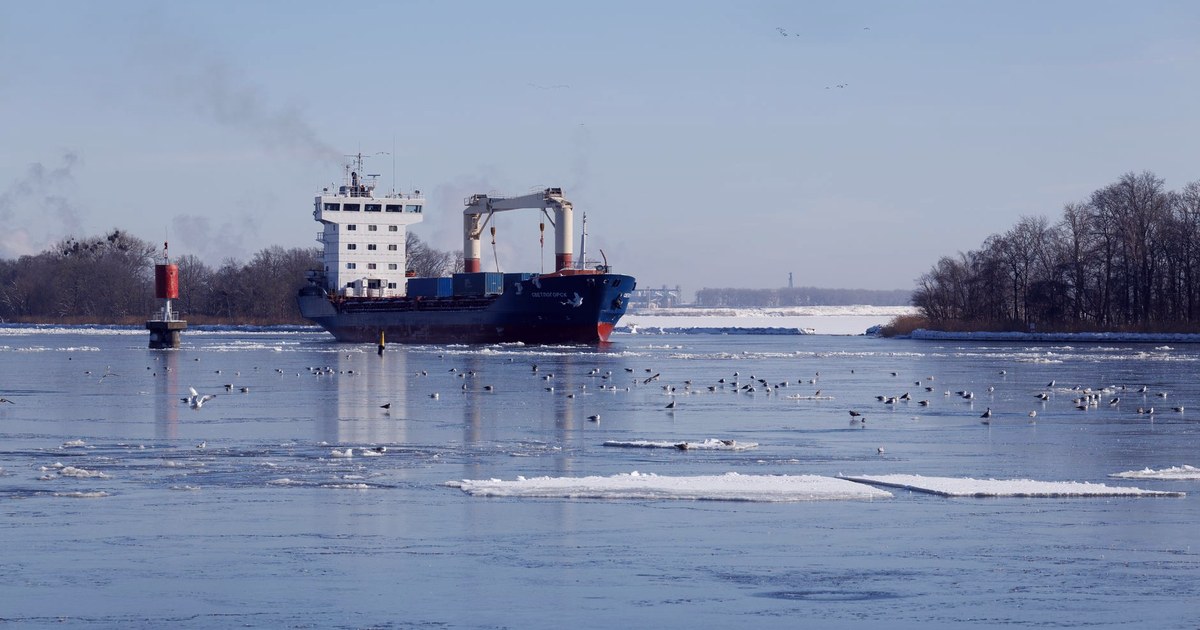
It is worth slowing down on the word "bypass." A chokepoint is not just a strip of water, it is whoever controls passage through that water. Sailing around the Suez Canal does not remove that control, it just relocates it. The Northern Sea Route that Dubai Tower is using runs almost entirely through Russia's Arctic exclusive economic zone, escorted and regulated under Russian rules the whole way. China has not escaped the chokepoint problem. It has picked a new chokepoint, and a new landlord.
This is not a fringe shortcut. It is already a working route. World Nuclear News reports, citing Rosatom, that the Northern Sea Route carried a record 37.8 million tonnes of cargo in 2024, breaking the previous high by 1.6 million tonnes. Sea Legend's weekly service is not testing an empty ocean. It is plugging a Chinese shipping line into Arctic infrastructure that Russia has already built out for a decade, tonne by tonne.
What the old route already cost
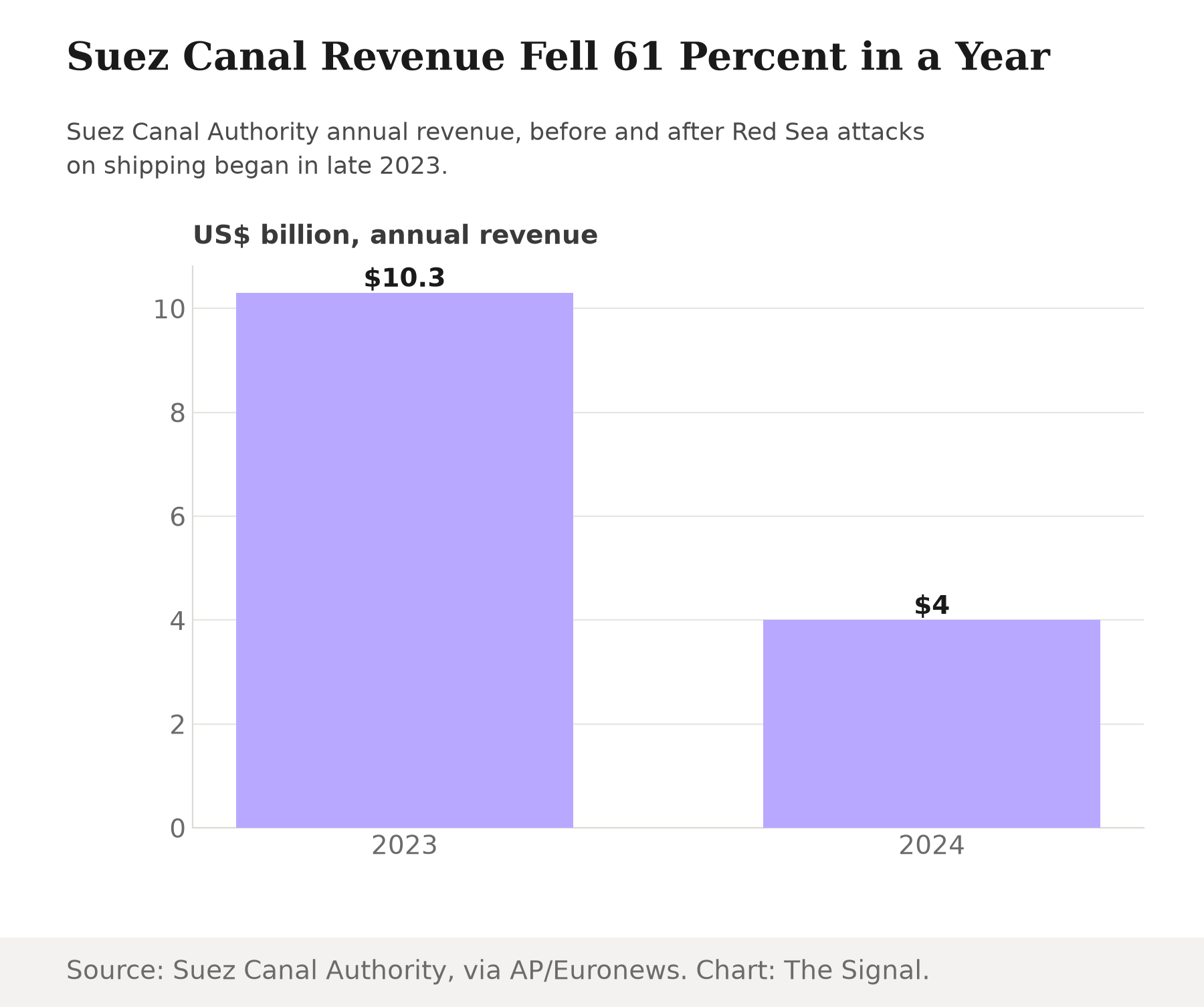
The chokepoint risk this route is meant to dodge is not theoretical. The Suez Canal Authority's revenue fell 61%, from a record $10.3 billion in 2023 to $4 billion in 2024, as Houthi attacks on Red Sea shipping diverted traffic, according to the Associated Press's reporting on the canal authority's own figures.
The canal is still, even diminished, a far bigger conduit than the Arctic route. FreightWaves reports that 13,213 vessels transited the Suez Canal in 2024, carrying a net tonnage of about 524.5 million tons, against the Northern Sea Route's 37.8 million tonnes of actual cargo the same year. Sea Legend's weekly sailing is not challenging Suez on scale. It is proving a second option exists at all.
Shippers did not wait for an Arctic alternative to react. The U.S. Energy Information Administration reports that the volume of crude oil and oil products rerouted around Africa's Cape of Good Hope rose to 8.7 million barrels per day in the first five months of 2024, up from an average of 5.9 million barrels per day in 2023, as tankers avoided the Red Sea and Bab el-Mandeb Strait entirely. That detour adds roughly two weeks to a voyage. It was still cheaper than the risk.
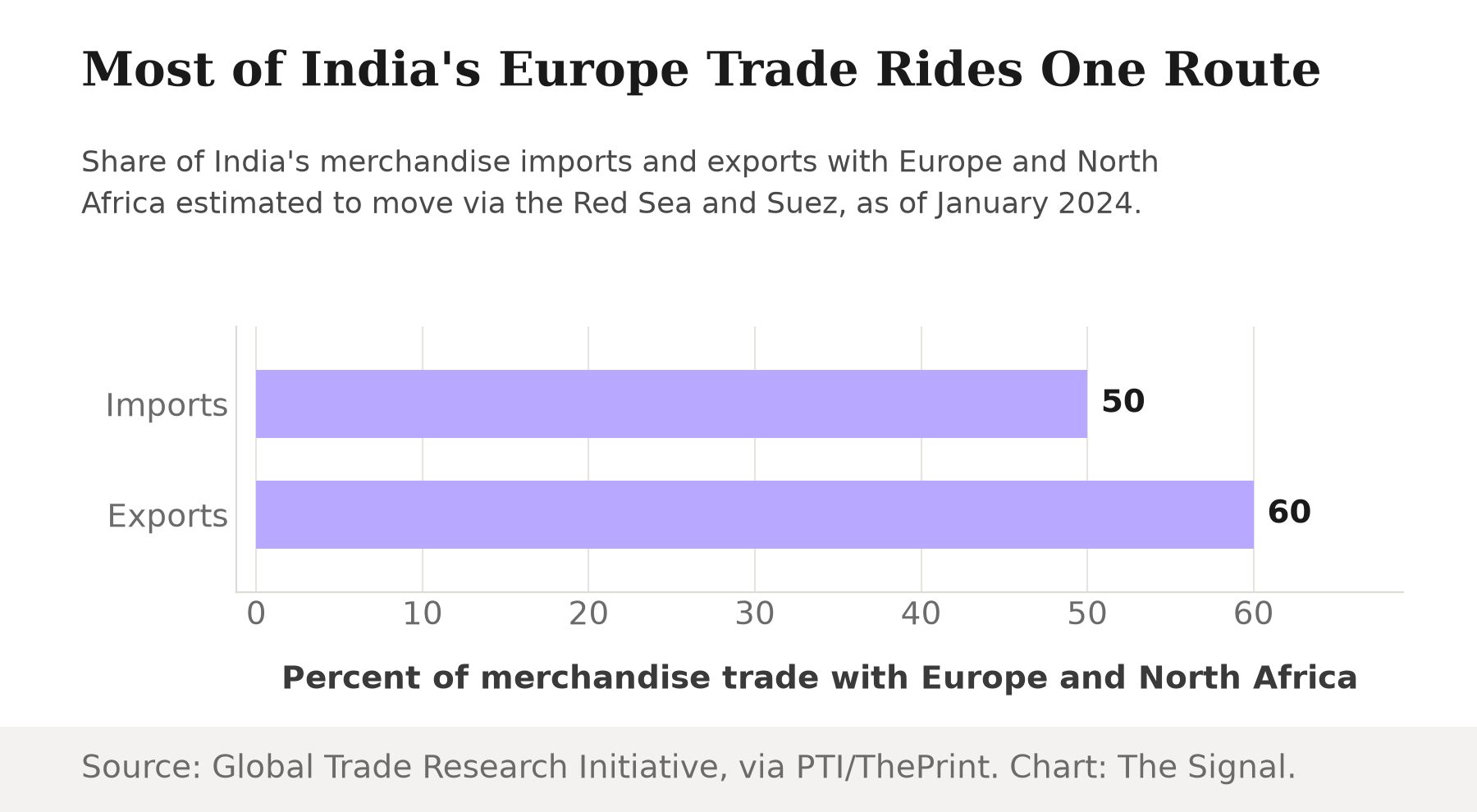
India was not a bystander to that shift. A Global Trade Research Initiative analysis, reported via PTI and ThePrint, estimated that about 50% of India's imports and 60% of its exports in merchandise trade with Europe and North Africa, together worth $113 billion, may have used the Red Sea and Suez route.
That is the backdrop Sea Legend's Arctic sailing lands on. The canal has already lost more than half its revenue rather than absorb the risk on its old terms. An operator with a genuine exit from that chokepoint has a real advantage. The question is who actually has one.
A different gatekeeper, not no gatekeeper
China does, for now, because it can route its container ships through Russian Arctic waters on terms Moscow controls, and because the Northern Sea Route's cargo volumes were already climbing to record levels, at 37.8 million tonnes in 2024, before this container service ever sailed. That dependency swap is a real trade: away from a canal exposed to Yemen-based militants and Egyptian tolls, toward a sea lane that exists on Russian terms, subject to Russian icebreaker escort and Russian permitting. Beijing appears to have judged that bet as more favourable to it right now, given how deep the Sino-Russian relationship already runs. Not every country gets to make that same trade.
India's slower bypass
India has no polar shortcut of its own to offer. Its answer to the same underlying vulnerability, the one GTRI priced at $113 billion of exposed trade, is a different kind of workaround: the India-Middle East-Europe Economic Corridor. The memorandum of understanding for IMEC was signed on 9 September 2023 at the G20 New Delhi summit by the United States, India, Saudi Arabia, the UAE, France, Germany, Italy and the European Union, a rail-and-sea corridor meant to connect India to Europe through the Gulf and the Eastern Mediterranean.
India's commerce minister projects that IMEC will cut logistics costs by up to 30% and transportation time by 40% versus the existing route, figures stated in April 2025, nearly two years after the corridor's signing.
| IMEC's stated target | Change versus today's route |
|---|---|
| Logistics costs | Down by up to 30% |
| Transportation time | Down by up to 40% |
Source: India's Commerce and Industry Minister Piyush Goyal, via Doordarshan News, April 2025.
Set the two projects side by side and the asymmetry is plain. China's Arctic route is not a projection, it is a ship that departed Ningbo on 15 August 2026 and is already at sea, headed for Felixstowe. IMEC, nearly three years after its signing ceremony, is still a minister's stated target for cost and time savings, not a corridor moving containers on a published schedule. That is not just slow bureaucracy: a Centro Studi Internazionali analysis states that IMEC's central segment, the rail links meant to connect the UAE, Saudi Arabia, Jordan and Israel, is currently at a standstill, pending a political resolution to the conflict in the Middle East. China converted a chokepoint problem into a working alternative route. India has converted the same problem into a plan that cannot move past a regional ceasefire it does not control.
The honest objection
The strongest case against reading any of this as a structural shift is that Sea Legend has launched exactly one scheduled service, and even its headline number comes with a qualifier: Marine Insight's own reporting on the transit-time cut notes it applies "depending on conditions", a reminder that Arctic sailing windows are narrower and less predictable than a canal transit. One weekly service, on a route that still depends on ice conditions, is a modest base on which to declare the Suez Canal's chokepoint leverage broken.
That case is real, but it understates how much capacity already sits behind this single sailing. The Northern Sea Route did not need Sea Legend to reach a record 37.8 million tonnes of cargo in 2024; it had already been climbing for years before this container service existed. Dubai Tower is not the opening bet on a route that might work. It is a new class of user joining a route that Russia has already spent a decade scaling up.
The Signal
The consensus read on Sea Legend's launch is about speed: a 20-day crossing instead of 40. The more durable read is about control: China now has two ways to reach Europe, one priced by Egypt and threatened by Houthi missiles, the other administered by Russia. That is optionality, not liberation, and it is optionality that runs through Moscow. India, whose traders had roughly $113 billion of Europe-bound and Europe-origin merchandise trade exposed to the Suez route as of January 2024, does not have a third lane to switch to. Its own corridor still runs through the Gulf chokepoints and the Red Sea's neighbourhood, just organised differently and still, years after the ribbon-cutting, unbuilt. Watch which of the two projects is still just a projection a year from now. A route is not an alternative until ships are actually using it every week, and right now only one of these two is.
Reporting basis: the Dubai Tower sailing and Sea Legend's Arctic service are per The Maritime Executive's reporting; the sailing-time comparison against the Suez route is per Marine Insight. The Northern Sea Route's 2024 cargo figures are per World Nuclear News, reporting Rosatom's own data. The Suez Canal Authority's 2023 to 2024 revenue change is per the Associated Press's report on the canal authority's statement, as carried by Euronews. The Cape of Good Hope rerouting volumes are from the U.S. Energy Information Administration. India's trade exposure to the Red Sea and Suez route is a Global Trade Research Initiative figure, as reported by PTI and ThePrint. The IMEC signing details are per the White House's own fact sheet from the 2023 G20 New Delhi summit, and the corridor's projected cost and time changes are per India's Commerce and Industry Minister, as reported by Doordarshan News. The Suez Canal's 2024 vessel and tonnage totals are per FreightWaves, citing Suez Canal Authority data, and IMEC's central rail segment being at a standstill is per an analysis from the Centro Studi Internazionali. This piece rests on nine distinct origins reporting ten distinct facts: the Suez Canal Authority is the origin behind both the revenue figures, via the Associated Press and Euronews, and the vessel and tonnage totals, via FreightWaves. None of the ten facts is a derived or calculated figure.