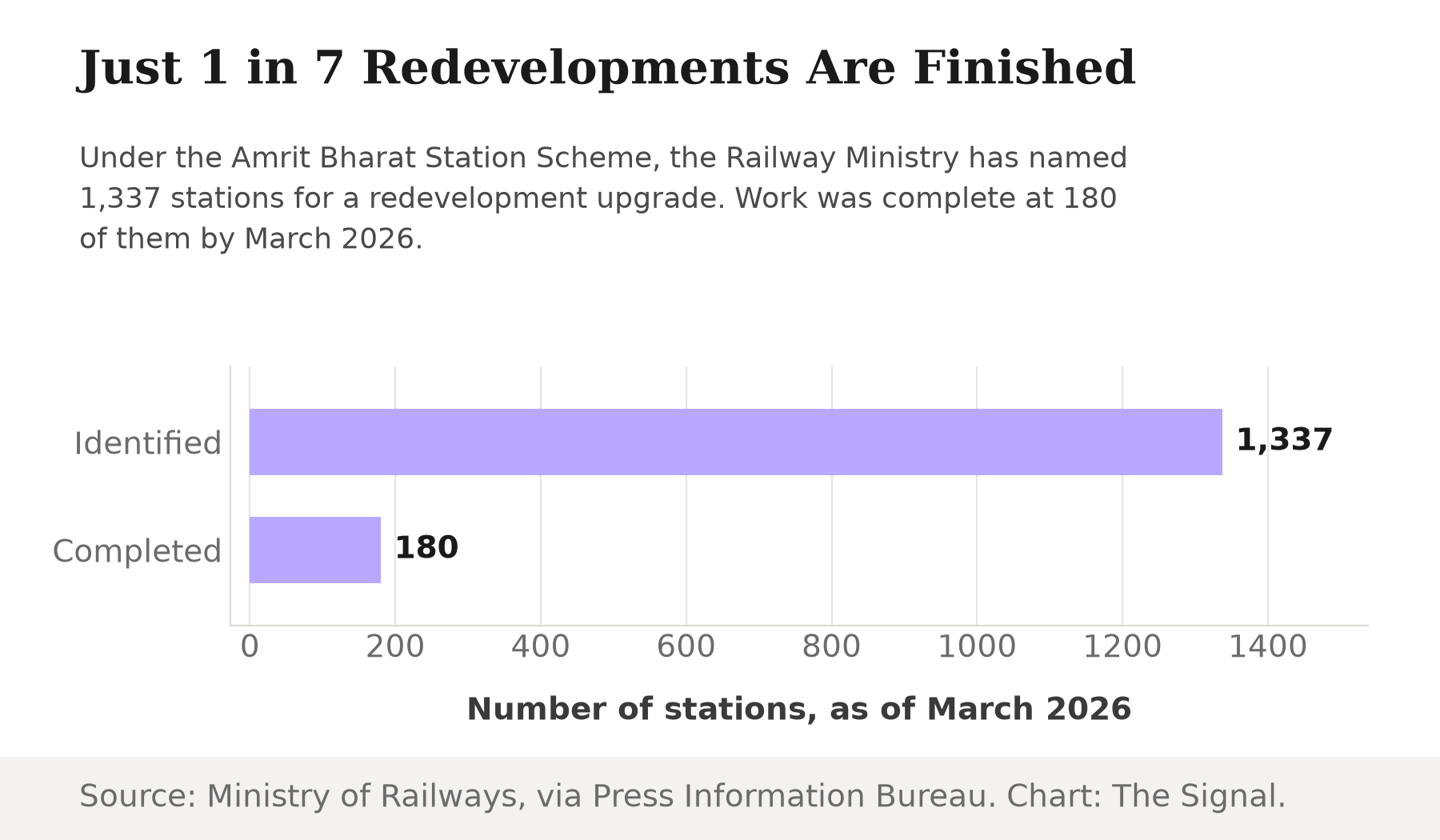
Indian Railways has a redevelopment story it likes to tell, and the numbers behind it are real. Under the Amrit Bharat Station Scheme, the Ministry of Railways has identified 1,337 stations for a redevelopment upgrade, and says work is now complete at 180 of them, as of March 2026. The scheme's budget backs that up: Railways was allocated 12,118 crore rupees for its passenger-amenities budget line, Plan Head-53, for FY2025-26. Read only the press releases and the picture is of a system finally rebuilding its stations at scale.
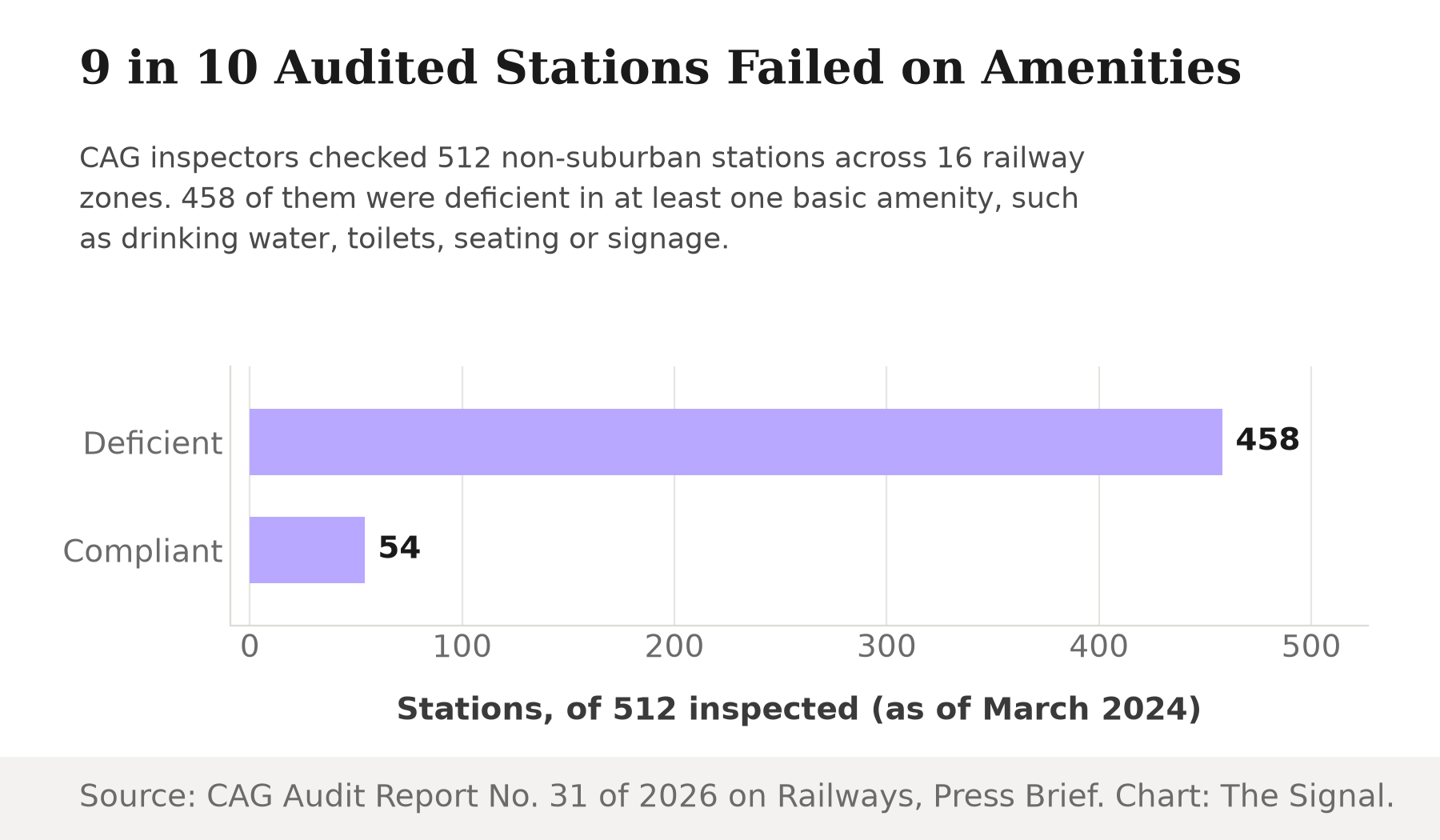
It is worth slowing down on that. On August 12, 2026, the Comptroller and Auditor General tabled Audit Report No. 31 of 2026 on Railways in Parliament, and it describes a different station network than the one in the press releases. Of 512 non-suburban stations the CAG inspected across 16 railway zones, 458 of them, more than 89 percent, were deficient in one or more Minimum Essential Amenities: drinking water, seating, toilets, platform shelters, fans, water coolers or signage.
Nearly nine in ten stations the CAG checked failed a basic amenities test.
That is not a scattering of remote halts falling through the cracks. It is the typical station, audited as of March 2024, across the bulk of the network the CAG actually walked through.
What "deficient" covers, and how slowly it gets fixed
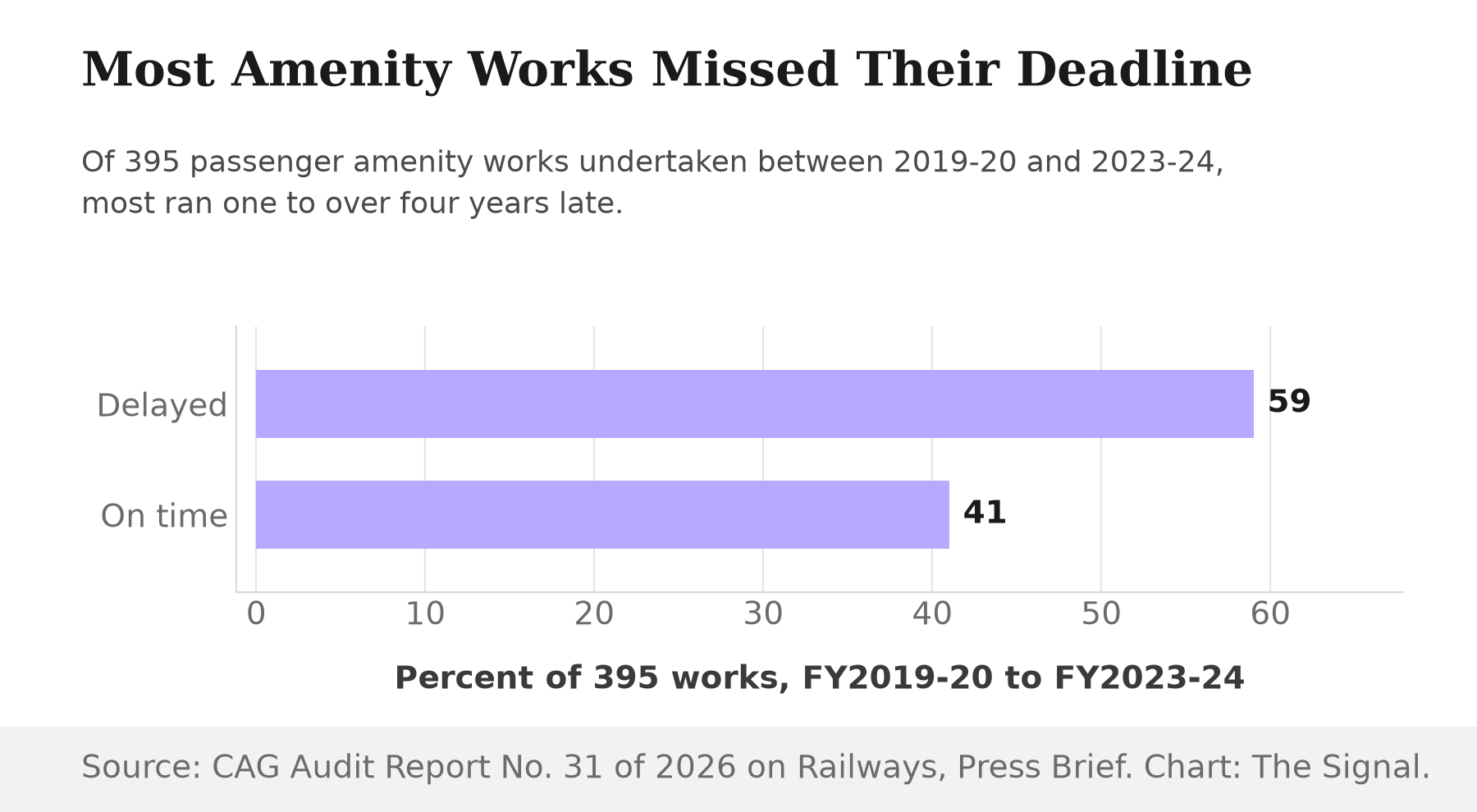
The deficiencies sit in the amenities a passenger actually uses, not paperwork technicalities: whether there is a working tap, a seat, a lit sign telling you which platform to stand on. And even where a tap exists, what comes out of it is not always safe: the CAG found that inspection of station water-supply systems fell short of the required schedule, and that where drinking water was tested, it turned up total coliform bacteria, including E. coli, alongside chlorine levels outside the prescribed range. And the fixes are not happening fast. A review of 395 passenger amenity works undertaken between 2019-20 and 2023-24 found 59 percent were delayed, by one to over four years, with only 41 percent completed on schedule. Even the paper trail meant to hold the system accountable has not been built: as of March 2024, no Railway Zone had operationalised the station-wise webpages on amenities and sanitation that the National Green Tribunal had ordered.
Not just the small stations
The easy assumption is that this is a problem of neglected minor halts, while the big, famous stations are fine. The audit does not support that. Even NSG-1 category stations, the highest passenger-traffic tier, including CSMT Mumbai, Howrah, Sealdah, New Delhi and Mumbai Central, were found deficient in seating, sanitary facilities, dustbins and electronic indicator boards. Drinking water taps were short at 12 of these top-tier stations, fans and water coolers at eight each, and signage at five. These are stations that already see some of the country's heaviest footfall and, in several cases, have been through recent redevelopment work of their own. The deficiencies showed up anyway.
The money was never the constraint
This does not fit a simple story about a cash-strapped railway. Between 36 percent and 44 percent of the Railways' annual budget grant for passenger amenities went unspent every single year from 2019-20 to 2023-24, despite the funds being available. Flip that around: even in the best of those five years, Railways spent no more than 64 percent of the money it had set aside for exactly the amenities the CAG found missing.
Railways left over a third of its own amenities budget unspent, every year, for five straight years.
FY2025-26, which closed in March 2026, did not break that pattern either. Of the 12,118 crore rupees allocated for Plan Head-53 that year, only 7,253 crore rupees, about 60 percent, had been spent by October 2025, the latest spending figure Railways has published. That 60 percent, seven months into the fiscal year, sits inside the same 56-to-64-percent spent band the CAG measured for every prior year on record. Meanwhile the redevelopment scheme that gets the headlines is also running behind its own numbers: of the 1,337 stations named for an Amrit Bharat upgrade, only 180 were finished as of March 2026, about 13 percent of the list.
Money for amenities keeps going unspent, redevelopment push or no redevelopment push.
| Period | Passenger-amenities budget (Plan Head-53) | Share spent |
|---|---|---|
| FY2019-20 to FY2023-24 (audited) | 36 to 44 percent of the annual grant went unspent each year, despite available funds | 56 to 64 percent |
| FY2025-26 (up to October 2025) | ₹12,118 crore allocated; ₹7,253 crore spent | About 60 percent |
Sources: Down To Earth, reporting on the CAG audit; Ministry of Railways, via Press Information Bureau. Spent-share figures for FY2019-20 to FY2023-24 are The Signal's calculation from the CAG's unspent range.
The honest objection
The strongest case against reading this as an unbroken pattern is that the October reading is a mid-year snapshot, not the year's final result. Five more months remained on the fiscal calendar after that reading, and spending on large capital programs often accelerates toward year-end, so FY2025-26 could still have closed near full utilisation by March 2026. On that reading, the October number does not tell us how the year actually finished, and it would be unfair to fold an incomplete-year snapshot into a five-year indictment.
That case would carry more weight if the prior five years had not already tested it. Every one of those years, 2019-20 through 2023-24, ran the same way: an allocation, and then between 36 and 44 percent of it left unspent by the close of the year, despite the money being available the whole time. A single slow year could be a fluke. Five in a row, each falling in the same narrow band, is a spending pattern, not a one-off lag. FY2025-26's final figures, once published, may still surprise on the upside. The base rate says not to bet on it.
The Signal
The story the press releases tell is about ambition: a nationwide scheme, thousands of crores allocated, stations rebuilt. Set against that, the CAG's own audit, tabled in Parliament this month, tells a story about execution: nine in ten inspected stations still missing something as basic as a working tap, delays running past four years on two out of five projects, and a budget that has left a third or more of its own money unspent every year for half a decade. Those are not competing accounts of two different railways. They are the same railway, described by what it announces versus what it actually delivers. The number worth watching next is not how many more stations get added to the Amrit Bharat list. It is whether, when Railways finally publishes FY2025-26's full-year spending figures, the unspent share breaks out of the 36-to-44-percent band it has sat in since 2019. If it does not, the constraint was never the money.
Reporting basis: the station-deficiency count, the amenity-work delay figures and the National Green Tribunal webpage finding are from the Comptroller and Auditor General's Audit Report No. 31 of 2026 on Railways, via its official press brief. The NSG-1 station findings, including the drinking-water-tap shortfall, are as reported by Press Trust of India and carried by Business Standard, drawing on the same CAG audit. The passenger-amenities budget underspend for 2019-20 to 2023-24 is as reported by Down To Earth, also drawing on the CAG audit. The Amrit Bharat Station Scheme's identified-versus-completed count and the FY2025-26 Plan Head-53 allocation and spend are from Ministry of Railways press releases via the Press Information Bureau. The spent-share percentages for 2019-20 to 2023-24, and the Amrit Bharat completion share, are The Signal's calculations from those figures.