On 7 August 2026, Turkiye, Saudi Arabia and Pakistan signed the Mecca Joint Deterrence Agreement, a mutual defense pact that Indian commentary moved fast to brand a "new NATO" on the country's western flank. Al Jazeera's tally of the three signatories' combined military weight counts nearly 1.4 million active troops, 3,400 aircraft, 6,000 tanks and more than 340 naval assets, and notes that Turkiye alone fields NATO's second-largest military. Set those figures next to a country India already watches closely and the arithmetic looks like it is building toward alarm.
India's own government has been more measured than its press. Ministry of External Affairs spokesperson Randhir Jaiswal told reporters at an 11 August briefing that New Delhi is "examining its implications, both from the perspective of our national security, as well as considerations of regional stability, peace and stability," adding that India "remains fully committed to safeguarding its national interests and will take all necessary measures in this regard." That is the language of watching, not the language of alarm.
It is worth slowing down on that framing. SIPRI's Military Expenditure Database puts 2025 defense spending at $11.9 billion for Pakistan, $30.0 billion for Turkiye and $83.2 billion for Saudi Arabia, a combined $125.1 billion. The same SIPRI release puts India's 2025 spending at $92.1 billion, the world's fifth largest, and China's at $336 billion, the world's second largest. The pact's three treasuries together spend about 36% more than India alone, but barely more than a third of what China spends by itself.
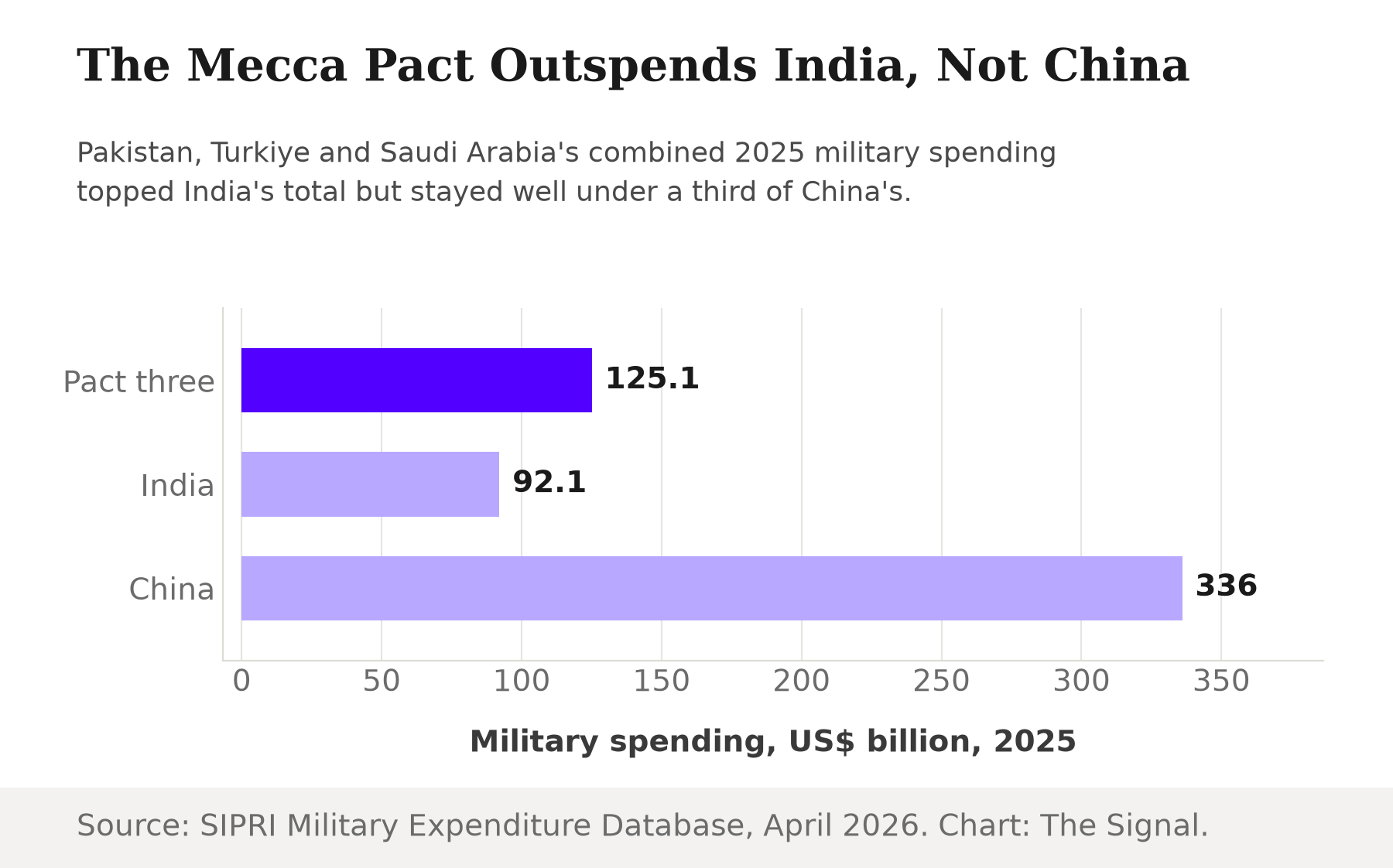
Source: SIPRI Military Expenditure Database, April 2026. Chart: The Signal.
That is the number missing from the "new NATO" headlines: the pact's combined budget is real, and it does clear India's own. But it sits closer to a rounding error against China, the country India's own defense planning is actually built around.
Scaled to the size of each economy, the picture shifts again. World Bank data put 2024 military spending at 7.3% of GDP for Saudi Arabia, against 2.7% for Pakistan, 2.3% for India, 1.9% for Turkiye and 1.7% for China. Saudi Arabia is the outlier straining hardest against its own economy, not the trio as a bloc. Pakistan's burden is barely above India's, and Turkiye and China both carry a lighter one.
Three armies, three budgets, three chains of command
The hardware and personnel counts are large because they are additive across three separate militaries with three separate budgets, not a single unified force. Al Jazeera's analysis is explicit that the totals are simply added across the three commands.
Added together, the pact's three militaries are large. As three separate forces, they are not one.
| Capability | Combined, Pakistan + Turkiye + Saudi Arabia |
|---|---|
| Active troops | Nearly 1.4 million |
| Aircraft | 3,400 |
| Tanks | 6,000 |
| Naval assets | More than 340 |
Source: Al Jazeera's analysis of the pact's combined capabilities.
The clause itself is short. It commits the three governments to treat an armed attack on any one of them as an attack on all, but a Turkish official told Reuters the agreement "is defensive in nature and not directed at any specific actor." It names no adversary, unlike NATO's Article 5, which sits inside a treaty built around a defined alliance and a defined threat from the outset.
A mutual-defense clause between three governments with three different sets of interests is not the same commitment as a single power fielding that force against one target. Those interests are concentrated on the Gulf and the eastern Mediterranean, not South Asia.
India is not standing still either
India's Ministry of Defence received an all-time-high ₹7.85 lakh crore in the Union Budget for FY2026-27, a rise of 15.19% over FY2025-26 and now equal to about 2% of the country's estimated GDP. That is the fastest pace of increase in years, arriving the same month the Mecca pact was signed. If a combined $125.1 billion from three foreign treasuries reads as a new pressure, the more direct measure of how New Delhi is actually responding is its own budget trajectory, not a count of Turkish jets or Saudi armor.
The loyalty test the pact does not settle
The sharper story sits in Pew Research Center's India-Pakistan comparative report, part of its Spring 2026 Global Attitudes Survey, not in the hardware counts. It finds Pakistanis hold overwhelmingly positive views of China, 90% favorable, with 83% expressing confidence in President Xi Jinping. Only 15% of Pakistanis view the United States favorably, a country whose formal alliance history with Islamabad runs back decades.
That sentiment already has a hardware record behind it. SIPRI's arms-transfers database shows 80% of Pakistan's major-arms imports between 2021 and 2025 came from China, up from 73% in the previous five-year period, and that Pakistan alone absorbed 61% of all Chinese arms exports in the same window. The favorability numbers are not a stray poll result. They track a defense relationship that was already built.
Indians read the same two powers in reverse. Only 23% of Indians view China favorably, against 54% who see it unfavorably, while 45% of Indians hold a favorable view of the United States, roughly three times Pakistan's US number.
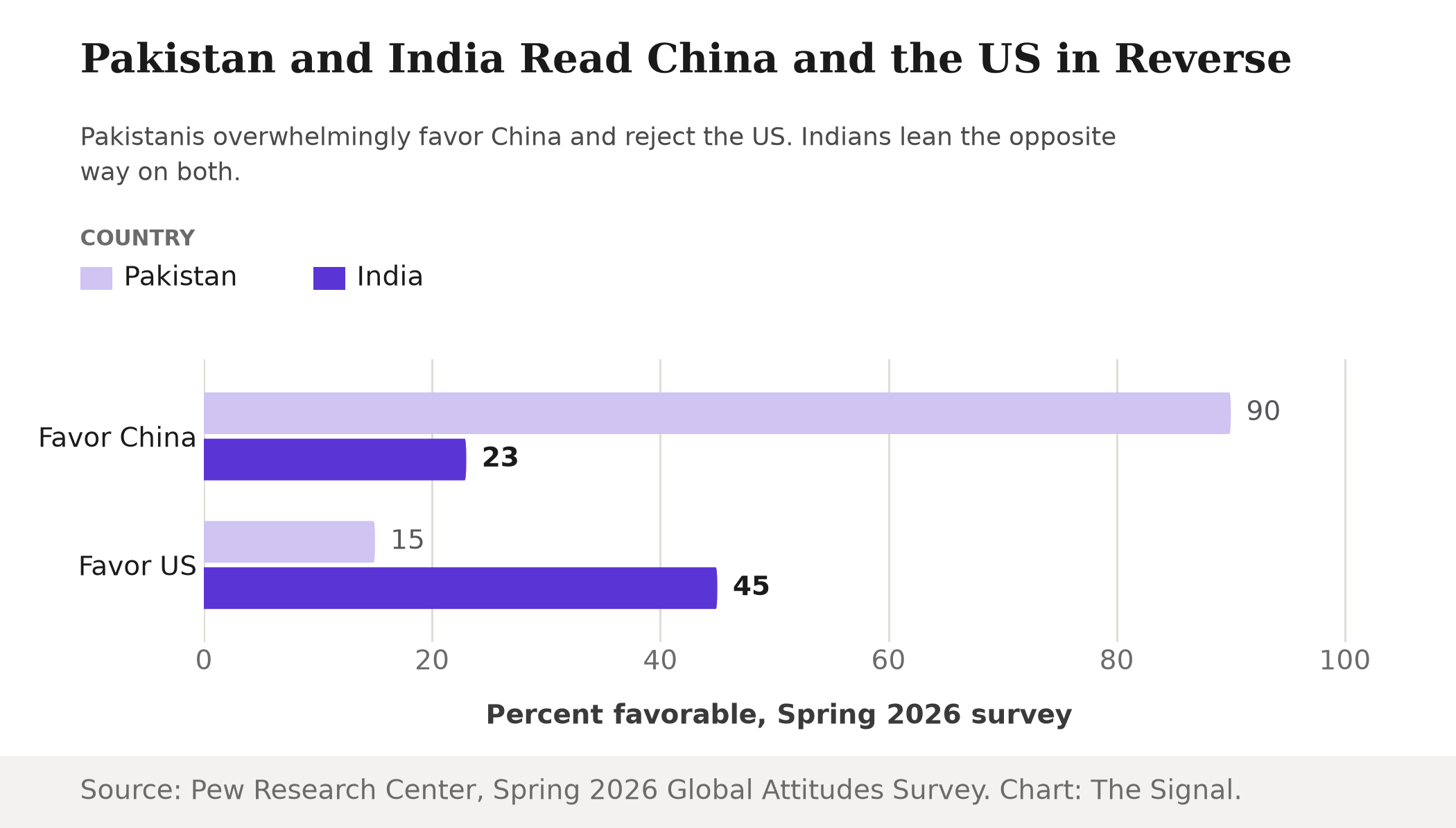
Source: Pew Research Center, Spring 2026 Global Attitudes Survey. Chart: The Signal.
The Mecca pact carries no Chinese signature. It is styled as a Gulf-and-Turkiye arrangement. But the Pakistani public that pact is meant to reassure had already, on its own account, settled its loyalties elsewhere. Ninety percent favorable to Beijing against 15% favorable to Washington is not the profile of a country hedging between blocs. It is the profile of one that made its choice well before 7 August 2026.
The honest objection
The strongest case against reading the Mecca pact as strategically thin is that raw spending is a poor proxy for what a mutual-defense clause actually changes. A trilateral commitment that pulls in Turkish drone manufacturing, Saudi financing and Pakistan's own nuclear-capable arsenal creates risks that a dollar comparison cannot capture, and Turkiye's status as NATO's second-largest military gives the pact a form of interoperability India has no equivalent access to. None of that shows up in a budget line.
That case is real, but it misses the part of this story that is actually new. The capability counts and the spending totals describe a trilateral arrangement whose logic predates 7 August 2026 by years; Gulf money and Turkish hardware flowing toward Pakistan is old news. What the Pew numbers add is a measurement of the ground the pact sits on, and that ground already leans toward Beijing, a government with no seat at the table in Mecca.
The Signal
India's press reached for "new NATO" because it fits an existing anxiety about encirclement. The spending numbers alone do not support that alarm: $125.1 billion split across three treasuries and three militaries is real money, but it is barely more than a third of what China spends on its own, and India's own defense budget is rising fast enough to keep pace with the trio's total. What the numbers do support is a narrower, more durable worry. A Pakistani public that is 90% favorable to China and 15% favorable to the United States is not a swing constituency the pact's Gulf and Turkish backers can easily pull toward themselves. It is evidence of where Pakistan's alignment already sits, pact or no pact. Watch whether Chinese financing or hardware quietly attaches itself to this trilateral over the next year. If it does, the "new NATO" story was pointed at the wrong flag.
Reporting basis: 2025 military spending for Pakistan, Turkiye, Saudi Arabia, India and China is from the Stockholm International Peace Research Institute's Military Expenditure Database, April 2026 update. Military spending as a share of GDP for the same five countries is from World Bank data for 2024. India's FY2026-27 defense budget figures are as reported by All India Radio's News on Air, citing the Union Budget. India's official response to the pact is from Ministry of External Affairs spokesperson Randhir Jaiswal's remarks, per the ministry's own transcript of its 11 August 2026 briefing. The pact's combined troop, aircraft, tank and naval-asset counts, and Turkiye's NATO ranking, are per Al Jazeera's analysis of the pact's capabilities; the pact's mutual-defense clause and the Turkish official's description of it as defensive, that official's remark reported by Reuters, are per Al Jazeera's separate report on the agreement's terms. Pakistan's share of arms imports from China is from SIPRI's Trends in International Arms Transfers fact sheet, 2025, a separate SIPRI database from the spending figures above. Favorability and confidence figures for Pakistan and India are from the Pew Research Center's Spring 2026 Global Attitudes Survey, drawn from its India-Pakistan comparative report and its topline tables on views of China and the United States. The percentage gap between the pact's combined spending and India's, and the pact's combined spending as a share of China's, are The Signal's calculations from those SIPRI figures.