Parliament moved fast. The Lok Sabha passed the Mines and Minerals (Development and Regulation) Amendment Bill, 2026 on 12 August 2026, and the Rajya Sabha cleared it a day later, sending it to the President for assent. Its new Section 9D bars State governments from taxing mineral rights or mineral-bearing land except under conditions the Centre prescribes. The consensus read writes itself: two years after the Supreme Court handed states a landmark taxing power, the Centre has clawed it back through ordinary legislation.
That is true, but it is worth slowing down on the timing rather than the reversal.
A nine-judge Supreme Court Constitution Bench ruled on 25 July 2024 that royalty on minerals is not a tax, and that the power to tax mineral rights sits with State legislatures under Entry 50 of the State List, not with Parliament. Three weeks later, the Court's 14 August 2024 order gave that ruling a repayment schedule: retrospective demands were capped at transactions after 1 April 2005, and the dues were to be paid in instalments over 12 years starting 1 April 2026, with interest and penalty waived for the period before the July ruling. That start date, 1 April 2026, is now more than four months in the past. The 12-year clock the Court set was already running when Parliament took up the bill.
Section 9D does not touch money states have already banked. It wipes out what they have not.
Once the amendment takes effect, any State levy on mineral rights that has not yet been deposited or recovered is deemed invalid from the start; whatever a state has already collected stays with it, with no obligation to refund. A state that had already received the first of the twelve instalments the Court ordered keeps that money. Instalments two through twelve are a different story: the law now says the underlying claim never existed.
What the Court actually gave states
The ruling itself was not close. The bench decided by an 8:1 majority, with Justice B V Nagarathna dissenting, that royalty is a contractual payment rather than a tax and that Parliament lacks the competence to tax mineral rights under Entry 54 of the Union List. In her dissent, Nagarathna took the opposite view: that royalty is in the nature of a tax, a statutory levy under Section 9 of the mining law rather than merely a contractual payment.
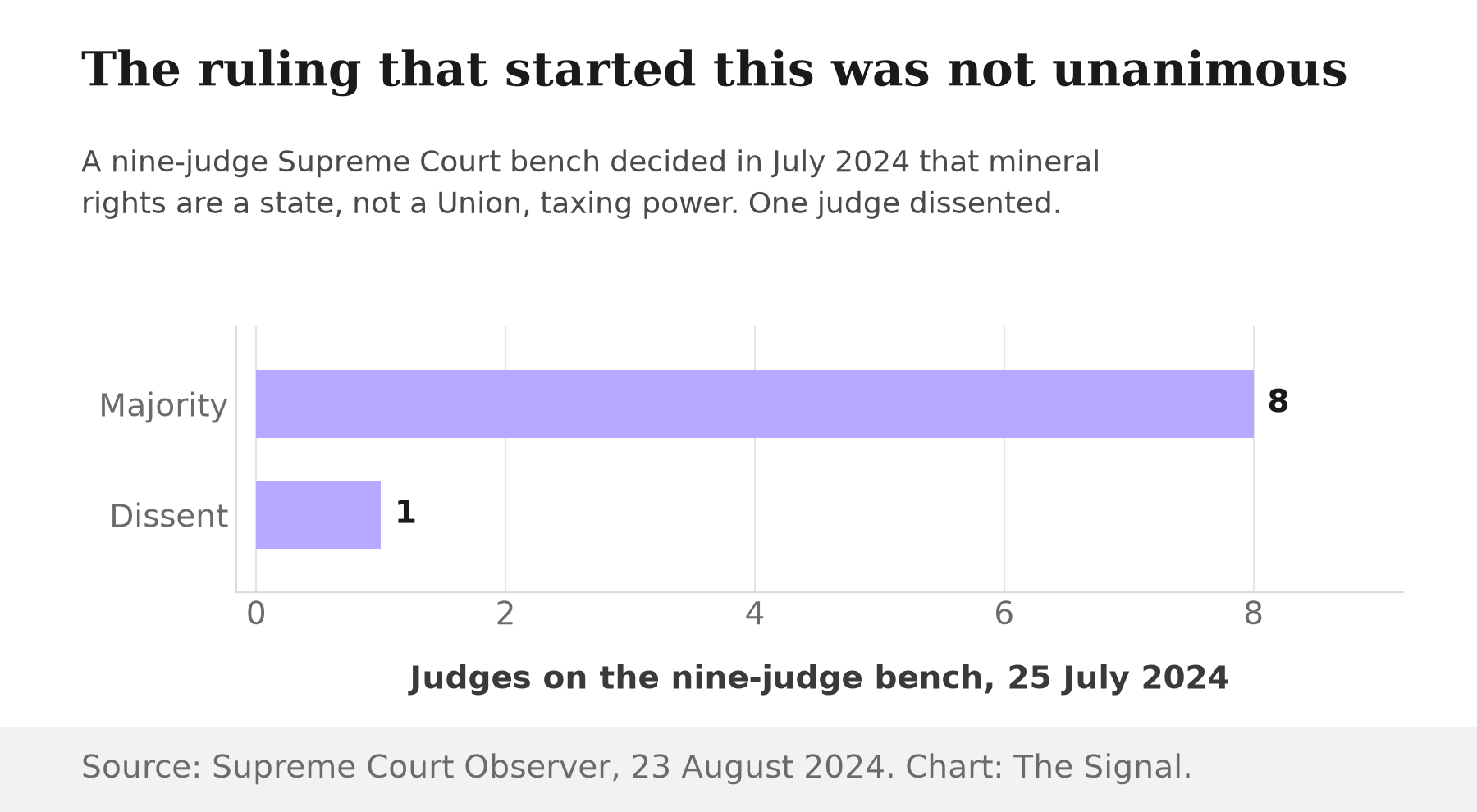
That size of majority mattered for what followed. The Court's own August 2024 order was a compromise between two risks: it let States collect what the Constitution, in its reading, already gave them, while staggering the bill so mining companies and public-sector units were not hit with an immediate lump sum. Parliament's amendment does not adjust that compromise. It ends the part that had not yet been paid.
Who pays, and who does not
The scale of what was at stake explains why the Centre moved. Steel Authority of India told the Court on affidavit that retrospective application could revive cumulative demands of about Rs 3,000 crore against it alone. The Solicitor General had separately told the Court that retrospective dues could burden public-sector mining and mineral-dependent units with more than Rs 70,000 crore in additional state levies, interest and penalties combined. SAIL's own figure works out to roughly 4 percent of that economy-wide estimate: one company's exposure was already large enough to put on affidavit, and the number the Centre was defending against was more than twenty times bigger.
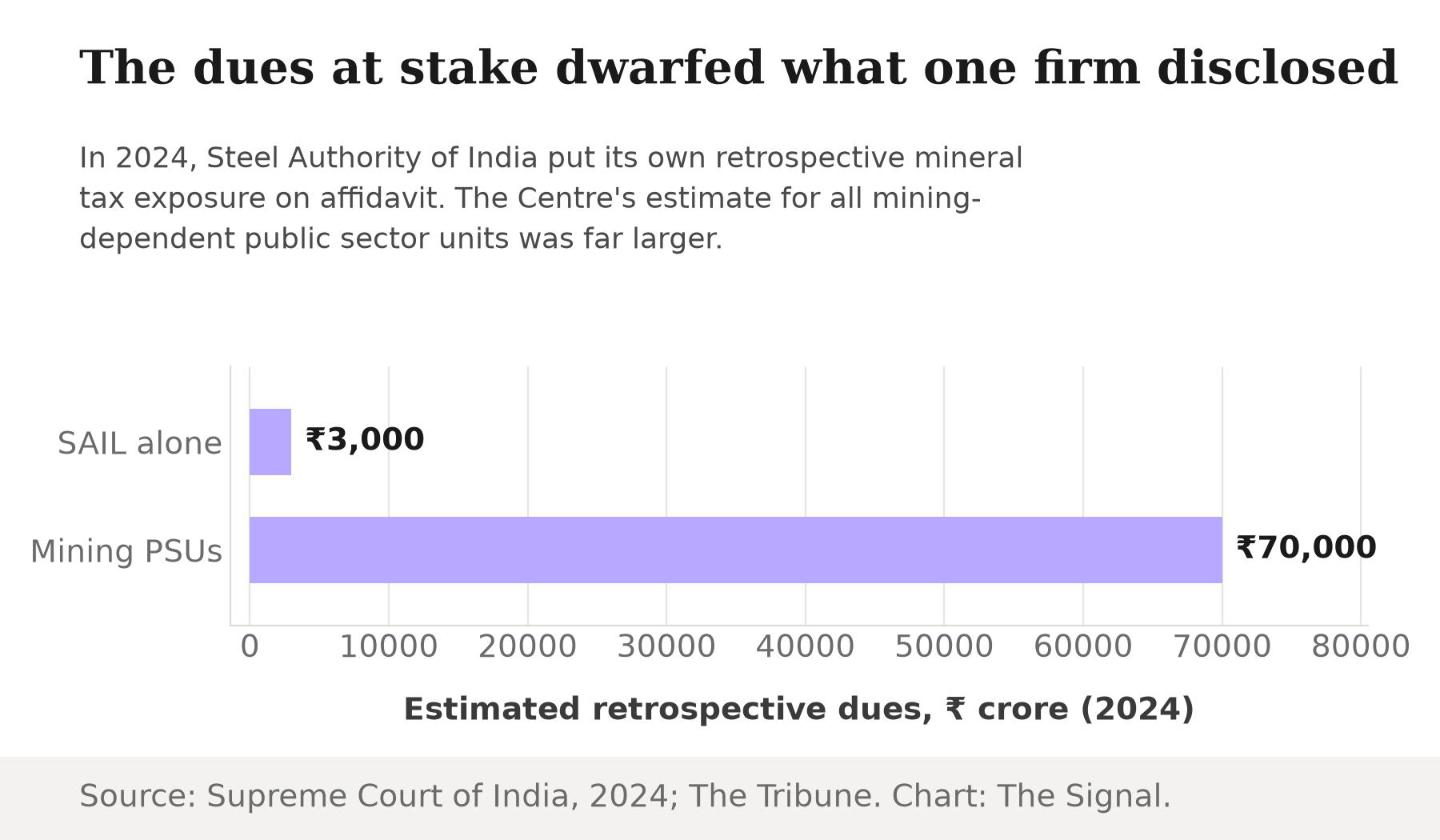
That exposure is what Section 9D is aimed at closing, and it does not just cap or reschedule the outstanding dues: it deems any pre-commencement State levy not yet deposited or recovered permanently invalid, removing the liability rather than restructuring it.
| Supreme Court's order, 14 August 2024 | Section 9D of the 2026 amendment | |
|---|---|---|
| Who can tax mineral rights | States, under Entry 50 of the State List | Only the Centre, or States on conditions the Centre sets |
| Retrospective demands | Capped at transactions after 1 April 2005 | Any levy not yet deposited or recovered before commencement is void |
| Payment schedule | Instalments over 12 years, starting 1 April 2026 | No refund required for dues already collected |
| Interest and penalty on pre-25 July 2024 demands | Waived | Not addressed |
Source: Supreme Court of India, 14 August 2024 order; Mines and Minerals (Development and Regulation) Amendment Bill, 2026, as introduced in the Lok Sabha (PRS Legislative Research).
The honest objection
The strongest case for the amendment is fiscal, not constitutional. That Rs 70,000 crore estimate was money that would have come out of firms the government itself owns, and by extension the exchequer that funds them. A disputed 2024 royalty ruling was on track to become a multi-year cash outflow for the state's own companies, on top of whatever private miners owed. On that view, Parliament had every reason to step in before the schedule the Court set began emptying public balance sheets.
That case explains why Parliament might want to cap or slow the payment schedule the Court had already set. It does not explain why Section 9D goes further and bars States from taxing mineral rights at all except on terms the Centre prescribes, as a standing rule rather than a transitional fix. A response to a disclosed Rs 70,000 crore liability did not need to reopen who holds the power to tax minerals in the first place. That question, that States held it under Entry 50 of the State List rather than Parliament under Entry 54, is the one Section 9D overturns wholesale.
The Signal
The bill still needs the President's assent before it takes effect. When it does, it will not erase the Supreme Court's 25 July 2024 finding that royalty is not a tax and that the taxing power sits with the states. It will simply route around that finding, using ordinary legislation to bar a right a nine-judge bench had settled by an 8:1 vote two years earlier, without a constitutional amendment and without going back to the Court that decided it. Any state that had already banked an instalment keeps the money. What is still owed beyond that is now a claim the statute says never existed. The number that mattered here was never the size of the exposure. It was the date on the calendar when Parliament chose to act, four months into a 12-year countdown the Court itself had started.
Reporting basis: the 25 July 2024 ruling and the 14 August 2024 order, including Steel Authority of India's disclosed retrospective exposure, are drawn directly from the Supreme Court of India's own judgment and order. The bench's 8:1 vote split is per Supreme Court Observer's case analysis. Justice Nagarathna's dissenting reasoning is quoted from her opinion as reported by Verdictum. The 2026 amendment bill's text, including Section 9D, is per PRS Legislative Research's publication of the bill as introduced in the Lok Sabha. Parliament's passage of the bill through both houses is per LiveLaw's reporting. The Centre's Rs 70,000 crore exposure estimate is per The Tribune, reporting the Solicitor General's submission to the Supreme Court. The percentage comparing Steel Authority of India's disclosed figure to the Centre's economy-wide estimate is The Signal's calculation from those two figures.