For most of 2026, the Western pressure campaign on Russian oil has read like an accounting exercise. The G7-aligned price cap on Russian crude was cut again, to $44.10 a barrel, effective 31 January 2026, per UK government guidance that enforces the mechanism. The European Union had already closed a related loophole the year before: its 18th sanctions package, adopted 18 July 2025, banned EU imports of refined fuel made from Russian crude that had been refined in a third country. That closed the maneuver that had let Russian oil reach Europe relabelled as someone else's diesel. Read only those two moves and the picture is a slow financial squeeze: caps and paperwork closing in on the price Russia gets for its crude, one basis point and one loophole at a time.
It is worth slowing down on that framing. The mechanism actually throttling Russian fuel supply this year has little to do with a price formula in Brussels or London. It has been Ukrainian drones, and they have hit something the price cap never touches: Russia's capacity to turn its own crude into usable fuel.
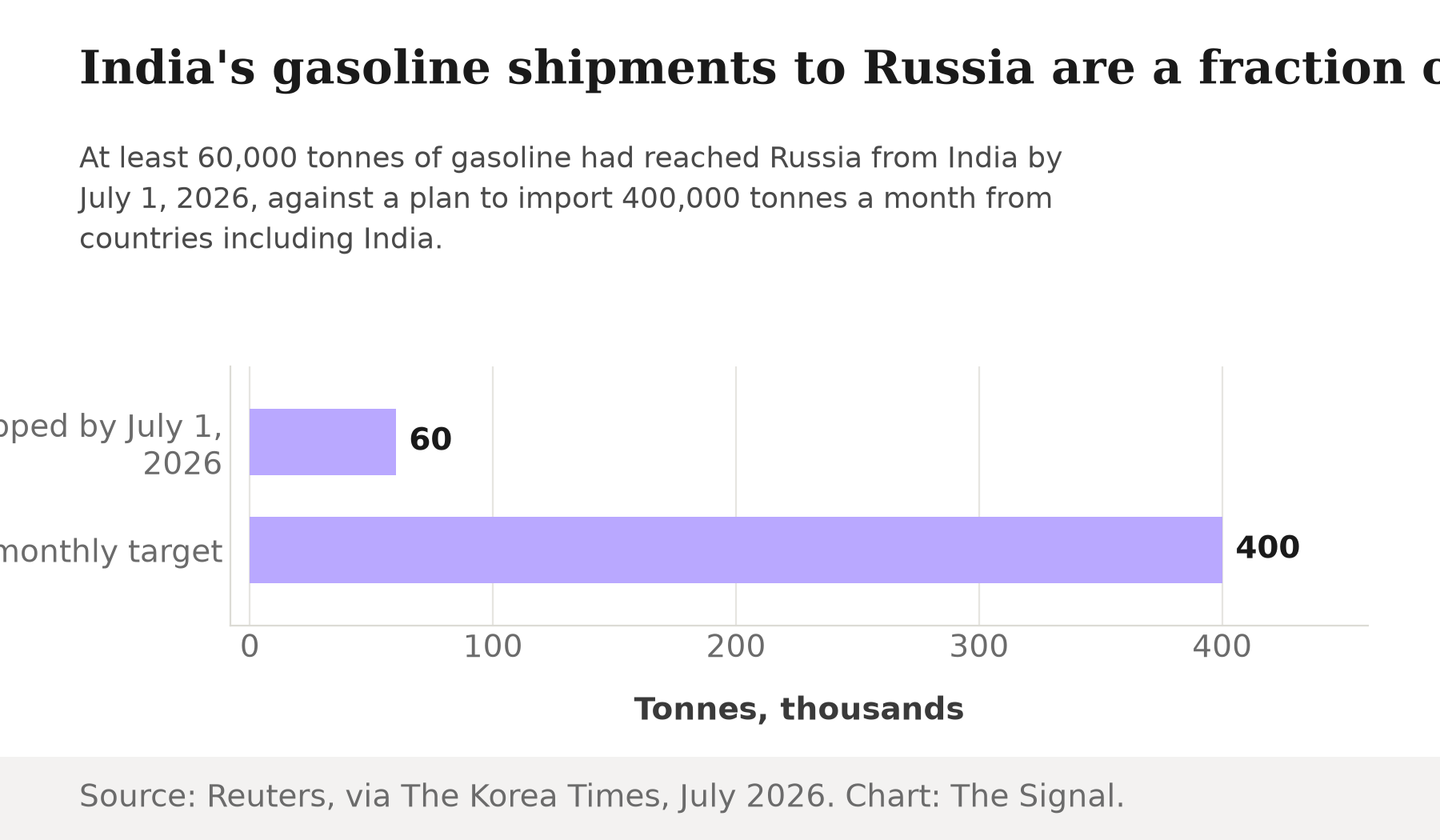
The number that carries the story is 60,000. At least 60,000 tonnes of gasoline had been shipped from India to Russia by 1 July 2026, Reuters reported via The Korea Times, the opening leg of a Russian plan to import 400,000 tonnes of gasoline a month from countries including India. Russia sells India crude at a discount and now buys finished gasoline back from refiners that process it. That is not sanctions evasion running in the familiar direction. That is a shortage.
The refineries drones can reach
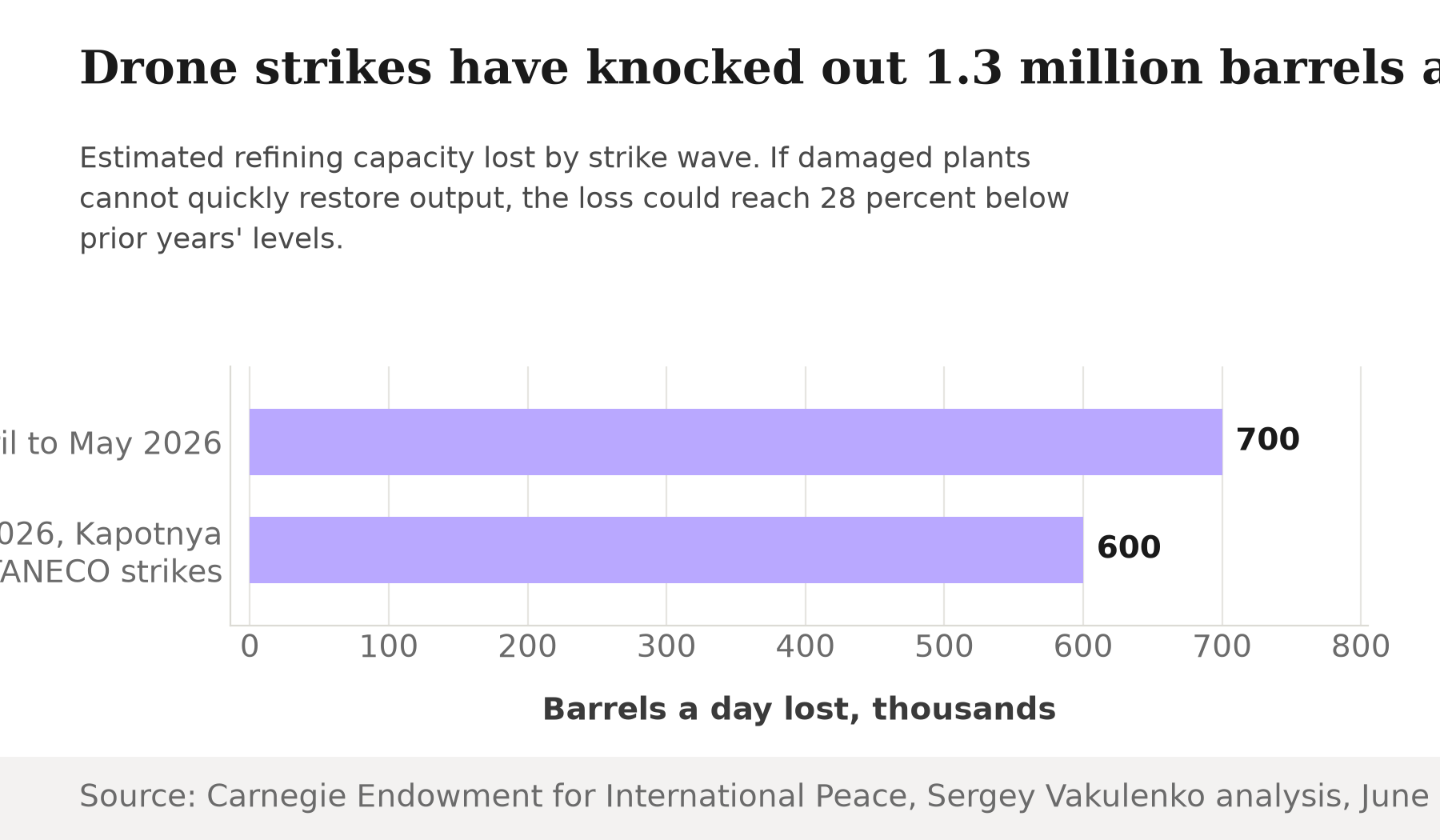
Russia's refining sector has taken a battering measurable in the language of the front line, not the market. Ukrainian strikes on the Kapotnya refinery in Moscow and Tatneft's TANECO plant alone knocked out about 600,000 barrels a day of refining capacity in June 2026, on top of a roughly 700,000-bpd drop in April and May, a Carnegie Endowment analysis by Sergey Vakulenko estimates. That pushes Russia's refining-capacity loss toward 28 percent below prior years' levels, if the damaged plants cannot recover quickly.
The result showed up in the July numbers. Russian refineries processed an estimated 3.6 million barrels of crude a day that month, the lowest throughput since May 2002 and roughly a third below the seasonal norm, Bloomberg-compiled data reported by The Moscow Times show. The campaign was not incidental damage. When a 6 July 2026 strike hit the Omsk refinery, Russia's largest, Ukraine's General Staff confirmed it was the last of Russia's 11 largest fuel-producing refineries to have been hit at least once since the full-scale invasion began, The Moscow Times reports. Every major refinery Russia has, drones have now reached.
Rationing at home
The strain has reached the pump, thousands of miles from any front line. State-run Rosneft stations in Siberia's Irkutsk region capped purchases at 50 liters a vehicle a day, and Crimea suspended gasoline sales to civilians entirely, the Associated Press reported via Fortune in late June 2026, after the drone strikes choked refinery output. A government that describes its energy sector as resilient is, in the same weeks, rationing gasoline for its own drivers. That is the revealed preference: not what Moscow says about the sanctions regime, but what it has had to do to keep its own filling stations supplied.
The loop closes
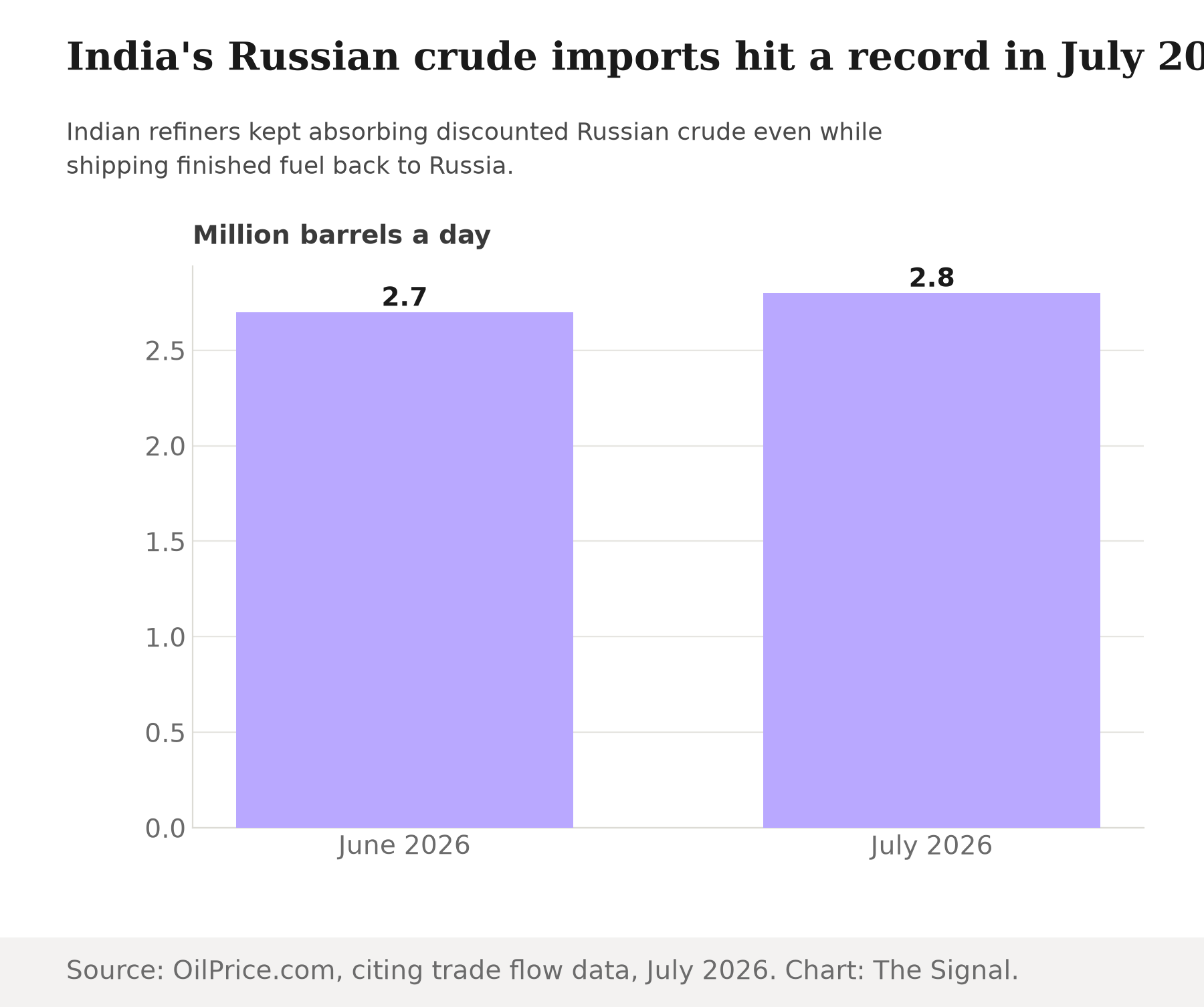
In the same weeks Russia started rationing at home, it leaned harder on the country it depends on to buy its crude. India's crude oil imports from Russia rose to a record 2.8 million barrels a day in July 2026, up from the previous high of 2.7 million bpd in June 2026, OilPrice.com reports, citing trade-flow data, as Indian refiners kept absorbing discounted Russian crude even as some of that same capacity shipped finished fuel back the other way.
One refiner sits at the center of both flows. Nayara Energy's 400,000-bpd Vadinar refinery in Gujarat, roughly half owned by Rosneft-linked interests, has been processing only Russian crude oil since Western and Gulf suppliers stopped supplying it after EU sanctions on the company, Al Jazeera reports. Vadinar is the extreme case of a broader position: refiners that took Russia's discount on crude coming in are now positioned to sell Russia the fuel it cannot make, going back out.
The loop is not just structural, it is literal. The 42,000-tonne gasoline cargo that reached Russia on 5 August 2026 was loaded in June 2026 from Vadinar itself, a refinery Rosneft partly owns and supplies with the crude it processes, Bloomberg-sourced data reported by OilPrice.com show. Russia is not merely buying gasoline from India: in that cargo, it was buying gasoline refined from its own crude.
Sanctions have kept tightening on paper and on price, while the physical fuel flow reversed.
| Date | Move | What it targets |
|---|---|---|
| 18 July 2025 | EU's 18th sanctions package | Refined-fuel imports into the EU made from Russian crude refined elsewhere |
| 31 January 2026 | G7-aligned price cap cut | Lowered the cap on Russian crude to $44.10 a barrel, from $47.60 |
Source: European Commission; UK government, OFSI guidance.
The honest objection
The strongest case against reading too much into this is scale and specificity. Sixty thousand tonnes is a sixth of the 400,000-tonne monthly target Russia has set for gasoline imports from countries including India: this looks like a shortfall being patched at the margin, not a wholesale reordering of trade. And Vadinar running solely on Russian crude reflects one company's ownership structure and sanctions exposure, not a broader Indian government policy. The price cap and the EU's refined-fuel rule still constrain what Russia earns per barrel of crude it sells, even if some fuel comes back the other way.
That case holds on scale, but it does not explain away the direction. Refining capacity down toward 28 percent against prior years is not a marginal wobble, and neither is a July throughput last that low in May 2002. A country that sells crude at a discount does not also need to buy back gasoline from the same buyer unless something upstream has actually broken. That is the reason the fuel is moving in a direction the price-cap architecture never priced in.
The Signal
The Western sanctions regime was built to squeeze the price Russia gets for a barrel of crude, not to stop Russia from refining it. Ukraine's drone campaign did the second job instead, and did it well enough that Russia now rations gasoline for its own citizens while shipping crude to India at a discount and buying finished fuel back from the same trade. If the gasoline flow scales toward Russia's stated monthly import target, and if refiners like Vadinar keep running solely on Russian barrels while shipping product the other way, the arrangement stops looking like a wartime patch and starts looking like a structural loop the sanctions architecture has no rule for. Watch the tonnage, not the price cap. The number that will show whether the loop is closing is how much gasoline moves next month, not how many dollars a barrel of crude is capped at.
Reporting basis: the EU's refined-fuel rule is per the European Commission's own sanctions notice; the price-cap cut is per UK government (OFSI) guidance. The refining-capacity loss estimates are from a Carnegie Endowment analysis by Sergey Vakulenko; the July throughput figure and the Omsk-strike detail are Bloomberg-sourced and Ukrainian General Staff-sourced data respectively, both as reported by The Moscow Times. The gasoline-shipment and import-target figures are per Reuters, as carried by The Korea Times; the Vadinar-cargo tracking detail is Bloomberg-sourced, citing Kpler shipping data, as reported by OilPrice.com. India's record crude-import figures are per OilPrice.com's trade-flow reporting, and the Nayara/Vadinar detail is per Al Jazeera. The Siberia and Crimea rationing details are Associated Press reporting, via Fortune. The combined capacity-loss figure shown in the refining chart is The Signal's calculation from the Carnegie Endowment's two cited figures.