
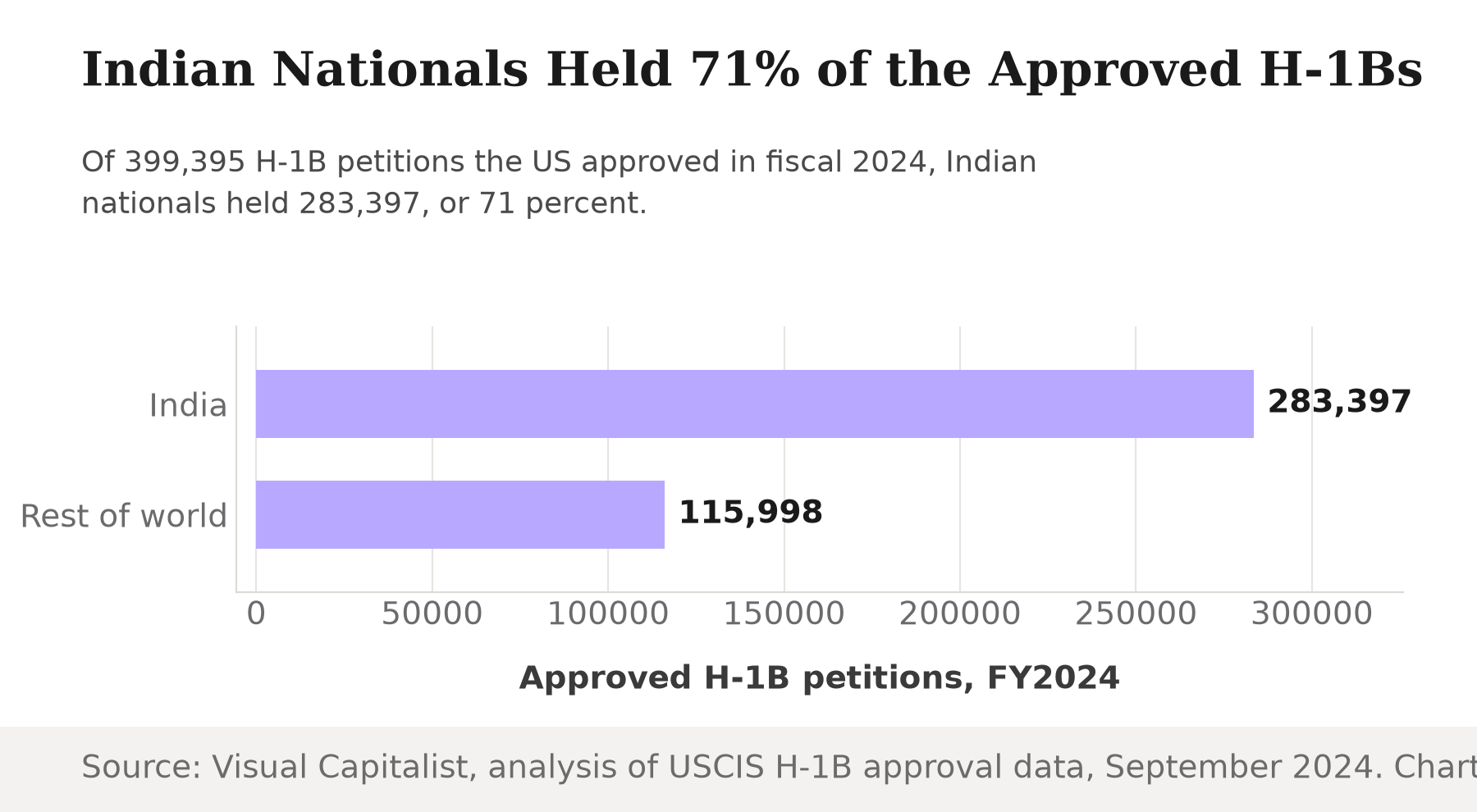
A presidential proclamation attached a $100,000 payment requirement to new H-1B petitions, effective September 21, 2025, landing on a visa category Indian applicants dominate: Indian nationals held 283,397 of the 399,395 H-1B petitions the US approved in fiscal 2024, or 71.0 percent of the total. Read as a single act, the fee looked like Washington had finally put a real price on the route that carries most Indian engineering and technology graduates into American employers.
Then, a federal judge vacated that fee on June 8, 2026, ruling the policy behind it an unlawful tax the president had no authority to impose. Two readings in sequence: first that Indian hiring had just gotten dramatically more expensive, then that the crackdown had been thrown out entirely.
It is worth slowing down on both. Indian graduates working in the US often pass through Optional Practical Training, the work authorization tied to an F-1 student visa, before any H-1B petition is ever filed. That route never carried a $100,000 fee, or anything close to it, at any point in this fight.
The route that never carried a toll
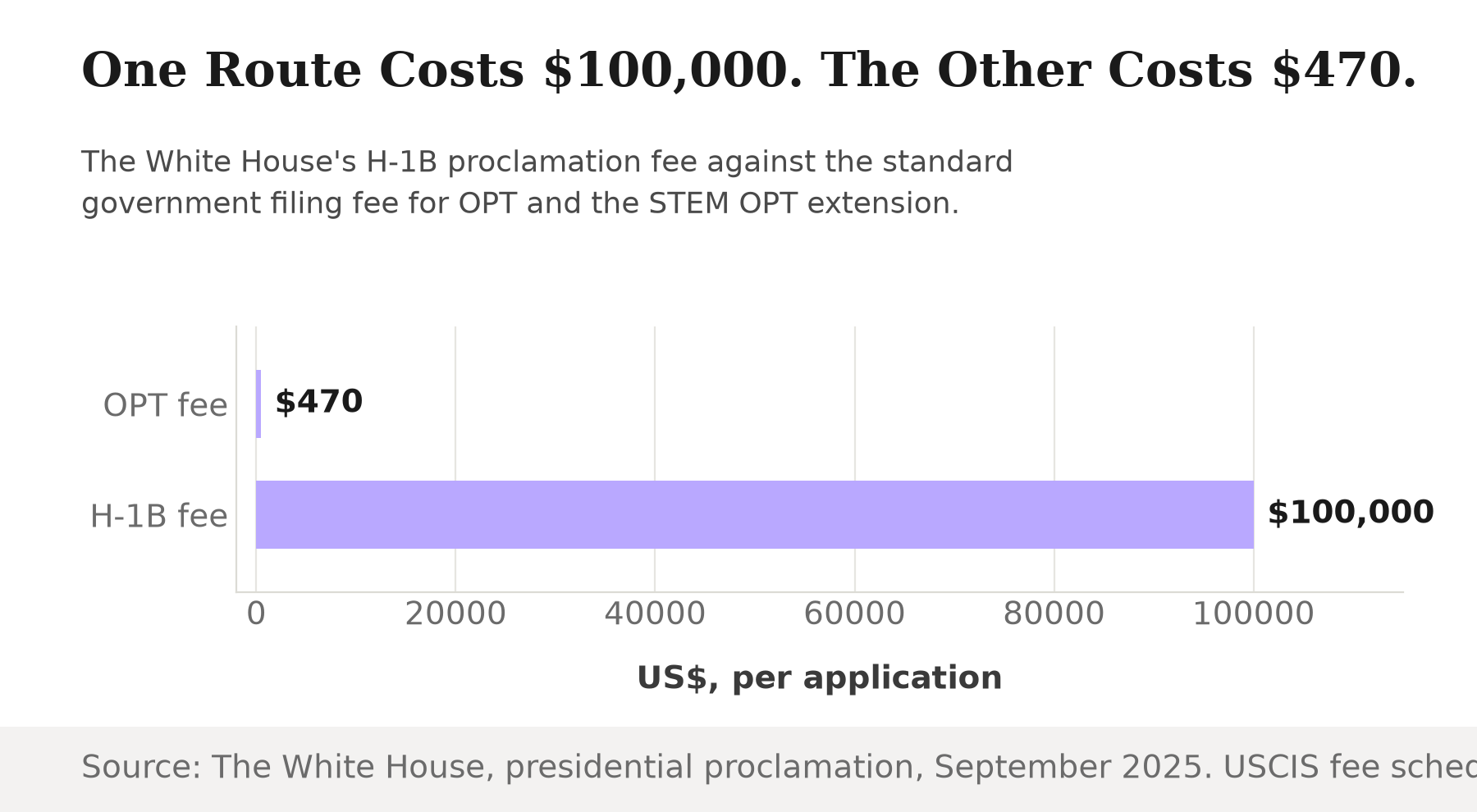
The standard government charge for OPT and its STEM extension is the I-765 application fee of $470 online, a rate that has held since April 1, 2024, against the $100,000 the White House attached to a new H-1B petition. A STEM-eligible graduate can work under that authorization for up to 36 months, the initial 12-month OPT period plus a 24-month STEM extension added under a rule that took effect May 10, 2016, without ever filing an H-1B petition. For a graduate hired straight out of a STEM program, three years of legal US employment can run before the $100,000 question comes up at all, and for many it never does, because an employer that is not required to sponsor a petition has no reason to start.
A tax break stacked on the fee break
OPT is not merely fee-light. It is tax-light too. The IRS exempts F-1 students' practical-training employment, the category that covers OPT, from Social Security and Medicare payroll taxes. Sen. Jim Banks has put a number on what that means for a hiring manager: his office argues OPT gives employers an effective 15 percent cost advantage over hiring an equivalent American worker, because OPT wages, like the workers themselves, are generally exempt from Social Security and Medicare payroll taxes. Whatever one makes of that framing, the underlying fact holds regardless: through 2025 and into 2026, OPT remained the one channel in the whole system carrying neither the new petition fee nor the standard payroll tax load.
Where the numbers already show it
The volume moving through that channel was climbing well before the H-1B fee existed. India passed China as the top source of international students in the US in the 2023/24 academic year, with 331,602 Indian students enrolled, up 23 percent from the year before, while a record 97,556 Indian students moved onto OPT in that same academic year, up 41 percent: nearly double the growth rate of Indian enrollment itself.
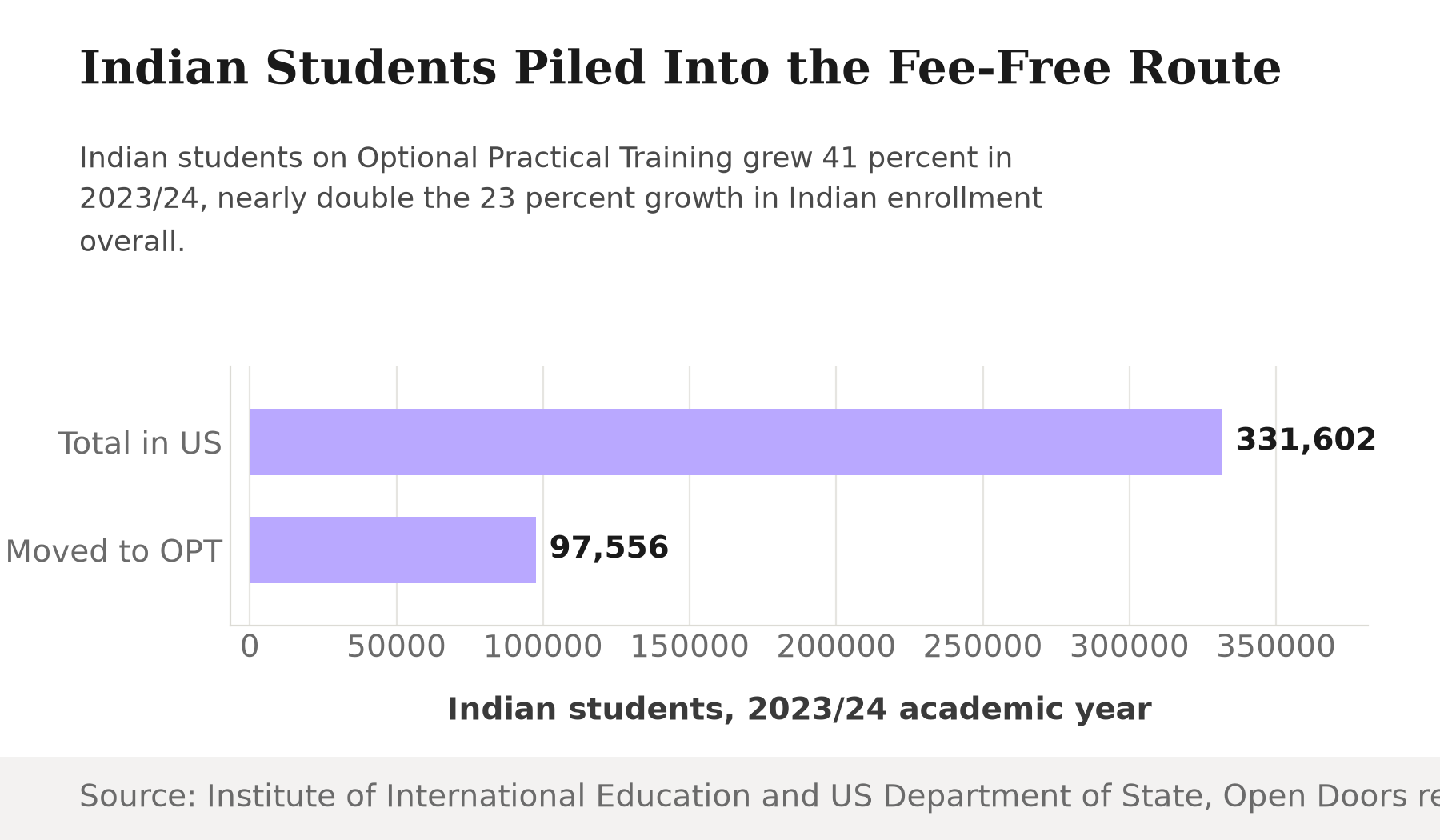
That is not a niche workaround. It is a main pipeline, and its expansion outpaced overall Indian enrollment growth in that same 2023/24 academic year, more than a year before the H-1B fee took effect in September 2025. Within the STEM OPT extension specifically, the group most exposed to a fee on that route, Indian nationals received nearly half, 48 percent, of all STEM OPT extensions granted in 2024, more than double China's 20.4 percent share, making this overwhelmingly an India story rather than a general international-student one.
Closing the workaround
The court's ruling in June 2026 did not end the administration's interest in that pipeline. It redirected it. Forbes, citing Wall Street Journal reporting, wrote on July 30, 2026 that the Trump administration is weighing a $100,000 fee on OPT work authorization itself, a proposal still under discussion at the Department of Homeland Security. That reporting notes roughly 419,000 international graduates were working under OPT in 2024 and states the new fee would accomplish much of what the vacated H-1B fee was meant to do. This is not a second front opening in the immigration fight. It is the same fee, retargeted at the door that was always open.
The honest objection
The strongest case against calling this a loophole closure is that OPT and H-1B are not really the same kind of authorization. OPT is a training extension attached to a student's own degree, capped by how long that training can run; H-1B is an employer-sponsored work visa with no such built-in limit once renewed. Collapsing the two ignores that a $100,000 charge on a training program is a far larger intervention than extending an existing employer fee: no employer pays six figures to bring on an entry-level graduate trainee, so a fee at that level would not reprice OPT so much as end it as a workable US pathway. Sen. Banks frames the payroll-tax exemption as an unfair subsidy government should close; a critic would call ending practical training altogether a much blunter instrument than closing a tax gap.
That objection is real, and it explains why the mechanism matters here, not just the headline number. A $100,000 H-1B fee changes which employers can afford to sponsor one particular worker after the fact. A $100,000 OPT fee cuts deeper: it would decide whether the training pathway exists at all for anyone whose employer will not absorb that cost before the person has proven themselves on the job. That is the opposite of what practical training is supposed to do.
The Signal
The H-1B fee's real lesson was never about the number attached to one visa category. It was that a fee on a single door does nothing if the building has another door with no lock on it, and Indian STEM graduates, in growing numbers, were already using that other door. Washington's answer is to try fitting the same lock onto OPT, the route roughly 419,000 international graduates used to work in the US in 2024 alone. Whether that attempt survives rests on the same legal question that killed the H-1B version: whether the executive branch has the authority to impose what a federal judge already called an unlawful tax, this time applied to a student visa category instead of an employment one. Watch the Department of Homeland Security's next filing, not the headline figure. A fee on the wrong door was never going to hold.
Reporting basis: the $100,000 H-1B fee and its terms are per the White House's own presidential proclamation. The OPT and STEM OPT filing fee is per George Washington University's International Services Office, relaying the USCIS fee schedule; the STEM OPT extension's structure is per NC State's Office of International Services, relaying the underlying DHS rule. The FY2024 H-1B approval breakdown by nationality is per Visual Capitalist's analysis of USCIS data. The FICA payroll-tax exemption for OPT is per the IRS directly. The June 2026 court ruling vacating the H-1B fee is per Forbes, and the July 2026 reporting that the administration is weighing an OPT fee is also per Forbes, citing Wall Street Journal reporting it did not itself independently verify beyond Forbes' account. Indian student enrollment and OPT movement figures are from the Institute of International Education's Open Doors report, published with the US State Department. The Indian and Chinese shares of 2024 STEM OPT extensions are per Careers360, relaying figures from ICE's Student and Exchange Visitor Program "SEVIS by the Numbers" report. The 15 percent cost-advantage figure is Sen. Jim Banks' office's own calculation, presented as such. No figure in this piece is The Signal's own calculation.