On July 21, 2026, Defense Secretary Pete Hegseth told the Senate Appropriations Committee that the Iran war has cost the Pentagon $37.5 billion to date, and asked for $67.1 billion more in emergency supplemental funding. Read as a headline, it is an unremarkable story: wars cost money, and this one is asking Congress for more of it, the way every extended US military campaign eventually does.
It is worth slowing down on that framing. Of the roughly $67 billion request, $18.2 billion is earmarked specifically to replenish interceptor stocks: up to $5.75 billion for THAAD, $5.57 billion for Patriot MSE interceptors, and $1.9 billion for SM-6. This is not a story about the price of a war. It is a story about how few interceptors the world's most heavily funded military has left, and how slowly it can make more of the one it is shortest on.
The number that matters is how thin both stockpiles have run. Patriot interceptor inventories have fallen to under 1,000, and THAAD inventories to about 250, according to a Center for Strategic and International Studies analysis published July 27, 2026. Those are the interceptors standing between an incoming ballistic missile and whatever it is aimed at, for the entire US arsenal, not just the forces that fought Iran.
The mechanism THAAD cannot out-build
Money can, in theory, buy speed. It cannot buy a production line that does not exist yet. Current US production of the PAC-3 MSE Patriot interceptor runs at a baseline rate of about 650 a year, with surge capacity of 2,000, while THAAD production runs at a surge rate of only 96 a year, according to a CSIS analysis of US missile production capacity published May 27, 2026. Patriot's factory floor can turn out nearly seven interceptors at its ordinary baseline pace for every one THAAD's surge line manages today, before even counting Patriot's own surge capacity of 2,000: THAAD has one number, and it is already the fastest the line goes.
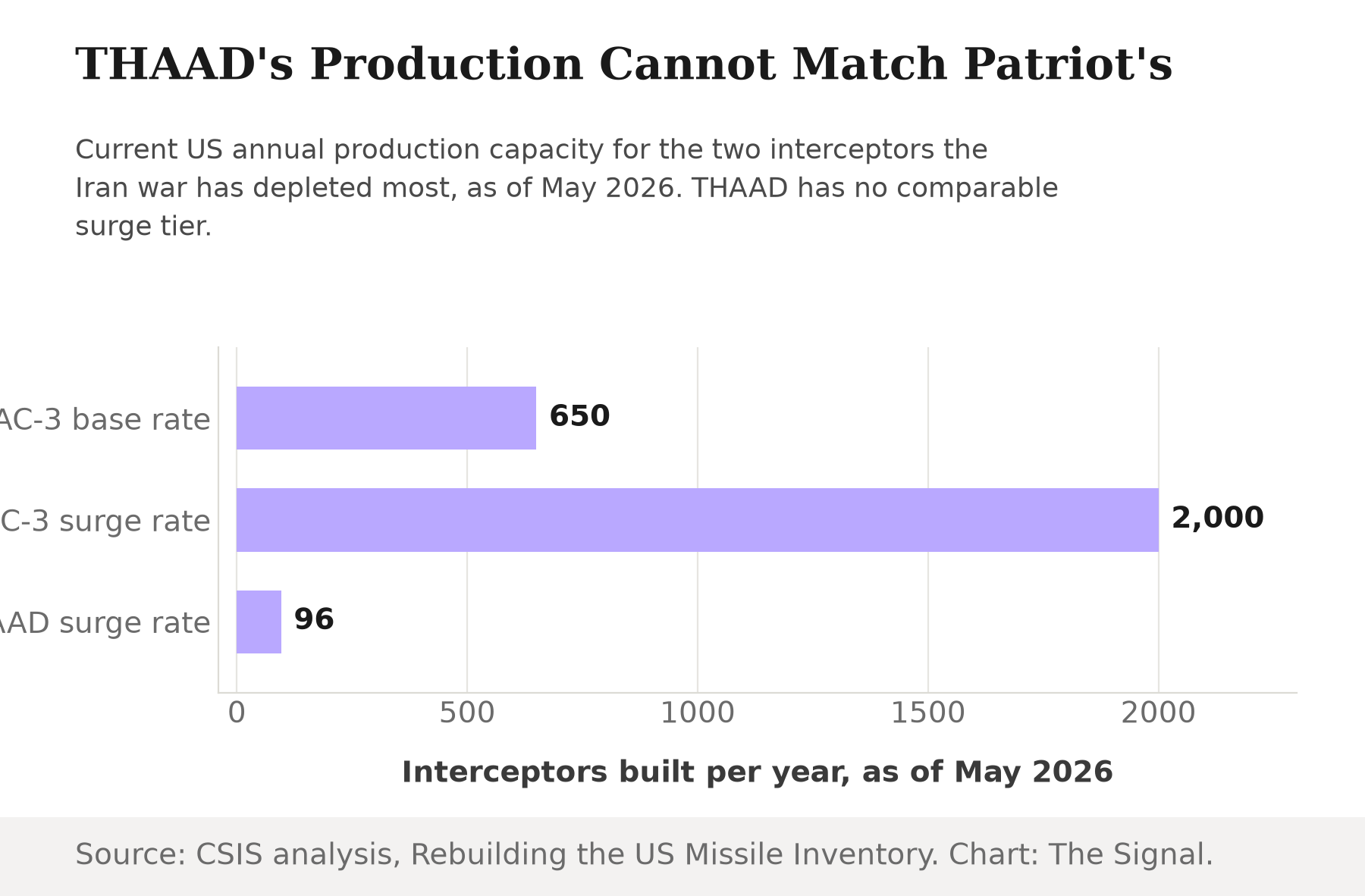
Source: CSIS analysis of US missile production capacity, May 27, 2026. Chart: The Signal.
That gap explains why the two interceptors, both drained by the same war, are not equally recoverable. The Iran war consumed roughly 65% of the pre-war Patriot stockpile and about 38% of the THAAD stockpile, leaving an estimated 234 to 278 THAAD interceptors on hand, per Military Times' reporting of the CSIS analysis published July 30, 2026. Patriot lost the larger share of its stockpile, proportionally. THAAD started from a stockpile a fraction of Patriot's size, so its smaller percentage loss cuts into a much thinner cushion, leaving it the one with less room left to lose.
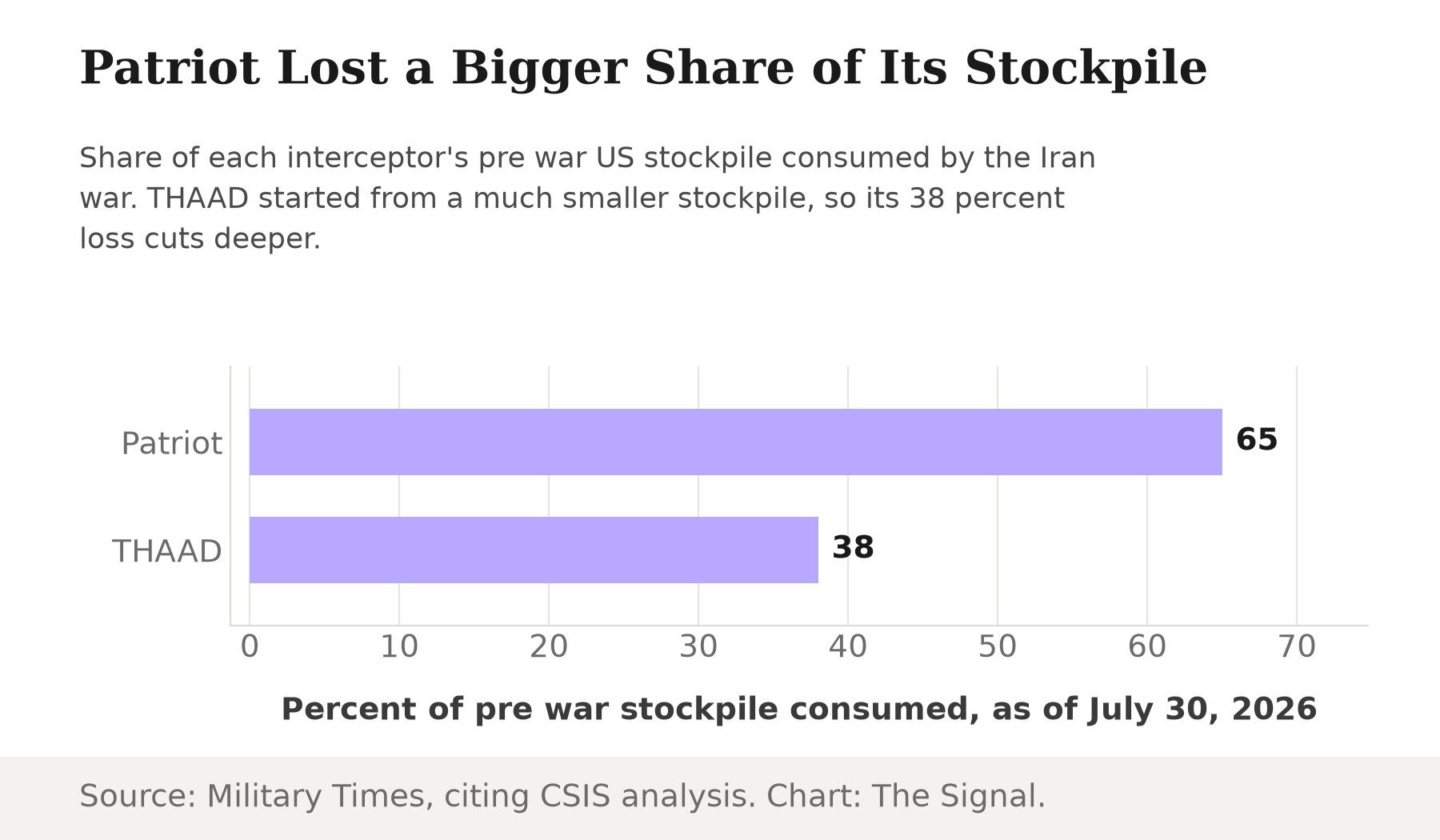
Source: Military Times, reporting the CSIS analysis, July 30, 2026. Chart: The Signal.
Run the two CSIS figures together and the rebuild math separates further. If THAAD's current 234 to 278 interceptors represent the 62% that survived a 38% loss, the pre-war stockpile was roughly 377 to 448, meaning the war used up somewhere between 143 and 170 THAAD interceptors. At THAAD's surge rate of 96 a year, replacing just that war-time loss, before any future contingency draws down a single interceptor, takes THAAD's production line between roughly 1.5 and 1.8 years running flat out (our calculation from the CSIS inventory and production figures above). Run the same logic on Patriot, whose roughly 65% loss from a stockpile that would put the pre-war total near 2,850 implies a war-time loss near 1,850 interceptors, and Patriot's surge rate of 2,000 a year closes that gap in under a year (also our calculation, from the same two CSIS analyses). Patriot's shortfall is a bad quarter; THAAD's is a multi-year hole.
The bottleneck money alone can't buy out
It would be easy to read this as a story about the Pentagon choosing not to fund THAAD. It isn't. The Pentagon has awarded Lockheed Martin a $58.6 billion, seven-year contract, running fiscal years 2026 through 2032, to triple PAC-3 MSE Patriot interceptor production capacity by the end of 2030, but a month earlier, Lockheed Martin won a separate, over $35 billion, seven-year contract, announced June 25, 2026, to quadruple THAAD interceptor production, from 96 to 400 a year, on a ramp running from March 2026 through June 2032. THAAD's fix is, proportionally, the bigger of the two: a fourfold increase against Patriot's threefold. A companion deal with BAE Systems, announced March 25, 2026, aims to quadruple production of the infrared seeker each THAAD interceptor needs to find its target, the sensor component most likely to have gated the interceptor's output in the first place.
The interceptor-replenishment request itself does not shortchange THAAD on paper, either. It is close to an even split between the two systems, with THAAD's dollar figure the largest single line.
| Interceptor | Requested funding | Share of the $18.2B request |
|---|---|---|
| THAAD | $5.75 billion | 32% |
| Patriot MSE | $5.57 billion | 31% |
| SM-6 | $1.9 billion | 10% |
Source: WION, citing Bloomberg's review of Pentagon documents. Remaining share of the $18.2 billion request covers other interceptor lines. Percentages are The Signal's calculation.
So the money is there for both. What is not there is time. THAAD's ramp finishes in June 2032, two years after Patriot's tripled capacity is due online, and that gap is not a funding choice. Solid rocket motors, the propulsion component THAAD shares with PAC-3, SM-3, and other US interceptors, are made by only a handful of specialized, certified suppliers, and the manufacturing process (curing before assembly, X-ray inspection after) cannot be sped up regardless of how much money sits behind it. Patriot's line can be tripled faster because it has more physical slack to expand into. THAAD's has to wait on a supply chain that a bigger check cannot compress.
A smaller preview, already priced in India
The United States is discovering this constraint at the scale of a single, months-long air campaign against Iran. Other militaries that rely on similarly scarce interceptors have already run a smaller version of the same problem. India's Defence Acquisition Council approved a $1.1 billion (₹10,000 crore) purchase of 288 S-400 surface-to-air missiles from Russia, to restore stocks depleted during Operation Sindoor, the 2025 conflict with Pakistan. A conflict lasting days, not months, was still enough to force an emergency foreign purchase to refill an advanced air-defense stockpile.
The comparison is not that India and the United States face the same scale of threat. It is that both cases show the same underlying fact: modern long-range interceptors are produced in the hundreds a year, not thousands, and a real conflict draws them down faster than a production line restocks them. The US controls its own THAAD and Patriot factories. India's fix required buying from Russia's own production queue, a queue with its own war in Ukraine drawing on it.
The honest objection
The strongest case against treating this as a crisis is that US missile production has closed gaps like this before, and eventually catches up once Congress appropriates money and industry retools. On that view, the new Patriot contract and THAAD's own $35 billion contract are exactly that response, both already arriving.
That case holds up better than the topline funding numbers alone suggest, but it still concedes the timeline gap between the two systems. The math above shows a full-surge Patriot production line could plausibly replace the Iran war's losses in under a year once tripled capacity comes online by the end of 2030. THAAD's ramp to 400 a year, by contrast, does not land until June 2032. The CSIS analysis describes 96 a year as the current surge rate, the ceiling of what today's line can do, and the contract to lift that ceiling still runs through a solid-rocket-motor and seeker supply chain that cannot be compressed by writing a bigger check. Money has now been committed to fix both interceptors. Time has not been, because only one of them runs through a physically constrained industrial base that a check cannot speed up.
The Signal
A $67 billion supplemental sounds like the story. It is not. The story is that the United States fought one war against a single country and it took a chunk out of the two interceptor types it would most need in a larger or second conflict, and even with tens of billions of dollars now committed to rebuilding both, one of them still will not be fixed until 2032. Watch the solid-rocket-motor and seeker supply chain, not the topline budget number: THAAD's contract and seeker deal are already signed, so the next real signal is whether that supply chain actually reaches 400 interceptors a year on schedule, or slips. Interceptors, unlike money, cannot be printed, and this time, neither can the factories that make them, fast enough.
Reporting basis: the Iran war's cost and the supplemental funding request are per Army Times' reporting of Secretary Hegseth's Senate Appropriations Committee testimony. The interceptor-replenishment funding breakdown is per WION's reporting of Bloomberg's review of Pentagon budget documents. The Patriot and THAAD inventory levels and each stockpile's war-time depletion are from a CSIS analysis by Mark Cancian and Chris Park, as also reported by Military Times. Current PAC-3 MSE and THAAD production rates are from a separate CSIS analysis of US missile production capacity. The Patriot production contract is per Defense News' reporting; THAAD's separate production contract and its companion seeker-production deal are per Military Times' and Defense News' reporting, respectively. The solid-rocket-motor supply-chain constraint is per Breaking Defense's reporting. India's S-400 replenishment purchase is per Army Recognition's reporting of the Defence Acquisition Council's approval. The pre-war stockpile figures, the war-time interceptor losses, the rebuild-time figures for both THAAD and Patriot, and the funding-share breakdown of the interceptor request are The Signal's own calculations from those reported figures.