In June 2026, The Week reported that commercial talks between HAL and GE Aerospace over the engine for India's AMCA stealth fighter had stalled, with GE quoting a price nearly three times the original estimate of around ₹70-80 crore per engine. The story fit a familiar shape. India's most advanced fighter programme, Cabinet-approved to build five flying prototypes at an initial estimated development cost of about ₹15,000 crore, still cannot pin down the one part that actually makes the jet fly. As of 27 May 2025, India's Aeronautical Development Agency had approved a new execution model opening the AMCA to private industry, but had not yet issued the tender needed to start the prototype's development phase. That changed a year later. On 27 May 2026, the defence ministry issued the actual Request for Proposal for the AMCA prototype development phase to three shortlisted private-sector bidders: Larsen & Toubro-Bharat Electronics Limited, Tata Advanced Systems, and Bharat Forge-BEML. So it is the engine, not the tender, that is now the open question. Read on its own, the June 2026 price dispute looks like one more delay in a programme that keeps not quite starting.
It is worth slowing down on that framing. The assumption underneath it, that a properly advanced country's fighter programme gets its engine on schedule and only India's does not, does not survive a look at the two other fighter jets currently making headlines for the same reason.
No advanced fighter programme has its intended engine ready when its jet is.
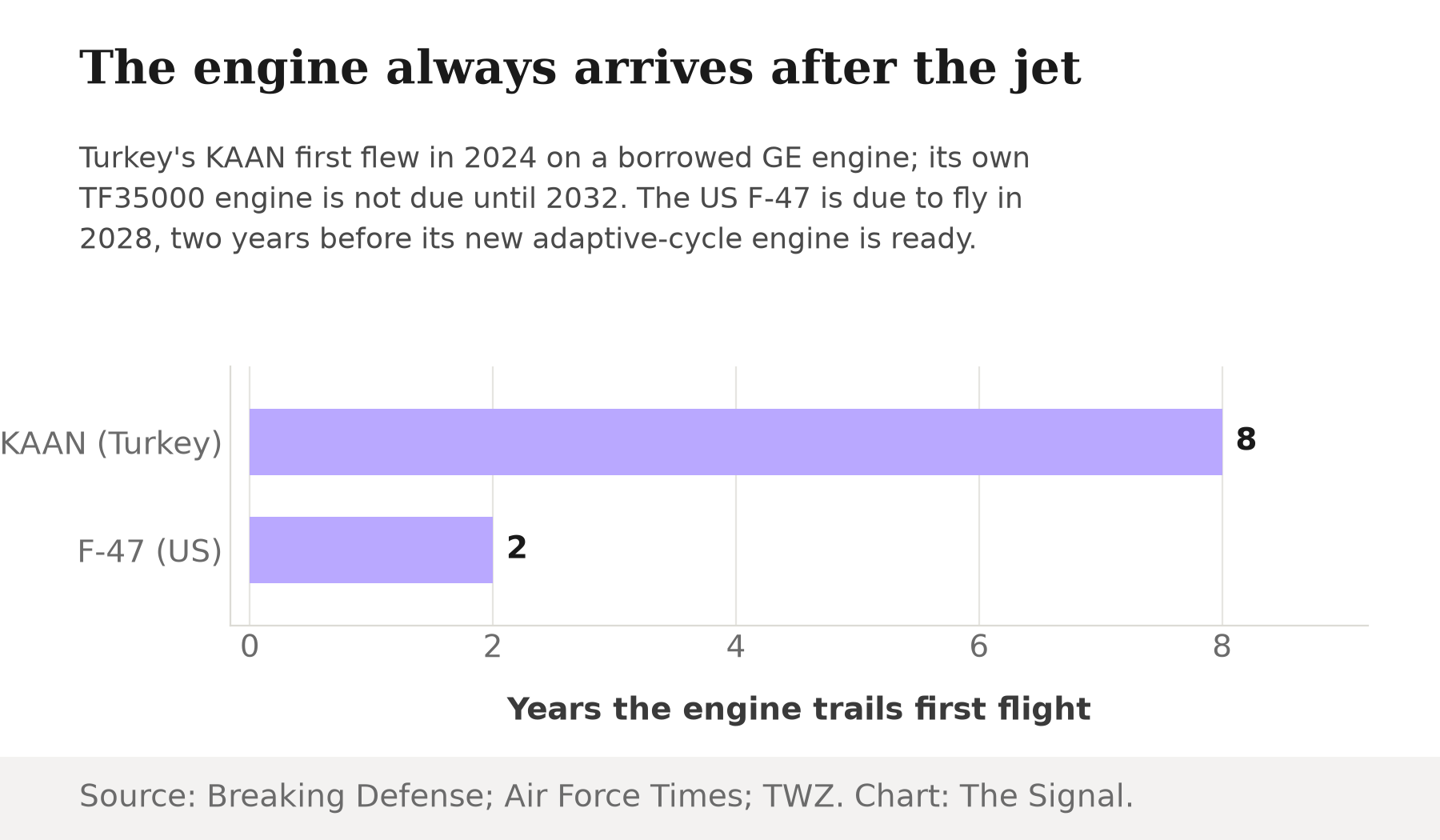
Turkey's KAAN made its maiden flight on 21 February 2024 powered by two interim General Electric F110-GE-129 turbofans, the same engine family used on Turkish F-16s, while Turkey developed an indigenous engine for later production batches. That indigenous engine, TEI's TF35000, is projected to arrive only in 2032, eight years after the jet it belongs to first left the ground. The US Air Force's F-47 has not flown at all yet, and as of 30 July 2026 the programme remained on schedule for a first flight in 2028, but the adaptive-cycle engine actually designed for it, GE's XA102 or Pratt & Whitney's XA103, could be ready for integration onto an actual aircraft only in 2030, two years after that first flight. Whatever is slowing AMCA's engine down, it is not a uniquely Indian inability to plan ahead.
The engine, not the airframe, is the constant
KAAN is the clearest case because it is already a flying aircraft, not a plan. Turkey chose to fly its fighter on a borrowed, already-proven engine rather than wait for its own, and it will keep flying that way for years. The three programmes line up as follows.
All three next-generation fighter programmes share the same open question: which engine gets there first.
| Programme | First flight | Engine at first flight | Intended production engine |
|---|---|---|---|
| Turkey's KAAN | 2024 | Interim GE F110-GE-129 (shared with Turkish F-16s) | TEI's TF35000, projected 2032 |
| US F-47 | Targeted 2028 | Not yet flown | GE XA102 or Pratt & Whitney XA103, integration possible from 2030 |
| India's AMCA | Not yet flown | Not applicable | GE F414-INS6, price still unresolved as of June 2026 |
Source: Defense News and Breaking Defense (KAAN); Air Force Times and TWZ (F-47); The Week (AMCA).
Turkey did not wait for its indigenous engine to fly KAAN on interim GE F110-GE-129 turbofans in 2024; it flew on someone else's hardware and kept developing its own engine in parallel. The US is not flying the F-47 on its real engine either; it is designing the airframe around an adaptive-cycle engine that will arrive only after the jet does. Both choices reflect the same underlying fact: engine development, materials, cooling, fuel efficiency, thrust at altitude, is a slower and harder problem than airframe design, radar cross-section, or avionics integration, for every country attempting it.
Washington is hedging with two bets, not one
The scale of that difficulty shows up in what the US Air Force is willing to spend to solve it twice over. The US Air Force raised its Next Generation Adaptive Propulsion contract ceilings for GE Aerospace and Pratt & Whitney to $3.5 billion each on 27 January 2025, funding two competing prototype engines rather than committing to one. Turkey's own engine bill, by comparison, is smaller and points the other way: in June 2026 the Trump administration moved to approve a General Electric F110 engine export deal to Turkey, worth more than $700 million, to power early-production KAAN jets while Turkey's own engine is still years from ready.
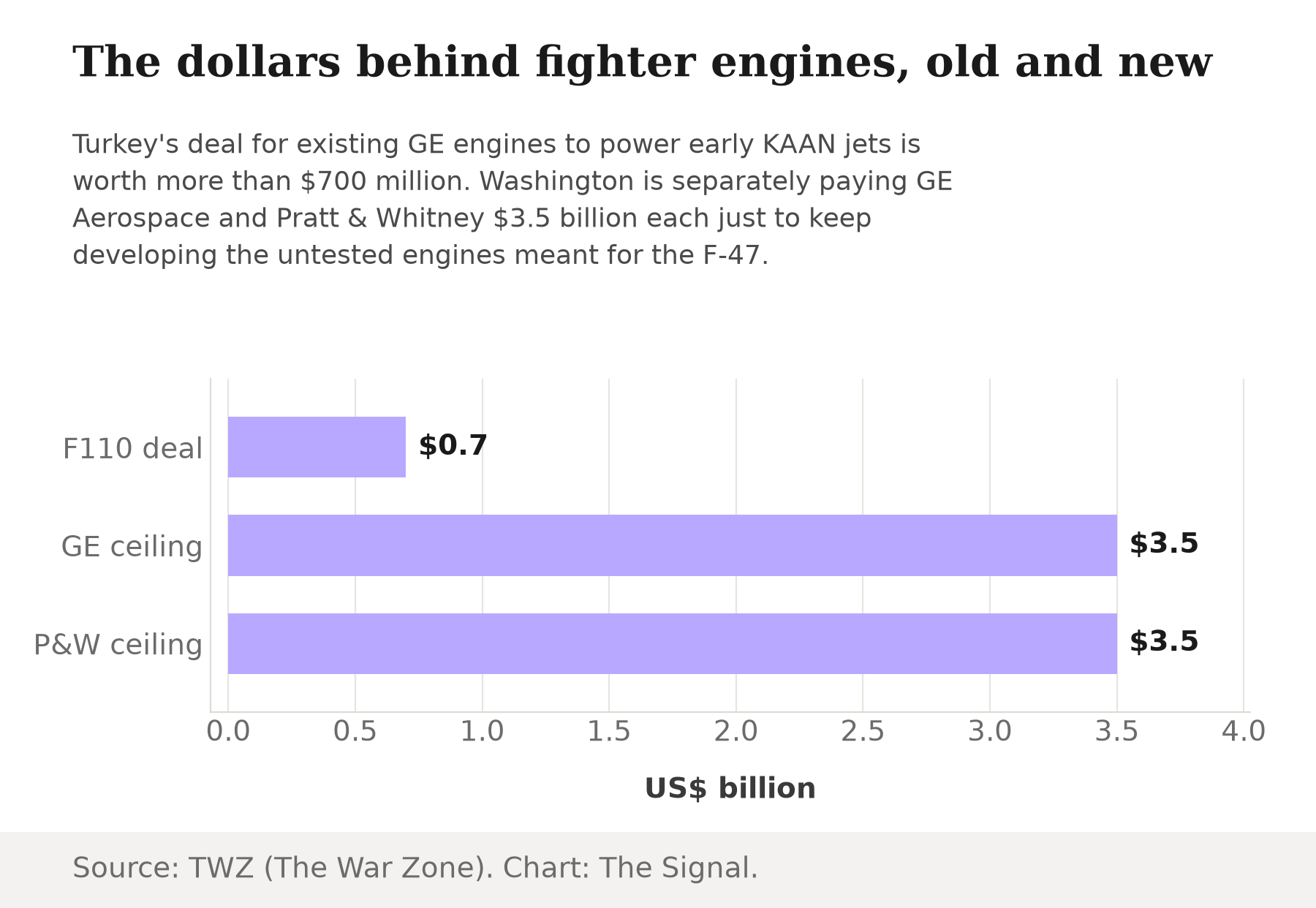
Read together, the two figures say something about the AMCA price dispute too. Washington is paying two different companies $3.5 billion apiece to build engines that do not exist yet. HAL is arguing with one company over the price of an engine, the F414-INS6, that already exists and already flies elsewhere, with GE quoting a price nearly three times the original estimate. That is a smaller, more tractable fight than the one the US is funding, even if it is taking its own time to resolve.
The honest objection
The strongest case against this comparison is that KAAN and the F-47 have both already cleared a bar AMCA has not. KAAN is a flying aircraft. The F-47 has an active, funded, two-company engine competition running toward a scheduled 2028 flight. AMCA, by contrast, did not even have the tender for its prototype development phase issued until 27 May 2026 (a year after the private-industry execution model that would make that tender possible was approved), and still has no prototype in the air. A programme that has not started cutting metal is not obviously living through "the same" problem as one that is already airborne on an interim engine.
That objection is right about the stage and wrong about the mechanism. What is holding up AMCA is not the design or the readiness of its engine. The GE F414-INS6 is not a new, unproven engine like the F-47's adaptive-cycle prototypes or KAAN's still-developing TF35000; it is a known design already flying on other aircraft. The dispute reported in June 2026 is over price, not performance. Washington and Ankara are paying to invent engines from nothing. India is haggling over an invoice for one that already works. That is arguably an easier problem, and it is still the same category of problem: the engine, not the airframe, is the line item that decides the timeline. India is also not simply waiting on GE the way the objection implies: like Turkey's parallel bet on the TF35000, the F414 price dispute is part of what pushed DRDO to restart its own indigenous Kaveri engine programme in July 2026, pursued now as "Kaveri 2.0" for future Tejas, Ghatak and next-generation aircraft.
The Signal
None of this makes AMCA on schedule. It is not. But the specific claim that keeps attaching to India's fighter programme, that its engine trouble marks it out as technologically behind, does not survive a look at the two most closely watched fighter jets outside India. Turkey chose to fly on borrowed engines in 2024 rather than wait for its own, which is not due until 2032, eight years later. The US is designing its newest fighter around an engine that will not be ready for integration until 2030, two years after the jet's targeted first flight. Engine development is the bottleneck everywhere this kind of aircraft gets built, funded by the world's richest air force or negotiated line by line by HAL. Watch what actually moves next: the Development Phase tender has already gone out, to three shortlisted bidders, so the F414 price is now the one open variable standing between AMCA and metal being cut. If HAL and GE settle it, AMCA will have resolved its version of this problem faster than either of the other two managed theirs. If the dispute drags on instead, it will keep being read as evidence of falling behind, when it is really evidence of being in exactly the same fight as everyone else.
Reporting basis: the AMCA's Cabinet-approved prototype plan and its initial cost estimate are per All India Radio's official newsonair.gov.in, quoting the Defence Minister; the AMCA execution model and the pending Expression of Interest, as of 27 May 2025, are per the Press Information Bureau, and the RFP that was actually issued a year later, on 27 May 2026, is per The Week. The stalled GE engine price talks, as of June 2026, are as reported by The Week, citing defence sources, and DRDO's July 2026 restart of the indigenous Kaveri engine programme is also per The Week, citing a Times of India report. The F-47's NGAP engine contract ceilings are per TWZ (The War Zone), and its adaptive-cycle engine's 2030 integration timeline is also per TWZ; the F-47's on-schedule 2028 first flight, as of 30 July 2026, is per Air Force Times. KAAN's 2024 maiden flight on interim GE F110 engines is per Defense News; the approved F110 export deal to Turkey is per TWZ; and the 2032 timeline for KAAN's indigenous TF35000 engine is per Breaking Defense. The eight-year and two-year engine lag figures are The Signal's calculations from those dates.