On 24 July 2026, the Delhi High Court designated a special fast-track court at the Rouse Avenue Courts, under Judge Anu Grover Baliga, to hear cases under the Public Examinations (Prevention of Unfair Means) Act, 2024. The trigger was fresh: NEET-UG 2026, held on 3 May 2026, was cancelled nine days later after paper-leak allegations, with the case handed to the CBI. A nationwide re-test followed, and by mid-July the National Testing Agency reported that close to 20 lakh candidates had appeared for the rerun, with 11.21 lakh qualifying for admission. The read is straightforward: a scandal that embarrassed the government now gets its own dedicated court, day-to-day hearings, and a faster route to conviction.
It is worth slowing down on that. A fast-track court is not a new invention built for this scandal. It is a designation inside an existing scheme, the Fast Track Special Courts, that already handles a different category of urgent case: rape and offences against children under the POCSO Act. That scheme has no shortage of work. It just isn't clearing what it already has.
2,44,479 rape and POCSO cases are pending before India's Fast Track Special Courts right now.
That is the number the Department of Justice gave the Lok Sabha in March 2026: 2,44,479 rape and POCSO cases pending before the FTSCs, including the exclusive POCSO courts. The paper-leak court that opened in Delhi last week sits inside the same institutional family as a bench that is already carrying a quarter-million-case queue.
A scheme that used to keep pace
The Fast Track Special Courts scheme was not always this stretched. On paper, staffing looks close to complete: 774 of the 790 sanctioned FTSCs, including 398 exclusive POCSO courts, were functional as of 31 January 2026, spread across 29 states and union territories. That is 98% of the sanctioned bench count in place, which is not a hollow scheme on the org chart.
The speed premium the scheme was built for is real, or was. FTSCs dispose of an average of 9.51 rape and POCSO cases per court per month, nearly three times the 3.26 cases per court per month a regular court manages, per Department of Justice data drawn from the High Courts. That threefold speed advantage is exactly what makes the collapse in throughput below so striking: the structural advantage didn't vanish, the incoming volume simply outran it.
What changed is throughput, not headcount. FTSCs registered 1,43,936 new cases in 2025 but disposed of only 66,500 of them, a clearance rate of 46%. The year before, the same courts cleared 96% of what they registered; the year before that, 94%. The benches did not shrink and the caseload did not obviously double in kind, yet the share of cases actually resolved fell by half in a single year.
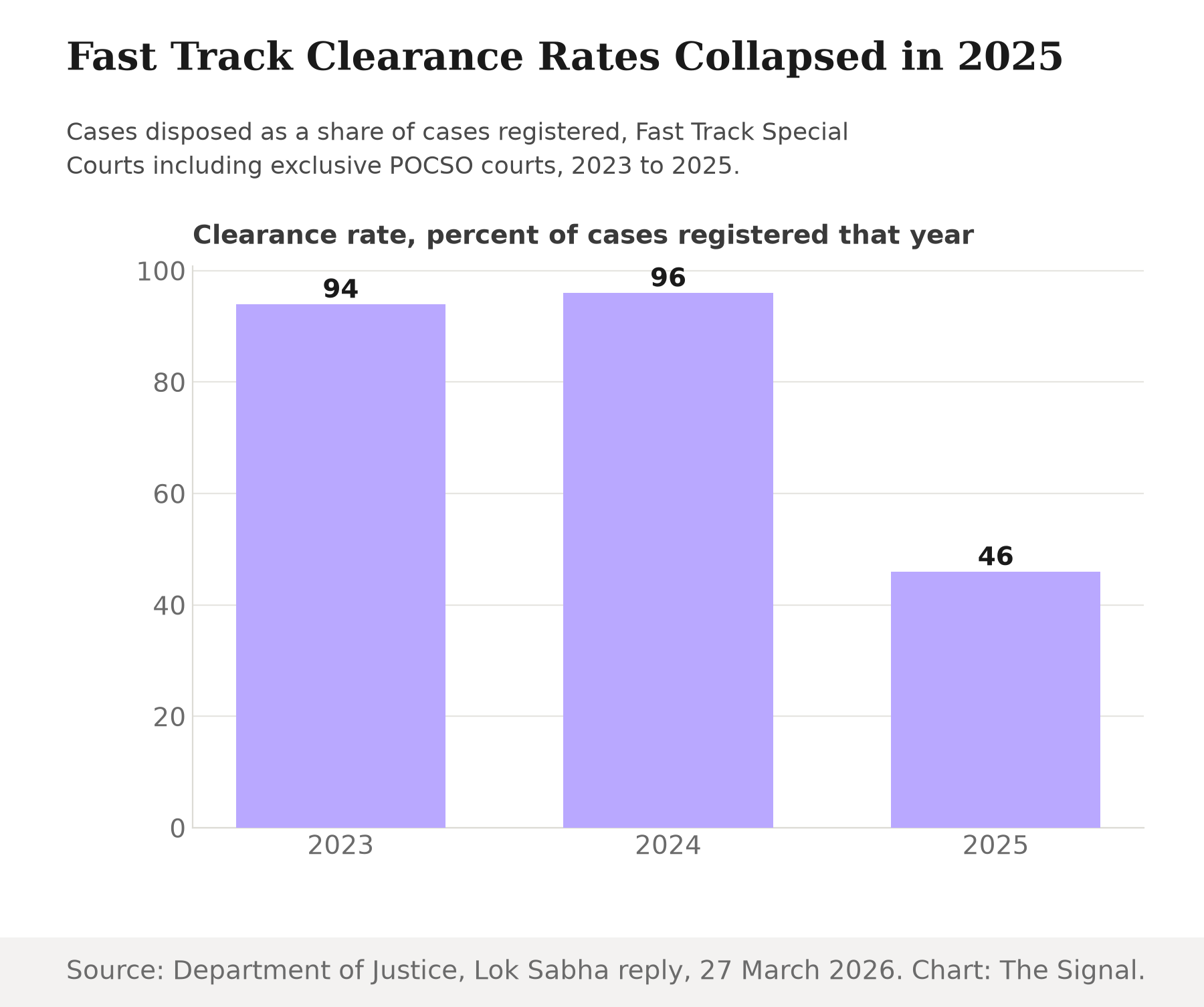
Source: Department of Justice, Lok Sabha reply, March 2026. Chart: The Signal.
Clearance is not conviction, either. Nationally, only 29.0% of the 40,492 POCSO Act cases disposed by courts in 2023 ended in a conviction, per the National Crime Records Bureau's Crime in India report, and the rest closed in acquittal or discharge. A case leaving the pending queue faster doesn't by itself mean more offenders are being convicted; it only means the docket moved, which is a distinct and narrower kind of progress than the "clearance rate" figure alone suggests.
One state carries an outsized share of this machine. Uttar Pradesh alone runs 218 of India's 774 functional FTSCs, more than a quarter of the national total, including 74 of the 398 exclusive POCSO courts. A scheme this concentrated in one state's capacity is also a scheme where one state's court administration sets the pace for the national clearance number.
Uttar Pradesh runs more than a quarter of India's Fast Track Special Courts.
| National total | Uttar Pradesh | |
|---|---|---|
| Functional FTSCs (of 790 sanctioned) | 774 | 218 |
| Of which, exclusive POCSO courts | 398 | 74 |
Source: Department of Justice, Lok Sabha reply, 27 March 2026.
The other fast-track scheme never came close
The FTSC scheme is the newer of two overlapping fast-track efforts, and the older one is in worse shape. The 14th Finance Commission recommended 1,800 Fast Track Courts for the 2015 to 2020 period; as of 31 January 2026, only 862 are functional, across 21 states and union territories, less than half the original target, nearly six years after the period it was meant to cover ended.
Neither scheme runs in isolation from India's wider judicial staffing problem. The subordinate judiciary, the tier that supplies the judges for both fast-track schemes, has 4,868 vacant posts out of a sanctioned strength of 25,894, an 18.8% vacancy rate, as of March 2026. Money has moved: the Centre has released Rs 1,210.91 crore in Nirbhaya Fund money to states since the FTSC scheme's October 2019 launch, including Rs 176.36 crore in the current financial year. What has not moved at the same pace is the share of cases that money and staffing translate into finished trials.
The backlog these courts sit inside
Even at 2,44,479 cases, the FTSCs' pending queue is a small piece of a much larger pile. India's Supreme Court and High Courts together had 64.5 lakh cases pending as of 9 March 2026, and the District and Subordinate Courts, where fast-track benches physically sit, had 4,95,62,229 cases pending, nearly 5 crore, on the same date.
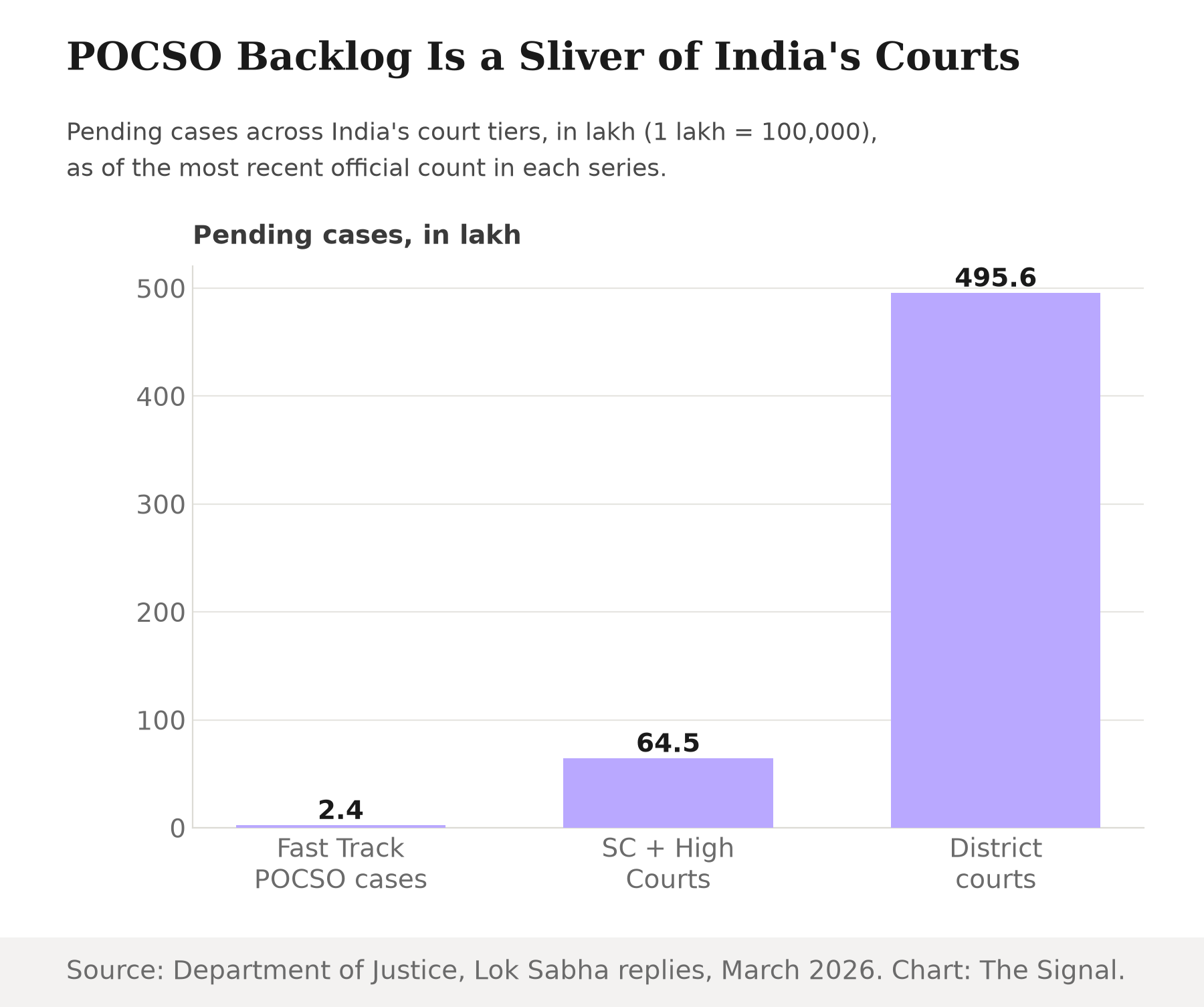
Source: Department of Justice, Lok Sabha replies, March 2026. Chart: The Signal.
That scale is the context the new paper-leak court opened into on 24 July. A single designated court at Rouse Avenue is not going to move the national pendency number. But it inherits the same subordinate-court plumbing, the same judge pool, and, if the pattern from the POCSO courts holds, the same risk that a caseload manageable in its first year outruns the bench within a few more.
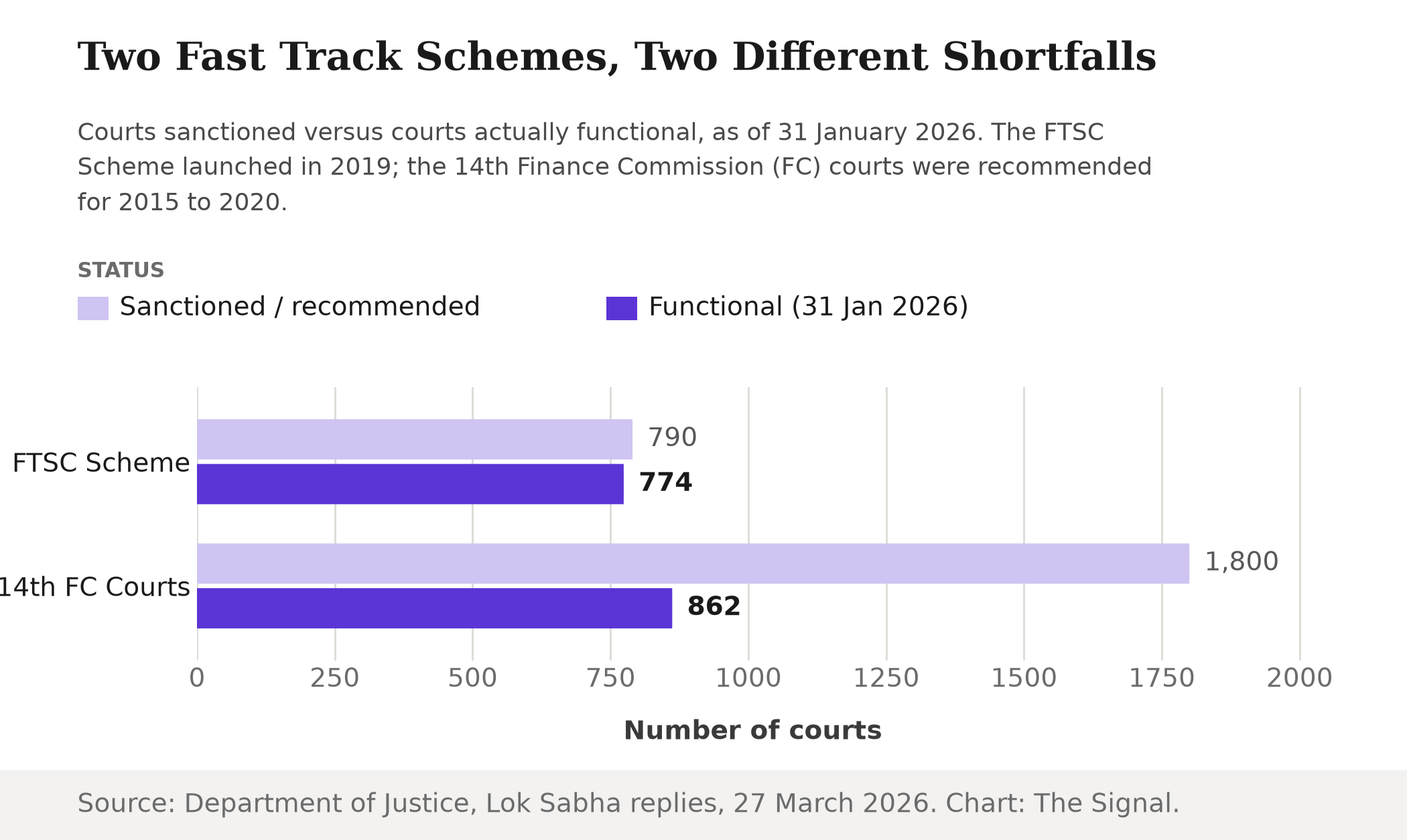
Source: Department of Justice, Lok Sabha reply, March 2026. Chart: The Signal.
The honest objection
The strongest case for optimism is that paper-leak prosecutions are not POCSO prosecutions. A leaked question paper leaves a documentary and digital trail, procurement records, WhatsApp chats, printer logs, that a rape or child-abuse case, dependent on witness testimony and forensic timelines, often does not. The Public Examinations Act is a new, narrow statute with a small initial docket, heard by one dedicated judge at one location, not diffused across hundreds of benches nationwide. A focused court with a light early caseload could plausibly move faster than a scheme carrying six years of accumulated volume.
That case is real, and it is exactly the case the FTSC scheme's designers could have made in 2019: 774 of 790 sanctioned courts were built out and the clearance rate was still 94 to 96% as recently as 2024. The mechanism that broke the older scheme was not a hard category of case. It was volume arriving faster than the bench could absorb it, in a judiciary already running an 18.8% vacancy rate beneath it. A single Delhi courtroom looks resilient at the scale of a few dozen cases. Whether it stays resilient depends on whether paper-leak prosecutions stay that small, and whether more state exam boards and the CBI feed it more cases than one judge can clear.
The Signal
The government chose the fastest lane it had available for paper-leak prosecutions: a scheme with a designation built for urgency and, on 24 July, a specific bench willing to take the caseload. What it did not choose was to build new capacity. It routed a politically urgent problem into infrastructure that its own data, tabled in the Lok Sabha five months earlier, shows is already buckling: a clearance rate cut from 96% to 46% in a year, a companion scheme stuck at 862 of its 1,800-court 2015 target six years late, and a judiciary short nearly a fifth of its sanctioned posts. Watch what happens to the Rouse Avenue court's docket once more states refer paper-leak cases into it. If its clearance rate tracks the FTSC average, the fast lane will look, within a couple of years, exactly like the lane it was built to bypass.
Reporting basis: the pendency, staffing, clearance-rate and funding figures for India's Fast Track Special Courts and 14th Finance Commission courts, the Supreme Court, High Courts and District and Subordinate Courts, and judicial vacancy data are all from the Department of Justice's replies to the Lok Sabha, tabled in March 2026, with the underlying pendency and vacancy figures sourced from the National Judicial Data Grid and the NyayaVikas 2.0 Portal. The 9.51-versus-3.26 cases-per-month disposal-rate comparison is from a separate Department of Justice press release. NEET-UG 2026's cancellation is per Akashvani News, reporting the National Testing Agency's decision; the re-exam turnout and qualification figures are from the National Testing Agency's own press release. The Delhi High Court's fast-track court order is per Akashvani News. The clearance-rate percentages for 2023 through 2025 are the Department of Justice's own stated figures, derived from the registered and disposed case counts in the same reply. The national POCSO Act conviction rate is from the National Crime Records Bureau's Crime in India 2023 publication and reflects all courts, not FTSCs specifically.