Dharmendra Pradhan resigned as India's Union Education Minister on 25 July 2026, telling Prime Minister Narendra Modi that the move was not about personal prestige, but meant to safeguard students and stop anti-national elements from hijacking the protests. The protests had been building for weeks. Activist Sonam Wangchuk began an indefinite hunger strike at Delhi's Jantar Mantar on 28 June 2026, backing the Cockroach Janta Party's demand for Pradhan's resignation, a group that had gained 22 million Instagram followers within days of its founding in May 2026. The strike was still drawing attention when Al Jazeera reported on it on 14 July. The trigger was the NEET-UG medical entrance exam: after the 3 May 2026 sitting, the National Testing Agency cancelled the result and ordered a free re-exam once the CBI registered a paper-leak case, with NTA Director Abhishek Singh saying if there is even the slightest doubt regarding the integrity of the examination process, the appropriate decision in such a scenario is to cancel the examination. Read the headlines and this is a governance story: a compromised exam, an agency that could not hold the line, a minister who fell on it.
It is worth slowing down on that read. The National Testing Agency's competence is a fair question, but the exam it runs sits on top of a state-capacity question that predates this scandal by years: how much India actually spends teaching the students the exam is meant to serve.
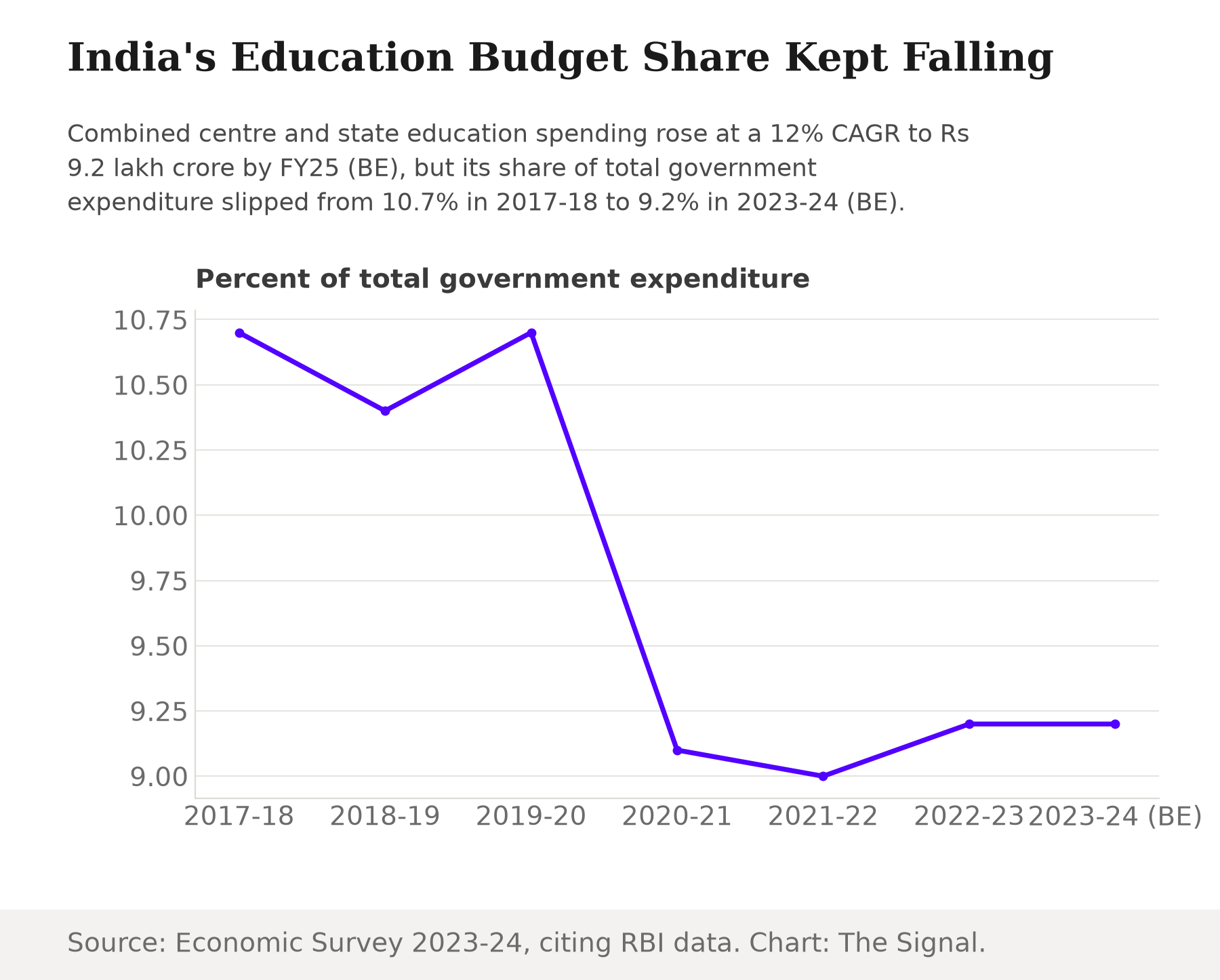
Education's share of what India spends has been shrinking since 2017-18.
Combined centre-and-state education spending's share of total government expenditure fell from 10.7% in 2017-18 to 9.2% in 2023-24 (BE), and its share of GDP slipped from 2.8% to 2.7% over the same span, according to RBI data reported in the Economic Survey 2023-24, less than half the National Education Policy's own target of 6% of GDP. That is not a story of falling rupee amounts. Combined education spending grew at a 12% CAGR, from Rs 5.8 lakh crore in FY21 to Rs 9.2 lakh crore in FY25 (BE), according to the Economic Survey 2024-25. The money kept coming. It just kept losing ground to everything else India was spending faster on.
Source: Economic Survey 2023-24, citing RBI data. Chart: The Signal.
Health set the pace education could not match
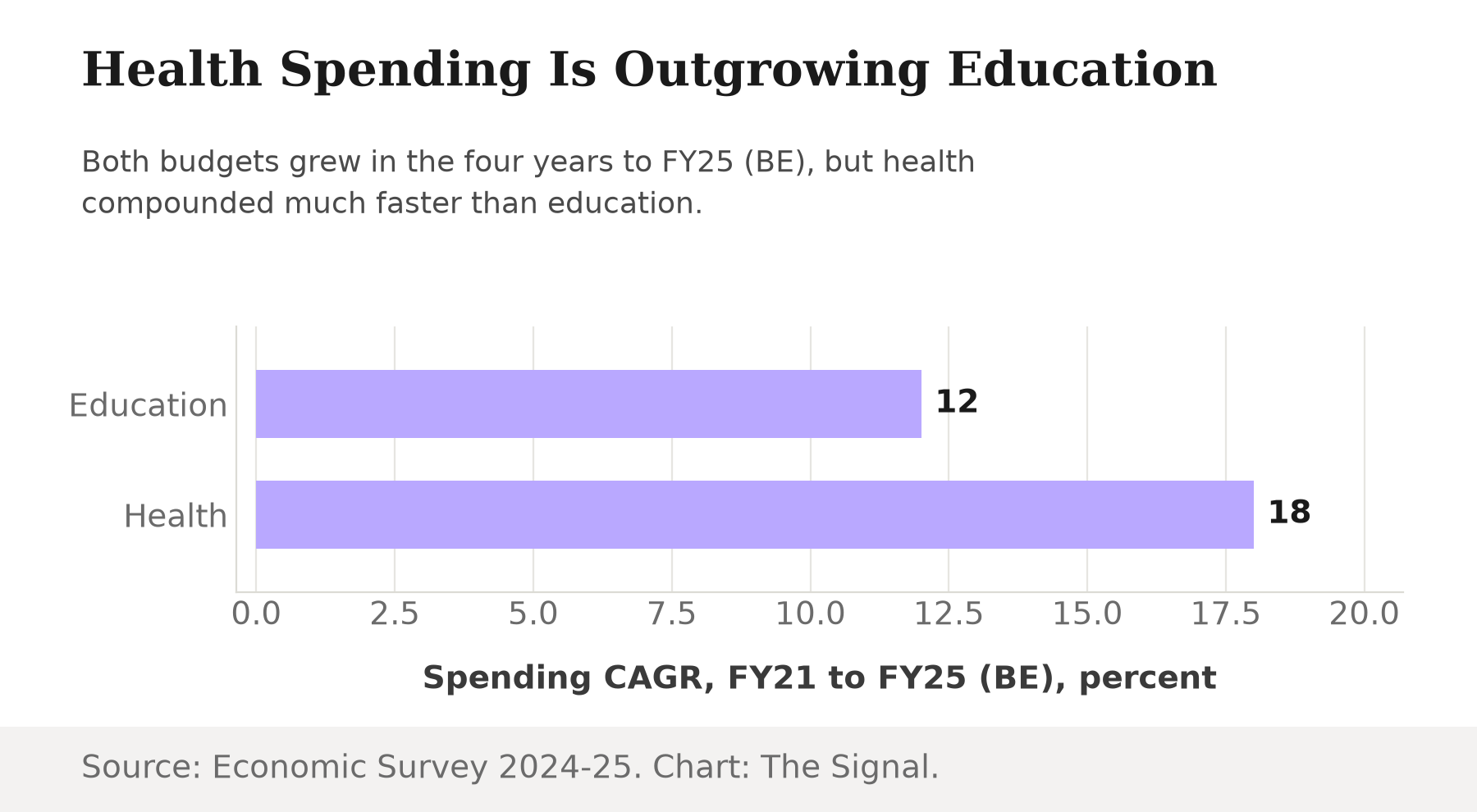
The clearest place that shows up is the comparison the Economic Survey itself draws. Health spending grew at an 18% CAGR over the same FY21-to-FY25 window, from Rs 3.2 lakh crore to Rs 6.1 lakh crore, against education's 12%. A six-percentage-point gap in annual growth, compounded across four budgets, reshapes which ministry gets the marginal rupee even when both are nominally growing.
Source: Economic Survey 2024-25. Chart: The Signal.
Neither series is a live number. The Economic Survey 2024-25 figures were published in early 2025, and the Economic Survey 2023-24 breakdown is now more than two years old. The newest structural read on what pays for Indian education predates this week's resignation by roughly a year and a half to two years, not days.
It shows up outside India's own accounting too
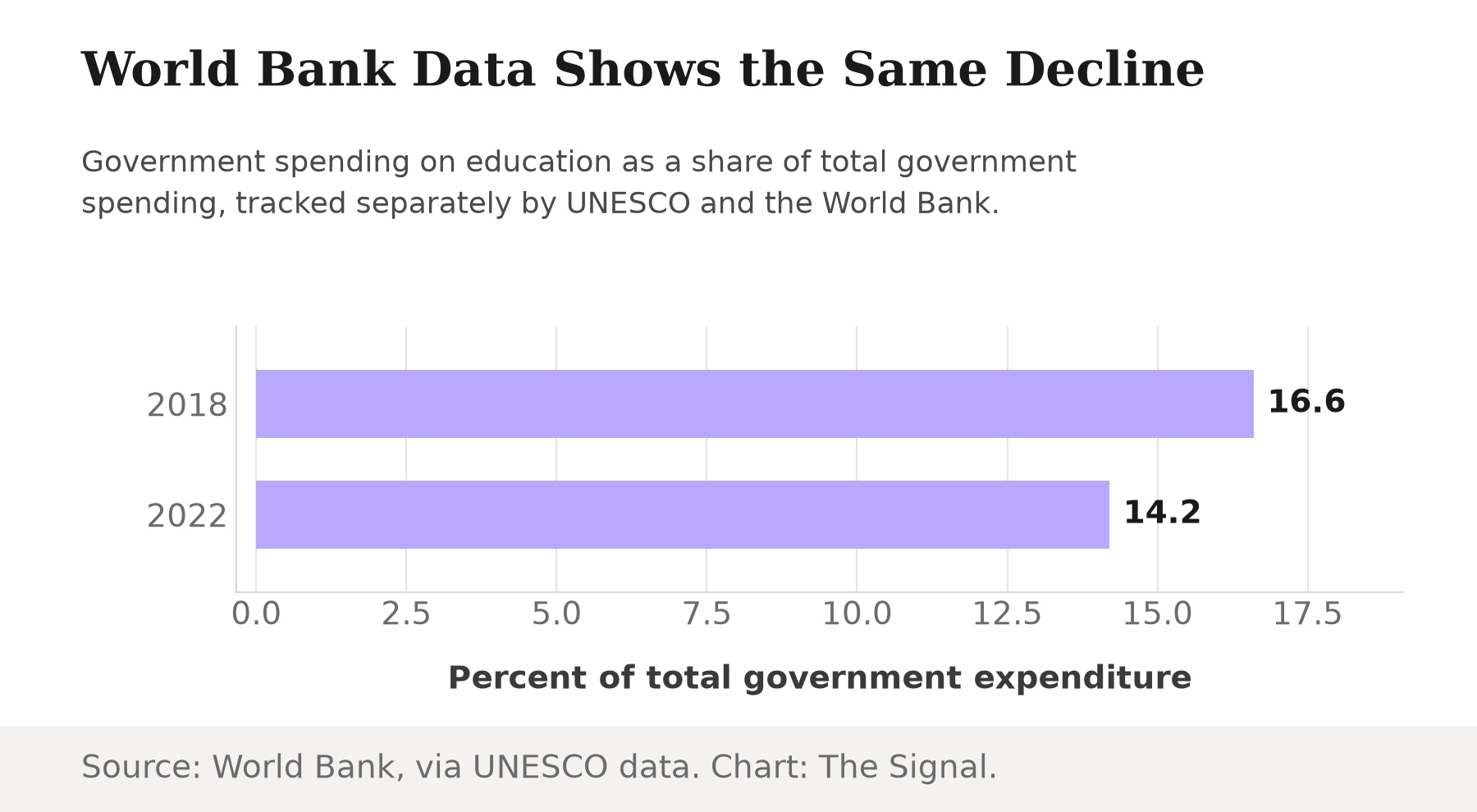
The same direction shows up in a completely separate data pipeline. World Bank data, sourced from the UNESCO Institute for Statistics, shows India's government expenditure on education falling from 16.6% of total government expenditure in 2018 to 14.2% in 2022. That series uses a different methodology and a different reporting window than the RBI-based figures above, so the two numbers should not be read as the same measurement, but they move the same way: down. The World Bank series is also the older of the two, current only to 2022, the latest edition UNESCO has compiled.
That answers what "falling" is falling against. UNESCO's Education 2030 Framework for Action calls on governments to allocate at least 15% to 20% of public expenditure, or 4% to 6% of GDP, to education. India's 9.2% of total expenditure, 2.7% of GDP, and the separately measured 14.2% World Bank figure all sit below that range, not just below their own past levels. It is a reference benchmark, not a binding rule, but it means this is a trend moving away from an internationally agreed floor it was already under.
Source: World Bank, via UNESCO data. Chart: The Signal.
The squeeze is not even across states
National totals hide which states are actually cutting. Punjab's capital expenditure on education, sports, art and culture fell every year for four straight years, from Rs 227 crore in 2019-20 to Rs 183 crore in 2022-23, according to the Tribune's reporting on the CAG's State Finances 2022-23 review.
| Fiscal year | Punjab capital spending on education, sports, art and culture (Rs crore) |
|---|---|
| 2019-20 | 227 |
| 2020-21 | 200 |
| 2021-22 | 196 |
| 2022-23 | 183 |
Source: The Tribune, citing the CAG's State Finances 2022-23 report.
That decline runs against the national grain. The same CAG review found the combined capital spending across all states in those three categories rose from Rs 6,842 crore in 2013-14 to Rs 24,467 crore in 2022-23. Punjab was not following the national pattern; it was cutting while most states, on the whole, were adding.
The honest objection
The strongest case against tying any of this to the NEET-UG leak is that a leaked question paper is a physical-security and integrity failure, not a funding failure. More rupees in the education budget would not by themselves have stopped a print-room breach or an insider selling answer keys. Well-funded exam systems elsewhere have been compromised by a single corrupt actor, and thinly funded ones have run clean for years. On its own terms, that case is correct: money does not explain the mechanism of a leak.
What it does explain is the slack the system had to absorb the shock. The NEET-UG 2026 re-exam drew close to 20 lakh candidates who sat at 5,440 centres in 551 cities in India and 14 abroad, of whom 11.21 lakh, just over half, qualified, according to the National Testing Agency's own numbers. Standing up a clean re-exam at that scale, on short notice, for an agency already under public scrutiny, is an institutional-capacity problem as much as an integrity one. A testing and oversight apparatus asked to do more each year, inside a budget line that keeps losing ground to the rest of government spending, has less room to invest in the security, staffing and audit trail that make a leak harder to pull off a second time.
The exam is not the only place the squeeze shows up. The share of India's 15-16-year-olds not enrolled in school fell from 13.1% in 2018 to 7.9% in 2024, an improvement that stalled between 2022 and 2024 rather than continuing, per the ASER Centre's national household survey, an independent sign the system's capacity to keep older children in school has plateaued. Where the public system stalls, private money fills the gap: GST revenue from coaching centres grew nearly 150%, from Rs 2,240.73 crore in 2019-20 to Rs 5,517.45 crore in 2023-24, per a government reply to the Rajya Sabha, a rough proxy for how much more Indian households now pay privately for the exam preparation the public budget does not fully fund.
The Signal
Pradhan's resignation answers the political question the protests were asking: accountability for a compromised exam. It does not touch the budget question underneath it, and that one was not created by the leak. Education's share of what India spends has been falling since 2017-18, confirmed independently by a second, separate data compilation, while the money that reaches it keeps growing more slowly than health's. Whoever succeeds Pradhan inherits an exam system the country still expects to run cleanly for tens of lakhs of students a year, funded by a budget line that has spent most of a decade shrinking relative to everything else India pays for. Watch what the next Union Budget does with the education allocation as a share of total spending, not its rupee total. A bigger number that still loses ground to health and to the NEP's own 6%-of-GDP target is not a fix. It is the same story with a new minister's name on it.
Reporting basis: the account of Dharmendra Pradhan's resignation and his stated reasoning is per Gulf News; Sonam Wangchuk's hunger strike and the Cockroach Janta Party's Instagram following are per Al Jazeera's reporting. The NEET-UG cancellation and the National Testing Agency director's statement are from a News on Air report citing the NTA, and the re-exam turnout and qualification figures are from the National Testing Agency's own press release. The combined centre-and-state education and health spending figures, including the FY21-to-FY25 CAGRs, are from the Economic Survey 2024-25; the education spending share of total expenditure and of GDP, and the National Education Policy's 6%-of-GDP target, are from the Economic Survey 2023-24, both compiling data from the Reserve Bank of India and government budget documents. The international comparison is World Bank data sourced from the UNESCO Institute for Statistics, a separate compilation on a different reporting cycle. The Punjab and all-states capital expenditure figures are per the Tribune's reporting on the Comptroller and Auditor General's State Finances 2022-23 review. The international spending benchmark is from UNESCO's Global Education Monitoring Report team. The dropout figure for 15-16-year-olds is from the ASER Centre's ASER 2024 national household survey, and the coaching-sector GST figures are per ThePrint's reporting on a Rajya Sabha reply from the Department of Higher Education. The National Education Policy target-shortfall framing and the NEET-UG qualification share are The Signal's calculations from those figures.