On 23 July 2026, as protests over a cancelled medical entrance exam spread across Indian campuses, Prime Minister Narendra Modi announced that the government will set up fast-track courts to try examination paper-leak cases, promising swift and stringent punishment. The trigger was the National Testing Agency's decision two and a half months earlier to cancel the NEET-UG 2026 exam, held on 3 May 2026, after paper-leak allegations. The agency referred the matter to the CBI for a comprehensive inquiry. Read as a decisive response, the numbers back it up: nearly two million medical aspirants sat the exam, 13 people have already been arrested and jailed over the leak, and India's Public Examinations (Prevention of Unfair Means) Act, 2024 already carries three to five years in prison and fines up to Rs 10 lakh for individuals, and five to ten years with a minimum Rs 1 crore fine for organised leak syndicates. Fast-track courts, the pledge implies, will make sure that law bites quickly.
It is worth slowing down on that read, because this is not the first time a fast-track-court promise has followed a national outcry in India. In October 2019, the government launched the Fast Track Special Courts (FTSC) scheme for rape and POCSO Act cases, targeting 1,023 dedicated courts financed through the Nirbhaya Fund. Six years, one revised target and Rs 1,952.23 crore later, that scheme is a preview of what a fast-track-court promise looks like once the announcement fades.
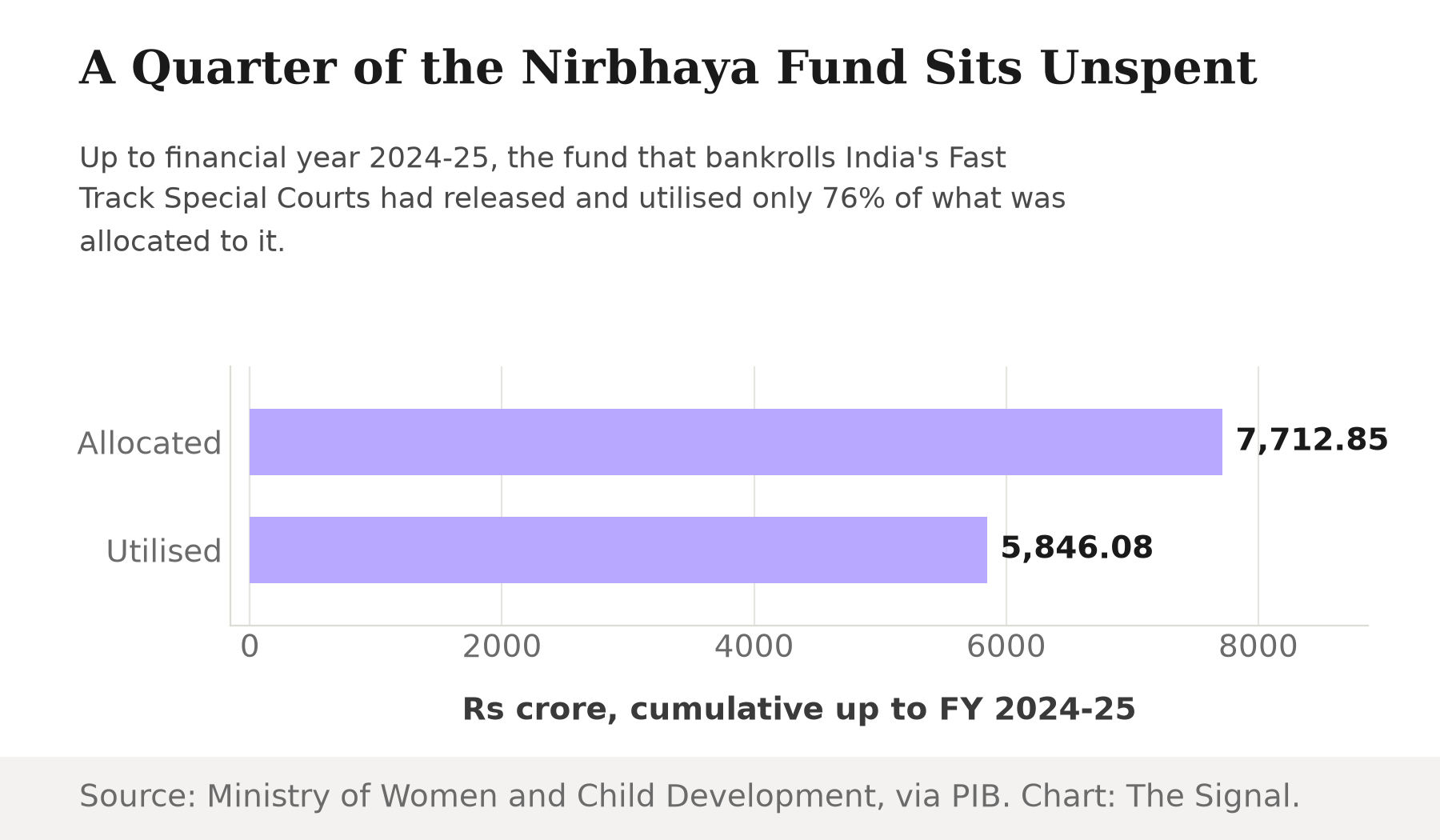
A quarter of the fund that finances India's rape and POCSO fast-track courts sits unspent.
Up to financial year 2024-25, the Nirbhaya Fund, which also bankrolls the FTSC scheme, had Rs 7,712.85 crore allocated but only Rs 5,846.08 crore, nearly 76%, actually released and utilised, leaving roughly Rs 1,866.77 crore unspent. Money committed to fast-track justice has sat idle even as the courts it is meant to build stay short of target.
Source: Ministry of Women and Child Development, via PIB. Chart: The Signal.
A scheme that keeps missing its own target
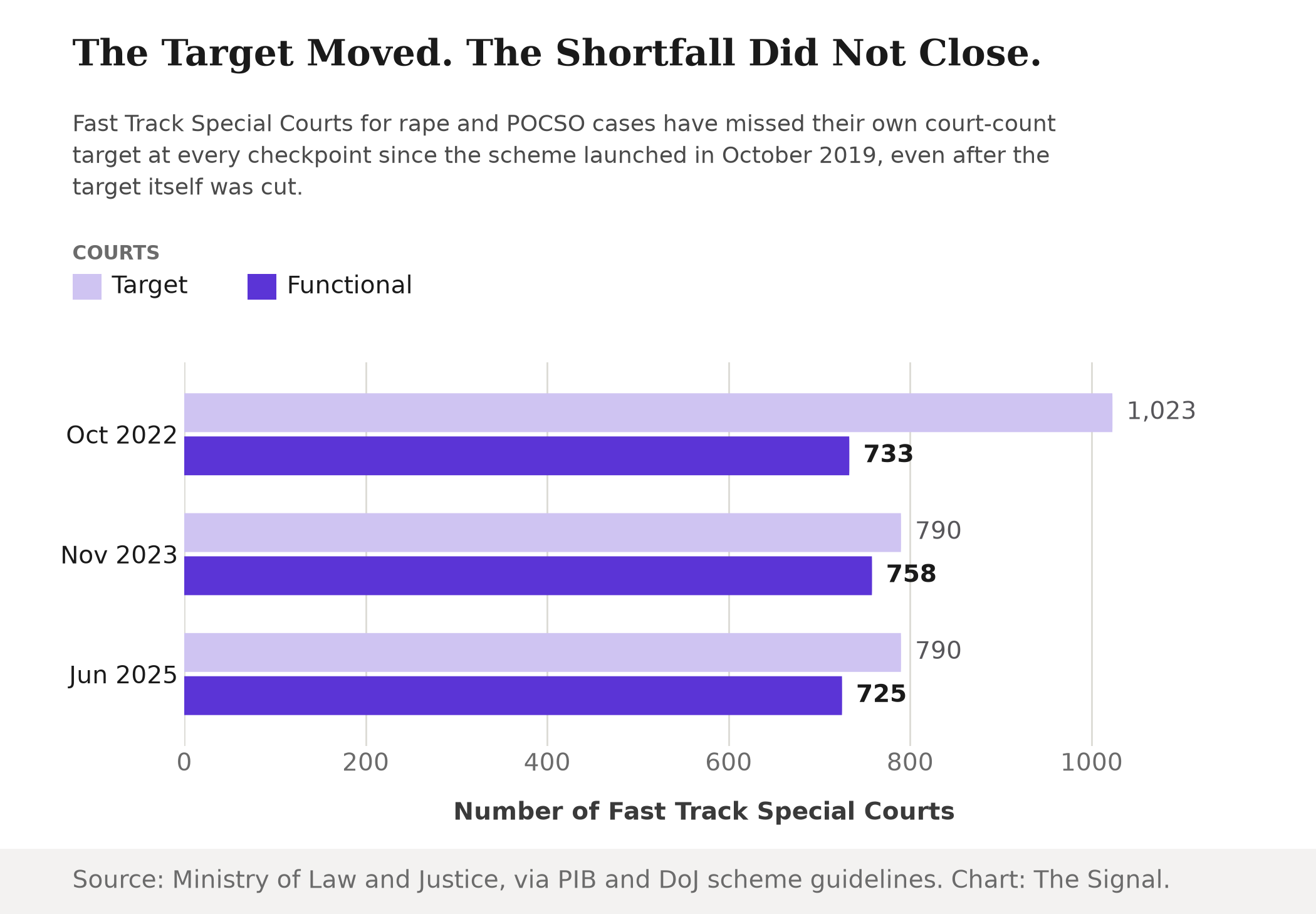
The FTSC scheme's history is a study in moving goalposts. Three years after the October 2019 launch, only 733 of the promised 1,023 courts, about 72%, were functional, spread across 28 States and Union Territories. Unable to hit that number, the Union Cabinet revised the target down to 790 courts in November 2023, running through March 2026, at a higher outlay of Rs 1,952.23 crore, including Rs 1,207.24 crore as the Central share. By then, 758 FTSCs, including 411 exclusive POCSO courts, had been set up.
| Launched, October 2019 | Revised, November 2023 | |
|---|---|---|
| Target courts | 1,023 | 790 |
| Total outlay | Rs 1,572.86 crore | Rs 1,952.23 crore (Rs 1,207.24 crore Central share) |
| Financed from | Nirbhaya Fund | Nirbhaya Fund |
Source: Ministry of Law and Justice, via PIB; Department of Justice scheme guidelines.
Even against its own lowered bar, the scheme kept falling short. As of 30 June 2025, six years after the scheme's launch, only 725 of the 790 targeted FTSCs, including 392 exclusive POCSO courts, were functional, across 29 States and Union Territories, a shortfall of 65 courts against a target the government had already cut once.
Source: Ministry of Law and Justice, Rajya Sabha reply via PIB; Department of Justice scheme guidelines; Ministry of Law and Justice, Lok Sabha reply via PIB. Chart: The Signal.
The courts that exist work. The queue does not shrink.
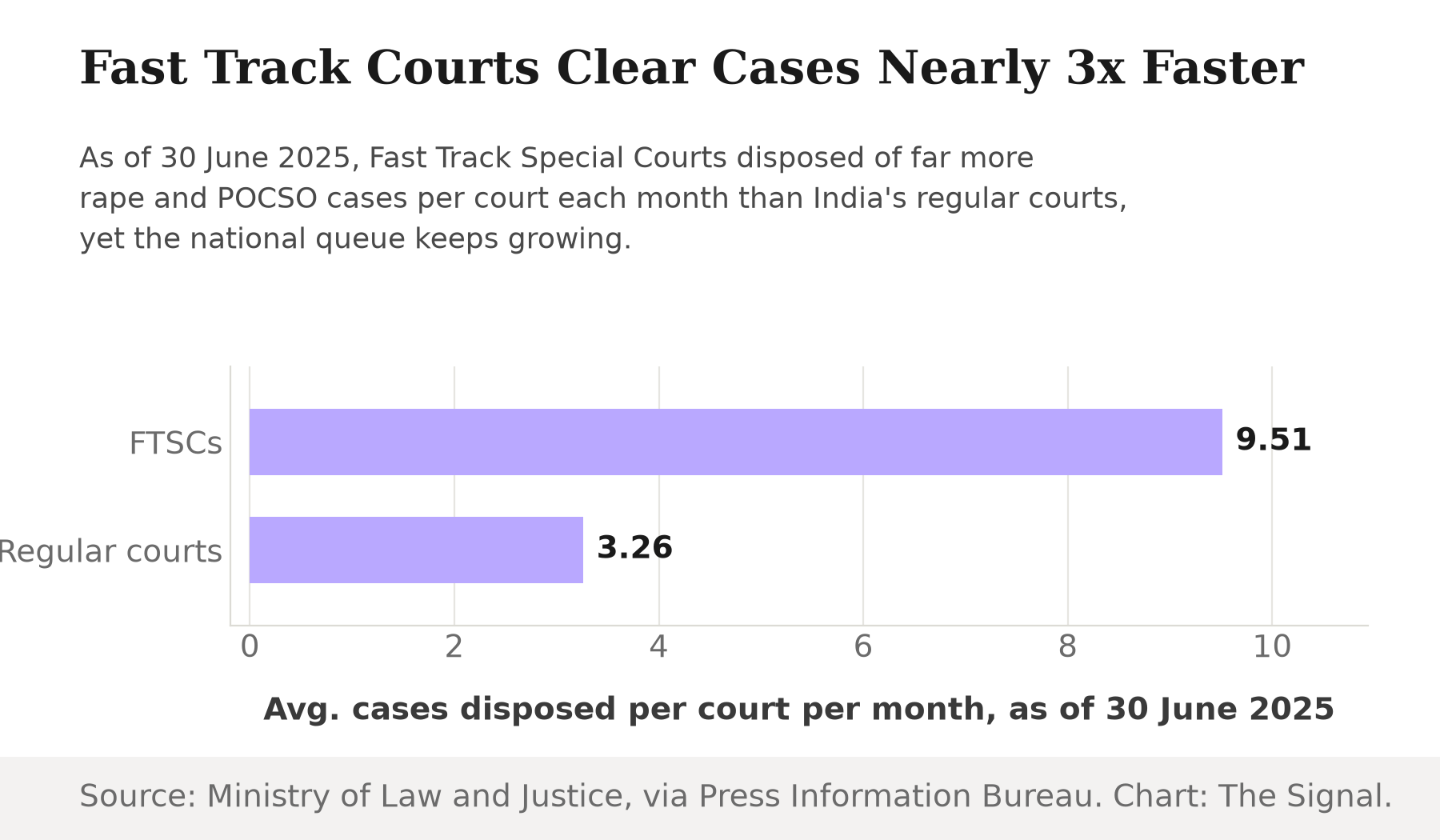
None of this is because the courts that do exist are failing at their job. Those 725 functional FTSCs have disposed of 3,34,213 cases since the scheme's inception and average 9.51 case disposals per court per month, against 3.26 in regular courts, nearly three times the ordinary rate.
Source: Ministry of Law and Justice, Lok Sabha reply via PIB. Chart: The Signal.
That efficiency shows up in the annual numbers too. In calendar year 2024, FTSCs instituted 88,902 new cases and resolved 85,595 of them, a 96.28% disposal rate. But a 96.28% disposal rate on a caseload that size still left the pending count roughly 3,300 cases longer at the end of the year than at the start. A court system running at nearly three times the ordinary clip is still losing ground, because the number of courts hearing cases has itself been undershot for six straight years.
Zoom out to the national docket and the mismatch gets starker. In 2022, the most recent year for which case-level data are available, 89.2% of India's POCSO Act cases, 239,188 of 268,038, were still awaiting trial nationally, per National Crime Records Bureau data. A 2022 Vidhi Centre for Legal Policy study found FTSCs took an average of 509.78 days to dispose of a single POCSO case, well past the one-year disposal target the POCSO Act itself sets.
The honest objection
The strongest case that this time could be different is scale. Only 13 people have been arrested so far over the NEET-UG 2026 leak, against the tens of thousands of new rape and POCSO cases FTSCs absorb every year. A pipeline built for one high-profile leak investigation faces a different volume problem than one built for an open-ended national category of crime, so the FTSC precedent might simply not apply to it.
That case holds until you ask what actually produced the FTSC shortfall. It was not that too many cases showed up for too few courts on day one. It was that the fund built to pay for the courts released only three-quarters of what was allocated to it, and a target already cut once was still missed. That is a deployment problem, not a volume problem, and a small, contained docket is not automatically immune to it just because it starts small.
The Signal
The FTSC scheme is not a story about courts that do not work. Per court, they dispose of cases at nearly three times the rate of a regular court. It is a story about a government that is quick to announce dedicated capacity and slow to fully fund and staff it, then revises the target down rather than closing the gap. Watch what happens to the paper-leak fast-track courts over the next year: if they are named, funded to their stated number, and staffed on the schedule the announcement implied, the precedent breaks. If the number of courts lags the announcement the way FTSC's did, and quietly shrinks a few years in, the pattern will have repeated for a third time. A fast-track court is only as fast as the day it is fully built, not the day it is announced.
Reporting basis: the Fast Track Special Court target, functional-court counts and outlay figures for October 2022 and June 2025 are from written replies by the Ministry of Law and Justice to the Rajya Sabha and the Lok Sabha respectively, both via Press Information Bureau releases; the November 2023 revision and functional count are from the Department of Justice's own scheme guidelines document. The 2024 case-institution and disposal figures are from a Ministry of Law and Justice press release via PIB. The Nirbhaya Fund allocation and utilisation figures are from a Ministry of Women and Child Development release via PIB. The national POCSO trial-pendency rate and the Vidhi Centre for Legal Policy's average-disposal-time finding are both as reported by ISignal (formerly IndiaSpend), citing National Crime Records Bureau and Vidhi Centre data respectively; ISignal is the sole source for those two figures. The NEET-UG 2026 cancellation and CBI referral are per News on Air, relaying the National Testing Agency's own statement. PM Modi's fast-track-courts announcement, the arrest count, the aspirant count and the penalties under the Public Examinations (Prevention of Unfair Means) Act, 2024 are as reported by Bar & Bench, relaying the Prime Minister's own post and government statements. The unspent-fund figure, the FY2024-25 caseload growth and the disposal-rate multiple are The Signal's calculations from those figures.