On 20 July 2026, Canada's foreign minister landed in Islamabad on a visit her own delegation called overdue. Anita Anand noted that "our two countries have shared 80 years of diplomatic relations" and that "it has been approximately 20 years since a Canadian foreign minister visited Pakistan." The official framing was simple: reopen a neglected relationship and back it with real money. Canada paired the visit with more than $47 million in combined assistance, split between security cooperation and a larger package for climate resilience, girls' education and flood recovery.
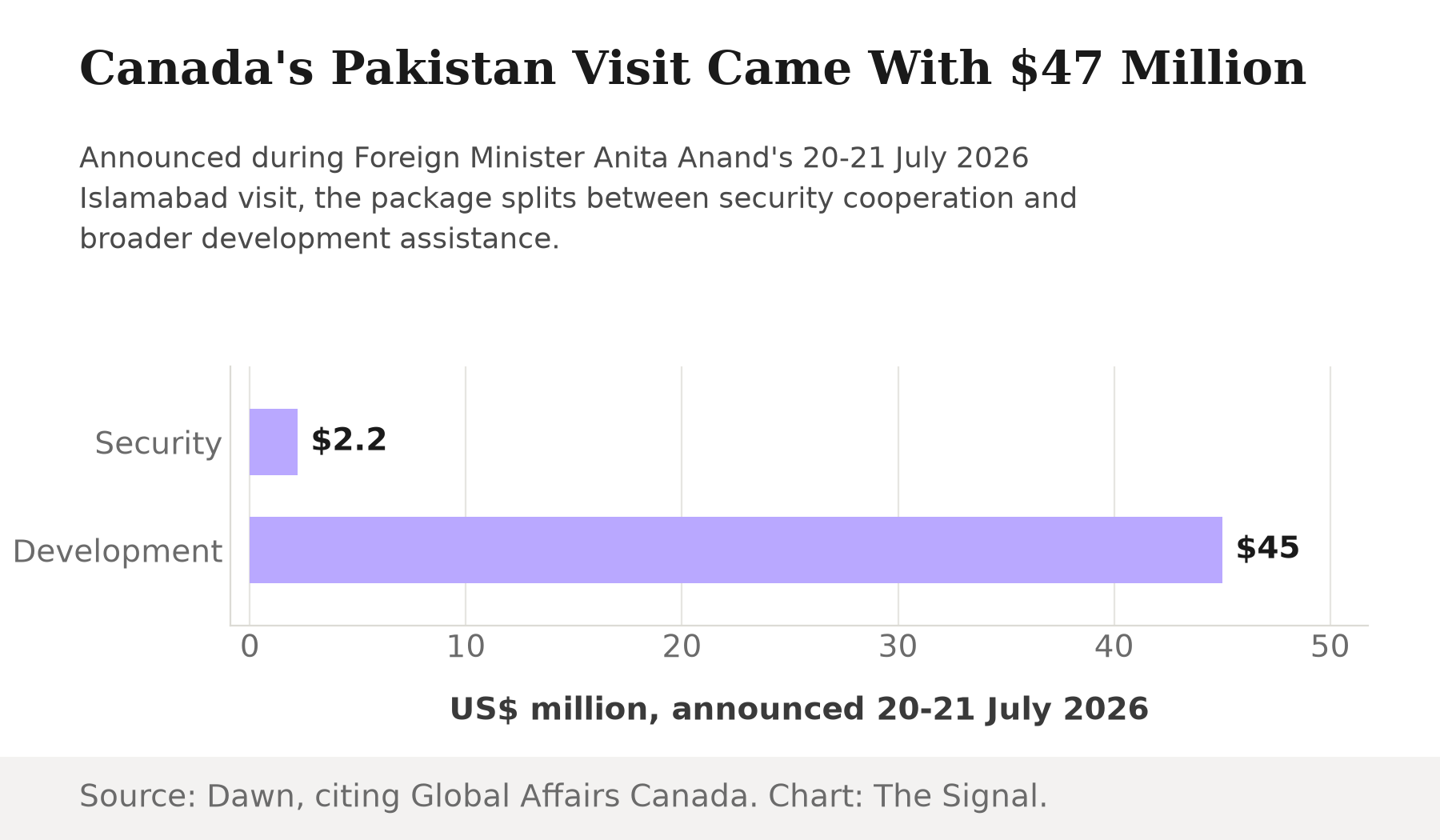
Source: Dawn, citing Global Affairs Canada's announcement. Chart: The Signal.
Pakistan's water dispute with India has stayed almost entirely bilateral for as long as Canada stayed out of Islamabad, argued out between the two governments with no third government drawn directly into the exchange. A Canadian foreign minister's first trip to Islamabad in a generation was never billed as an entry point into that argument. It became one anyway.
It is worth slowing down on what happened at the other end of that visit. Pakistan's Deputy Prime Minister and Foreign Minister Ishaq Dar used the platform to make a direct, public ask of Canada: to back "India's immediate restoration of the IWT, ending the weaponization of water." A courtesy call built around 80 years of diplomatic history became the stage for Pakistan's campaign to bring a G7 government into a dispute India has always insisted belongs to India and Pakistan alone.
What the treaty actually splits
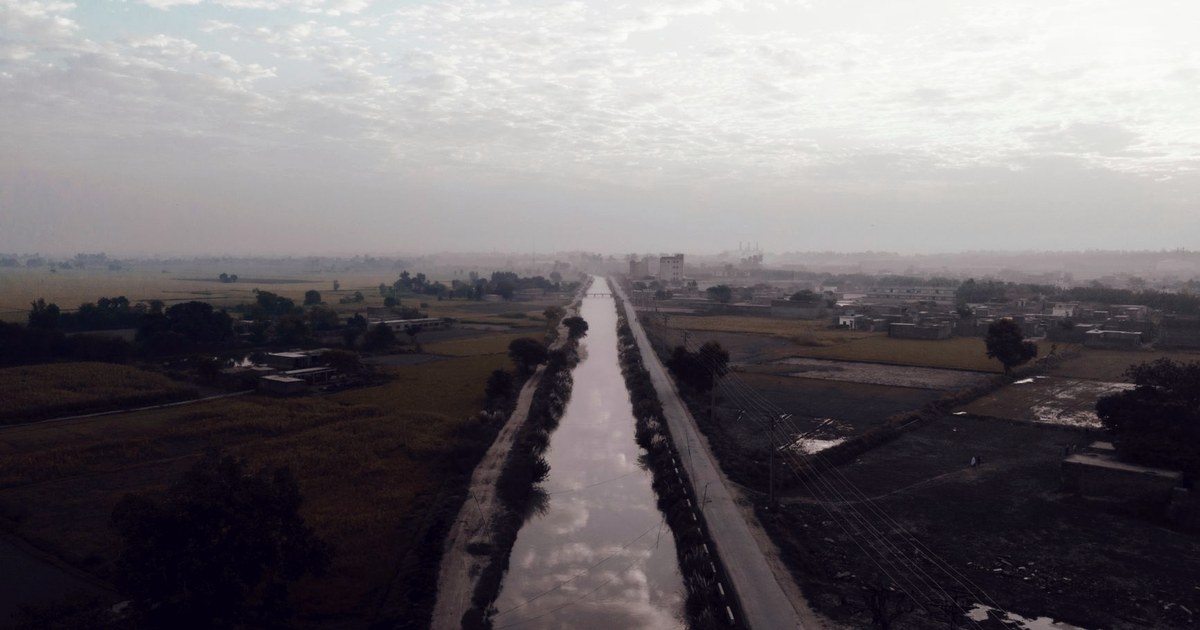
The Indus Waters Treaty is not an abstraction. Brokered by the World Bank in 1960, it hands Pakistan the western rivers, the Indus, Jhelum and Chenab, and gives India the eastern rivers, the Ravi, Beas and Sutlej.
The 1960 split ran by geography, not by volume.
| Rivers | Allocated to |
|---|---|
| Indus, Jhelum, Chenab (western) | Pakistan |
| Ravi, Beas, Sutlej (eastern) | India |
Source: World Bank.
For 65 years that division held through wars and standoffs the treaty was designed to survive, a rare instance of India and Pakistan honouring one shared document while contesting almost everything else between them. It stopped holding in 2025.
Why India calls the treaty suspended, not negotiable
India suspended the treaty in April 2025 in the wake of the Pahalgam terror attack, with the Union Jal Shakti Minister vowing the government would ensure "not a single drop" of Indus water reaches Pakistan. Two months later, the Ministry of External Affairs rejected a Hague-based Court of Arbitration's supplemental award on the Kishenganga and Ratle hydropower projects, saying India "has never recognised the legal validity of this Court of Arbitration" and considers itself "no longer bound to perform any of its obligations under the Treaty". Fifteen months after the suspension, the position has not moved. At a 3 July 2026 briefing, MEA spokesperson Randhir Jaiswal reiterated that Pakistan "must credibly and irrevocably renounce its support for cross-border terrorism" before the treaty can resume. None of this is framed by New Delhi as a negotiating position that could move with the right incentive from a friendly third country. It is framed as a security threshold: a specific Pakistani action, not diplomatic pressure from Ottawa or anyone else, is what the government says would restore the treaty. That is the backdrop Anand walked into just over two weeks later: a government that treats the treaty as closed pending a security condition, not a document open for a third country's input.
The economics behind Pakistan's urgency
Pakistan's push is not sentimental. In a 2019 estimate, rice, wheat, sugarcane and cotton, the country's four thirstiest crops, consumed 80 percent of its water while contributing just 5 percent of its GDP, and poor water management was estimated to cost the economy about 4 percent of GDP a year.
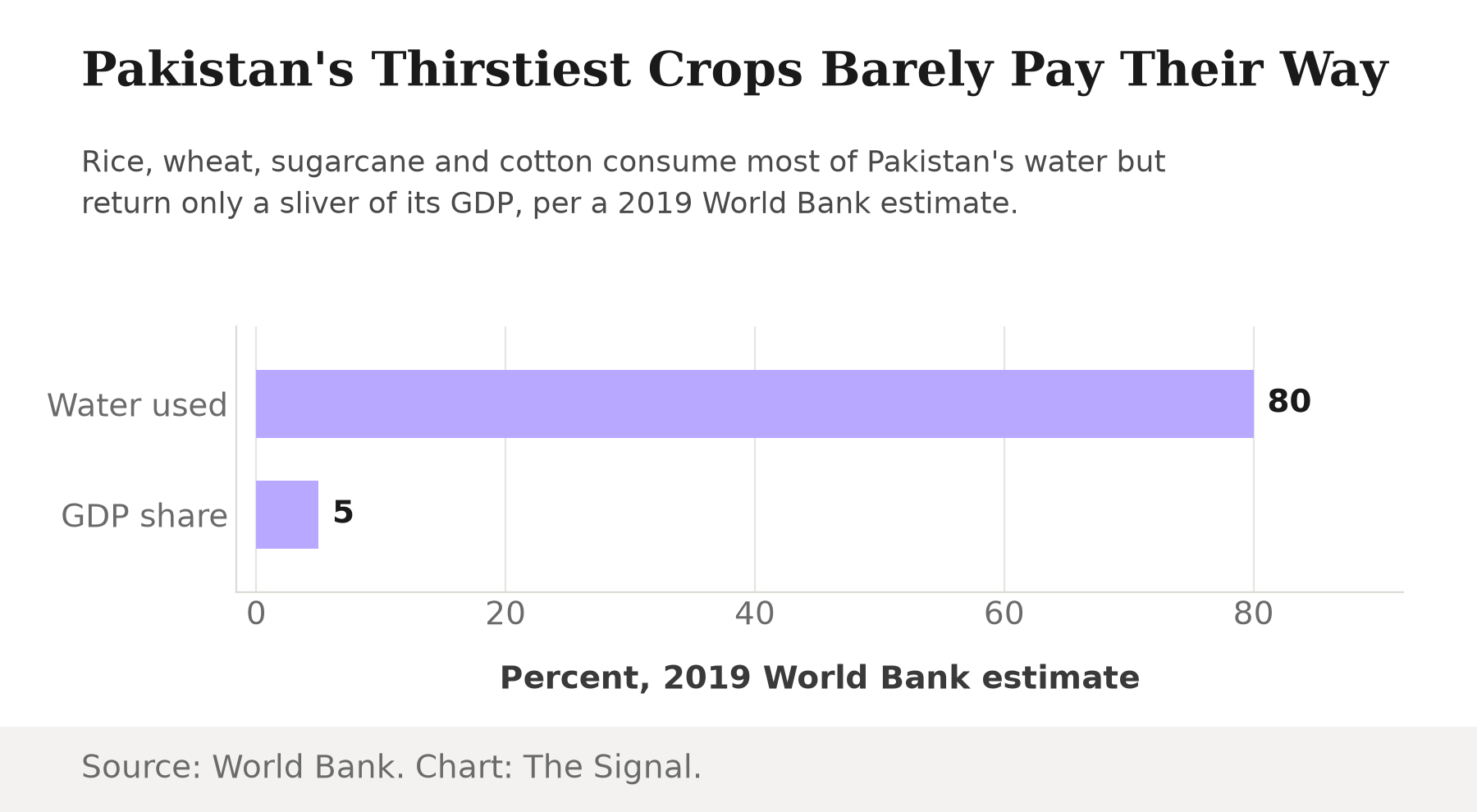
Source: World Bank, 2019. Chart: The Signal.
That gap is the real stake behind Dar's appeal to Canada. Restoring the treaty would not fix the water-to-GDP mismatch on its own, but losing certainty over the western rivers on top of it raises the cost of getting that mismatch wrong. None of that changes because a G7 minister visited Islamabad. Restoring the treaty does not modernise Pakistan's irrigation, does not shift acreage away from thirsty crops, and does not touch the incentives that keep the water-to-GDP gap where it is. What it would restore is narrower: certainty over the flows those crops depend on, which is the problem Pakistan's diplomats are actually trying to solve right now.
The honest objection
The strongest case against reading this as a diplomatic win for Pakistan is that Canada never said any of it. Canada's own announcement of the assistance package covers border management, counterterrorism, law enforcement, climate resilience, girls' education and flood recovery, a conventional aid list for a conventional bilateral reset, not the treaty, water, or India. Anand's own remarks were about the 80-year relationship and the 20-year gap since the last visit, not the Indus. On the available record, Canada showed up, wrote a check, and let Dar make his case to a camera that happened to be pointed at a Canadian minister.
That objection holds, and it should temper any claim that Ottawa has taken India's or Pakistan's side. But it also describes exactly how a bilateral dispute starts turning multilateral: not with a foreign government declaring for one side, but with a foreign government's presence becoming the backdrop for one side's argument, made on the record, with no corresponding platform on the other side of the border that day. India was not in the room to answer Dar's appeal in real time. Canada did not have to say a word to serve as its stage.
This is a familiar move in smaller-power diplomacy: when a government cannot force a bigger neighbour to negotiate, it looks for that neighbour's own partners to stand next to instead. The ask does not need an answer to do its work. It needs an audience, and Anand's visit gave Dar a bigger audience than Pakistan's case has had since the treaty was suspended.
The Signal
Watch what Canada does with the ask, not what it said standing next to it. If Ottawa's next statements on Pakistan stay confined to aid and security cooperation, this was a one-country moment India can safely ignore. If a reference to water, the treaty, or river-basin stability turns up in a future Canadian readout, joint statement, or multilateral forum, the dispute India has spent fifteen months insisting is bilateral will have picked up its first outside voice, invited in by Pakistan, unanswered by India, and unclaimed, so far, by Canada itself.
Reporting basis: the account of Anand's Islamabad visit, the 20-year gap since a Canadian foreign minister last visited Pakistan, and the 80-year diplomatic relationship are per Dawn, citing Minister Anand's own remarks; the assistance-package figures are per Dawn, citing Global Affairs Canada's announcement. Ishaq Dar's appeal to Canada is per The Tribune. India's suspension of the treaty, its rejection of the Court of Arbitration's award, and the Ministry of External Affairs' 3 July 2026 restatement of its abeyance position are per Akashvani (All India Radio), the Government of India's own broadcaster, reporting the relevant ministries' statements directly. The treaty's river allocation and Pakistan's crop-water-GDP figures are per World Bank publications. No figure in this piece is The Signal's own calculation.