On 20 July 2026, the National Testing Agency said its forensic reviewers had gone back over every OMR sheet flagged in a NEET-UG 2026 scoring dispute, and every single one matched the agency's own scanned record. In every case examined so far, NTA said, the disputed image was not the OMR sheet it had issued at all, but a fabricated document generated using AI-based tools that regenerate the sheet's pre-printed grid and leave distinctive typographical distortions no genuine scan would carry. Read on its own, the notice looks like vindication: an agency accused of botching thousands of scores quietly proving, sheet by sheet, that its own record was the real one all along. The stakes are not abstract: the Ministry of Education itself calls NEET-UG one of the largest undergraduate entrance examinations in India, with the 2026 cycle conducted for nearly 23 lakh registered candidates.
It is worth slowing down on that. The same week NTA was describing fabricated scans, real candidates were describing a different problem. In Beed district, Maharashtra, one candidate said her own tally against the official answer key put her at roughly 702 of 720 marks; her scorecard read 87. A second candidate in the same district expected 522 and was scored 95, and his father says the family will go to court if the number is not corrected. In Karnataka, the state's second-ranker by her own count said she should have scored a perfect 720 and was awarded 695, a 25-mark cut, and other candidates reported deductions of 10 to 25 marks that dropped their rank by thousands of places. None of these candidates is accused of submitting anything fake. Their complaint runs the other way: that NTA's own record needs checking.
Three candidates, three states, one complaint: the scorecard does not match their own answer-key tally.
| Candidate | State | Expected (own tally) | Awarded | Gap |
|---|---|---|---|---|
| Dnyaneshwari Pawar | Maharashtra | ~702 of 720 | 87 | 615 marks |
| Soham Gavte | Maharashtra | 522 of 720 | 95 | 427 marks |
| M Suchita | Karnataka | 720 of 720 | 695 | 25 marks |
Source: Deccan Chronicle; The Federal.
That is the collision the 20 July notice sits inside. NTA's forensic answer to score disputes is now, in effect, that the image is fake. A week before the result, the agency had already set the terms for that answer: a non-refundable fee of ₹200 for every individual OMR challenge, and a warning that a challenge built on a manipulated or tampered scan would be treated as Unfair Means, carrying debarment and possible legal proceedings. The day before the forensic notice, NTA told media that a number of the scanned images submitted with scrutiny complaints had turned out to be fake or AI-generated, and warned that submitting one may invite legal action against the complainant. A candidate who pays the fee, disputes a score and turns out to hold a genuinely doctored image is no longer just wrong. By NTA's own framing, they are a suspect.
A system that leaked from the inside
The forensic notice does not stand alone. It lands on an agency that spent the same admissions cycle proving the opposite kind of fraud was real. CBI arrested Pune-based chemistry lecturer P.V. Kulkarni, an NTA-appointed exam-content expert, as the kingpin behind the leak of the original NEET-UG 2026 paper set for 3 May 2026, with seven people arrested by 15 May. A day later, CBI arrested a second NTA-appointed expert, Pune botany teacher Manisha Mandhare, in the same leak probe, taking the total to nine arrests by 16 May 2026. The insiders NTA trusted to guard its own paper were the ones who leaked it.
The leak that forced NEET-UG 2026's re-exam came from inside NTA's own vetting process.
| Date | Development | Arrests to date |
|---|---|---|
| 3 May 2026 | Original NEET-UG 2026 paper set sat for the exam; later found leaked | not yet public |
| By 15 May 2026 | CBI names Pune chemistry lecturer P.V. Kulkarni, an NTA exam-content expert, as the leak's kingpin | 7 |
| 16 May 2026 | CBI arrests a second NTA expert, Pune botany teacher Manisha Mandhare | 9 |
Source: PIB press releases citing the CBI, 15 May 2026 and 16 May 2026.
So the same admissions cycle now runs two fraud stories at once: a confirmed leak that came from people NTA itself vetted and appointed, and a claimed wave of doctored scorecards that NTA says is coming from candidates on the other side of the counter. Both can be true at once. But an agency mid-scandal on one side has less standing to be the sole judge of the other, especially when its own scanned record is the thing under dispute.
The exam nobody wanted to retake
The re-exam that followed the leak was enormous, and unusually empty. Close to 20 lakh (1,999,895) candidates appeared for the NEET-UG 2026 re-exam on 21 June 2026, at 5,440 centres in 551 Indian cities and 14 cities abroad, and 11.21 lakh, about 56 percent, qualified.
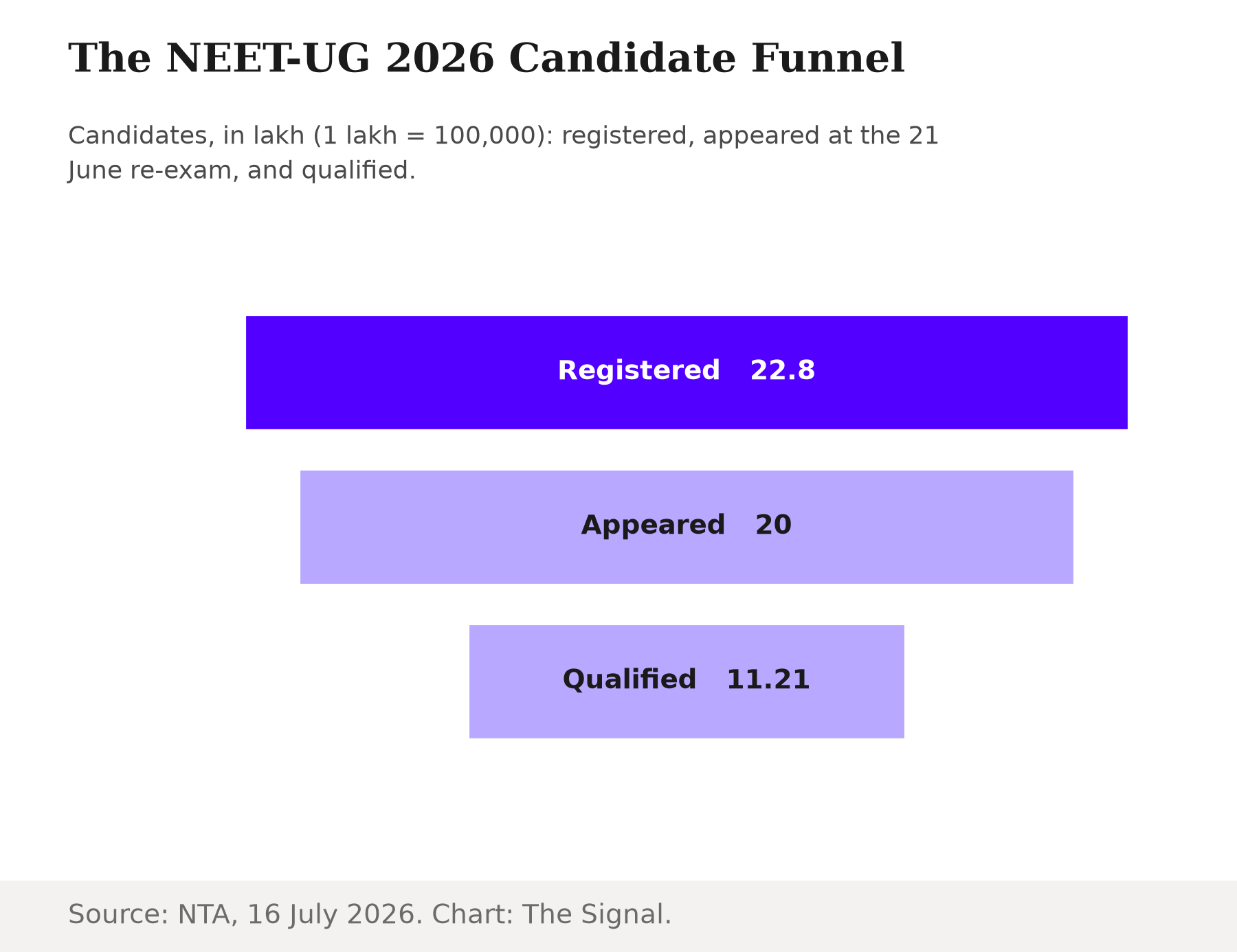
Source: Ministry of Education, via PIB; National Testing Agency press release on the NEET-UG 2026 result. Chart: The Signal.
NTA's own factsheet puts the gap between registration and appearance at 279,848 candidates, 12.3 percent of everyone registered, against 66,751 absent, 2.9 percent, in NEET-UG 2025. That is more than four times the prior year's no-show rate, in an exam that had already been cancelled and re-run once this cycle.
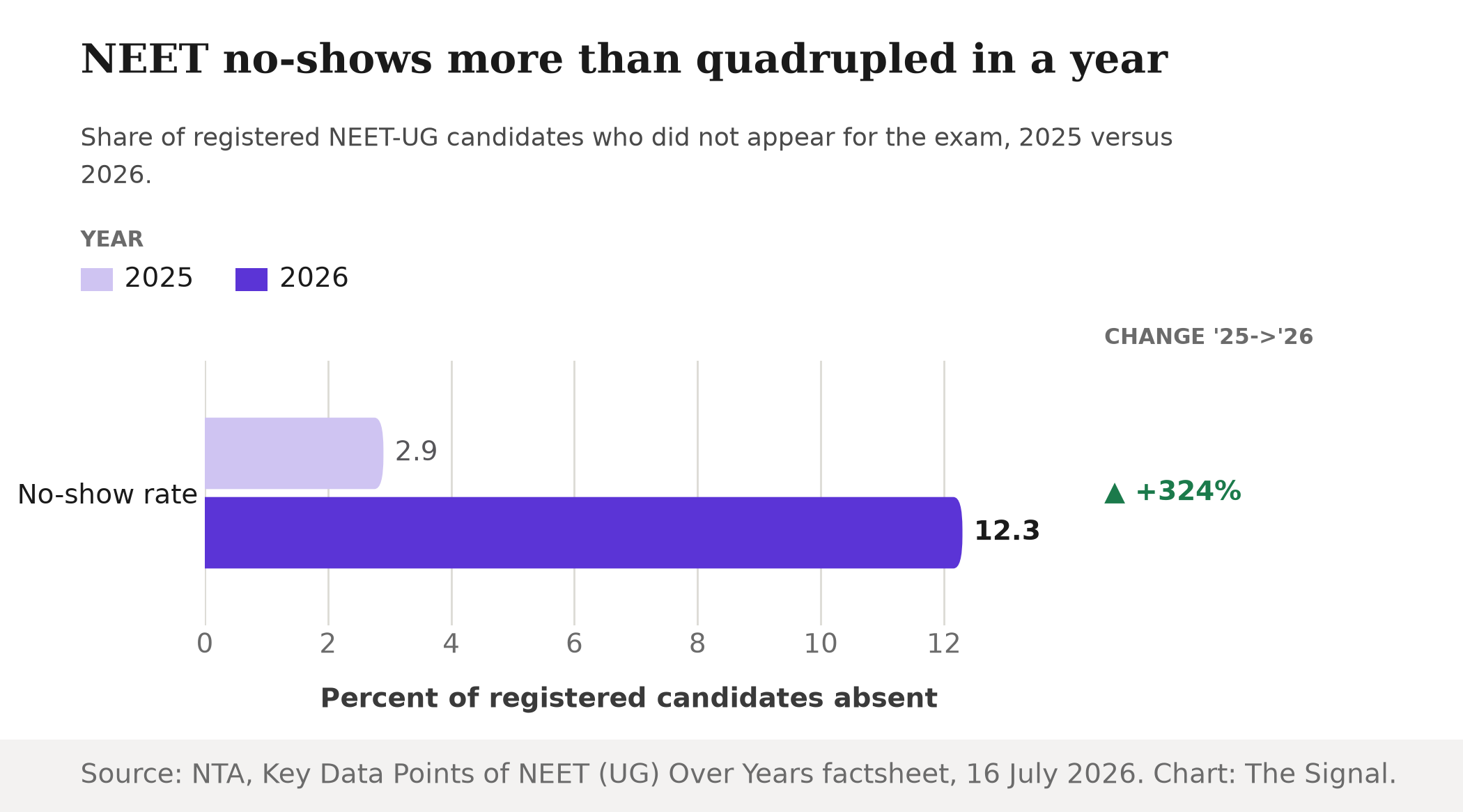
Source: National Testing Agency, Key Data Points of NEET (UG) Over Years. Change figure is The Signal's calculation. Chart: The Signal.
A leak, a cancellation, and a fee-and-prosecution regime for anyone who disputes the retest's result: each step is defensible alone. Stacked together, they describe a process that got harder to trust at every stage, not easier.
The honest objection
The strongest case for NTA's position is that the fabrication is real and the scale genuinely warrants a hard line. The agency told media outright that OMR sheets submitted for verification had been found fabricated or AI-generated, and its 20 July notice describes a specific, checkable forensic signature rather than a vague accusation. Across close to 20 lakh candidates who sat the exam, even a small share of bad-faith, doctored challenges could swamp a scrutiny process built for the ordinary case of a mis-scanned bubble. A steep fee and a real prosecution threat are exactly what would deter a bulk fabrication attempt at that scale.
That case is real, but it does not explain why the same deterrent applies just as hard to Pawar, Gavte and Suchita, each holding nothing but their own copy of the answer key. Nothing in the 20 July notice, or the 13 July fee order, gives a genuine complainant any faster or cheaper way to prove their scan is real than NTA's own forensic review takes to prove someone else's is fake. The burden of authenticating a scorecard has moved almost entirely onto the candidate, at the exact moment the candidate is worst placed to meet it.
The Signal
NTA's forensic notice answers a narrower question than it looks like it does. It shows that the specific images it checked were doctored. It does not, and cannot, prove that every disputed scorecard is correct, or that the leak-scarred exam behind it produced clean results everywhere. What is left is a fight over authentication, not accuracy, and that fight is structurally lopsided: NTA controls the record, the forensics, and now the legal consequence for guessing wrong. Watch what happens next to Pawar's, Gavte's and Suchita's specific complaints. If NTA corrects a real mismatch once one is proven, the system still works, just slower and angrier than before. If every remaining dispute resolves the way the 20 July notice resolved all of them so far, with the candidate's image the one called fake, then the agency has not settled the evidentiary crisis AI created. It has only landed on the losing side of every argument.
Reporting basis: the forensic finding on fabricated OMR images is per a National Testing Agency public notice dated 20 July 2026; the OMR challenge fee and Unfair Means terms are per an NTA notice dated 13 July 2026, and the warning on fake or AI-generated scans is per an NTA statement to media dated 19 July 2026, as reported by The Week. The re-exam scale, qualification count and year-on-year absentee figures are from NTA's own press release on the result and its Key Data Points of NEET (UG) Over Years factsheet, both dated 16 July 2026. NEET-UG's standing as one of India's largest undergraduate entrance examinations, and the 2026 registration count, are per a Ministry of Education press release via PIB dated 3 May 2026. The original paper leak and the arrests of P.V. Kulkarni and Manisha Mandhare are per Press Information Bureau releases citing the CBI, dated 15 and 16 May 2026. The Beed district scorecard complaints are per Deccan Chronicle, drawing on the affected families' account; the Karnataka complaints are per The Federal, drawing on candidates' and parents' accounts, both dated 19 July 2026. The mark gaps in the comparison table are The Signal's calculations from those reported figures.