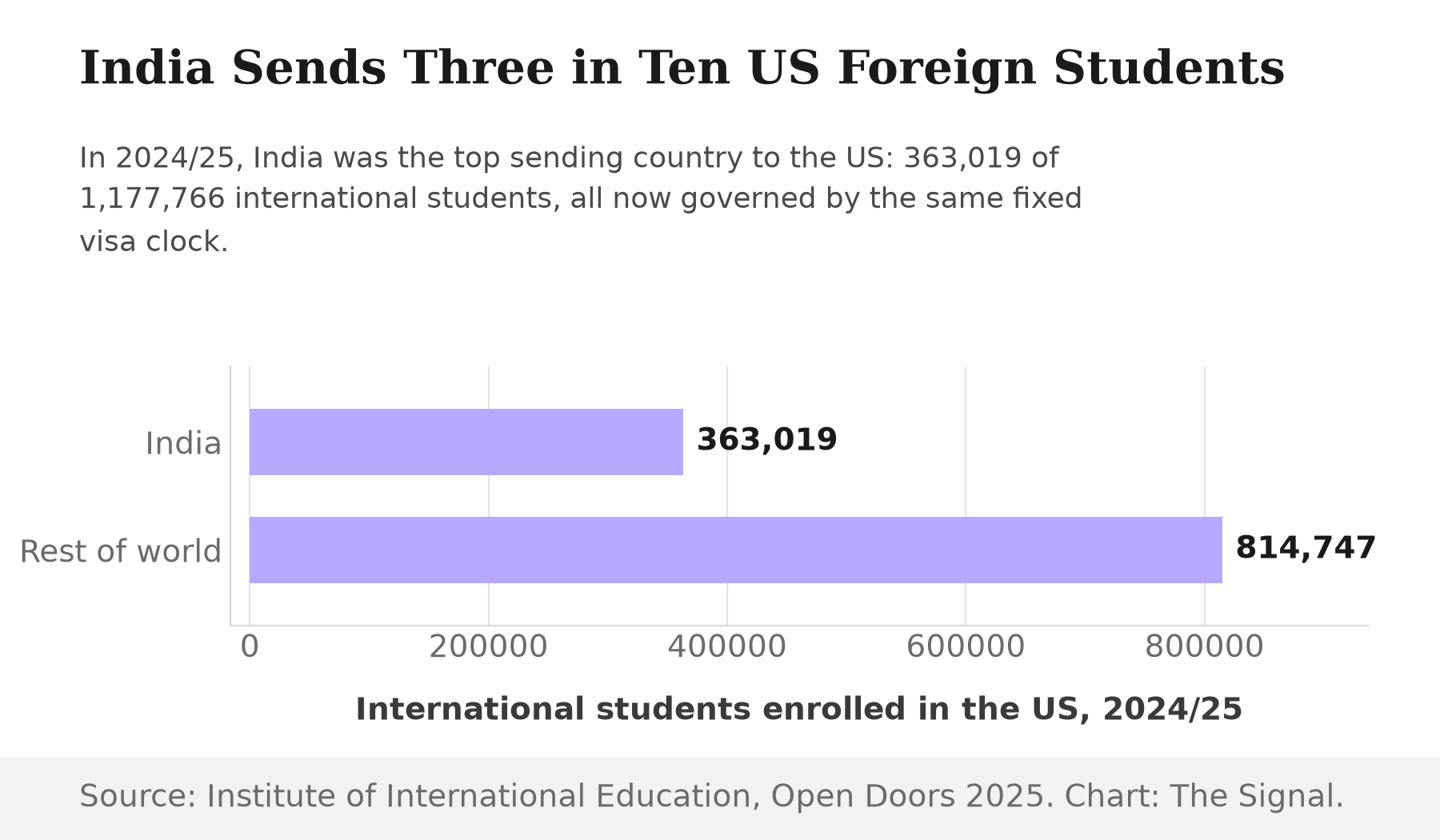
India sent more students to the United States than any other country in the 2024/25 academic year. The Institute of International Education's Open Doors 2025 report finds 363,019 Indian students in the US, about 30.8 percent of the 1,177,766 international students enrolled nationally, up 10 percent from 2023/24. Every one of them now falls under a rule the Department of Homeland Security finished writing on July 17, 2026, two days before this was published. DHS's final rule states that it ends the open-ended "duration of status" F-1 students have held for decades, replacing it with an admission period tied to the length of a student's program and capped at four years. DHS's final rule states that it is classified as a major rule subject to congressional review, taking effect September 15, 2026. Read as a headline, that is a tightening: less flexibility, a hard end date instead of an open one. That much is true, and it matters.
But the calendar is not where the real exposure sits. It is worth slowing down on what actually changed underneath it. Duration of status was never really about how long a student could stay. It was about the process for declaring a student out of status, and how forgiving that process was.
The mechanism that actually changed
DHS's final rule states that under the policy it replaces, an F or J nonimmigrant admitted for duration of status did not begin accruing unlawful presence, the clock behind inadmissibility and re-entry bars, until USCIS formally found a status violation while adjudicating another benefit, or until an immigration judge ordered removal. That is a high bar: a named officer, a formal adjudication, a specific finding on paper. DHS's final rule states that under the new fixed-period regime, if an immigration officer discovers a nonimmigrant has overstayed or otherwise violated status, that person begins accruing unlawful presence immediately, which can make them inadmissible on departure. The finding moved from a formal adjudication to a field discovery.
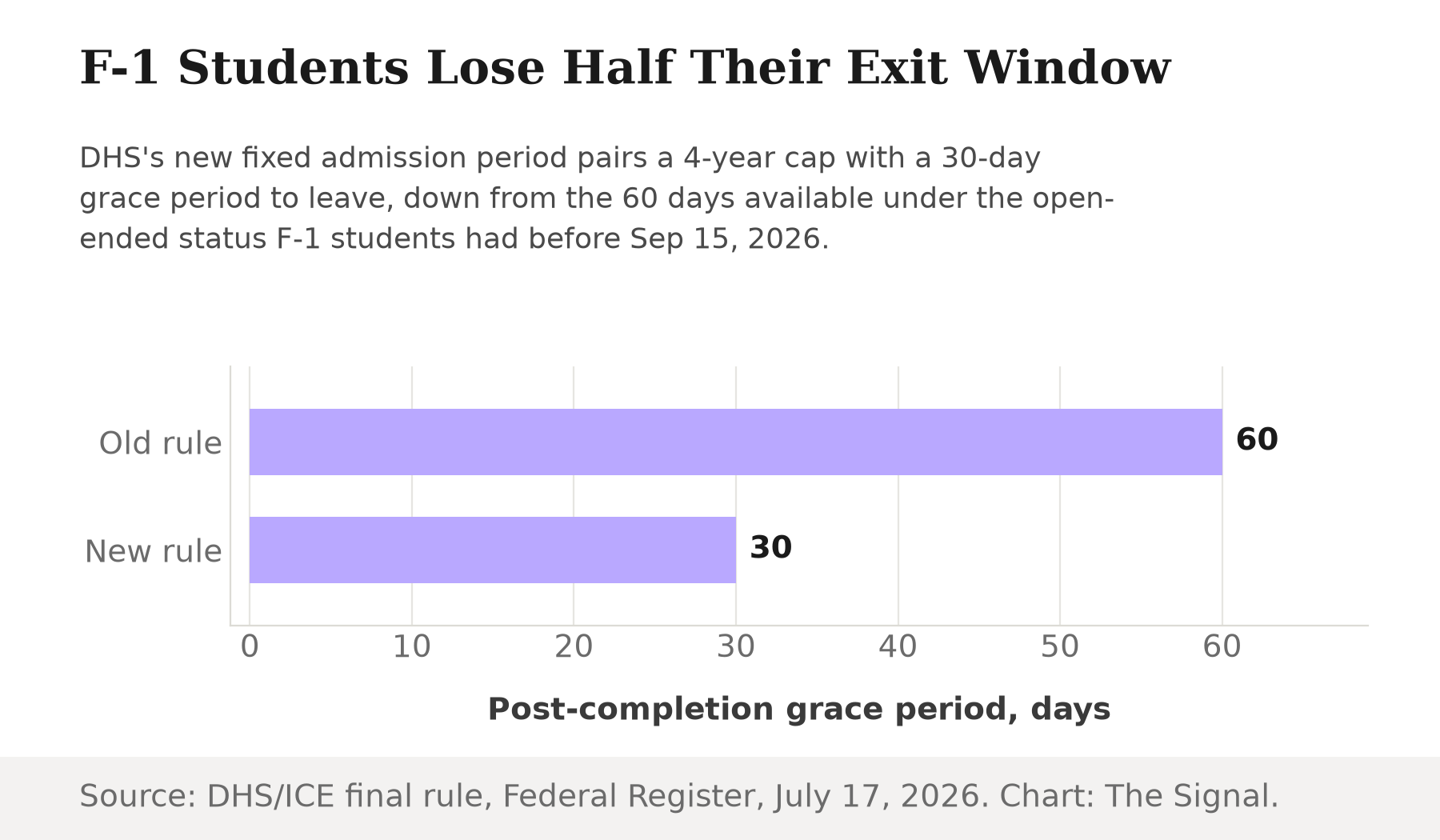
The same rule also shortens the runway on the way out. DHS's final rule states that the new fixed period pairs a maximum four-year admission with a 30-day grace period after a program ends, down from the 60 days available under the prior duration-of-status framework.
The safeguard that changed is procedural, not just temporal.
| Rule feature | Duration of status (until Sep 15, 2026) | Fixed admission period (from Sep 15, 2026) |
|---|---|---|
| Length of stay | Open ended, tied to enrollment, no fixed exit date | Up to the program length, capped at 4 years; longer programs need an approved Extension of Stay |
| Grace period after completion | 60 days | 30 days |
| Unlawful presence begins | After a formal USCIS finding or an immigration judge's removal order | The day an immigration officer discovers an overstay or status violation |
Source: DHS/ICE final rule, Federal Register, July 17, 2026.
The backlog DHS already admits to
DHS's final rule states that it has itself acknowledged backlogs in USCIS's processing of Extension of Stay applications, the filing every F-1 student will now need once a program runs past the fixed admission period. The rule adds that DHS expects its own reform to add to those processing times rather than shrink them, judging the added oversight worth that cost. That is a load-bearing admission. The department is designing a system where more students will need a government approval to stay legal, on a queue the department's own rulemaking says is already backed up and expects to get slower.
That is the mechanism in full. A four-year program that runs into an ordinary delay, a lab rebuilt after equipment failure, a defense pushed a semester, now needs an Extension of Stay filed and approved before the admission clock runs out. If the approval does not land in time, on a queue DHS itself flagged, a status lapse that used to sit invisibly under duration of status becomes a fixed-date breach the moment an officer looks.
Who is actually exposed
The rule is not retroactive in the way "three lakh students at risk" implies. DHS's final rule states that students already in the US on duration of status when the rule takes effect are grandfathered with up to four years to finish their programs without switching to a fixed date, and that only nonimmigrants arriving after the effective date face the full fixed-period regime from day one. The exposure builds forward, through new arrivals and through anyone whose program outlasts the four-year cap, not backward onto everyone already enrolled.
The compliance layer around the fixed date is still real for both groups. DHS's final rule states that SEVP-certified schools must update the SEVIS database with enrollment, attendance, transfer and completion changes within 21 days, and that a student who fails to attend can be reported as having failed to maintain status, a ground for removability. Under duration of status, a late SEVIS update or an administrative gap rarely mattered, because there was no fixed date for it to collide with. Under the fixed-period regime, the same 21-day reporting cycle now runs against a hard expiry, which is exactly where a processing backlog turns a paperwork delay into a documented status violation.
The honest objection
The strongest case for the rule is DHS's own stated one: a uniform, dated admission gives the government real-time visibility into which students are still enrolled, instead of trusting an open-ended status that could drift for years before anyone checked. A fixed clock forces the check to happen on schedule rather than never. Grandfathering current students softens the transition, and the four-year cap covers the overwhelming majority of degree programs without ever requiring an Extension of Stay filing at all.
That case is real, and it is why the rule is not simply a crackdown aimed at any one country's students. But it does not answer the backlog problem, because DHS is not disputing that the backlog exists. The department's own rule says processing times may get worse, not better, precisely as more students are forced to depend on that processing to stay legal. A safeguard that used to require a judge's order now trips on an officer's field observation of a delay the government caused.
The Signal
None of this is a ban on Indian students, and it is not written as one. It changes who absorbs the cost of a government delay. Under duration of status, a slow Extension of Stay was the government's problem: the student stayed in status while it processed. Under the fixed-period regime, a slow Extension of Stay becomes the student's problem: the clock runs out regardless of whose backlog caused it, and the record of an overstay follows from the moment an officer notices, not from a judge's ruling. Watch two things after DHS's rule takes effect on September 15, 2026: whether the congressional review that could still change or terminate the rule moves before then, and whether Extension of Stay processing times, the number DHS's own rule predicts will rise, actually do. A backlog is normally an inconvenience. Under this rule, it is a trigger.
Reporting basis: every figure and mechanism in this piece is drawn from two origins. The rule's provisions, its effective date, its admission-period and grace-period changes, its unlawful-presence and SEVIS-reporting mechanics, and DHS's own acknowledgment of Extension of Stay backlogs are all from the DHS/ICE final rule as published in the Federal Register on July 17, 2026, cited to the specific paragraph anchor for each provision. The India enrollment figures, count, share and year-over-year change, are from the Institute of International Education's Open Doors 2025 report, the annual State Department-sponsored census of international students in the US. The share and the rest-of-world figure charted alongside it are The Signal's calculations from those Open Doors totals.