India's Parliament has not redrawn its own seat map in fifty years. The Constitution (Forty-second Amendment) Act, 1976 froze the inter-state allocation of Lok Sabha and state Assembly seats on the 1971 census, with no readjustment required until the first census after 2000. The Constitution (Eighty-fourth Amendment) Act, 2002 extended that freeze so seat shares stay fixed until the first census after 2026, explicitly to incentivise population stabilisation. 2026 is that year. The delimitation package, defeated once already, is expected back when the Monsoon Session opens July 20 and runs to August 13, roughly 19 sittings. The easy read: a half-century freeze is thawing, and India's growing population finally gets the representation it has outgrown.
It is worth slowing down on that. The freeze was built to reward states for cutting birth rates, and the states that did exactly that are now bracing to lose ground.
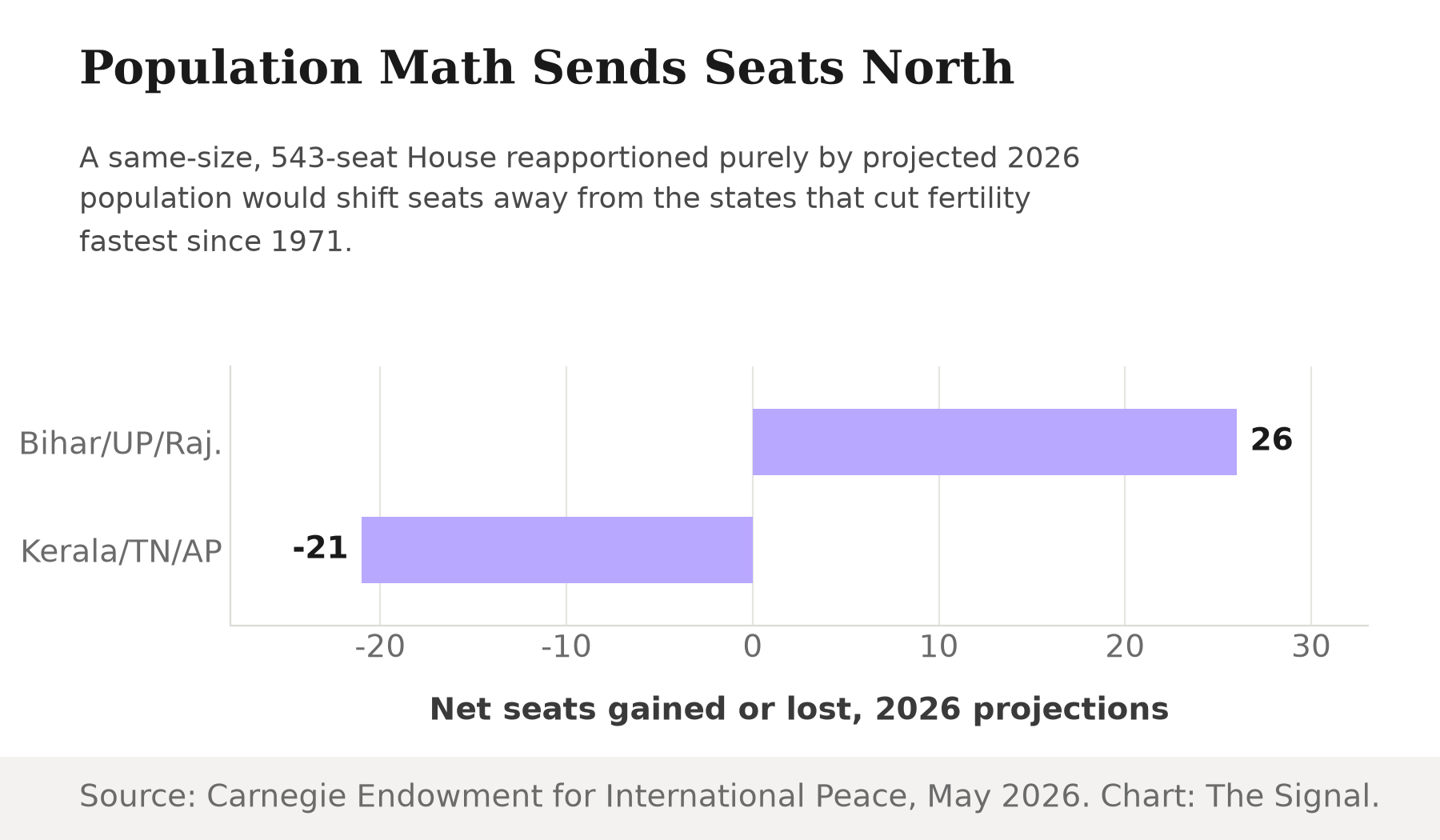
Under a like-for-like reapportionment, the states that grew fastest gain 26 seats combined; the states that grew slowest lose 21.
Using the government's own 2026 population projections, a Carnegie Endowment for International Peace analysis estimates that a Lok Sabha reapportioned purely by population, at today's 543-seat size, would give Bihar, Uttar Pradesh and Rajasthan 26 more seats between them, while Kerala, Tamil Nadu and Andhra Pradesh would together lose 21. That is the outcome the freeze was designed to prevent, and 2026 has arrived regardless.
What the freeze was actually paying for
The 1976 freeze was not a neutral pause. It was a deal: keep each state's share of Parliament fixed at its 1971 level, so no state that reduced its birth rate would be punished with a shrinking say in the national legislature. The 2002 extension's Statement of Objects and Reasons said so directly, describing the freeze as part of the National Population Policy strategy and a motivational measure to help state governments pursue population stabilisation. That was the whole point.
Bihar and Uttar Pradesh have not yet reached the replacement fertility rate; Kerala and Tamil Nadu passed it years ago.
| State | Total fertility rate, NFHS-5, 2019-21 |
|---|---|
| Bihar | 3.0 |
| Uttar Pradesh | 2.4 |
| Tamil Nadu | 1.8 |
| Kerala | 1.8 |
Source: NFHS-5 data, via the Economic Survey's Statistical Appendix.
Bihar's fertility rate stood at 3.0 children per woman and Uttar Pradesh's at 2.4 in the 2019-21 survey round, both still above the replacement level of 2.1, while Kerala's and Tamil Nadu's had already fallen to 1.8. Between the 1971 and 2011 censuses, Uttar Pradesh's population more than doubled, from 83.8 million to 199.8 million, while Kerala's population grew far more slowly, from 21.3 million to 33.4 million, over the exact window the freeze holds fixed.
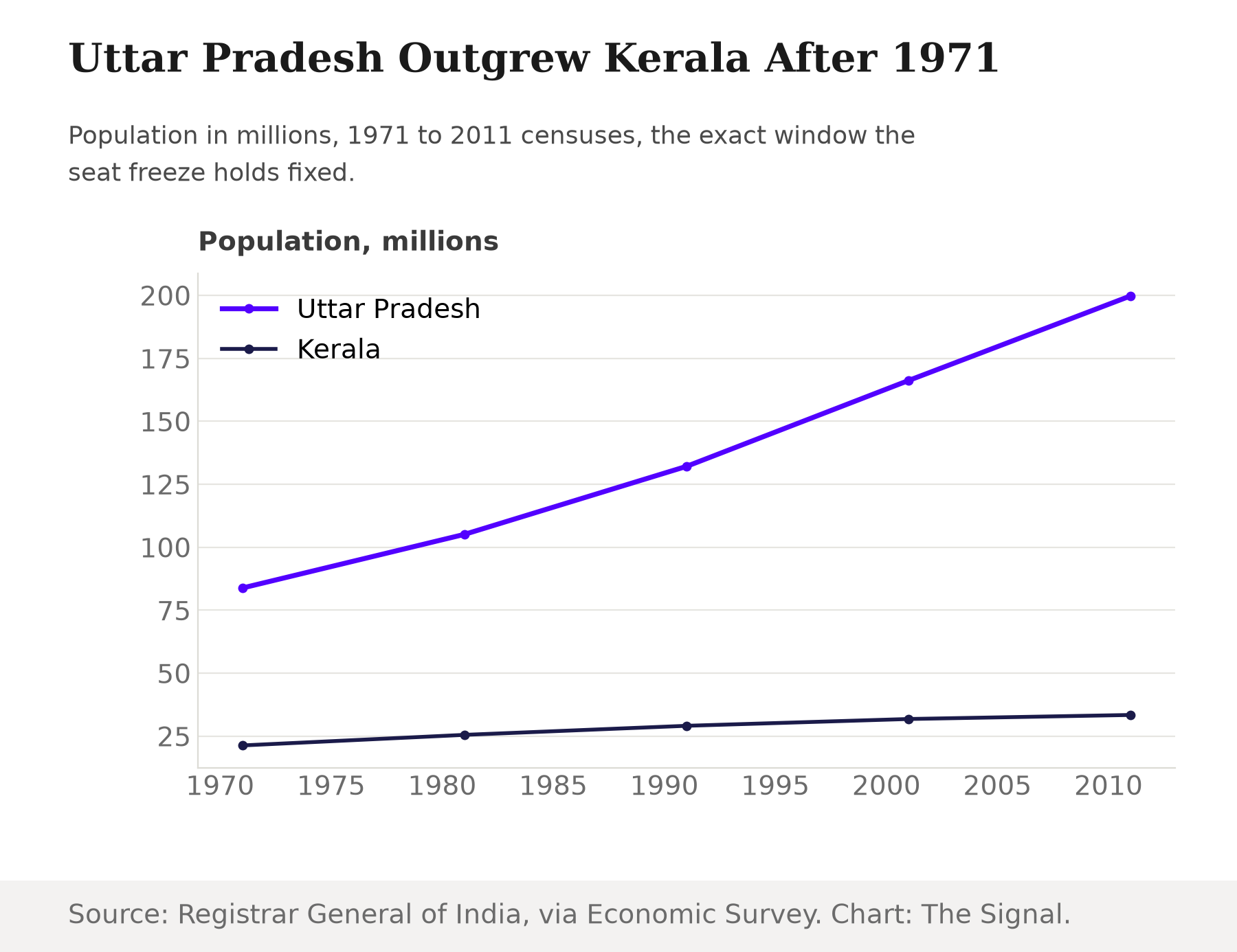
Uttar Pradesh did not violate the freeze. It kept growing while the freeze protected everyone's relative seat share from that growth. Ending the freeze is what lets the divergence start to matter.
The bill that already failed once
The government has already tried this once. A companion constitutional amendment bill to expand the Lok Sabha was introduced alongside the delimitation package. Neither survived its first day in the Lok Sabha, as the timeline below shows.
The delimitation package was introduced and defeated within 24 hours.
| Event | Date |
|---|---|
| Delimitation Bill, 2026 introduced in the Lok Sabha | April 16, 2026 |
| Delimitation Bill marked infructuous after its companion amendment bill failed | April 17, 2026 |
| Monsoon Session opens, about 19 sittings | July 20, 2026 |
| Monsoon Session concludes | August 13, 2026 |
Source: PRS Legislative Research bill tracker, recording the bill introduced April 16 and marked infructuous April 17, 2026; WION, reporting the government is likely to table the same package again once the Monsoon Session opens.
How big a House avoids the losses
There is a version of this that avoids the seat losses entirely: make the House big enough. The government's own first attempt went well past that threshold: the Constitution (131st Amendment) Bill, 2026, introduced alongside the delimitation package, proposed capping the Lok Sabha at 850 seats (up to 815 from the states and up to 35 from Union Territories, up from 543 today), before it was negatived in the Lok Sabha on April 17, 2026. The same Carnegie analysis estimates that, using the Webster apportionment method and 2026 population projections, avoiding any state losing seats would require expanding the Lok Sabha to roughly 775 members, a smaller House than the roughly 824 seats implied by the government's own proposal. On paper, the expansion is generous enough to let every state grow, but a bigger House can add seats everywhere while a state's share still slides if its population grew slower than the national average. Size cushions the loss. It does not remove the mechanism that produces it.
The honest objection
The government's own defense is that the fear is overstated. Union Home Minister Amit Shah told the Lok Sabha, per a Press Information Bureau release, that the five southern states, Karnataka, Andhra Pradesh, Telangana, Tamil Nadu and Kerala, hold 129 of 543 Lok Sabha seats today, 23.76 percent of the total, and would hold 23.87 percent of an expanded 816-seat House under the government's proposal. By that math, the south's collective voice barely moves.
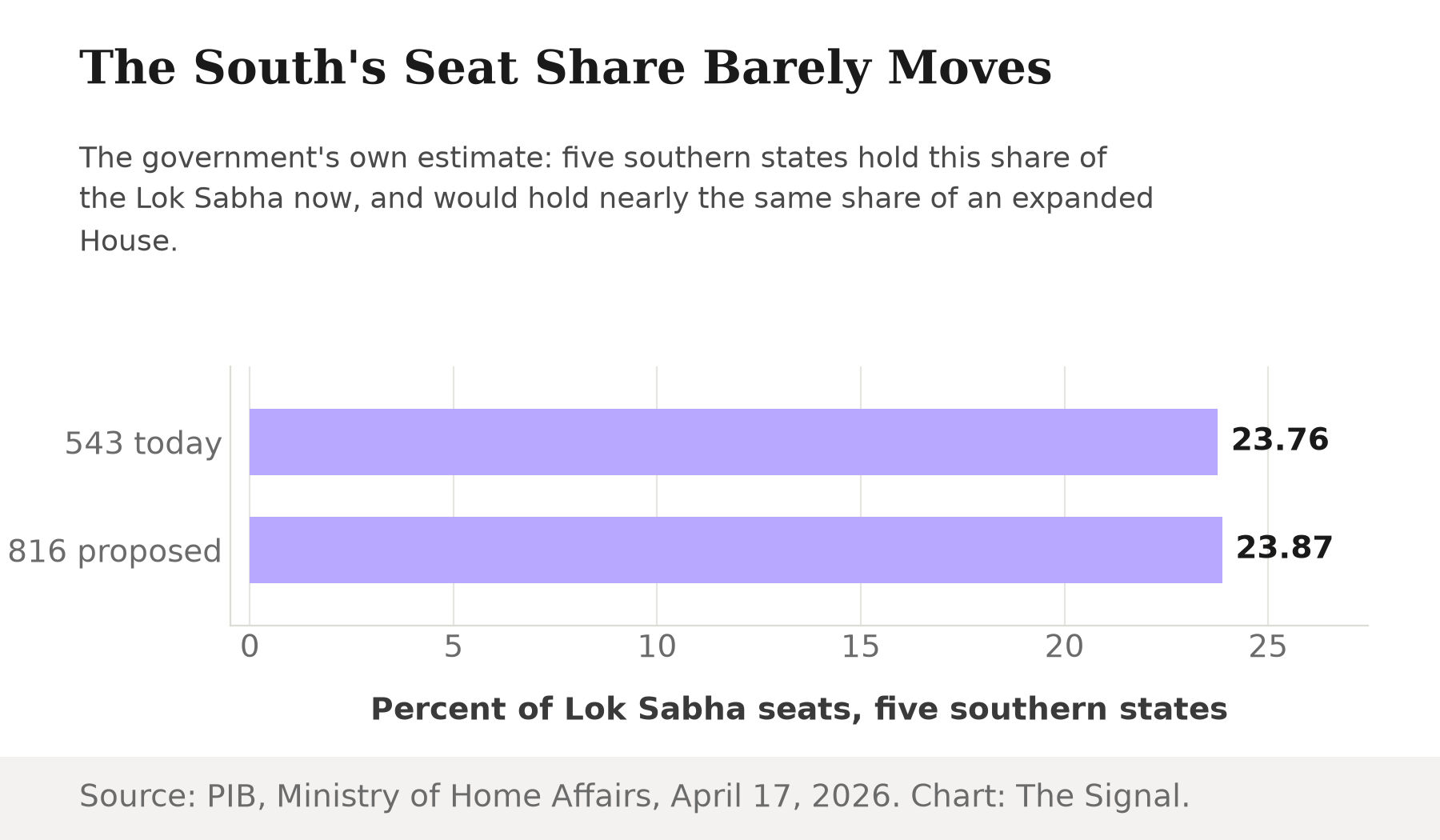
That case is real, and it rests on a specific design choice: expand the House in the right proportions and the south's share moves only from 23.76 to 23.87 percent, even as the north's absolute seat count rises faster. The government is not disputing that raw population math favors the north. It is arguing a large, carefully proportioned expansion neutralizes the effect on relative share, an argument that holds only if the final bill preserves those proportions when redrafted and repassed. The first version did not survive a single day. A share that "barely moves" in one estimate is not yet a guarantee written into law.
The Signal
The freeze did what it was built to do for fifty years: let Bihar and Uttar Pradesh keep growing and Kerala and Tamil Nadu keep slowing their growth, without either choice changing anyone's seat count. That protection ends this year, and the session opening July 20 is where the terms of what replaces it get decided, not by demographics but by drafting. Watch two things when the bill returns: the final House size against Carnegie's roughly 775-seat no-loss threshold, and whether the formula locks in a share close to the government's 23.87 percent figure or lets it fall out of a population count that has moved one way for fifty years. A state that spent five decades slowing its own growth on a promise that it would not cost seats is about to learn whether that promise survives the bill that ends the freeze.
Reporting basis: the text and stated purpose of the 1976 and 2002 amendments are from the enacted Acts. The seat-share defense is per a Press Information Bureau release of Union Home Minister Amit Shah's statement. Fertility and census figures are Economic Survey Statistical Appendix data, sourced to NFHS and the Registrar General of India. The reapportionment and no-loss House-size estimates are from a Carnegie Endowment analysis by Milan Vaishnav and colleagues. Bill status is per PRS Legislative Research's tracker, the companion Constitution Amendment Bill's proposed seat cap and outcome are per PRS Legislative Research's tracker for that bill, and the session schedule is per WION. No figure here is The Signal's own calculation.