Pew Research Center released its Spring 2026 Global Attitudes Survey on July 15, and the headline finding is a genuine shift in world opinion. China is now viewed more favorably than the United States in most of the 36 countries Pew surveyed, with the US retaining an edge in just six, India among them. Read only that top line and the story is simple: years of eroding American standing have finally tipped a majority of the world toward Beijing.
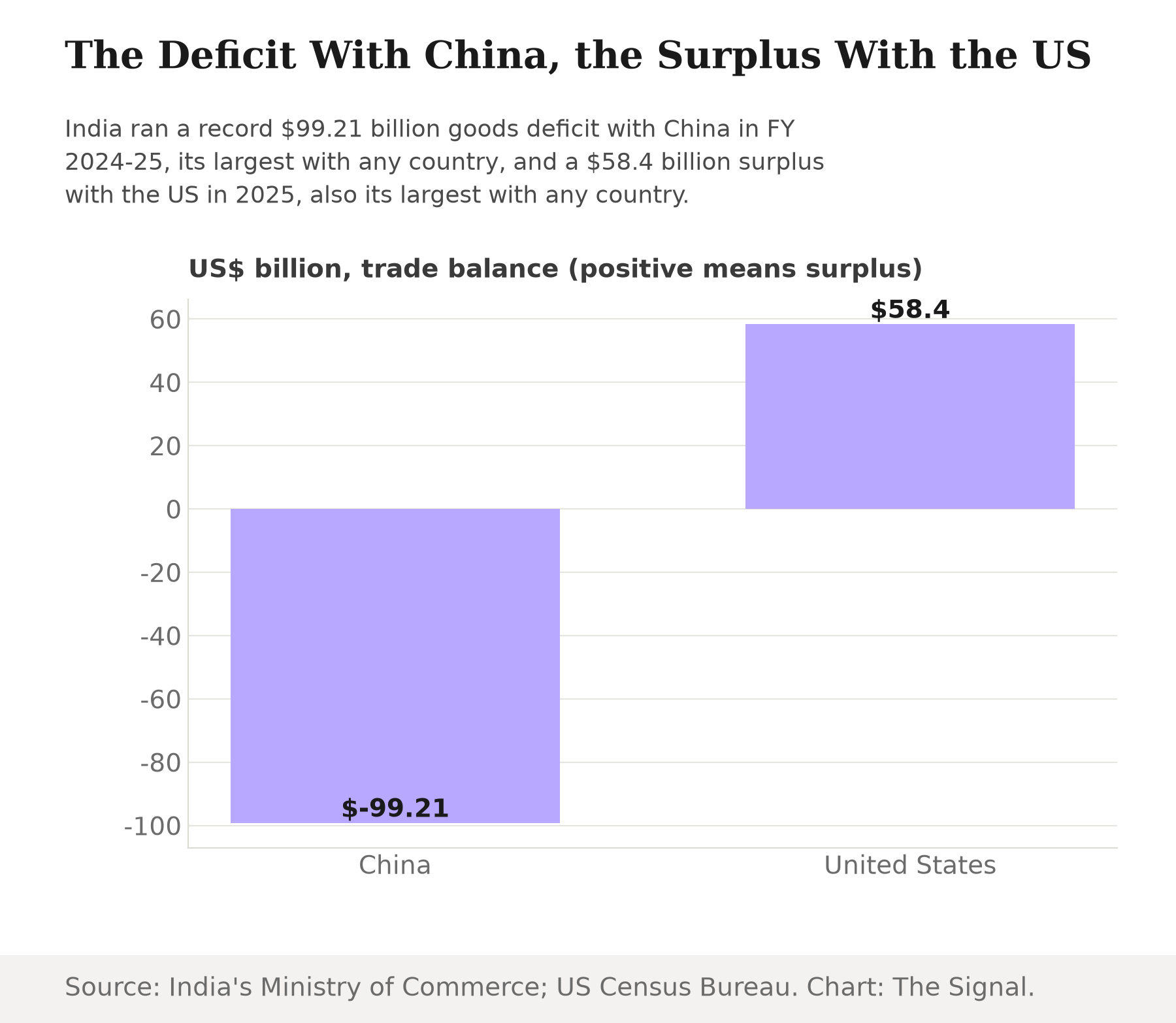
It is worth slowing down on India's place in that list. Of the six countries still siding with Washington, India is not a marginal holdout. Indians favor the US over China by 45% to 23%, a 22-point gap, even as the global median flipped from a 26-point US lead in 2023 (58% to 32%) to a 10-point China lead in 2026 (36% to 46%). The rest of the world's median crossed over to China. India's current number sits nowhere near that line.
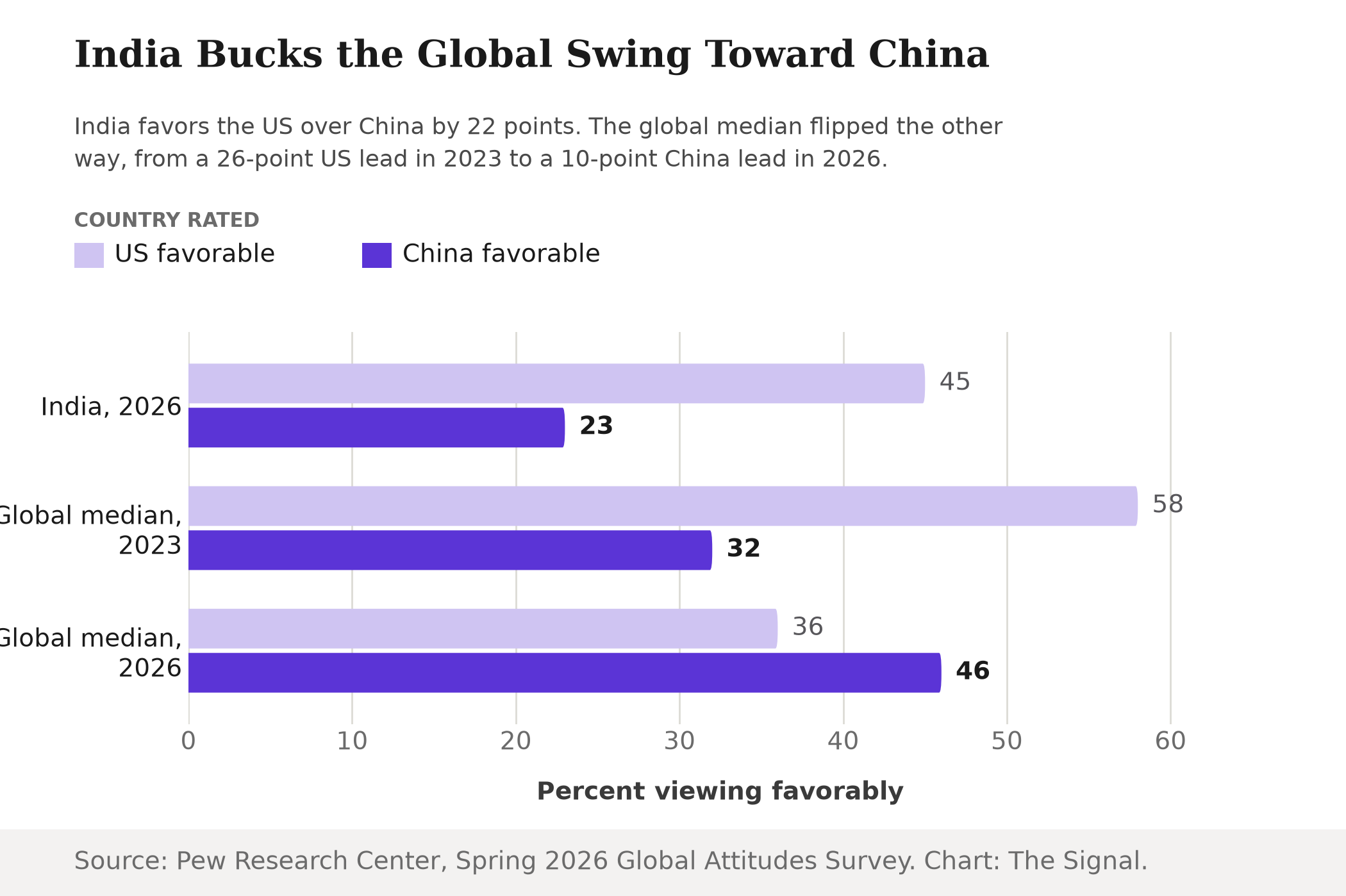
Favorability isn't where the real tension sits. Only 33% of Indians call China a reliable partner, the lowest such score of any Asia-Pacific country in Pew's survey. Yet India's single largest trade deficit with any country in the world, a record $99.21 billion in the year to March 2025, is the one it runs with China.
One of six, by a wide margin
Pew's survey names the six countries where America still outpolls China: India, Japan, the Philippines and South Korea in the Asia-Pacific, alongside two others. India holds a wide, double-digit US lead there, at a moment when the rest of the world's median moved decisively the other way.
The world's median opinion flipped toward China. India's current numbers sit on the opposite side of that line entirely.
That is the shape of the outlier: not a country slightly cooler on China than its neighbors, but one standing apart from the swing Pew recorded across the rest of the world.
India's skepticism of China predates this survey wave. A 2023 Pew report found 67% of Indian adults already held an unfavorable view of China, up 21 points since 2019, while roughly two-thirds held a favorable view of the US.
The trust gap is about reliability, not just sentiment
Favorability is a broad, emotional register. Pew also asked a sharper question: does the respondent's country see China as a reliable partner. Here India's answer is the lowest recorded among the Asia-Pacific countries in the survey.
| Country | Say China is a reliable partner |
|---|---|
| Philippines | 42% |
| India | 33% |
| Other Asia-Pacific countries surveyed | 70% or more |
Source: Pew Research Center's companion report on China's global image.
Every other Asia-Pacific country in the survey gives China a reliability score of seven-in-ten or higher. India and the Philippines are the only two exceptions, and India's number is the lower of the two.
Not primarily a security story
A natural assumption is that this distrust is driven by security fear: a shared, contested border, a military buildup, the memory of past clashes. The survey complicates that reading. Asked to name their country's top perceived threat, 54% of Indians point to Pakistan. China comes in a distant second, at 21%.
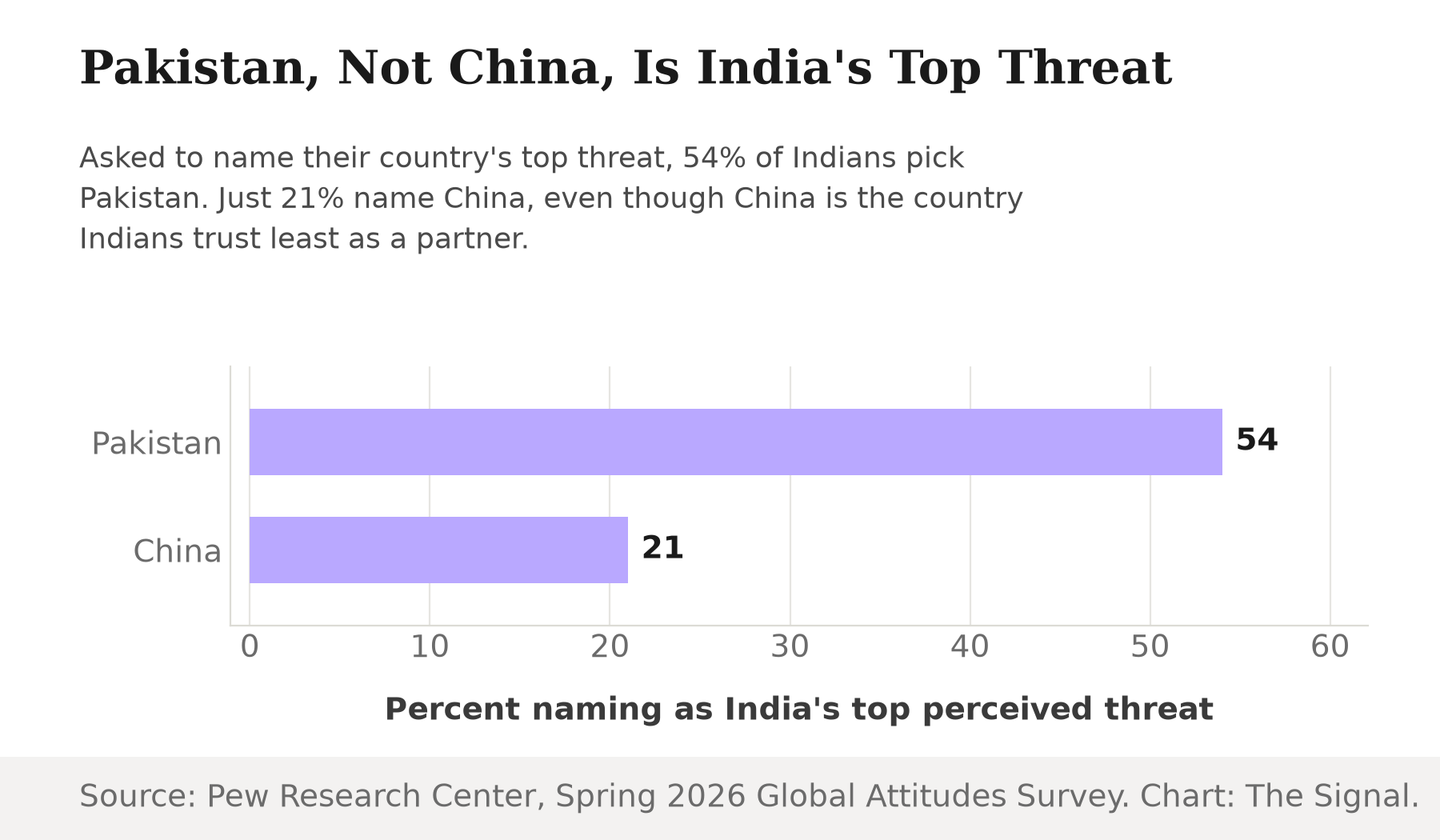
Pakistan, not China, is the threat most Indians name first.
If China's low trust score in India were mainly a security-threat story, it would be competing with Pakistan for the top spot, not trailing it 21% to 54%. Indians can hold two distinct judgments about China at once: not the country's most feared adversary, but still, by a wide margin, its least trusted economic partner.
The dependency underneath the distrust
That second judgment, reliability rather than threat, sits uneasily next to the trade numbers. India's exports to China totaled $14.25 billion against $113.46 billion in imports in the year to March 2025, for $127.71 billion in total trade and a $99.21 billion deficit, the widest India runs with any trading partner. On the other side of the ledger, India ran an estimated $58.4 billion trade surplus with the US in 2025, with US exports to India of $45.35 billion against $103.78 billion in US imports from India: India's largest surplus with any country, run with the same country it favors over China by 22 points.
Sentiment and trade are not moving in the same direction here, and nothing in these two datasets suggests they need to.
The honest objection
The strongest case against reading anything into this pairing is that trade deficits track comparative advantage and supply chains, not sentiment. China is a dominant global manufacturer of electronics, machinery and industrial inputs, and India's $99.21 billion deficit may simply be the predictable result of buying from the world's largest factory floor rather than a referendum on how its public feels about Beijing.
That case is real, and it explains why the deficit exists. It does not explain why distrust and dependency coexist without either one moving the other. Even if trade follows pure comparative advantage, that leaves the question Pew's reliability finding raises: whether a public that trusts a partner this little expects the relationship to keep deepening anyway.
The Signal
India's break from the global mood toward China shows up consistently across favorability, reliability and trade. Two figures are worth watching from here: whether next year's China deficit narrows from $99.21 billion, and whether the reliability score moves at all from 33%. If both hold roughly where they are, it will confirm what this year's numbers already suggest: India's distrust of China is a political fact that does not require, and may never require, an economic one to match it.
Reporting basis: the favorability, reliability and threat-perception figures for India and the global median all come from Pew Research Center's Spring 2026 Global Attitudes Survey, fielded February 8 to May 13, 2026 and released July 15, 2026, drawn across the survey's main report, its full PDF report, its companion report on China's global image, and its Asia-Pacific regional report. These are one origin, Pew, across four linked documents from the same wave, not four independent sources. India's trade deficit with China is per India's Department of Commerce, Ministry of Commerce and Industry, as published via the Embassy of India, Beijing, for the year to March 2025. India's trade surplus with the US is per the US Census Bureau's foreign trade data for calendar 2025. The point-gap figures (22 points, 26 points, 10 points) are The Signal's calculations from Pew's published favorability percentages. The 2019-2023 trend figures are from a separate, earlier Pew report on Indians' views of other countries.