On July 10, 2026, Senators Jeanne Shaheen, Richard Blumenthal, Lindsey Graham and Roger Wicker announced they had reached agreement with the Trump administration to move their Russia sanctions bill forward. The read writes itself: Washington is reviving the tariff threat that already hit India once, and the bill's core mechanism has not softened. As introduced, S.1241 would set a duty of at least 500 percent on goods and services from any country still buying Russian oil, gas, petroleum products or uranium. It already had the numbers to matter: 81 senators had co-sponsored the bill as of May 21, 2025, more than the 67 votes needed to override a presidential veto. And Trump himself had already backed the bill on January 7, 2026, after meeting Graham. On the surface, this looks like a rerun.
It is worth slowing down on that comparison. India already lived through a version of this threat, at a lower rate, through a different legal channel, and that version was struck down in court within six months. The bill senators revived this week is not that threat wearing a bigger number. It is a structurally different one, and the difference sits in two details the coverage of the announcement will skip: what happens after a waiver runs out, and what a court can and cannot do to an act of Congress.
A tariff Washington already tried, and lost in court
India has been here before, just not with this bill. Trump's August 6, 2025 executive order added a 25-point tariff on Indian goods over its Russian oil purchases, taking the cumulative rate to 50 percent, effective August 27, 2025, on an estimated $48.2 billion of Indian exports. That is the precedent for what a country-wide tariff over Russian oil purchases actually costs: not a duty on oil, but on nearly $50 billion of unrelated goods, because the order used those purchases to justify taxing the whole trade relationship.
That tariff did not survive. On February 20, 2026 the Supreme Court ruled 6-3 that the International Emergency Economic Powers Act does not authorize the president to impose tariffs, invalidating the legal basis for the India-specific 50 percent rate. Hours later, Trump replaced it with a flat 10 percent global surcharge under Section 122 of the Trade Act of 1974, effective February 24, 2026, a rate capped by statute at 150 days and due to expire July 24, 2026, thirteen days from today.
Three tariffs, one built to survive a court challenge the other two could not.
The rate India is living under right now is a tenth of what it paid a year ago, and both are dwarfed by what Congress has on the table.
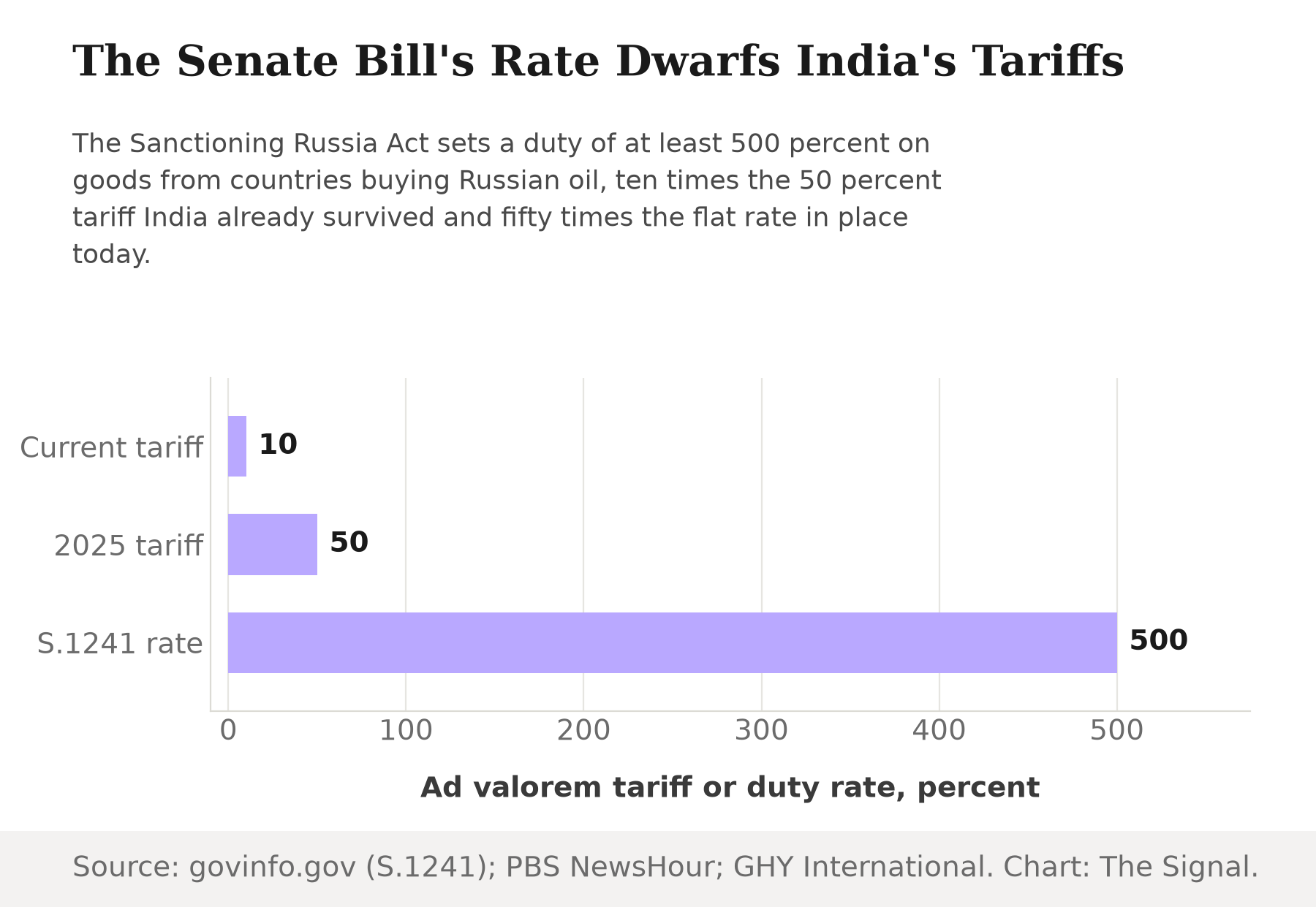
Source: SCOTUSblog; GHY International; S.1241 as introduced, via govinfo.gov. Chart: The Signal.
What matters is not the size of the number. It is where each tariff's authority comes from. The IEEPA tariff was an emergency executive order, and the Supreme Court struck it down for lacking statutory basis in that specific law. S.1241 is an act of Congress, not an executive order, immune to a ruling on what IEEPA does or does not authorize, and it already carries the votes to survive a presidential veto. The mechanics below are from the bill as introduced in April 2025; senators call the version moving forward "updated" without detailing changes, so treat the rate and waiver terms as the last confirmed text, not the final one.
| 2025 IEEPA tariff | Current Section 122 tariff | Senate bill S.1241 | |
|---|---|---|---|
| Legal basis | Emergency executive order | Trade Act of 1974, Section 122 | Act of Congress |
| Rate | 50 percent cumulative | 10 percent flat | At least 500 percent |
| Status | Struck down Feb 20, 2026 | Expires by statute Jul 24, 2026 | Advancing, Trump-backed since Jan 2026 |
| President's waiver | None (voided by ruling) | None (statutory cap only) | One time only, up to 180 days per country |
Source: SCOTUSblog; GHY International; S.1241 as introduced, via govinfo.gov. Table: The Signal.
The president may waive the 500 percent duty, but only once, for up to 180 days per country, good or service, and only on a national-security determination, a waiver that is unavailable to state sponsors of terrorism. That is the detail the "here we go again" framing misses. The 2025 fight was a single executive order a court could and did unwind. This one is a statute with a veto-proof floor of support and exactly one exemption window.
What share of India's oil trade sits inside the trigger
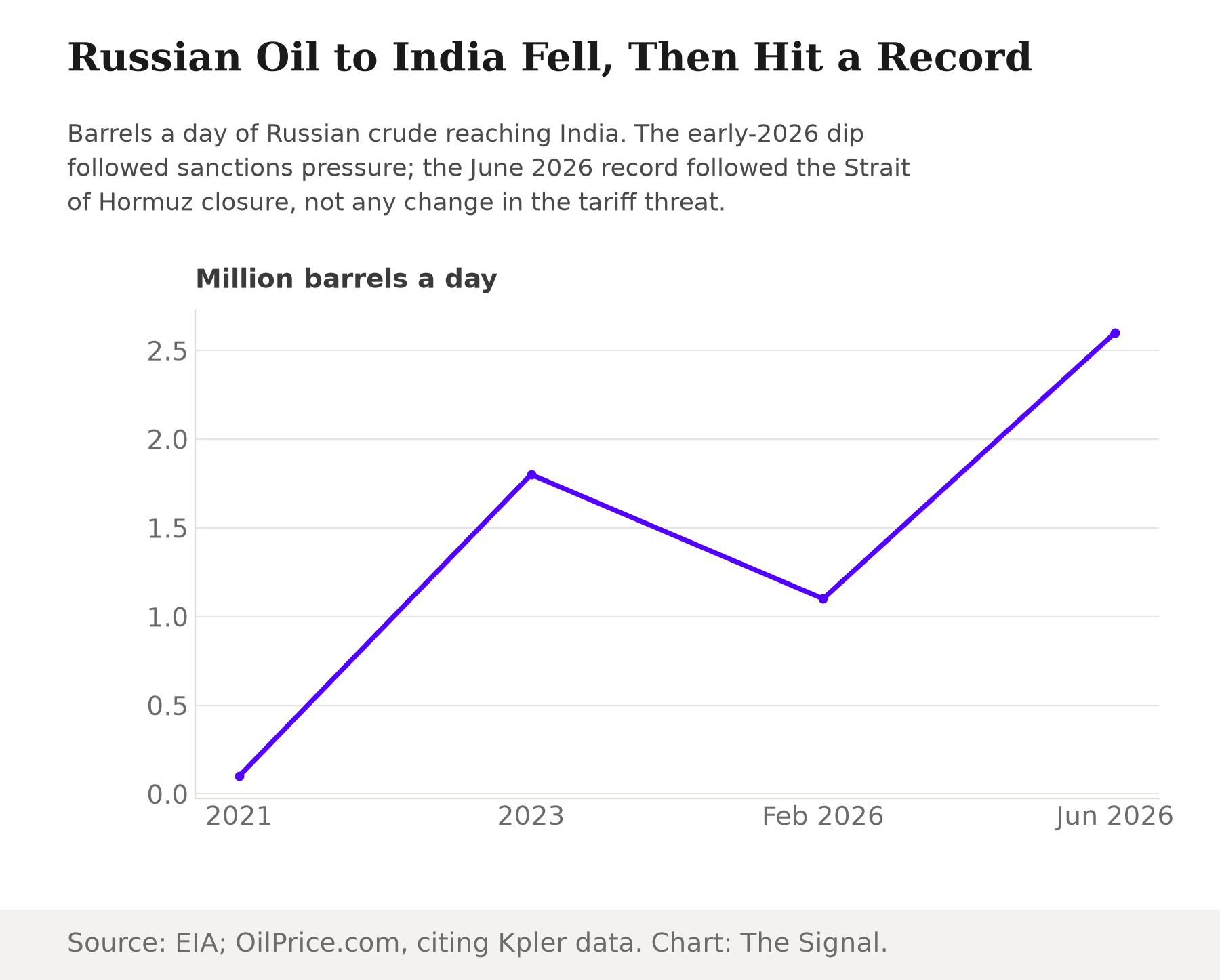
The bill does not need India's Russian oil habit to be large to bite. It only needs it to exist, since the trigger applies to a country's entire export basket, not a barrel count. But India's Russian oil habit is not small, and it just got much larger. Russia's share of India's crude oil and condensate imports rose from just 2.5 percent, under 100,000 barrels a day, in 2021 before the full-scale invasion of Ukraine, to 39 percent, almost 1.8 million barrels a day, by 2023. That was the buildup. In June 2026, India's Russian crude imports hit a record 2.6 million barrels a day, 53.5 percent of all Indian oil imports, as refiners pivoted to Russian barrels after the Strait of Hormuz closure disrupted Gulf supply.
The dip came from sanctions pressure. The record came from a different crisis entirely.
Russian oil to India fell when Washington leaned on it, then rose past its old high once the Gulf stopped being reliable.
Source: EIA country analysis brief: India; OilPrice.com; OilPrice.com, citing Kpler vessel-tracking data. Chart: The Signal.
The dip is the tell. Russian oil supply to India had fallen to about 1.1 million barrels a day in February 2026 under sanctions pressure, before more than doubling to that June 2026 record in four months. Pressure worked, briefly. It stopped working the moment India needed the barrels for a reason that had nothing to do with sanctions: India's strategic petroleum reserves cover only 9 to 10 days of normal domestic demand, which is a thin enough cushion that a Gulf supply shock leaves discounted Russian crude as the fastest available substitute, tariff threat or not. India was already deep in this trade before the Hormuz shock. In November 2025, the last month for which that breakdown has been published, India bought 38 percent of Russia's crude oil exports, worth EUR 2.6 billion, and EUR 3.3 billion of Russian fossil fuels overall. That made it the second-largest buyer, after China's 47 percent share.
The honest objection
The strongest case against alarm is that nothing has to change for India in practice. Trump already backed this bill, met its Republican sponsor before doing so, and his administration just agreed to help move it forward rather than fight it. He also holds a national-security waiver he can invoke the day the bill becomes law. With reserves covering barely a week and a half of demand and Russian barrels now supplying more than half of India's oil, a national-security case for exempting India is not hard to build, and a White House that wrote the bill's path forward has every incentive to grant it. India's own government has said as little as possible about the threat itself: asked about the bill at its January 9, 2026 weekly briefing, the Ministry of External Affairs said only that it was "aware of the proposed bill" and "closely following the developments," repeating that its energy purchases are guided by market dynamics and the need to secure affordable supply for 1.4 billion people.
That case is real, and it may hold for a while. But it rests entirely on one administration's willingness to use a waiver that exists exactly once, and this administration's recent record on Russian-oil waivers is inconsistent rather than reassuring. A separate Treasury license that let India keep buying already-loaded Russian crude was renewed repeatedly through the spring of 2026, then allowed to expire again on June 17 without a published extension. The S.1241 waiver itself is capped at 180 days per country, good or service, not renewable, and not available at all to a subset of targeted countries. Once it lapses, the 500 percent duty applies automatically unless Congress amends the statute. The Senate already has the votes to override a president who wants to soften it, but the House does not yet: its companion bill, H.R.2548, has 155 cosponsors, nowhere near the roughly 290 of 435 a two-thirds override would need there. A future administration, or this one under different pressure, inherits a law with no second waiver built in, not an order it can simply set aside.
The Signal
The bill converts a fight India already survived, and won, into one it has not yet faced. A court struck down the 50 percent tariff because the president had reached past what an emergency-powers law allows. That option does not exist against a statute Congress passed on its own authority with a veto-proof majority behind it. The number, at least 500 percent against 50 against 10, is the part that will lead every headline. What is worth watching is smaller and less visual: whether the bill that clears Congress still carries that one-time, 180-day waiver, and what happens on the 181st day. India has already absorbed one warning shot and had it overturned by a court that will not get a second chance at this one.
Reporting basis: the July 10, 2026 agreement to advance the bill is per the joint statement from the offices of Senators Shaheen, Blumenthal, Graham and Wicker; Trump's January 7, 2026 backing and the bill's May 2025 co-sponsor count are per Senator Graham's and Senator Blumenthal's offices respectively. The bill's rate and waiver mechanics are from S.1241 as introduced, via govinfo.gov, the only version of the text these sources detail. The 2025 tariff and its $48.2 billion export exposure are per PBS NewsHour; the Supreme Court ruling is per SCOTUSblog; the Section 122 replacement tariff is per GHY International's trade-compliance bulletin. Russia's 2021 and 2023 shares of India's crude imports are from the US Energy Information Administration's country analysis brief; the February and June 2026 volumes, the June 2026 share and the strategic-reserve figure are per OilPrice.com, citing Kpler vessel-tracking data. India's November 2025 share of Russian fossil fuel exports is from the Centre for Research on Energy and Clean Air's monthly analysis, the sole source for that figure. The House cosponsor count for H.R.2548 is from GovTrack.us, which mirrors official Congress.gov cosponsor data. India's Ministry of External Affairs statement is per its January 9, 2026 briefing, as reported by The Wire; the June 17, 2026 lapse of the separate Treasury waiver on already-loaded Russian crude is also per The Wire. The multiples between the three tariff rates are The Signal's calculations from those figures.