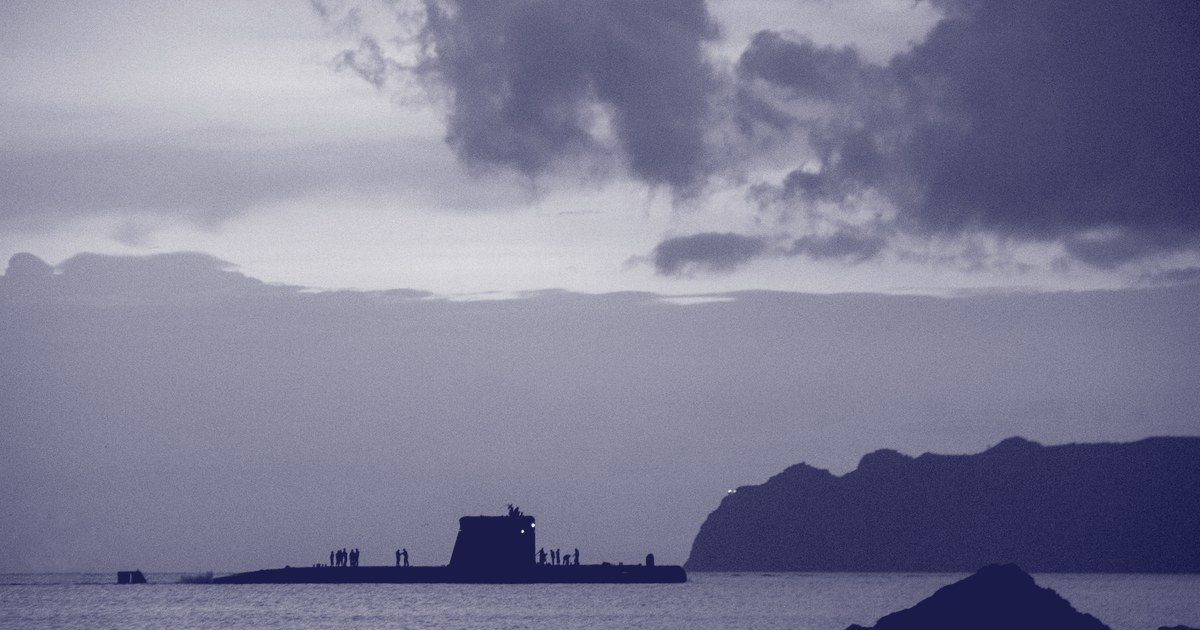
On July 6, 2026, China's navy test-launched a long-range ballistic missile from one of its nuclear-powered submarines in the South Pacific, Al Jazeera reported, citing China's state news agency Xinhua. The launch, at 12:01pm local time, drew swift criticism from the United States, Japan, Australia and New Zealand. The coverage read the way these stories usually do: a rising power tests a long-range weapon, and its neighbors object.
It is worth slowing down on what the test actually demonstrated, and to whom it should matter most. The missile was likely a JL-2, with an estimated range of about 7,200 kilometers, or a JL-3, with an estimated range of about 10,000 kilometers, The War Zone reported, citing Pentagon assessments. It was only the second publicly known Chinese submarine-launched ballistic missile test of its kind: China's first such launch came in 1982, when a JL-1 was fired from a Type 031 submarine. Forty-three years is a long time between demonstrations for a power that already has the capability in hand. It is a much shorter runway for India, which shares an unresolved border with China and is only now racing to build the same kind of deterrent at sea.
That country is India, and the number that matters is 750. India's Arihant-class submarines are currently armed with the K-15 SLBM, which has a range of just 750 kilometers, the Carnegie Endowment for International Peace noted in April 2026, a range so short it forces the boats to patrol close to an adversary's coast to bring a target within reach. China's newly tested missile, with an estimated range of 7,200 to 10,000 kilometers, can be fired from deep inside protected home waters. Divide one range by the other and the gap runs to roughly ten to thirteen times.
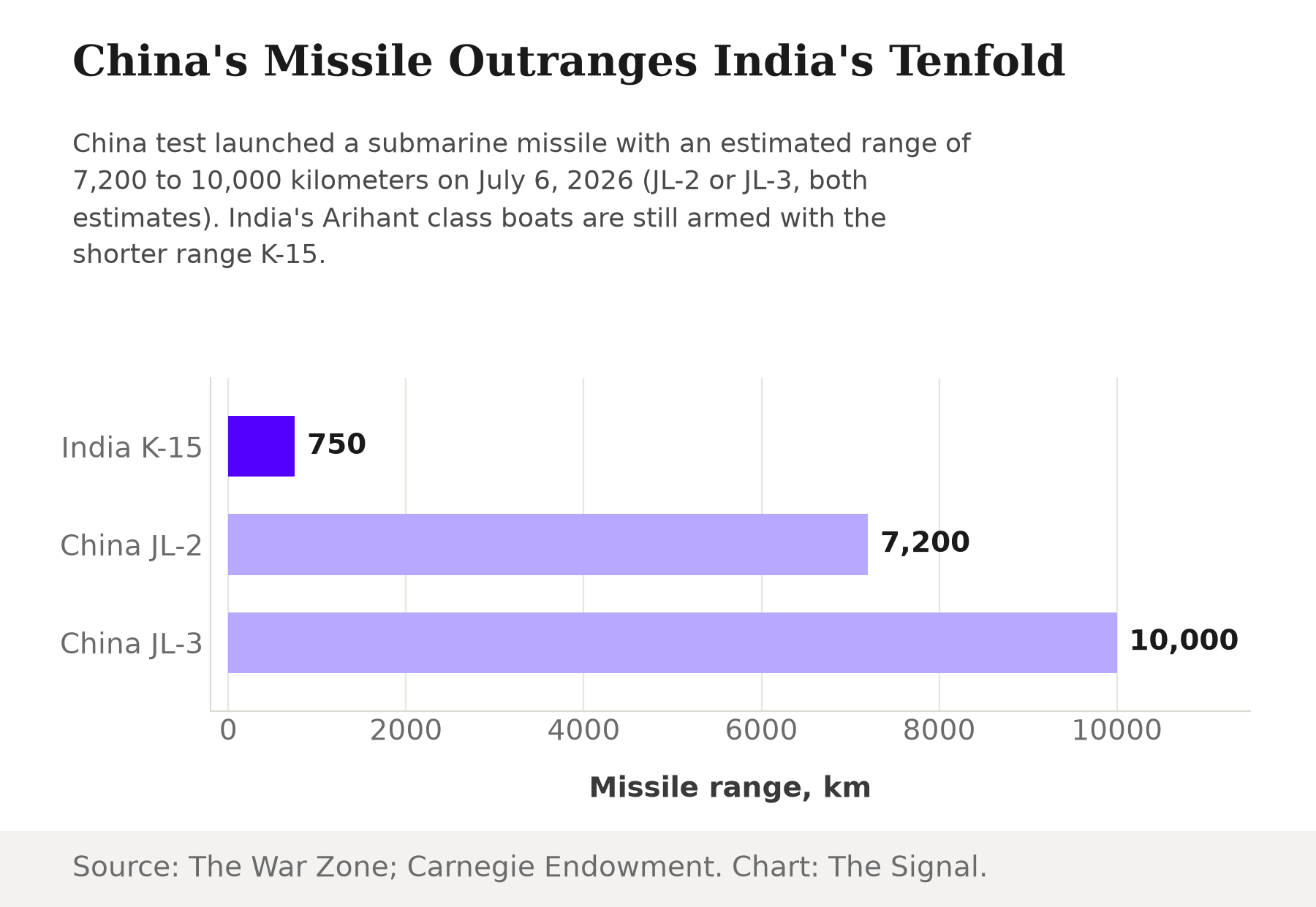
Source: The War Zone, citing Pentagon assessments; Carnegie Endowment for International Peace. Chart: The Signal.
Why 750 kilometers is a problem
A submarine-based deterrent exists for one reason: survivability. Fixed missile silos sit on a map an adversary can target first; a submarine's entire value is that it can hide, then fire from somewhere unpredictable. That only works if the boat's missile can reach its target from genuinely safe water, far from an adversary's coastal patrol zones. At 750 kilometers, the K-15 forces India's Arihant-class boats to patrol close to an adversary's coast just to bring a target within range, which is exactly the water where an adversary's own anti-submarine forces concentrate. A short-range missile does not just limit what a submarine can hit. It limits where the submarine can survive.
China already built the fleet for the range it just tested
China is not demonstrating this reach for the first time. The country operates a fleet of six Jin-class (Type 094) nuclear-powered ballistic missile submarines, as of January 2024, according to the Arms Control Association, an already-established fleet built around missiles with the kind of reach India's navy is still working toward. The force behind it keeps growing. China's nuclear warhead stockpile more than doubled from about 300 in 2020 to an estimated 600 in 2025, and is projected to exceed 1,000 by 2030, a CSIS analysis found. China's 2025 military spending rose 7.4 percent to $336 billion, the world's second highest, SIPRI data show, roughly 3.6 times India's own $92.1 billion, up 8.9 percent, the fifth highest in the world.
India is closing the gap, just not yet
India is not standing still. The country test-fired its K-4 SLBM, with an estimated 3,500-kilometer range, from the submerged submarine INS Arighaat in the Bay of Bengal on December 25, 2025, Army Recognition reported. DRDO has separately completed development of the K-5 SLBM, with a range of 5,000 to 6,000 kilometers, designed for the larger S4 and S4* variants of the Arihant class, the outlet reported in July 2025. INS Arighaat itself, India's second Arihant-class submarine, was commissioned into the navy on August 29, 2024, according to the Press Information Bureau. A third boat, INS Aridhaman, followed on April 3, 2026, giving India the three-submarine fleet that analysts say is the minimum needed to keep one boat on patrol at all times while the other two are in maintenance or transit, the Arms Control Association reported.
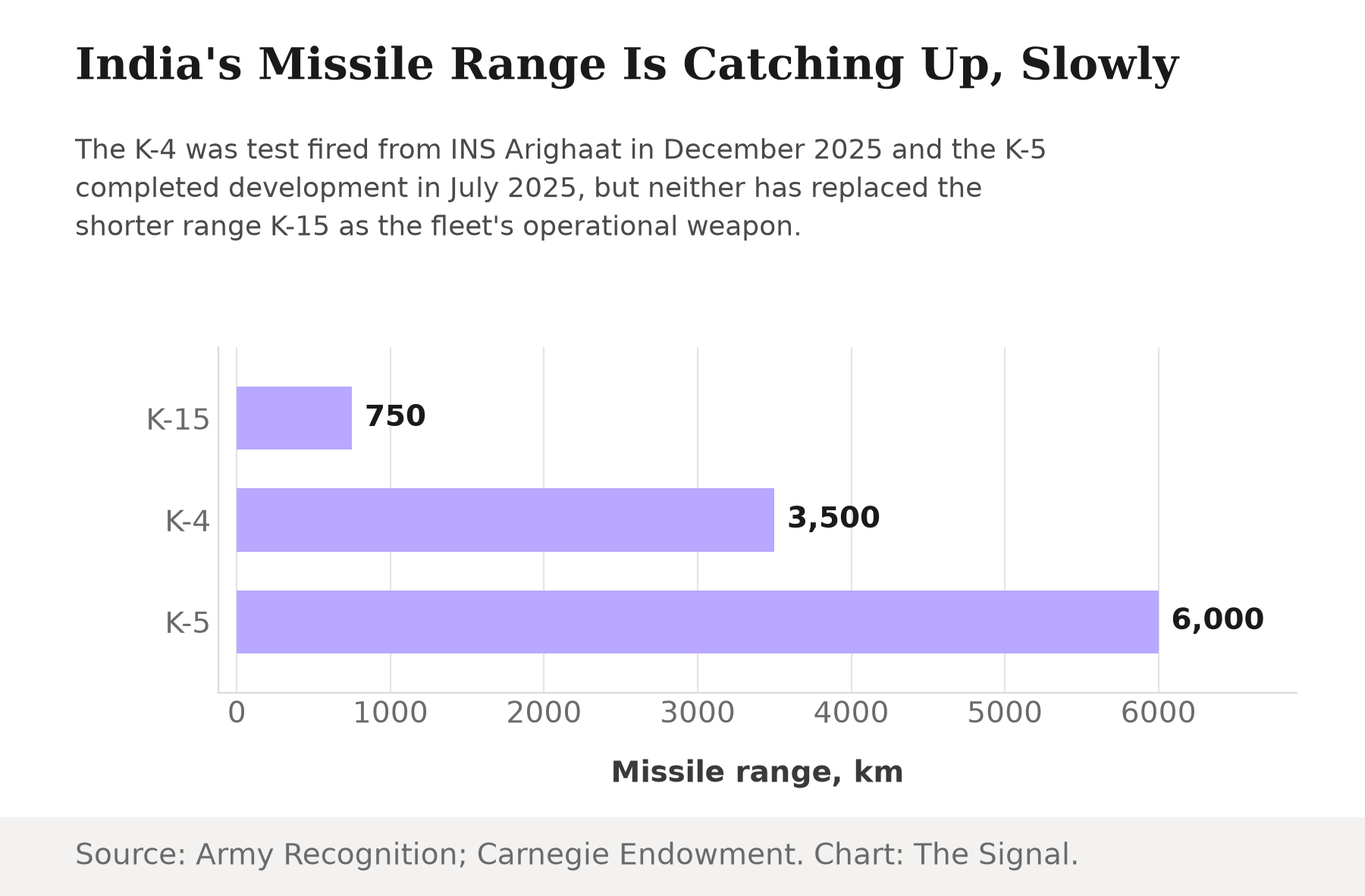
Source: Carnegie Endowment for International Peace for the K-15; Army Recognition for the K-4; Army Recognition for the K-5. Chart: The Signal.
Put the three generations together and the trend line is real. But a tested missile is not a deployed one, and a completed design is not a commissioned platform. The K-5 needs the larger S4 and S4* boats that have not yet entered service, and the K-4's confirmed test came in December 2025, just over six months before this one. Until one of those weapons becomes the standard loadout on a patrolling boat, the submarine actually on station is still armed with the 750-kilometer K-15.
The wider imbalance
The range gap sits inside a larger one.
China outspends and outguns India on every measure of the undersea deterrent, not just missile range.
| Measure | China | India |
|---|---|---|
| Nuclear warheads | ~600, 2025 | ~172, 2024 |
| Military spending, 2025 | $336 billion, up 7.4% | $92.1 billion, up 8.9% |
| SSBN fleet | 6 Jin-class boats, as of Jan 2024 | 3 Arihant-class boats, as of April 2026 |
Sources: CSIS; SIPRI; Arms Control Association; Bulletin of the Atomic Scientists; Press Information Bureau. Table: The Signal.
India is estimated to have assembled around 172 nuclear warheads, from a stock of weapons-grade plutonium sufficient for 130 to 210, the Bulletin of the Atomic Scientists' Nuclear Notebook estimated in September 2024, well under a third of China's estimated 600.
The honest objection
The strongest case against reading this test as bad news for India is that geography compensates for the range India's missiles still lack. India's plausible undersea targets, largely Pakistan and China's western and central military infrastructure, sit within a few thousand kilometers of the Bay of Bengal or the Arabian Sea. India does not need a JL-3's estimated 10,000-kilometer reach to hold at risk what its own deterrence doctrine actually requires; it needs enough range to fire from safe water, and the K-4's 3,500-kilometer test from a submerged Arighaat in December 2025 gets most of the way there from patrol areas well clear of the coast. The gap that remains is a narrow one: Beijing sits roughly 3,200 kilometers from the Bay of Bengal, so a 3,500-kilometer K-4 can only reach it fired from the bay's northernmost waters, close enough to risk giving away the submarine's position, a Belfer Center analysis found. Three hundred kilometers of spare range is a thin margin for a weapon whose entire purpose is staying hidden.
That case is real, and it is exactly why the K-4 test mattered more than the K-15 staying in service. But it does not answer the Carnegie Endowment's underlying point: as of April 2026, the K-15 is still what is currently loaded, and a tested missile can take years to become a fleet's default weapon. China took decades to go from its 1982 first test to a fleet of six Jin-class boats built around exactly this kind of range. India's equivalent transition is only now underway.
The Signal
China's July 2026 test was newsy because it was rare, only the second publicly known launch of its kind since 1982. But the more durable story sits quietly inside India's own submarine fleet: a first-generation missile with a range measured in the hundreds of kilometers, next to a program that has just proven a second missile can fly and a third can be built, neither yet on patrol. Watch which missile India loads onto its next commissioned boat. If it is the K-4 or the K-5, the range gap this test reopened is closing on schedule. If the fleet is still sailing with the K-15 a year from now, the number to watch is not China's 10,000 kilometers. It is India's 750, unchanged.
Reporting basis: the July 2026 test details are per Al Jazeera's report of Xinhua's account; the missile identification, its estimated range and the 1982 precedent are per The War Zone, citing Pentagon assessments. China's SSBN fleet count is from the Arms Control Association; its warhead stockpile and trajectory are from a CSIS analysis. Military spending figures for both countries are SIPRI data. The K-15's range and operational status are per a Carnegie Endowment for International Peace analysis; the K-4 test and the K-5's completed development are as reported by Army Recognition; INS Arighaat's commissioning date is per a Press Information Bureau release, and INS Aridhaman's per the Arms Control Association. India's warhead estimate is from the Bulletin of the Atomic Scientists' Nuclear Notebook. The Beijing-to-Bay-of-Bengal distance and its implications are per a War on the Rocks analysis by a Belfer Center nuclear security fellow. The range ratios and the spending multiple are The Signal's calculations from those figures.