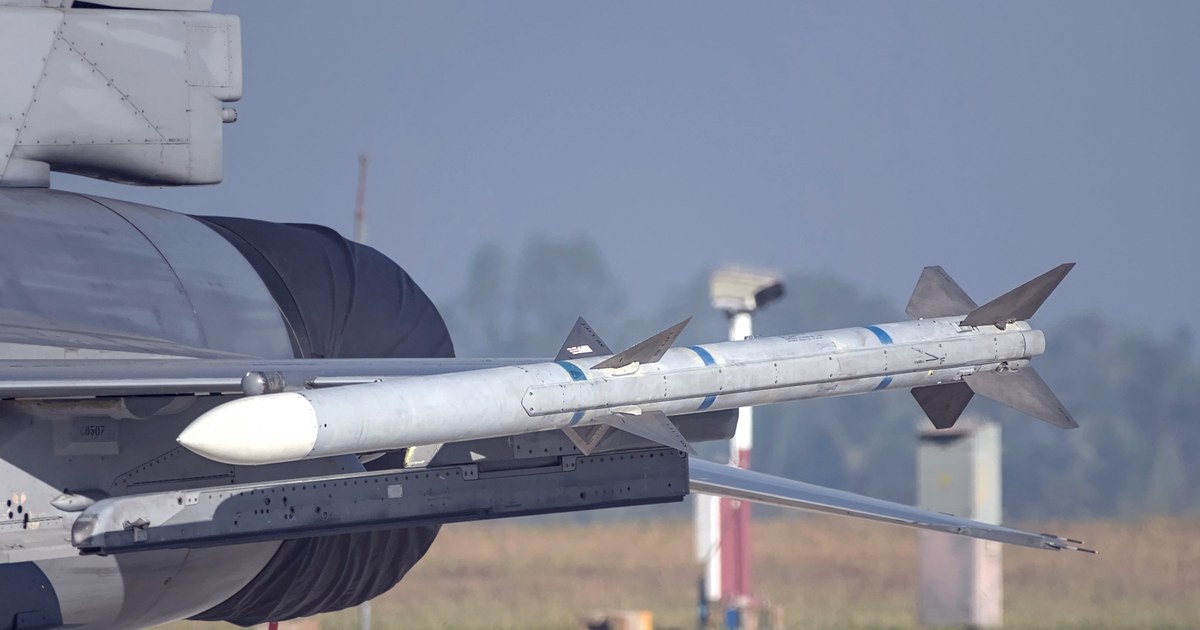
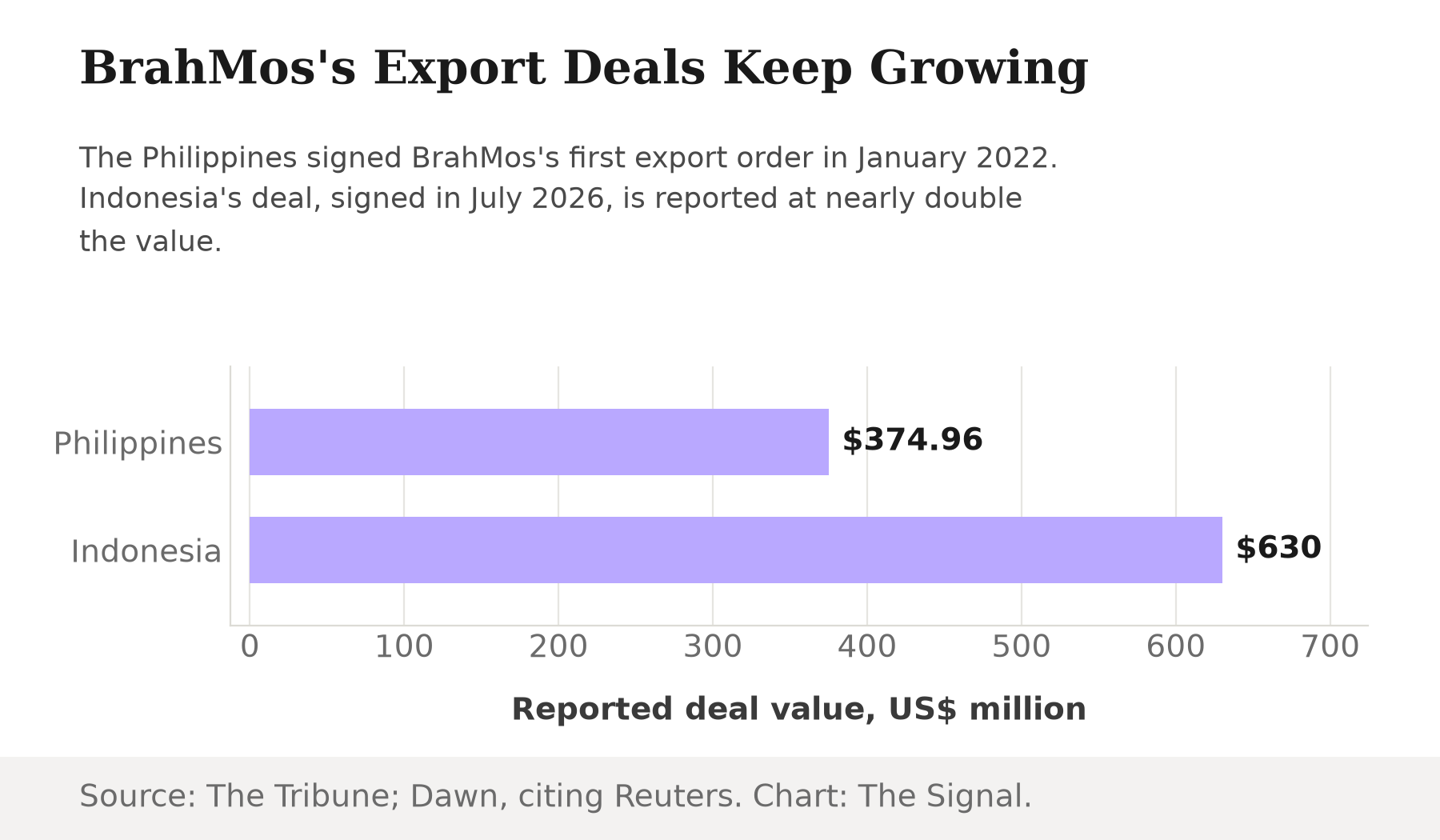
Prime Minister Narendra Modi was in Jakarta on July 7, 2026 when India and Indonesia signed a contract for the BrahMos supersonic cruise missile, making Indonesia the third country to buy the missile after the Philippines and Vietnam. Indian sources told Reuters the deal is worth around $630 million, nearly double the $374.96 million the Philippines paid for BrahMos's first-ever export order in January 2022. The coverage writes itself: an Indian-designed missile is finding new buyers, and it is happening against the backdrop of a genuine export boom. India's defence exports hit a record Rs 23,622 crore, about $2.76 billion, in the financial year 2024-25, up 12 percent on the year before, with the government targeting Rs 50,000 crore by 2029, roughly double the current level.
BrahMos's disclosed export deals have nearly doubled from customer to customer.
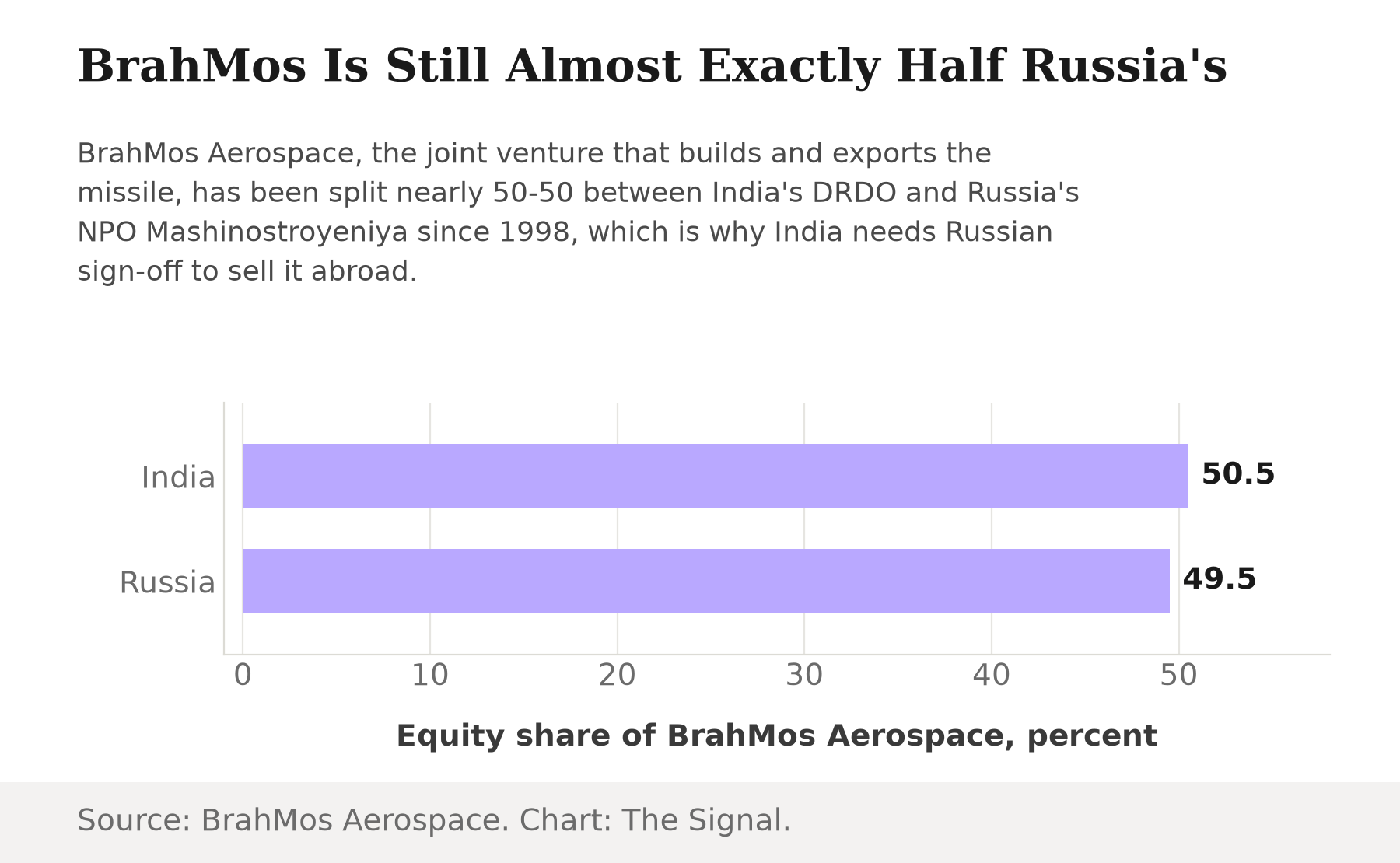
It is worth slowing down on the word "Indian" in that story. BrahMos is not a purely Indian program. It is built and exported through BrahMos Aerospace, a joint venture set up under a 1998 inter-governmental agreement and split 50.5 percent to India's DRDO and 49.5 percent to Russia's NPO Mashinostroyeniya. Every sale to a third country requires Moscow's approval, and India cannot export the missile without Russia's formal consent. Indonesia's new deal, like the Philippines' before it, only exists because Russia signed off on it too.
BrahMos Aerospace is still split almost exactly down the middle.
Three customers, one veto
Here is what the export list actually looks like. Vietnam is named as BrahMos's second export customer, ahead of Indonesia; India's government has never disclosed a figure for that deal, but a Reuters source put its value at around $629 million, including training and logistical support, in the same range as Indonesia's contract.
| Customer | Year signed | Reported deal value | Source |
|---|---|---|---|
| Philippines | 2022 | $374.96 million | The Tribune |
| Vietnam | Confirmed May 2026 | Around $629 million (Reuters sourcing, undisclosed officially) | Army Technology |
| Indonesia | 2026 | Around $630 million | Dawn, citing Reuters |
Every row on that table required the same second signature from Moscow. That is not a technicality of how the paperwork is filed. It is the reason India's flagship, internationally visible defence-export product, the one carrying the government's growth story, is the one item on the list that is not entirely India's to sell.
The approver carries a sanctions tag
The company on the other side of that signature is not a neutral bystander in global politics. NPO Mashinostroyeniya, BrahMos's Russian joint-venture partner, appears on the US Treasury's OFAC sanctions list under Ukraine- and Russia-related programs. India's fastest-growing export product depends, deal by deal, on continued cooperation with a company the United States has formally sanctioned. That is not a hypothetical risk sitting off in the distance. It is baked into the ownership structure every buyer, including Indonesia, is signing up for right now.
The dependency has shaped the product before, not just its paperwork. Before India joined the Missile Technology Control Regime in 2016, MTCR rules meant India could not receive missile technology from fellow member states, such as Russia, if it was capable of flying more than 300 kilometers. That is why BrahMos's export version was long capped near that range, while India's own missile was extended to 500 kilometers only after India joined the regime in 2016. A multilateral regime built around Russia's own membership has already constrained what BrahMos could do abroad once. The joint-venture structure means it can happen again, in either direction, at Moscow's discretion.
Everywhere else, India is buying less from Russia
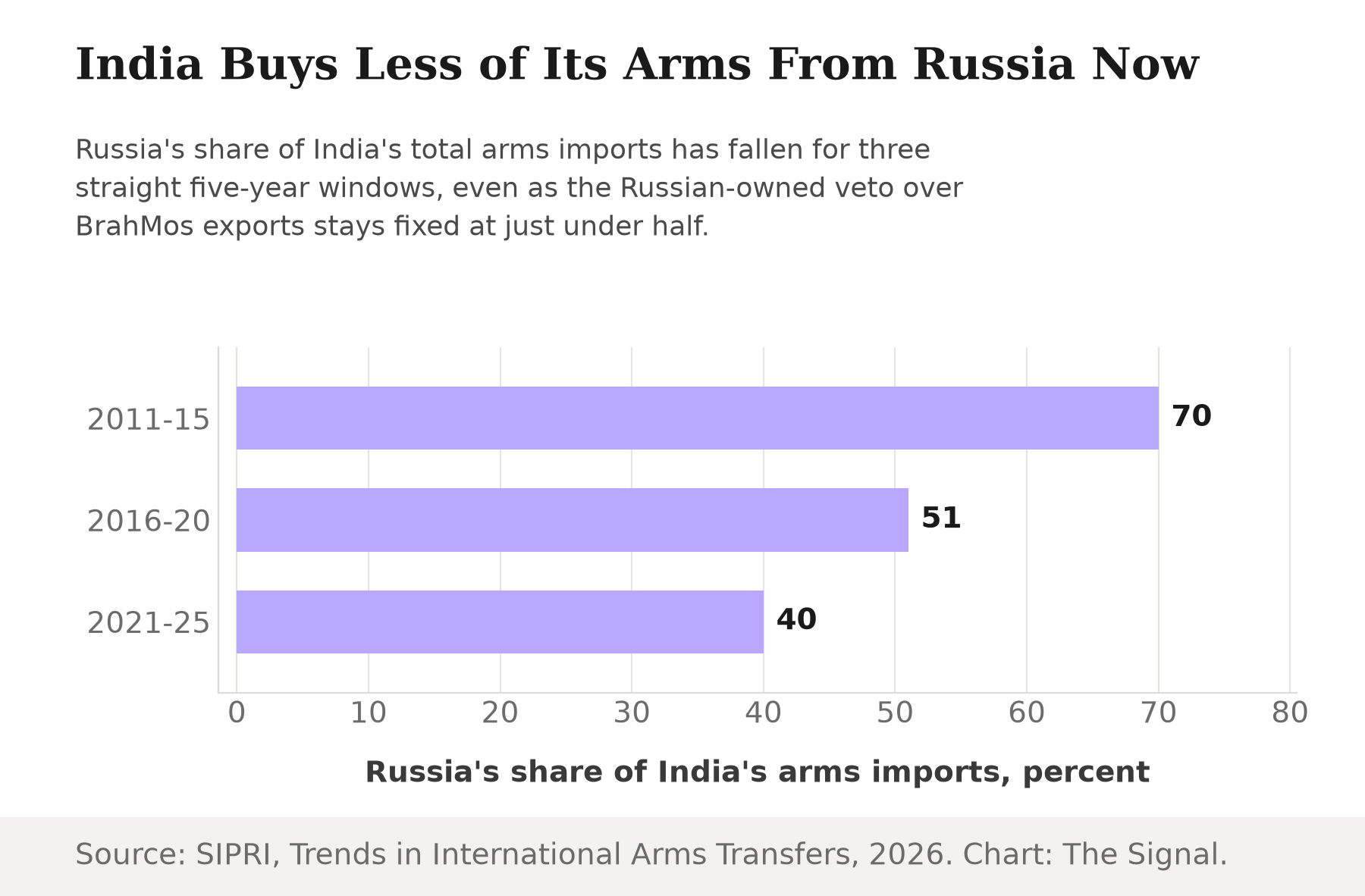
Set that against the rest of India's arms relationship with Russia, and the BrahMos veto looks like an outlier running the wrong way. Russia's share of India's total arms imports fell to 40 percent in 2021-25, down from 51 percent in 2016-20 and 70 percent in 2011-15, even as India remained the world's second-largest arms importer. Three straight five-year windows, each one lower than the last.
Russia's grip on India's arms imports keeps loosening. BrahMos's Russian veto does not.
That diversification has a visible destination. India and France signed an Inter-Governmental Agreement in April 2025 for 26 Rafale-Marine aircraft, with a technology-transfer clause for integrating indigenous weapons in India, the kind of deepening Western defence-industrial tie that has no BrahMos equivalent. Every other category of Indian arms purchasing has been diversifying away from Russia for over a decade. BrahMos has not moved at all. Its ownership split has sat at 50.5 to 49.5 since the joint venture's 1998 founding agreement, and nothing about the Indonesia signing changes that math. The product India is most eager to show off to the world is also the one still structurally anchored to Moscow.
The honest objection
The strongest case against reading this as a real vulnerability is that Russia has every financial incentive to keep saying yes. NPO Mashinostroyeniya owns 49.5 percent of BrahMos Aerospace, against India's 50.5 percent, so it collects a share of every export sale the venture signs, Indonesia's included. A partner that profits from each new customer has no obvious reason to start blocking them, and India's majority stake means New Delhi holds formal control of the joint venture's board, even if third-country exports still need Russian sign-off under the underlying agreement.
That case is real, and it likely explains why Russia has, in the end, signed off on every BrahMos sale India has brought to it. But the veto is not a formality even when it eventually says yes: as of November 2025, India had finished its own end of the Indonesia deal while the sale still could not close because it remained contingent on Russia's mandatory approval, the one step neither government controlled unilaterally. An incentive to approve today is not the same as immunity from disruption tomorrow. The approving partner sits on a Western sanctions list already, which is a fact about today, not a forecast. A joint-venture structure that has already reshaped the missile's range once, when MTCR membership rules changed, can be reshaped by developments in Moscow's own politics or its relationship with Washington in ways neither India nor its new customers control. Profit motive keeps the veto quiet. It does not make the veto disappear.
The Signal
Indonesia's signing is a genuine milestone, and India's overall defence-export numbers are genuinely rising. But the flagship item carrying that story to the world is the one export line where a foreign, sanctioned company still has to say yes. Watch what happens to the mix behind the headline export total: if wins for wholly indigenous systems, radar, artillery, indigenous missiles built without a foreign joint-venture partner, start outpacing BrahMos in the years ahead, that is evidence the export story is de-risking away from Moscow. If BrahMos keeps supplying a growing share of India's marquee deals instead, every new customer is one more sale that still needs a Russian company's signature to close.
Reporting basis: the Philippines contract value is per The Tribune's 2022 report; the Indonesia signing date and customer sequence are per Naval News; the Indonesia deal value is per Dawn's report of Reuters sourcing. BrahMos Aerospace's ownership split and founding date are per the joint venture's own website, the primary artifact for its equity structure. The description of Moscow's approval requirement is per Zee News. India's FY 2024-25 defence-export figures and the FY2029 target are from the Ministry of Defence via a Press Information Bureau release. Russia's share of India's arms imports across three five-year windows is from SIPRI's own published arms-transfers data. NPO Mashinostroyeniya's sanctions listing is per the US Treasury's OFAC sanctions database, checked directly. The BrahMos export-range history tied to India's 2016 MTCR entry is per Arms Control Today. Vietnam's Reuters-sourced deal value is per Army Technology's report. The India-France Rafale-Marine agreement's date and technology-transfer terms are from the Ministry of Defence via a Press Information Bureau release. The status of Russia's pending approval on the Indonesia deal as of November 2025 is per The Week. The FY2029 target's ratio to the FY 2024-25 export figure is The Signal's calculation from those two figures.