When the Union Cabinet approved the Agnipath scheme on 14 June 2022, the design was explicit about what would not happen. Only up to 25% of each batch of Agniveers would be enrolled in the regular cadre of the armed forces after a four-year engagement, selected on performance. The government's own case for that number was just as direct: a smaller permanent force would considerably reduce the defence pension bill that had worried successive governments for years. The rest would serve four years and leave.
That first batch, recruited under the four-year engagement approved in June 2022, is only now reaching the end of its tour. And the services that agreed to the cap are asking to blow past it.
The Navy's own reported ask is three times the share Agnipath was built to keep.
Reported on 6 July 2026, the Navy is now seeking to retain around 75% of the Agniveers from that first batch, while the Army and the Air Force are separately seeking to raise their own retention to around 50%, each up from the 25% cap they currently operate under.
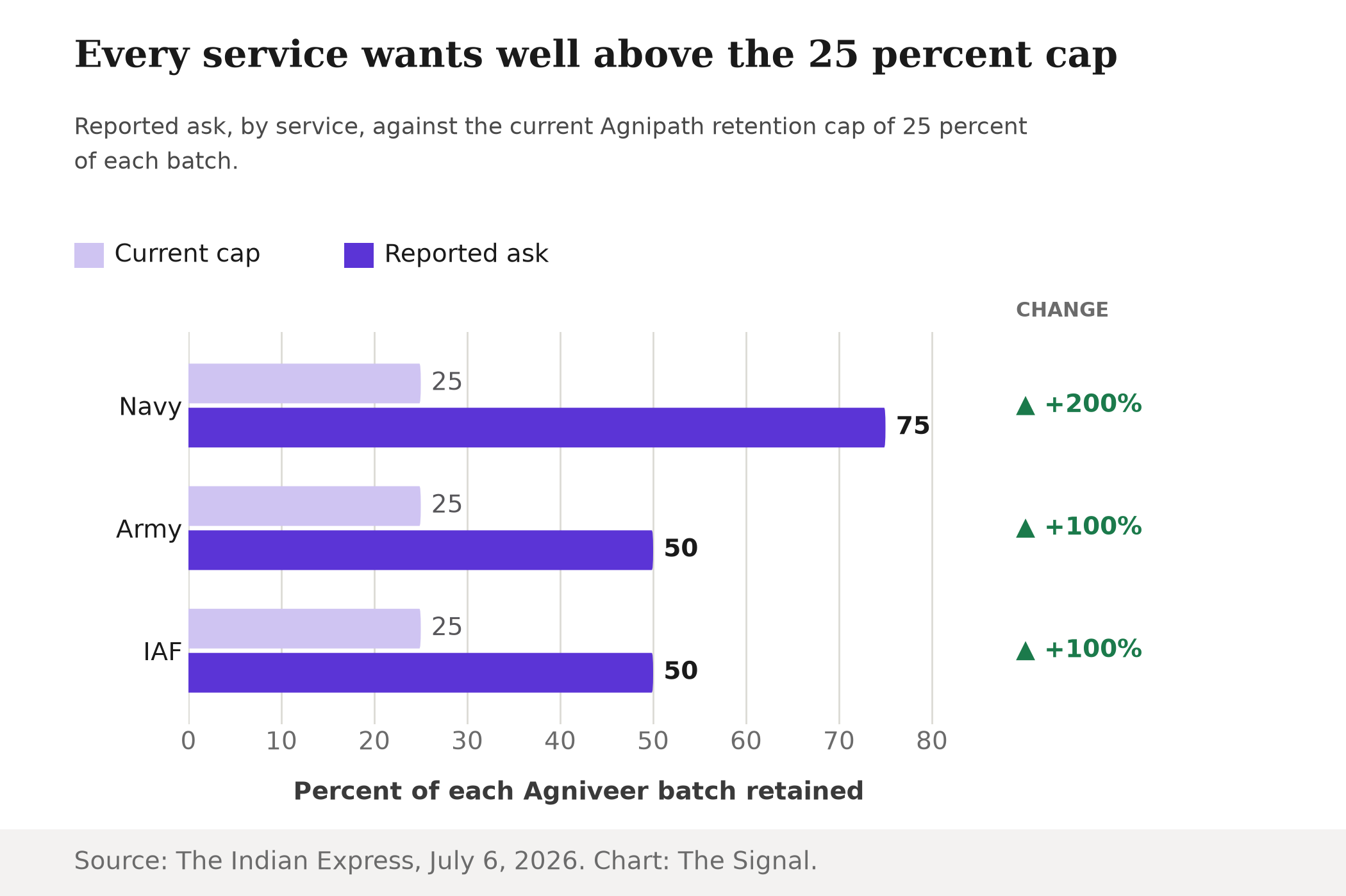
Source: The Indian Express; PIB, Ministry of Defence. Chart: The Signal.
Why 25% was the whole point
The 25% figure was never a rounding choice. It was the mechanism. A scheme that let three-quarters of every batch leave after four years, with no long-service pension to fund, was the entire basis for the promised savings. Anyone not selected for the regular cadre exits with a one-time Seva Nidhi payment of about Rs 11.71 lakh, exempt from income tax, and no entitlement to gratuity or pension. Since 2024, the government has also built a landing spot for that larger exiting group: a 10% reservation for ex-Agniveers in Constable (General Duty) and Rifleman posts in the Central Armed Police Forces and Assam Rifles, with age relaxation and exemption from the Physical Efficiency Test.
What an Agniveer gets depends entirely on which side of the cap they land on.
Source: PIB, Ministry of Defence; PIB, Seva Nidhi terms; PIB, CAPF reservation.
| If selected for the regular cadre (up to 25%) | If not selected (the rest) |
|---|---|
| Continues in the armed forces, chosen on performance during the four-year engagement | One-time Seva Nidhi of about Rs 11.71 lakh, tax free |
| No separate exit payout described in the scheme's terms | No gratuity, no pension |
| Since 2024, a 10% reserved quota for Constable (GD)/Rifleman posts in the CAPF and Assam Rifles |
That design only pencils out if the cap holds. It is the cap now moving.
Why the ask is landing now
Operation Sindoor in May 2025 put Agniveers into live combat for the first time since the scheme began, and the aftermath appears to have changed the internal argument inside the services. By August 2025, discussions were underway on a tiered retention increase: 70 to 75% for infantry and other combat arms, 80% for specially trained roles such as Air Defence, Signals and Engineers, and 100% for Special Forces. Then, in October 2025, a formal proposal to raise the Agniveer retention rate from 25% up to 75% was reportedly on the agenda at the Army Commanders' Conference in Jaisalmer, as the first batch's tenure neared its end.
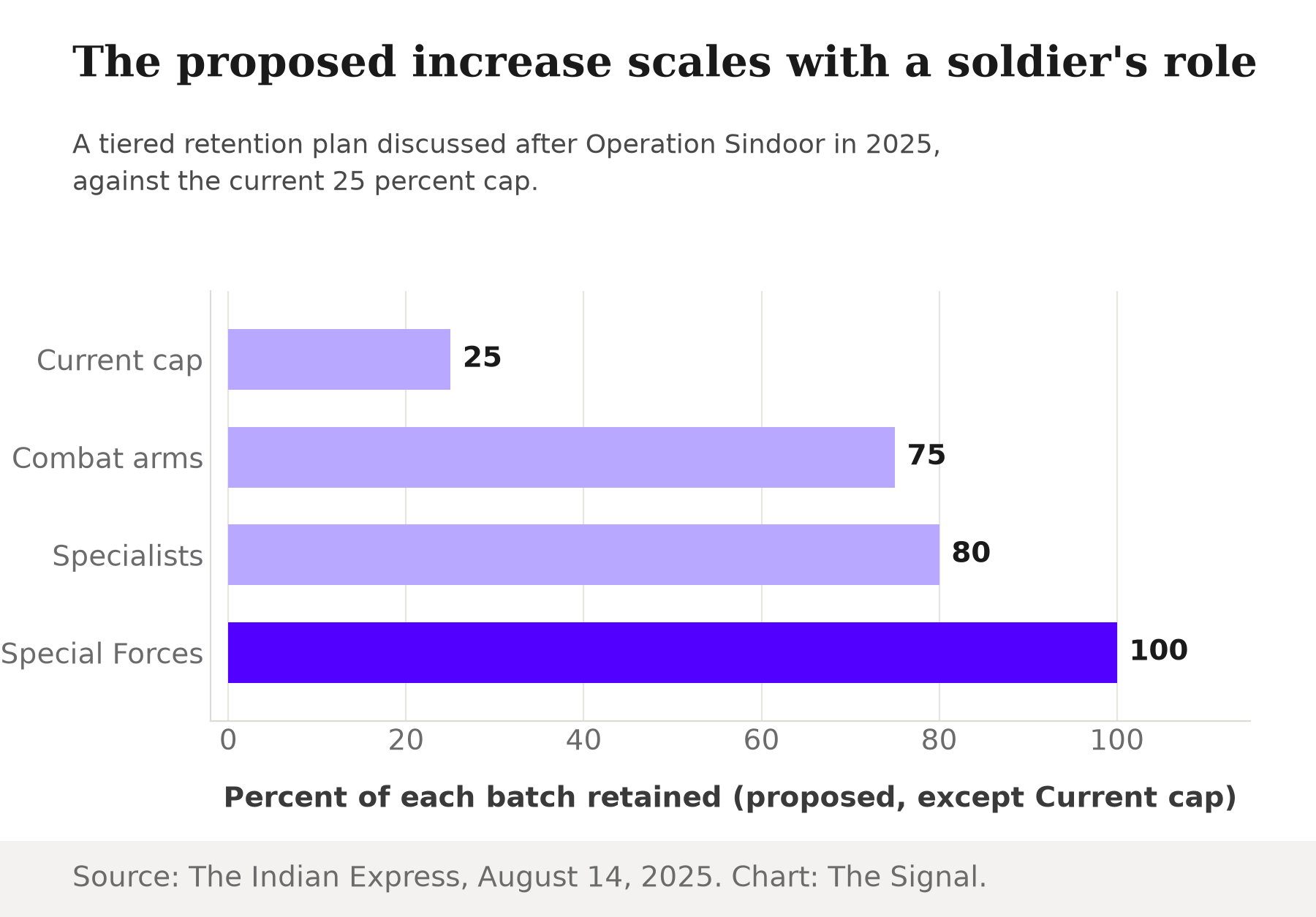
Source: The Indian Express; PIB, Ministry of Defence. Chart: The Signal.
The casualty list itself is part of the argument for continuity. When India released the names of the six Armed Forces personnel killed in Operation Sindoor, for the first time, on 27 June 2026, one of the six was an Agniveer, Rifleman Mood Muralinaik of the 851 Light Regiment. A scheme designed around four-year turnover looks different once its recruits are absorbing the same combat risk as career soldiers, with a fraction of the same institutional memory retained afterward.
The honest objection
The strongest case for the services is that this need not undo the fiscal logic at all. Selection is still performance-based, not automatic, so a higher ceiling is not the same as a guaranteed higher outcome. Even at the 50% and 75% levels the services are reportedly seeking, the force stays younger and leaner than the fully pensionable system Agnipath replaced. And the value of experience is not abstract: after a real shooting war, the services have a direct interest in keeping the soldiers who have already been tested in it, an outcome no pension-bill spreadsheet from 2022 could have priced in.
That case is real, but it strains against the arithmetic. A jump from 25% to 75% is not a marginal adjustment. It is triple the share of every future batch drawing long-service pay and eventual pension. A scheme engineered specifically to keep that share small is now being asked, by the same institutions that designed it, to keep three times as many people inside the system it was built to shrink.
The Signal
Nothing has been formally changed yet. What exists so far is a set of internal proposals from the Army, Navy and Air Force, reported but not yet confirmed as government policy. Watch for two things: whether the defence ministry sets one uniform retention number across all three services or lets the Navy's 75% and the Army and Air Force's 50% stand as separate figures, and whether anyone in government revisits the original pension-savings math out loud once a real retention rate replaces the designed one. A cap that was the entire fiscal argument for a scheme does not usually move this far, this soon, unless the people who set it have concluded the argument was never as settled as it looked.
Reporting basis: the original Agnipath terms, the Seva Nidhi exit package and the 2024 CAPF reservation are per Press Information Bureau releases from the Ministry of Defence and the Ministry of Home Affairs. The reported push to raise retention, the October 2025 Army Commanders' Conference proposal, the August 2025 tiered discussions and the naming of the Agniveer killed in Operation Sindoor are all as reported by The Indian Express, which is the sole outlet with this reporting; that concentration is a real limit on independent confirmation, not a gap this piece papers over. The tripling comparison between the Navy's reported ask and the current cap is arithmetic evident from those two already-cited figures.