On 14 August 2026, the Centre notified the exact questions Census 2027's population enumeration phase will ask of every household: 40 fields in total, caste and SC/ST status among them. It is the news the country has been waiting for since the Cabinet Committee on Political Affairs, chaired by Prime Minister Narendra Modi, decided on 30 April 2025 to fold caste enumeration into the main Census rather than run it as a separate exercise. CNN reported on 16 May 2025 that it would be the first caste count in a national census since 1931, when India was still a British colony. The obvious read is that after nearly a century of silence, the Indian state is finally about to measure, precisely, how many of its citizens belong to which caste.
The last time India counted caste nationwide, the country did not exist yet.
But the same 40-question form does more than ask about caste. It also captures Aadhaar and voter ID numbers, passport details for passport holders, and whether the respondent holds a driving licence, and the Centre's notification confirms one of the 40 fields records the site where a respondent received a Covid-19 vaccination. Self-enumeration in snow-bound areas runs from 17 to 31 August 2026, with the wider population enumeration phase beginning 1 September.
It is worth slowing down on what that bundling means. Caste is, by design, the single most politically consequential line on the form: it is the number reservation quotas in education and government jobs are ultimately argued over. Sitting it next to Aadhaar, voter ID and passport data invites an obvious question. Once the state holds both a person's caste and the identifiers that could, in principle, tie that caste to a named individual elsewhere, what stops that pairing from being produced whenever a quota dispute reaches a court?
The answer is that nothing produces it, because nothing can. Section 15 of the Census Act treats every individual response as strictly confidential: it cannot be published under the RTI Act, used as evidence in any court of law, or shared with any institution. That protection covers the caste answer, the Aadhaar number and the vaccination record alike, for every respondent, without exception.
The bigger form caste rides in on
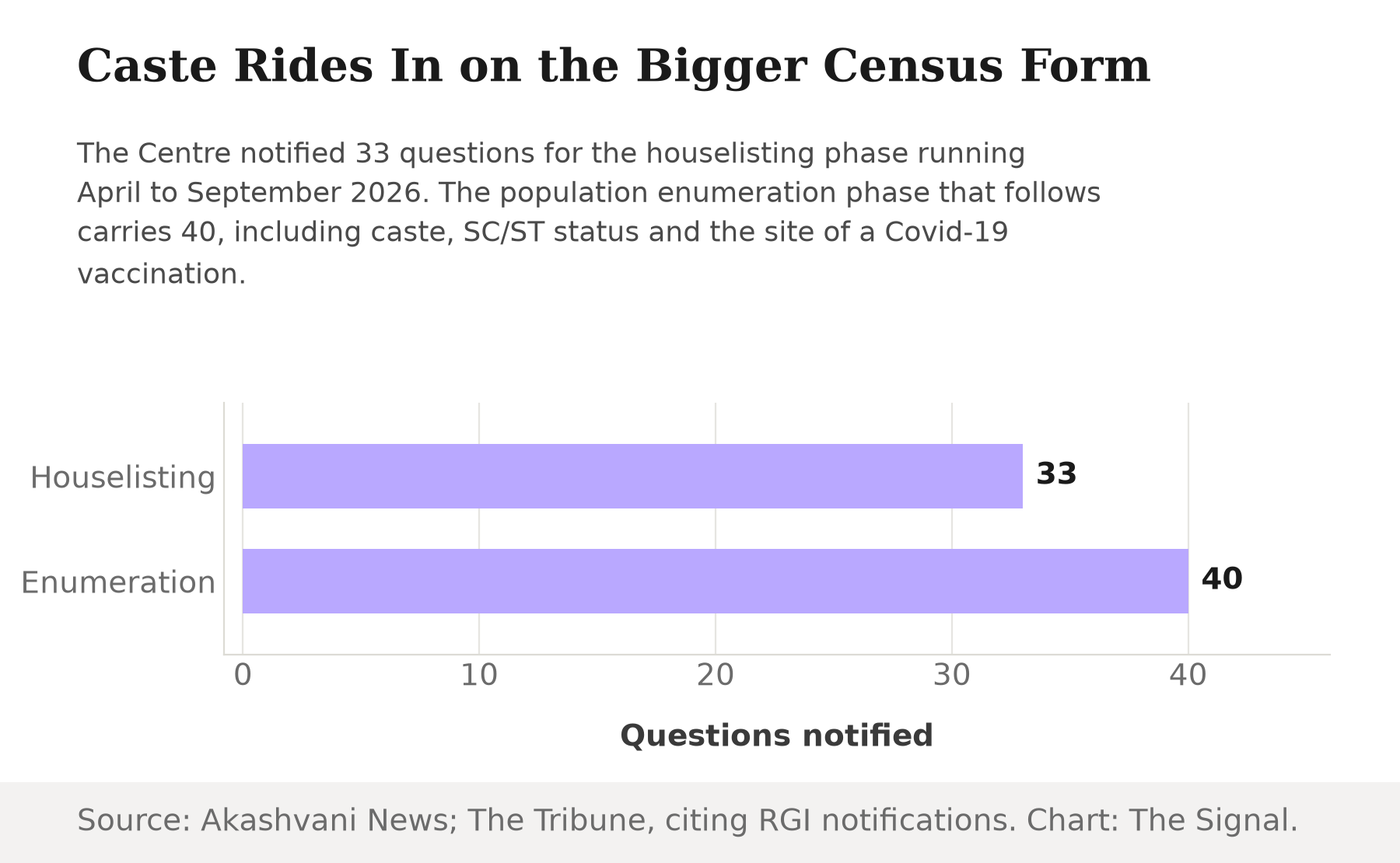
Census 2027 runs in two phases with two separate question sets. The Houselisting and Housing Census phase, running 1 April to 30 September 2026, carries 33 notified questions about the dwelling itself: building material, amenities, assets. Caste sits in the second phase. The Population Enumeration phase notified on 14 August 2026 carries 40 questions, the extra fields including caste, SC/ST status, the Covid-19 vaccination site and the identity documents above.
Until the 2011 Census, only Scheduled Castes and Scheduled Tribes were systematically counted: every other caste group was invisible to the state's own headcount. That silence was not an oversight. In a July 2022 written reply to the Lok Sabha, the Ministry of Home Affairs confirmed the government had not enumerated caste-wise population beyond SCs and STs in any Census since Independence, and had no plan to release the caste data it had already collected in the 2011 Socio-Economic and Caste Census. A comprehensive caste count existed once already. It was simply never published.
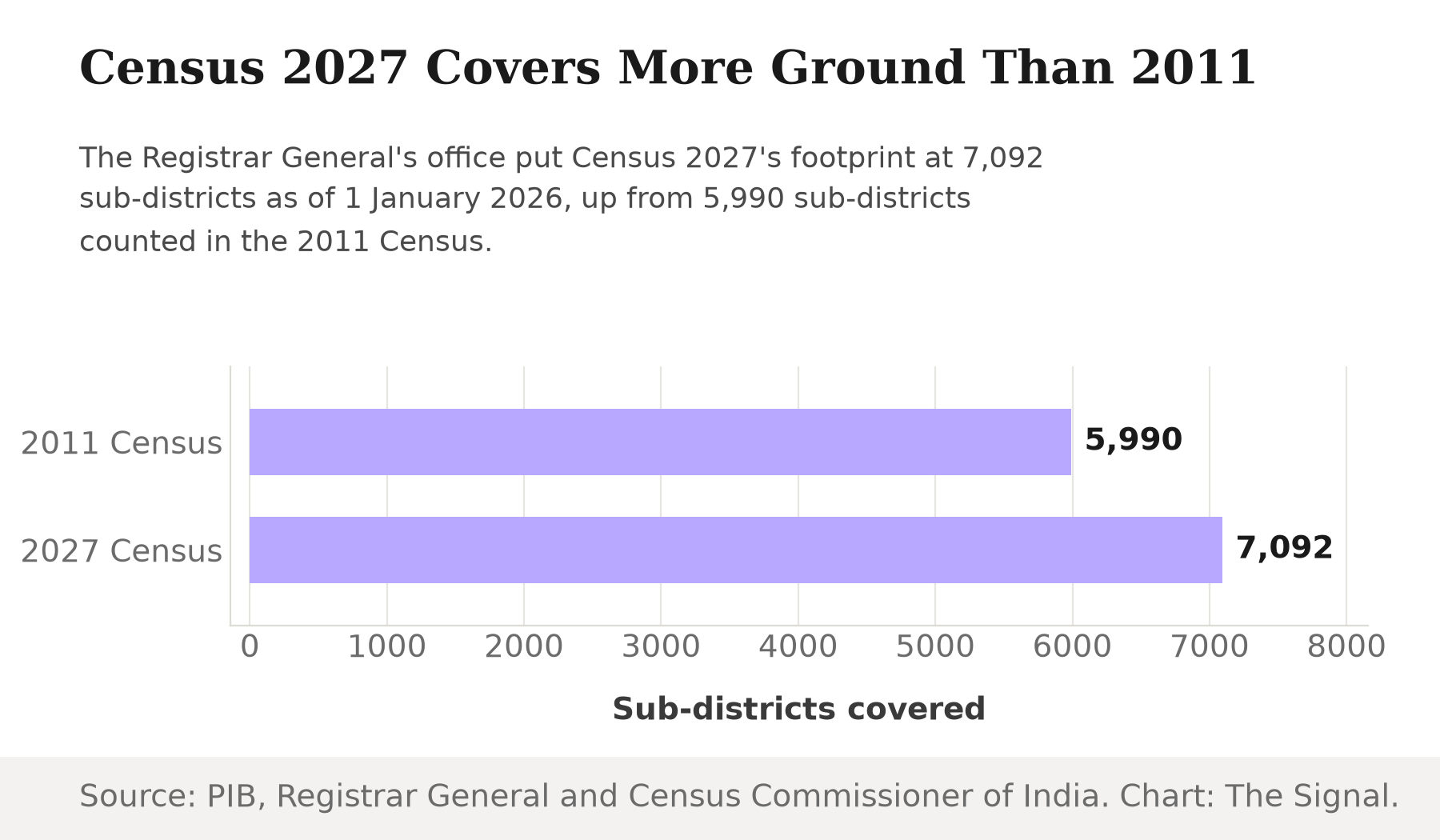
The Union Cabinet approved the full Census 2027 scheme in December 2025 at a cost of Rs 11,718.24 crore, run in the two phases above, with caste captured electronically in the second. As of 1 January 2026, the exercise covers 36 States and Union Territories, 7,092 sub-districts, 5,128 statutory towns, 4,580 census towns and around 6,39,902 villages, a wider net than the 2011 Census's 640 districts and 5,990 sub-districts.
A wall the count cannot cross
Every field added since 2011 sits behind the identical confidentiality wall.
| Field on the 2027 population enumeration form | New since the 2011 Census |
|---|---|
| Caste (comprehensive, beyond SC/ST) | Yes |
| Covid-19 vaccination site | Yes |
| Aadhaar number | Yes |
| Voter ID number | Yes |
| Passport details | Yes |
| Driving licence held (yes/no) | Yes |
Source: The Tribune; Open magazine.
None of those six fields, caste included, can be pulled out of that wall individually. The same Census Act provision that shields the caste answer shields the Aadhaar number, the vaccination record and every other response on the form, for every respondent, with no carve-out for litigation. A court hearing a reservation dispute cannot subpoena an individual's Census caste entry any more than it can subpoena their Census vaccination entry. Both are equally sealed.
What a state count already showed
Bihar ran its own caste-based survey in 2023, outside the central Census machinery, and its findings show what a comprehensive count can surface once it exists. The state's population was put at more than 13 crore, and the single largest caste group, Extremely Backward Classes, accounted for 36.01 percent of it. Extremely Backward Classes and Other Backward Classes together made up more than 63 percent of Bihar's population, a scale the state's existing quota framework had not been built to assume. Bihar's survey was never bound by the central Census Act's confidentiality provision. Its aggregate numbers were released, and became a public political fact within months.
The honest objection
The strongest defence of Section 15 is that it is not new secrecy invented for 2027. It is continuity: the government has kept individual caste data out of the public record in every Census since Independence, and the same shield now simply applies evenly to Aadhaar, voter ID, passport and vaccination fields too, nobody's Census answers, on any subject, can be produced in court. Confidentiality of that kind is also the ordinary bargain a statistical exercise offers respondents everywhere, in exchange for honest answers. On this view, bundling caste with identity fields is not a trap. It is what a modern Census form looks like, and the wall protects the respondent, not the state.
That case holds for individual records, but it does not settle what happens to the aggregate. The government has already confirmed it has no plan to release even the combined caste totals it collected in the 2011 Socio-Economic and Caste Census, which suggests confidentiality can extend well past the individual respondent if the Centre chooses. Bihar showed the other path: a state government that chose to publish its own aggregate caste survey turned a count into a political fact within months. Whether the Centre makes the same choice with Census 2027's aggregate numbers, or lets them sit unpublished the way the 2011 SECC's did, decides whether this count changes anything at all.
The Signal
Census 2027 will produce the number India has argued about without ever measuring for nearly a century: a comprehensive count of caste, not just Scheduled Castes and Scheduled Tribes. It notified that count on the same form as Aadhaar numbers, passport details and a Covid-19 vaccination field, inside a Rs 11,718.24 crore exercise covering more ground than any Census before it. But the individual answer is sealed the moment it is written down: Section 15 keeps it out of the RTI Act, out of any courtroom, and away from every institution. What decides whether Census 2027 reshapes quota politics is not the enumeration itself. It is the one decision the government has not yet had to make in public: publish the aggregate the way Bihar did, or file it away the way it filed away the last one.
Reporting basis: the Cabinet's decision to fold caste enumeration into the main Census is from a Press Information Bureau release on the Cabinet Committee on Political Affairs, and the Rs 11,718.24 crore scheme approval is from a further PIB release on the Union Cabinet's decision. Census 2027's geographic footprint is from a PIB-carried press conference by the Office of the Registrar General and Census Commissioner of India, and the 33-question houselisting schedule is from the same office, via Akashvani News. The history of caste enumeration before 2011 is from a PIB Research backgrounder, and the confidentiality protections under Section 15 of the Census Act are from a further PIB Research backgrounder. The government's record of never enumerating caste beyond SCs and STs since Independence, and its position on the unreleased 2011 Socio-Economic and Caste Census data, are from a Ministry of Home Affairs reply to the Lok Sabha, carried by PIB. The 40-question population enumeration schedule and its snow-bound self-enumeration dates are per a PTI wire report carried by The Tribune, quoting the Registrar General of India's notification; the Aadhaar, voter ID, passport and driving-licence fields are per Open magazine's reporting of the same questionnaire. The 1931 comparison is per CNN's reporting. Bihar's 2023 caste survey findings are from the Government of Bihar's own survey report, as carried by Akashvani News.