On 3 July 2026, the Defence Acquisition Council, chaired by Raksha Mantri Rajnath Singh, cleared a fresh batch of anti-drone, missile and surveillance systems for the Army, Navy and Air Force. The council accorded Acceptance of Necessity, an in-principle administrative approval, worth about Rs 52,000 crore. Coverage read it as one more entry in a defence-buying machine that rarely slows down.
It is worth slowing down on that number. Line up the council's last five publicly recorded meetings by the value each approved, and the Rs 52,000 crore cleared on 3 July 2026 is not routine. It is the smallest of the five.
The council's newest approval is its smallest in a year.
Ranked by the value of Acceptance of Necessity granted, the July 2026 meeting sits below every DAC sitting held since July 2025.
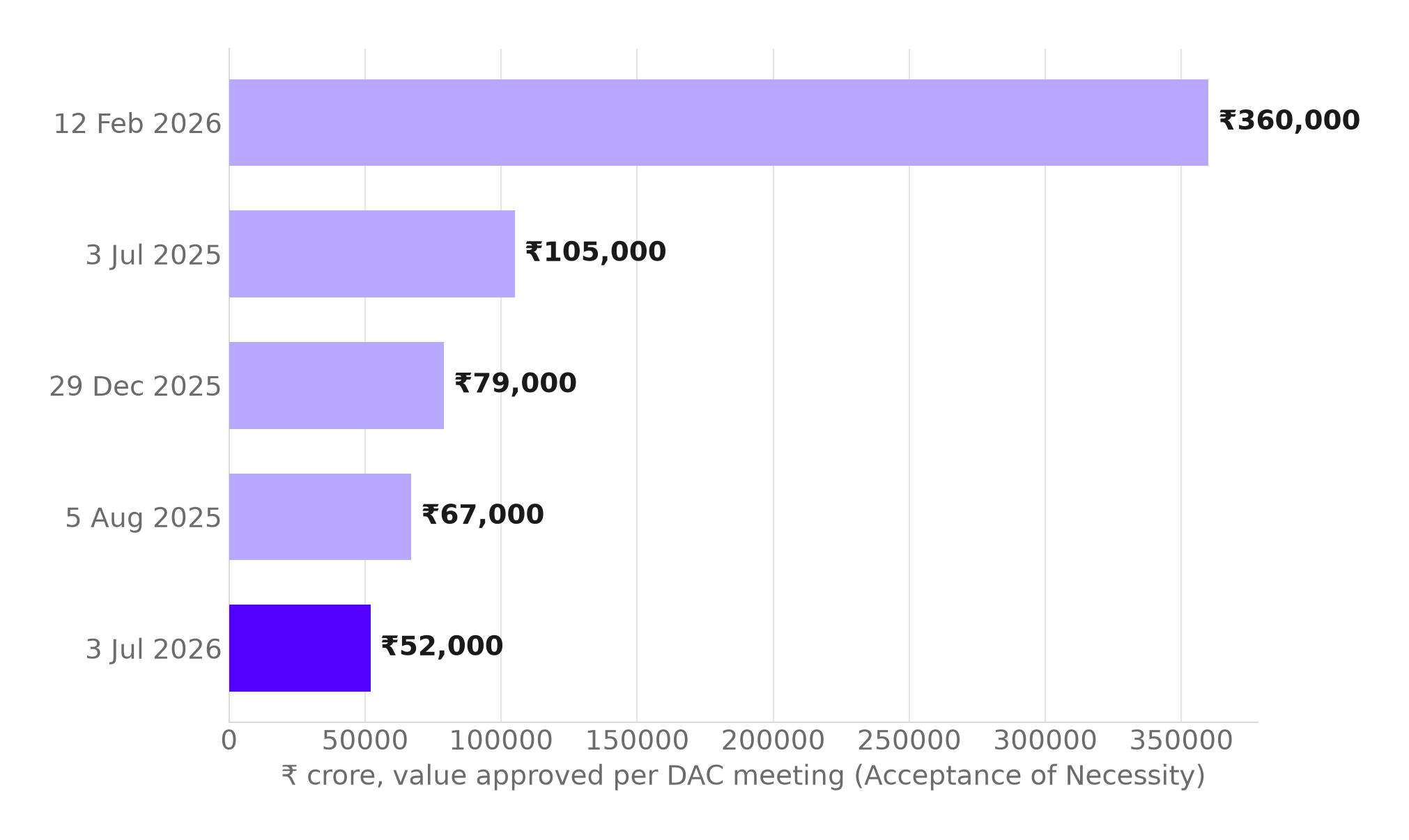
Source: Press Information Bureau, Ministry of Defence, DAC press releases dated 3 July 2025, 5 August 2025, 29 December 2025, 12 February 2026 and 3 July 2026. Chart: The Signal.
Five meetings, one clear ranking
Exactly one year before this meeting, on 3 July 2025 the council approved a considerably larger sum, about Rs 1.05 lakh crore for 10 proposals, entirely through indigenous Buy Indian-IDDM sourcing. On 5 August 2025 it cleared about Rs 67,000 crore. On 29 December 2025, about Rs 79,000 crore. On 12 February 2026, the council approved about Rs 3.60 lakh crore, its largest single-meeting approval of the past year. Against that run, the Rs 52,000 crore cleared on 3 July 2026 for anti-drone, missile and surveillance systems is the smallest figure the council has put its name to since the sequence began.
That does not make it a small purchase in absolute terms; anti-drone and missile systems for three services rarely are. It makes it small only relative to a council that, over the same stretch, twice cleared six-figure crore sums in a single sitting. The scale of what counts as an ordinary DAC meeting has moved so far that a sum which would have dominated headlines for weeks a decade ago barely registers as a data point today.
A quarter of the year's budget, in one sitting
The context that gives this meeting its edge is the calendar it landed on. The Union Budget for FY2026-27 earmarks Rs 1.85 lakh crore specifically for capital acquisition, out of a Rs 2.19 lakh crore total capital allocation to the Defence Forces, an increase of about 24 percent over FY2025-26. The fiscal year began on 1 April 2026; 3 July 2026 fell roughly three months in. In that stretch, the council had already signed off on approvals worth more than a quarter of the entire year's earmarked capital-acquisition budget, Rs 52,000 crore against Rs 1.85 lakh crore.
One meeting accounted for more than a quarter of the year's capital-acquisition budget.
Measured against the full-year allocation, the July meeting alone is not a footnote.
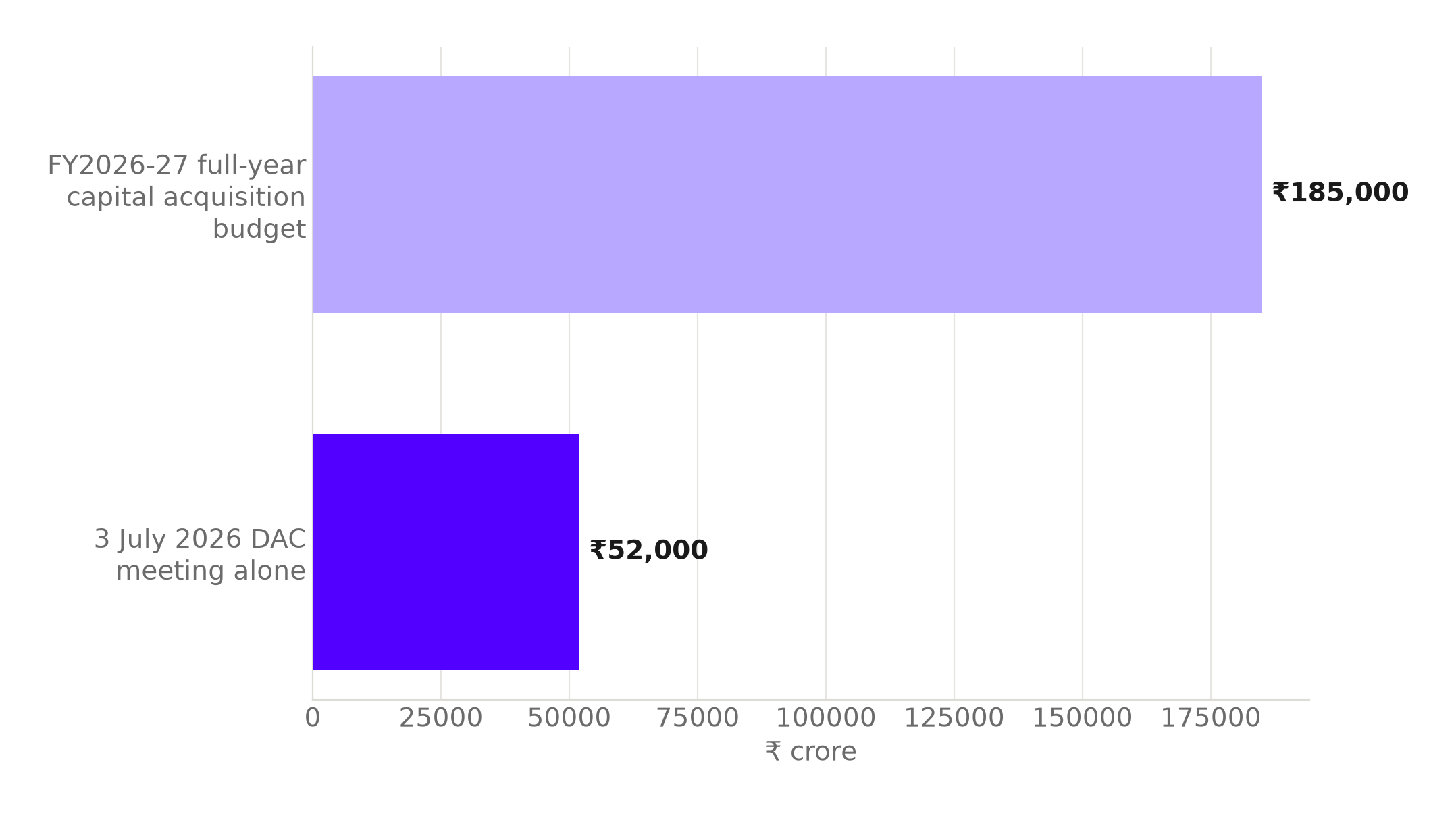
Source: Press Information Bureau, Ministry of Defence, FY2026-27 capital acquisition budget and 3 July 2026 DAC approval. Chart: The Signal.
Approval is not a contract
The bigger caution sits one step further back. In financial year 2025-26, the DAC granted Acceptance of Necessity for 55 proposals totalling Rs 6.73 lakh crore, and capital procurement contracts worth Rs 2.28 lakh crore across 503 proposals were actually signed, both figures the highest of any financial year on record. Set side by side, the contracts signed in FY2025-26 came to about a third of the value the council had approved, Rs 2.28 lakh crore against Rs 6.73 lakh crore.
The record year for approvals converted only about a third of that value into signed contracts.
An Acceptance of Necessity is a green light to negotiate, not a purchase order; the signed-contract figure is the closer proxy for money actually committed.
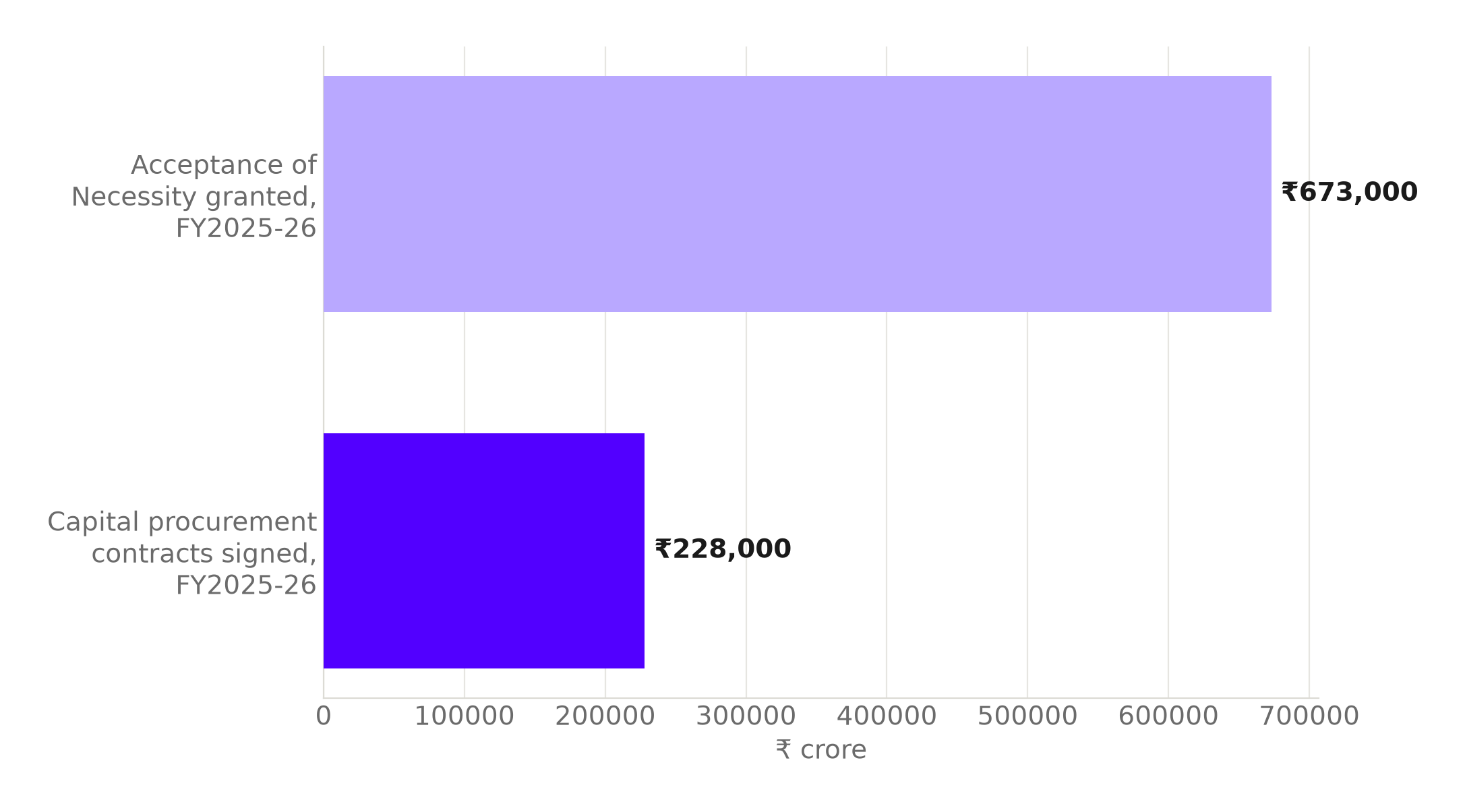
Source: Press Information Bureau, Ministry of Defence. Chart: The Signal.
That gap is not necessarily a failure. AoN and signed contracts run on different clocks, and a contract signed in one year can trace back to an AoN granted in an earlier one. But it does mean that the headline figure attached to any single DAC meeting, this one included, describes an intention to buy, not a completed purchase.
The decade behind the acronym
The council's approvals sit on top of a longer indigenisation push that predates this fiscal year by a decade. India's indigenous defence production rose from Rs 46,429 crore in 2014-15 to Rs 1.78 lakh crore in 2025-26, roughly a fourfold increase over the decade.
| Year | Indigenous defence production |
|---|---|
| 2014-15 | Rs 46,429 crore |
| 2025-26 | Rs 1.78 lakh crore |
Source: Press Information Bureau, Ministry of Defence.
That trend is context for why 10 of the 10 proposals cleared on 3 July 2025 were sourced entirely through the indigenous Buy Indian-IDDM route: a council whose domestic manufacturing base has roughly quadrupled over the past decade has more reason to route its approvals inward. It does not tell us how the 3 July 2026 batch splits between indigenous and imported platforms; the ministry's release for that meeting does not break the Rs 52,000 crore down by sourcing route, so that figure cannot be stated here.
The honest objection
The strongest case for reading nothing into the July 2026 figure is that AoN size was never meant to be steady. Proposals reach the council on their own procurement timelines: some meetings clear a handful of large systems, others clear many smaller ones, and a five-meeting run of about a year is a small sample. FY2025-26 delivered the highest AoN total and the highest contract-signing total of any financial year on record, and the FY2026-27 budget for capital acquisition is itself up about 24 percent over the prior year. A quieter meeting fits comfortably inside a year that is, by its own record-keeping, still expanding.
That case holds for a single meeting. It holds less well once the two FY2025-26 records are read together: a council that granted Rs 6.73 lakh crore in approvals in FY2025-26 converted only about a third of that value into signed contracts in the same period. If the pace of AoN issuance keeps outrunning the pace of contract signing, a smaller meeting is not obvious evidence of caution. It may just mean the backlog of approved-but-uncontracted proposals is large enough that the council does not need to approve as much to keep the pipeline full.
The Signal
The figure that made headlines on 3 July 2026, Rs 52,000 crore, is real money for anti-drone, missile and surveillance systems that three services will eventually receive. But measured against the council's own recent record, it is the smallest sign-off in a year, arriving in a fiscal year whose entire capital-acquisition budget that single meeting already consumed more than a quarter of. What determines whether 2026-27 matches or falls short of the record year before it is not any single AoN announcement, but how much of what gets approved actually turns into signed contracts, a number the ministry reports once a year, not once a meeting.
Reporting basis: every figure in this piece, the five Defence Acquisition Council approval values, the FY2026-27 capital-acquisition budget, the FY2025-26 Acceptance of Necessity and signed-contract totals, and the decade-long indigenous production trend, comes from Press Information Bureau releases issued by the Ministry of Defence. These are separate press notes from one origin, the ministry's own announcements of its council's decisions and its own budget and production figures, not independently reported by a second body. The share of the FY2026-27 budget spoken for by the 3 July 2026 meeting, and the share of FY2025-26's approved value that converted into signed contracts, are The Signal's calculations from those figures.