A car bomb killed people near Delhi's Red Fort on 10 November 2025. In a chargesheet press release dated 14 May 2026, India's National Investigation Agency named 10 accused it links to Ansar Ghazwat-ul-Hind, a group it calls "an offshoot of the Al-Qaida in the Indian Subcontinent (AQIS)," itself a group India's Ministry of Home Affairs designated a terrorist organisation back in June 2018. NIA's investigation found the bomb was TATP, an explosive the accused manufactured themselves by procuring ingredients and running experiments, and that 11 people have been arrested in the case so far. Read only that chargesheet and the story is settled: a homemade bomb, an Al-Qaida affiliate, a case built and charged.
It is worth slowing down on that. The UN Security Council's own Al-Qaida sanctions Monitoring Team filed its 37th report on 4 February 2026, three months before NIA's chargesheet, and its account of the same attack does not match. That report links the Red Fort blast not to AQIS but to a "reported" connection with Jaish-i-Mohammed (JiM), citing one member state. It dates the attack to 9 November rather than 10 November and puts the toll at 15 killed rather than 11. A separate member state, it notes, called JiM defunct.
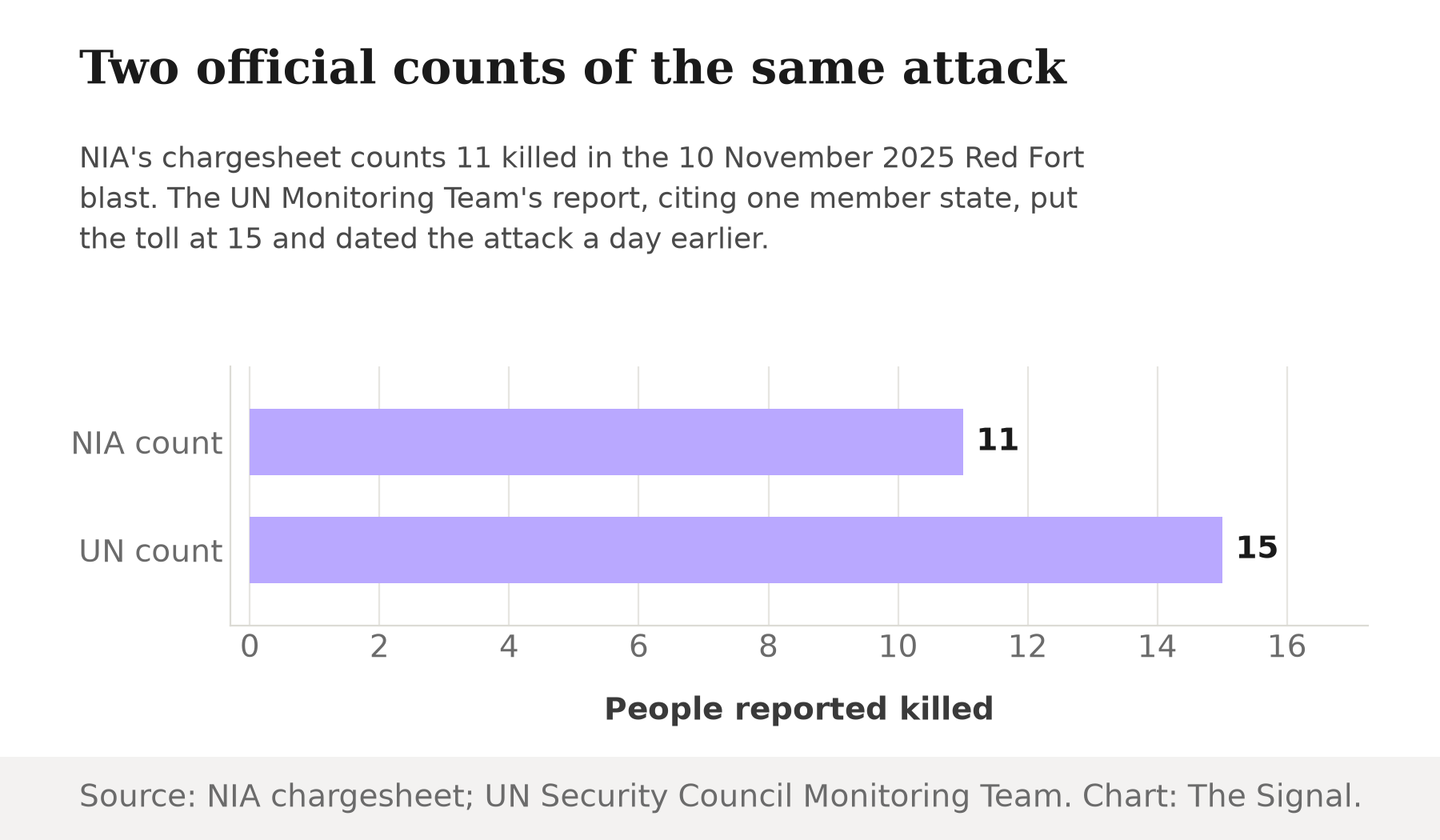
Two official accounts of one attack, filed three months apart.
| NIA chargesheet (14 May 2026) | UN Monitoring Team report (4 Feb 2026) | |
|---|---|---|
| Attack date given | 10 November 2025 | 9 November 2025 |
| Toll given | 11 killed | 15 killed |
| Group blamed | AGuH, called "an offshoot of" AQIS | Jaish-i-Mohammed, one member state's report |
| That group's UN 1267 status | AQIS: not listed | JiM: listed, code QDe.019 |
Source: NIA chargesheet press release; UN Security Council Monitoring Team, 37th report.
A decade of national bans, no UN listing
AQIS is not a new name to counterterrorism watchers. Al-Qaida's then emir Ayman al-Zawahiri announced the group's founding on 3 September 2014, in an hour-long video statement, roughly a decade before its affiliate was accused in the Red Fort bombing. The US State Department designated AQIS a Foreign Terrorist Organization on 10 June 2016, two years before India's own ban, and the department's most recent statutory review, completed in December 2024, concluded the group's threat profile had not changed enough to justify lifting that designation. Two governments, a decade of paper, both still current.
None of that paper is a UN listing. The Monitoring Team's own February 2026 report names AQIS's current leadership, "emir" Osama Mahmoud and his deputy Yahya Ghauri, both reported based in Kabul, and marks the group itself "(not listed)" on the UN's own Al-Qaida sanctions roster even while tracking it by name. That gap is not symbolic. The Security Council's own Sanctions Committee ties its assets freeze, travel ban and arms embargo, set out in paragraph 1 of resolution 2734 (2024), specifically to the individuals and entities placed on its Sanctions List. A group marked "not listed" sits outside all three, even as Washington and New Delhi keep sanctioning it on their own.
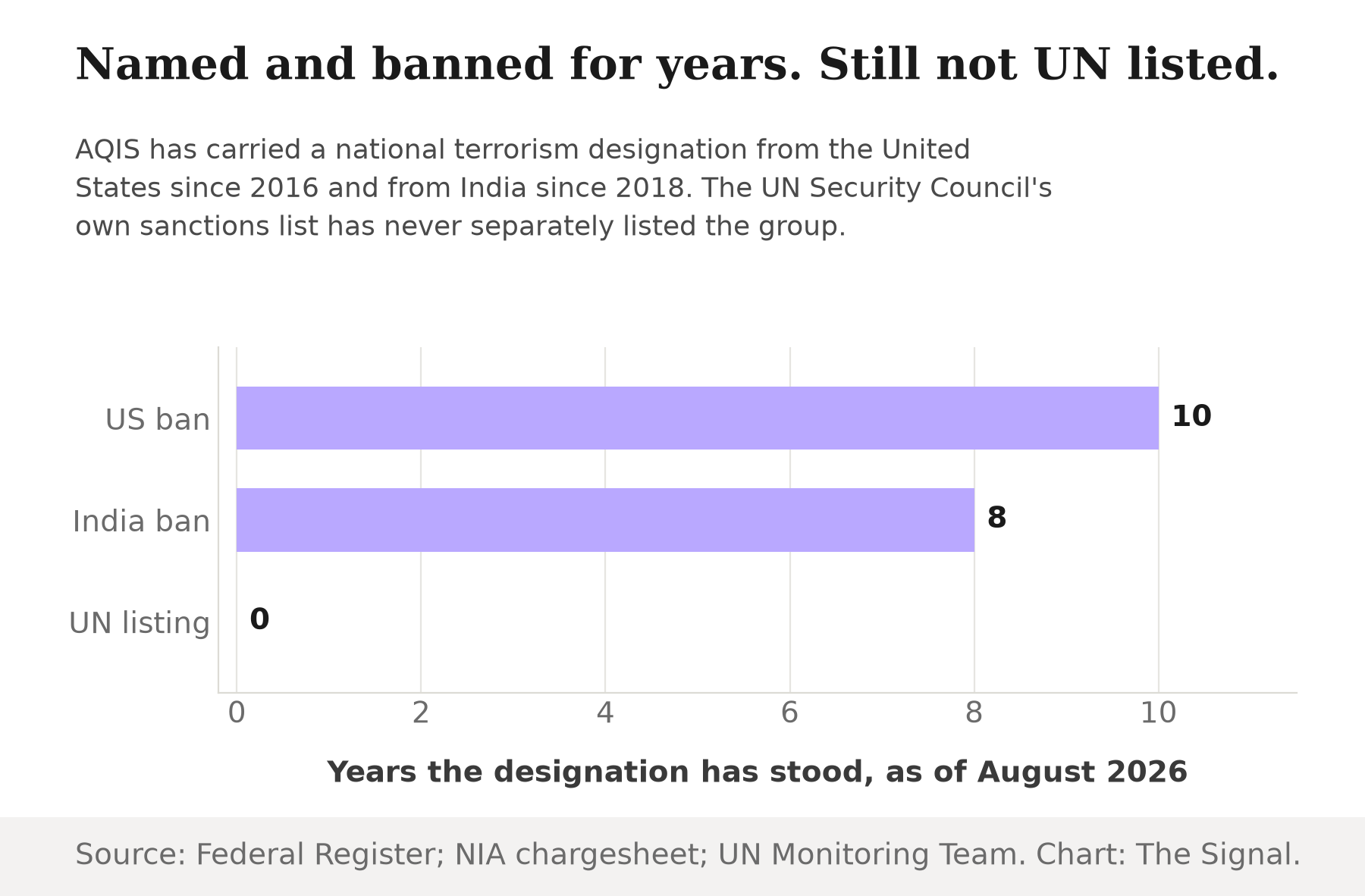
Two long-standing national bans; no entry yet on the international sanctions list.
Source: US Federal Register, 2016 FTO designation; NIA chargesheet press release; UN Security Council Monitoring Team, 37th report.
What the Monitoring Team's own language explains
The gap is not just paperwork. The same February 2026 report assesses that AQIS is "increasingly focused on external operations" and that such operations "would likely be unclaimed or deniable". That assessment sits inside the very same report. On the one recent case it discusses by name, the Red Fort attack, that report hands the case to a different, already-listed group on one government's word. Another government calls that group defunct. A monitoring apparatus that expects a group's own attacks to be hard to pin down is, on its own account of this case, having exactly that trouble.
The honest objection
The strongest case against reading any of this as dysfunction is that the Monitoring Team's biannual reports are built from member-state submissions relayed on a fixed six-month cycle, not from independent forensic work, while NIA's chargesheet rests on months of explosive analysis before its 11 arrests. A rough, secondhand account arriving early and later superseded by a slower, harder case is exactly what ordinary institutional process looks like. And unlisted is not unwatched: the US State Department reaffirmed AQIS's designation as recently as December 2024, a full year before the UN Monitoring Team's most recent report on the group. That gap is a sign of continued national attention, not neglect.
That case is real, but it explains why national governments keep acting. It does not explain why the UN's own instrument, the one meant to bind the wider international community rather than just Washington and New Delhi's separate decisions, has stayed silent on a group its own monitors have tracked by name, base and leadership since at least its public founding in 2014.
The Signal
The Red Fort case will keep producing paper. Watch two things past the headline arrest count. First, whether the Monitoring Team's next report revises the 9 November date and 15 killed toll it gave for this attack to match the forensic account NIA has since put on the record, or lets the mismatch stand. Second, whether AQIS ever gets its own line on the UN's own list, the step that would catch the multilateral machinery up to what Washington and New Delhi have each already concluded, on their own, for years. A group whose own monitors expect its attacks to look unclaimed and deniable does not need to hide from investigators nearly as much as it needs the paperwork to stay behind.
Reporting basis: the chargesheet details, including the accused's alleged links to AGuH and AQIS, the TATP explosive, and the arrest count, are from the National Investigation Agency's own chargesheet press release. The competing account of the attack, the AQIS leadership names, the group's UN listing status, and the Jaish-i-Mohammed link and defunct claim are from the UN Security Council's Analytical Support and Sanctions Monitoring Team's 37th report. AQIS's founding date is per West Point's Combating Terrorism Center. The 2016 designation is from the US Federal Register and its December 2024 review from the same publication. The Sanctions Committee's assets freeze, travel ban and arms embargo, and which entities they attach to, are from a UN Security Council press release on resolution 2734 (2024), a separate origin from the Monitoring Team's report. Every figure above is as reported by its origin; none are The Signal's calculations.